0:00 Hey storytellers, before we start today's episode, we have something exciting to share. The Storyteller Shelf Summit is almost here. A full week of virtual mini master classes to help you grow as a writer, an illustrator, or an educator in children's literature. We are also offering an exclusive pitch event with literary agent Cerrone Harvey, giving you a rare chance to get your work in front of an agent. To participate, you'll need to purchase both the summit ticket and the separate pitch ticket. Click the link in the description. We can't wait to see you at the summit.
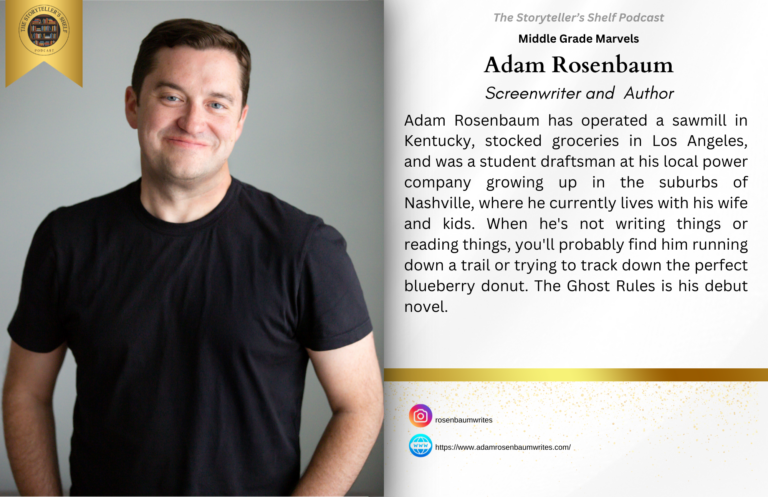
0:48 Hi everybody and welcome back to the Storyteller Shelf podcast. I'm Jackie here with Teresa and we are hopping right into our middle-grade Marvel series where we get to know the authors behind the epic reads and today we have Adam Rosenbomb with us and as is tradition we'll be asking Adam can you tell us a little more about yourself? >> I live just outside of Nashville, Tennessee. Um, I grew up here, spent some time in Southern California where I was doing screenwriting for a while and then moved back here with my family about 10 years ago and started writing books for uh, the middle-grade audience. And I've just I've just absolutely fallen in love with both writing books
1:27 in general, but also fallen in love with the with the middle-rade audience. >> Thank you so much for being here, Adam. I I'm excited because the fact that you mentioned Nashville, I always think of like obviously that's where the home of country music is at and artistry and amazing things. Um, so I feel like that is like the perfect thing to kind of uh to talk about because I feel like though there's a lot of superheroes when you think of like Nashville's >> That's right. It was a wild place to grow up because I mean you you would just see country music stars at the grocery store and and I would grow up with the children of really well-known country music stars and it just it felt
2:05 so normal growing up kind of around Nashville in a really fun way. >> That being said, we're talking about superheroes. If you were a superhero, what would your name be and why? >> My name. Oh my goodness. I thought you were going to ask what power my name. That's a great question. It would probably be something really lame. Um, and my power would be probably something really lame, too. One of one of the ideas that I have been kicking around for a while is about superheroes, and I've been able to name a lot of superheroes. Um, maybe not maybe not the smartest superheroes in this in this book idea. So, that's been a lot of fun. But, I don't know what I would name
2:43 myself. Probably probably something to do with the fact that I'm a I'm a southerner um at heart. Maybe I can't think of anything good. I'd probably be uh how about like the the the hillbilly, the great hillbilly. How about that? Reflects uh my Tennessee my Tennesseeiness. >> I think that it's going to be the most unique superhero name that we ever have on this show and I'm all for it. Somebody has to submit designs. All right. But why don't I give you an easier question? Okay. You told us you got started writing screenplays and then you got into middle grade, but can you tell us a little more about how you were inspired to turn to middle grade and how
3:25 is it that you tap into the perspective of this age group when you're creating your ideas? >> Yeah. Oh, I love that. Okay. I' I' I've been writing different things ever since I was little. I was doing songwriting for a while. being from Nashville, everybody everybody's a songwriter knows a songwriter. And so in middle middle school and high school, I would write songs and I would perform at school or at church or at coffee shops and I thought, "Oh, that's what I want to do." And then in college, I went to a a music school and realized everybody here wants to be a songwriter and they're way better than me. So I transitioned to to writing movies at that point and moved
4:00 to the West Coast cuz I thought, "Oh, that's it. I love movies. I'll do the screenwriting thing." So I wrote all kinds of scripts. I would write dramas. I would write action movies. I wrote a couple of horror scripts, comedies, I would write TV shows, everything. I just I just wanted to write everything and and kind of figure out what what I was most interested in. And the thing that I kept coming back to was kids movies like kind of in the the Pixar vein or the Steven Spielberg Amblin movies from the 80s that I grew up on like ET and The Goonies and Back to the Future. Those were the most fun for me and and where I felt like my heart was drawn. And so
4:36 when when I moved back to Nashville and I I wanted to do something a little different and I started writing a novel, it was for kids and it just felt natural and I I love of doing this and I'm probably stuck here forever. And as far as like how do I get into the mindset of the middle grade audience, I think for better or worse, my uh my my brain or my maturity is probably stuck in a middle school world. I I think I just haven't really matured beyond that. That's I love still love those those movies. I still love reading middle-grade books. I also have four children of my own and so I experience what it's like to be a kid every day for better or worse. So
5:20 there's a lot of stuff to work with when I'm driving my children and their friends around and I just am listening to all the ridiculous things they talk about on a daily basis. >> What inspired you from your latest book? like was there a moment or a scene that you absolutely loved and why? And then would you say also second question, the books, the movies, all the scripts, is that what led into your middle-rade writing style? >> Absolutely. I I think I think I'm always chasing that high of when I was a kid and saw ET for the first time, saw Back to the Future for the first time, saw Jurassic Park for the first time, like those those movies were so siminal for
6:03 me that I'm I'm always chasing that. For me, like the my favorite books of all time, the ones that I still come back to, the ones that that have meant so much for me are the books that I read when I was that age, when I was fourth, fifth, sixth grade. books like The Westing Game or The Phantom Toll Booth, books that that meant so much to me as a kid and and I will I will go back and I will reread those as an adult in the same way that I watched those movies. And so I think I think there is just something really special about that age, about that like kind of third through 7th grade age that's so so great because the kids at that age have progressed
6:42 beyond picture books. they've progressed beyond, you know, the basic chapter books, but they they're not quite jaded enough where they're, you know, immersed in in all of the really heavy YA books, which are which are awesome, by the way, and I I love YA as well. Um, but there's something really great about the the middle-rade audience of being able to handle heavy things, but still not yet jaded like a like an older teenager like a couple of my children, and they're able to just like hold on to that sense of awe and wonder. >> So, the films and books that you read as a child, they inspire how you write today, but you also come back to them as
7:23 an adult to keep inspiring yourself. Absolutely, 100%. It's one of my one of my favorite ways to to stay inspired is to go back and revisit those things that meant a lot to me as a kid. Um and and along the same lines, middle-grade books that I have discovered as an adult reading to my children or just books that I've stumbled on at the library, they kind of feel the same way. books that have meant a lot to me like when you reach me by Rebecca Steed. I I discovered as an adult and that's a book that I revisit every couple years because it means a lot to me in the same way that those books and movies meant a lot to me as a kid. >> So, Adam, you have a really broad
8:03 knowledge of entertainment from film to books. What's one trend, challenge, or opportunity that you see in the world of middle-rade literature today? Especially in comparison to how things have changed since you were a child. >> Hey storytellers, if you're still juggling Word Docs, sticky notes, and 47 browser tabs to keep your story straight, it's time to simplify your writing life. Meet Scriber, the writing software built by writers for writers. Whether you're drafting a novel, a picture book, or even a dissertation, Scriber helps you organize your scenes, research, and revisions all in one beautifully structured workspace. Many of our guests on the Storyteller
8:44 Shelf podcast have raved about Scriber and how it completely changed their writing flow. You can move chapters around with a click, store your notes right next to your draft, and even set word count goals that actually keep you motivated. >> Curious? Check out our affiliate link. It helps support the show at no extra cost to you. And let us know if you give it a try. We'd love to hear how it helps your writing process. That's a great question. This is something that I really love talking about just in terms of the challenges of what's happening in middle grade right now. There are lots of articles, lots of people talking about like gloom and doom
9:24 for middle grade. Sometimes I'll read something and something somebody's like, "Oh, you know, I feel hopeful for these reasons." But then I'll hear of of agents that aren't taking middle-rade books or middle-rade authors and publishers that are really really tightening their grasp and not accepting a lot of middle-rade books. And it's so frustrating to me because I feel like that's that's where we need to be putting um our time and our energy and our resources. We need to be having more books, more opportunities for kids to discover things and especially for boys I have discovered. So, my oldest three children are boys and and seeing them fall in love with reading in like the
10:06 younger elementary school ages and then once they hit middle school, once they hit sixth, seventh grade, it's like what what is there left? And and yeah, there there are some options there, but not enough. And and I feel like there's so much room for more diverse characters, diverse settings. there's there's so much room that we can expand and give kids more options in that space, especially boys, to keep encouraging them to read. So, this is something I feel really passionate about and I I don't always know the answer. I don't I don't know what the what the magic answer is for this other than we just need more we need more books, more opportunities, especially for diverse
10:54 characters, like I said, and in settings and more opportunities for diverse writers to to speak to those audiences. I will see these conversations happening online on social media and and I'll see authors saying like, "Well, I you know, I wrote my main character was a boy and every time I want to say like, yes, like like we need more of that, but also I think we just need more, like I said, more more diverse settings and opportunities because you will have a boy character that looks like this and and does this kind of thing, but then what about all these other kinds of boys that are living in different places and look different ways and believe
11:31 different things. Like I think we just need we just need more just more opportunities and more books and more opportunities for kids to find those books. >> This goes back to that same thing as a writer there. You're constantly evolving, constantly changing and you're you know that kind of thing. If you could go back in time and if you could give one piece of advice for your younger self, what would it be? >> Go back in time and give one piece of advice. Um, I would tell my younger self to chill out a little bit. Um, I think I was a very high strong kid in some in some ways. Um, and as far as like being a writer, um, I I just have always just wanted like I just want it to work right
12:17 now. I just want it to work right now. And and I think all the time I will I will start to think like, oh, I wish um I wish my debut so my debut came out a few months ago. um in 2024, the fall of 2024, and I think like, oh, what what if it had come out 10 years earlier? Like, what if it, you know, what if I could have started my career earlier? And and every time I start to think that way, um I think, well, I don't know if it could have because I I there was so much I needed to learn, so much growing I needed to do personally and as a writer. And so to that person, I think I would also say, chill out a little bit. Like, it's gonna happen. You just gota you got
12:56 to pace yourself. You got to take it slow. There's there's just a lot more growing that you need to do before you're ready. I probably need to hear that right now as well because even today I'm like I I want to go I want to I want to write this and I want to write that and I want to do this. And the wiser people in my life are like okay slow down a little bit. Like let's let's pace yourself right now, too. So maybe this is just something I'm always going to struggle with. >> Well, there's nothing wrong with that. But I will say this whole business is very much an exercise in patience. >> Absolutely. That's one thing that I didn't I didn't necessarily know before
13:32 I got into publishing just how slow it is. It's a very slowm moving business is the is the greatest thing in the world to see your book on a bookstore bookshelf or in a library on a display or in a kid's hand. Like it's the greatest thing in the world. But having to wait so long for that to happen is is so hard. I get so envious of the authors that are like, I have a book coming out every year and it's like, oh gosh, that's pretty that's pretty cool. You don't have to wait as long each time, but for most of us, we're we're waiting a little bit in between. >> What is one thing that you would like your readers to take away from your work and to know about you personally as an
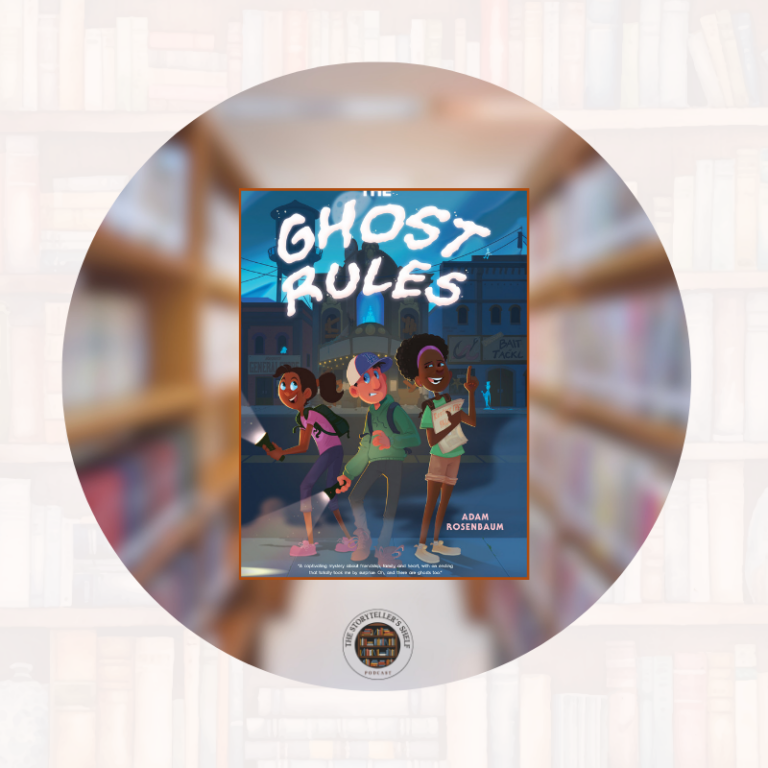
14:14 author? >> When I wrote the ghost rules, so the ghost rules is my debut. Um, and when I wrote it, I wrote it thinking I was writing a a funny ghost story. That's what appealed to me when I started writing it was like, what if just the concept of like what if ghosts weren't scary at all? What if they were just goofy and they drooled and and they ran into things? And that made me laugh and I just thought, oh, that's funny. So that's what I thought I was writing. And the deeper I got into the writing, I realized it was about a lot more. And it was about a boy that was struggling with the death of his older brother. And and so one of the most interesting things
14:52 for me is I do a lot of school visits which is so fun talking to kids of all ages. And one of the most interesting things for me is the kids that have read the ghost rules that they respond to that grief angle almost more than the than the funny even though the funny ghost is like the main the main part of this book. they respond to the grief and the loss that the main character Elwood is dealing with throughout the book. So, I think one of the things that I would encourage the readers of the Ghost Rules is one of the things I was really intentional about when writing the character Elwood was I wanted him to to cry at one point in the book and I
15:28 wanted it to be okay. Um, and that as he was dealing with that loss. And so when I think about readers, especially boys, I want to show them that it's okay to feel, that it's okay to emote, it's okay to cry, and that's not a negative thing. That's not a bad thing because all kids are dealing with loss on on some level. And for some kids, it's, you know, really prevalent because they have a loved one that died like Lwood in this book. Some kids are just dealing with the loss of a best friend that moved away or a loss even even as small as like they um they did poorly on a on a test or a project that they really really wanted to. But it it feels huge
16:08 when you're in middle school. And so especially for boys, I just want to show them it is okay to to feel what you need to feel when you encounter that loss in your life. Um and it's okay to cry. So, that's that's one thing that I that I really want to encourage, especially boys. And hopefully that that comes through in the book. And then as far as like what do I want people to know about me? I don't know. I love uh I love talking to students. I love talking about writing and and reading. And so, if you if you ever track me down online, if you ever see me on the street, let's let's talk about books. Like, tell me what you're reading. Tell me what your
16:46 favorite book of all time is. That's the that's the thing I always lead on with when I'm doing a school visit is I'm like I just want to I want to hear what you're reading. Like tell me what you're reading. Tell me what your favorite books are. Let's let's talk about how amazing books are and and how influential they can be and how powerful they can be. So that's that's one thing that I just I really love talking about and hope I get to you more and more. >> Thank you for watching the Storyteller Shop podcast. If you enjoyed this episode, be sure to like, share, and subscribe so you never miss new insights from emerging authors, illustrators, and
17:20 publishing professionals. Your support truly helps our show grow. And if you'd like to support us directly, visit our Kofi page and click buy me a Kofhei. Thanks again for tuning in.