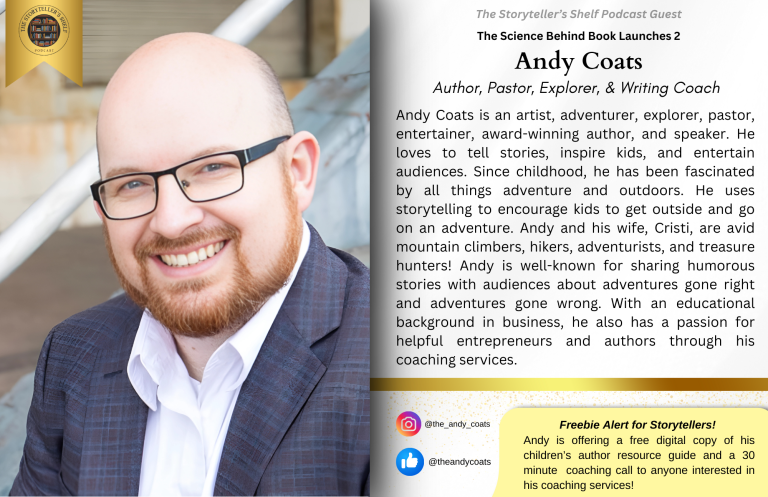
0:07 [music] Hi everyone, welcome back to the Storyteller Shelf podcast. I'm Jackie, there's Teresa. And we are back again with our miniseries, the science behind book launches. And we have a super special guest with us today, Andy Coats. Andy, will you please introduce yourself for our listeners? >> Glad to be here. Excited to join you ladies on the podcast and uh excited to bring some value hopefully to your audience today the best I can. And uh a little bit about me, I am a primarily a children's book author. Uh I have written a couple other books as well, but I now have going on well depending on what time when this airs, I currently have 12, but I'm releasing six books
0:52 this year. So I'll be 18 titles by the end of the year. Um, so right now I'm sitting at 12 titles and a lot more in the works, but primarily children's books are my main focus and we do a couple other little entrepreneurship things on the side, but my passion and my joy is to do children's book writing and then author also do some uh author coaching as well, helping other authors in their journey to figure it all out while we're all trying to figure this out. Well, we are so appreciative of you coming on uh our podcast and I feel like we are going to learn a lot from you and we'll probably like need to ask you more questions later on. Maybe like a
1:34 Raffford fire kind of thing, but let's start with author visits for those who may not know. Can you explain what author visits are and why they're important? It's probably the primary thing that I love when it comes to especially in children's when you're talking ch if you're a children's book author out there and you're listening to this if you're not doing author visit I'm going to convince you by the end of this podcast you need to be doing author visit. So a little bit what they are first it it's I mean clear in the definition that it's it's when an author makes a visit to a school. Now that can be done in a couple ways especially nowadays it can be virtually or in
2:10 person. A lot of schools have gotten away from the virtual, but just because it's not quite as engaging for the students, but primarily it's where an author goes in and they either do some kind something in the world of reading, writing, creativity. A lot of authors might be authors and illustrators, so they may do some drawing type things, but they're going in making a visit. Whether it's book readings or interactive presentations, sometimes even Q&A sessions are in the mix, writing workshops, whatever they choose to do for their their brand, they're going into a school to try to help encourage and inspire students to advance in their their future in that
2:49 world. Maybe not full-time, but but to use that world of creativity and engage with the author. And it's usually pretty transforming for most authors and students. >> It's an opportunity for you as the author to connect with kids right there, the people that you're actually writing for in person. It's a huge deal. >> It's it's instant feedback. You know, it's like that's your audience and I feel like I'm a celebrity when I go into a school, especially I've already been at that school before and I'm back for a second visit. It's like walking in as a celebrity on campus, you know? It's it's a lot of fun. And that and that's your audience. You get to one-on-one talk to
3:27 the people who are reading your your book. So that's fun. >> Exactly. And for our listeners, just to break it down a little bit further, obviously we're talking about book launches, and we know part of book launch is psychological in essence. There's a lot of anxiety that goes for a firsttime author especially. They know that they need to be doing something, but they're not quite sure what to do. So, how to launch your book, right? how to get your book out there right before pub date. We're really trying to gear this towards inspiring people to consider author visits to schools as something that's a really valuable experience for them to start working on
4:05 during this pre-launch launch time. And there's one question that always sticks out because everyone thinks it's a good idea. We all inherently see the value in it. But they say, "How? How do I do it?" So Andy, we're going to give you the hard question and ask you how did you secure your first author visit? What what was it like? Do you remember it? Do you have any advice for people who are trying to schedule that first visit? >> Absolutely. It's a whole different step in the journey. So like if if you if you've gone through the process of publishing, it takes a lot of mental strength, a lot of just resilience to get to the point of publishing your
4:44 book. And this is whether you you're doing traditional or self-publishing. the same the same pathway is true for doing going into school visits, taking that next step. You're entering into a whole different world. So now you're in the branding side of this. You're trying to get your book out to the world. Again, no matter how it's published, you want to be out there in front of your audience making connections. And it's a there the first is the mental thing is many people will shut themselves down and say, "I can't do this. This isn't for me. Maybe maybe Andy can do it, but that I'm not an extrovert like he is. So the the first thing I would say is
5:20 anyone can do a school visit and they can be successful. So the first thing I would say is just get the mind shift is the most important thing to secure the visit. Before you can sell it to a principal or a librarian or anybody, you got to sell it to yourself first. So, to secure your first school visit, you need to tell yourself, I can do this. And and the first one's not going to be the best, but I can do this. I'm going to go in and I'm going to keep going back. But that's the first piece. But actually getting into the schools. There's a few things I would say. Number one, start with who you know, your inner circle. You know, people, you have friends,
6:00 family, you went to school, especially if you still live in the area that you grew up. you have a school that you went to and they would love to bring you back. I can tell you from experience, schools want to bring if they have an author that came through their school, they would love to bring you back in to say, "Hey, look, he went here or she went here and now they're out there and they're an author." So, there's start with who you know, your inner circle, friends, family, and that can probably get you into a few schools just to get started. And I would say stick with just a few to get started. Don't go out there and try to book a 12 school author tour
6:39 in your first year and hope that you're going to be able to just knock them out because you're going to learn so much from the first one that you won't have time to adjust for the second visit. Uh if you're just backtoback trying to knock these things out. So start with who you know and book one. Find one. And so start with who you know, but also there there's plenty like parents are connected. A lot of times PTO's or PTAs bring in authors for school visits. They're the ones who are sometimes even the ones paying for it. So you could start there if you know just talking to parents. Put it out there in social media. Hey, do I have anyone who is part
7:12 of the PTA or PTO in their school and looking for an author visit. Um so just beginning there is plenty to get you started and get you into one school. So that that's a place I guess to begin. securing it does take an extra step I guess of you've got to have a plan and a program in place that you're going to offer to those people. So that helps you find them I guess is the starting with your circle but you need a good solid plan of what are you going to what value are you going to bring to the school to the students and to the administration and teachers who are there. So you need a plan and then start with your circle.
7:57 >> You were mentioning create a plan when reaching out to schools. Do you have any tips for creating a pitch for that? >> Yeah, so it it depends on what what you're aiming for. School visits are different than library visits. Library visits are different than other event visits you may you may be going and doing. I I I'd put them in separate categories. I would say school visits are a very specific category and then doing library visits really every other event I throw into a different category. So I say there are events that you do and there are school visits you do. Events ought to be places that you're just networking and connecting. And you
8:39 can do as many of those as you want to. You're just there to network and connect. You may read a book to kids and all that, but even if you're reading a book as an author at a library, you're just there to book school visits like that. That's my approach. I do a ton of events during the year, but the aim is to book a school visit. And so the creating that plan for it, you don't need a whole lot. If you're going into a library, it can be pretty simple. you know that I'm gonna I'd love to come do a reading for and or if they already have something in place and you just want to be on their schedule, you jump in. Those are pretty simple to do unless
9:15 you're trying to create some different unique event through the library. But from a school standpoint, a lot of what what I found is there's a lot of authors who like to go into schools and they they want to go read for students and so they'll try to do the classroom approach. And one of the things I found, here's a little tip for you. Insider tip. Most schools don't like that. Like they don't want you just to come into a classroom or hit all their classrooms for 15 minutes because it's kind of a logistics nightmare for them to figure that out. They want an assembly. And many times I'll I'll book one to three assemblies in that day. And
10:00 sometimes it's lower grade. And then sometimes they'll even break it up into lower middle grade and upper middle grade, but at least a usually a couple of assemblies for the younger kids and the older kids. Or maybe just one. Maybe they just want to bring you in for the older kids or just the young depend on on what your audience is. You know, if you're primarily a a picture book author, then you probably you may not want even do an assembly for the older kids, just the younger ones. or if you're writing, you know, more toward chapter books and not, you know, middle-rade novels, then you may want older kids that you're trying to connect with. So depending on your audience is,
10:36 I would say creating that plan and what that looks like for the school or who you're trying to put it together for is it's it's tailored to who that audience is. But there are some kind of general I would say um characteristics of of a plan that are that cross over for all of them. We know that you if you're going to go give a presentation, it needs to be engaging, interactive, and and hold their attention span. You you got to be able to go from one thing to another and not spend a whole lot of time. So, I've seen authors who go in and they'll especially like if I do an event where they bring in several of us authors and I'm having to watch another author, it's
11:18 great because I like I'm going to steal from whatever they're doing that's great and I'm going to learn from whatever they're doing that's not good. You have an author that's going they'll read for 20 minutes just from their book to read the whole book all the way through and it's like kids are kids are lost. I'm lost. I think they're lost up there. You know, it's it's just not as engaging as they hope it to be. And so for each one, it's like lower middle grades, they're looking, they want, they love energy, they love humor, they love quick transitions. So you're not spending more than three to five minutes on any certain part of your presentation. You
11:51 get up into the middle grades, you're you're looking at that exciting stories. They're wanting to learn about fun facts or unique things that are are interesting to learn about, if you will. And then they one thing I found is they love to ask questions. So when you're creating that plan, if I'm sitting down with a librarian or school administrator and I have those have that knowledge in my back pocket, when they say, "Well, what is exactly that you do?" I say, "Well, for the lower grades, I know they love high energy. They love humor. And so I've crafted this presentation towards them." or if I'm talking about middle grade, I know I have it's it, you
12:33 know, I've got exciting stories I'm going to tell, you know, fun facts I'm going to give, and then I'm going to give them time to ask questions because if one thing we know is that kids that age love to ask questions, and you're going to they're going to be agreeing with you. Yes, that's all they do is ask questions. So, it you're connecting with them because you're they know that you've done your homework and research on what what it what that audience is looking for and what they need. And so even if you don't have the specifics, I never send out my detailed outline of my presentation to the school. Never. They've never asked for it. I've never
13:08 sent it. But what they do ask for is how long are you going to take and what's going to be involved? And so I say I'm I have a very interactive presentation that I'm coming in and going to do. And the kids are going to love it. They're going to walk away excited and I'm going to give them opportunity to ask questions and we're going to get some crazy questions. But I think by the end you'll have your students talking for days about our experience together and that's all they need and it gets them pretty hooked. So now you got to deliver on that especially if you want to come back to that school later on. You got to deliver. We can talk about that some too
13:42 if you'd like on what that how I frame mine up. But ultimately when you put a plan together it needs to be tailored around yourself. You can't you can't be Andy. Andy can't try to be you. If I try to do what you do, Jackie, it probably wouldn't work for me. If you try to do what I do, it wouldn't work. My wife, she sings. I don't sing. So, if I tried to go in singing, I would 3 minutes in, the school's like, "This guy's got to go." So, you got to be yourself. What are your strengths? What are the things that you're good at? And how can you make that work inside of a framework that's going to be what that audience needs? >> I love that. Andy, I want to ask you
14:23 some particulars because you've given such wonderful advice so far about getting into the mindset of how to craft these plans, but I'm thinking of the author that's staring at their book right now, saying, "Okay, I have a school in mind, have some good connections. I know I can make this work, but what is it that I'm pulling from my book to create a lesson or presentation? What do I do?" especially if I'm going to a class that has not read my book before, which I know is typically the case. Could you give us some specific insight or maybe walk us through what you've done with some of your books? >> Yeah. So, here's what I've learned, but I'm I don't I don't know the exact
15:04 number, but I've got to be in the high 20s or low 30s of how many schools I've been in now. And what I've learned is that I'm not there to teach these students something in my short time that I'm there. Uh, I'm not trying to drive a lesson home or then walk away and be like, "We learned this." They're at school all day long learning. They're walking out of a learning environment and into an assembly. And most of the time at these assemblies, I mean, think back when we were kids. At these assemblies, I'm cutting up with my friends. I'm just I'm waiting for this to be over. I'm just out of class. So, I don't care what's really happening in the assembly. So, if we're going to try
15:42 to teach something in that setting, it's going to be difficult to try to teach one. and you're probably not going to it's not going to be effective. It's not the environment to try to to teach. So, go ahead and throw that out. You're not there to try to teach as a as an author. I think even from what the school wants, they're wanting you to come in and inspire. You're trying to inspire these kids with your story, what you've accomplished, and what you've done in your journey and how you got there. And we all have our own journey of what that looks like. and your story is inspiring because there's some kid out there that's going to connect to it. So, it's
16:17 it's you're already qualified. So, you don't have to be a dynamic person to be able to make this happen. Your job is just to inspire. So, what about your story do you believe inspires kids? So, what I've done in my own, now this this won't work for everybody, but hopefully I could. I I'll walk through it if you'd like kind of what my what it looks like in the particulars of my 45 to 50 minute presentation. And you'll see it's tailored to me. You probably have already picked up a little bit on my personality some and you know, I I I did camps for about a decade with kids and so large audiences, front of thousands and thousands of kids and I love to be on the platform. I'm the
16:59 primary speaker and I man, I just I love that. But that's not everybody. But it's my strength. So, I'm going to play to it. I imagine there are many of you who are listening, you are or even watching, you're already you already know by looking at me if you're watching, I'm more qualified than this guy is as an author because well, I I think I'm I'm a I'm an average author, but I think where my strength is is I am I'm a good communicator and I'm I'm high energy on a stage and I I want kids to walk away inspired. So, let me if if you're okay with it, I love just to walk through kind of what my So, I start with my introduction. I come in. Usually, the
17:36 teachers are going to give an introduction of whoever you are. And it's going to be one where the kids are already like, "Another one of these." And so, instantly, all I'm trying to do is flip that immediate feeling they have going on. This isn't going to be boring. and you know, so I'm going to tell them who I am, but I I begin with, "Hey, my name is Andy Coats and I didn't know they were bringing me as in as an author because I'm a treasure hunter." So, and it perks up kids. And just as a background to me, you know, my my story is my wife and I, we love adventures. So, we go on a lot of mountain climbs and hikes and all that. And it's through
18:15 that that really inspired me to in some of my books that I write, I put in some treasure hunts and some family adventures that are in the back of my chapter books. So, it's a little bit I'll get in that in a second, but it's an extra little hook. By the time I'm a treasure hunter and I'll walk through a story of how my wife and I on an adventure heard about this man who he hid $2 million worth of treasure in the Rocky Mountains and then wrote a book about it. and in the a poem and if you could solve the poem you could go find this treasure and me even as a grown adult I was like we're going to go find us a treasure so we went on multiple treasure hunts looking for this treasure
19:00 and so that inspired me it's like that's great for adults but how cool would it be if kids could go on that same treasure hunt and then I say how many of you would be think it would be fun to go on a treasure hunt and I've got them hooked. Doesn't matter what I do for the next 45 minutes. I've got them pulled in because I'm about to talk to them about writing books and storytelling and using your creativity and all that stuff, but I've brought I've hooked them in because they're like, "Hey, this guy, he he likes to go treasure hunting." That's not that's not your story. But what for you in your journey is your hook of you're going to pull the kids in of what what about your
19:40 story is gonna going to inspire them the most? So I do that intro who I am, what I do. I talk about that story of our adventure and then how that shifted me into writing books for them. And then I take the next that's about five minutes of my intro and most of them are already ready to start asking questions. And so in their mind it's already turnurning. I wonder what this I wonder how where's the treasure? Where'd he hide it? All that they don't know anything about what I'm about to share, but they're already ready to ask questions. So, I take the next 10 minutes and I start talking about my books. Now, if you're a first-time author, you've got one book
20:16 to talk about. So, you're going to be able to give a little more background on why you wrote it, telling a little about showing showing the book to them, the cover, if you have illustrations inside of it, maybe opening it up, let them see illustrations. And I I have several which I I'll I'll hit on that in our discussion before we get out of here. I'm going to talk about why you need to write multiple books. But I have several books. So I talk about I have a Mighty Max series, which is a picture book series. And if I'm talking most of my school visits are third to sixth grade is where most schools really want to bring me in. It's the primary audience.
20:50 Sometimes it'll go through 8ighth grade. Sometimes they'll want to use me for the younger kids, too. But primarily, if I book 10 school visits a year, 10 of those schools are going to primarily just want me in that third to sixth grade range. Some of them will say, "Hey, let's do multiple assembly. Sometimes I I'll be in a middle school, but that's the majority." But I'm going to talk about all my books. So, I I talk about my Mighty Max series for a minute, and I talk about my Big Seven series for a minute, and then I shift into the ones that apply to that age. So, if if I'm talking with younger kids, I'm still gonna hit on those treasure hunting. I'm
21:30 same thing. I'm talk about the treasure hunts, my hook, and I'm going to talk about those treasure hunting books, but I'm going ultimately shift to my Mighty Max books, which are for younger kids. But since the majority, I'm going to stick with just for the point of this, I'll talk about that third to sixth grade range. So, then I I jump into my chapter book series that's called The Wild Adventures of Barnaby and Drew. And the first book I wrote is Uncle Buck's Treasure. So, I take about three minutes and I talk about Uncle Buck's Treasure. In fact, it's right above me right here. It's won two different awards. Uh, it's a it's a great book. It was my first
22:02 one. And I talk about that, how, you know, what my inspiration for it was. And then I tell them at the end of the book there is a family adventure that my wife and I we went and hid $5,000 worth of gold, silver, uh, bracelets and jewelry and all kinds of fun antiques and we hid them. We spread that at $5,000 worth of treasure in three different containers and we hid them throughout the United States. And if you want to find our treasure, it's hidden out there. Go find it. And the clues to find it are in the book. So instantly I've got kids ready to buy Uncle Buck's treasure. And not that it's about selling it. It's it's a great story. I mean, it's won a couple of
22:45 awards, not because it's got a treasure, but because it's a good story, but kids are hooked because it's there. Okay, there's real treasure connected to this. So, I'll talk about that one. And that gets kids excited. And then the second book in that series is called Zombie Outbreak. And it's a story that takes place in the Grand Canyon. And that age group loves anything zombie related. And so now Barnaby and Drew are in in this story in the Grand Canyon about the zombie outbreak. And what we did in this one, we connected not connected to the story this time, but we did hide five um awards. So we created this trophy that connects to the book that there's
23:24 there's a this crystal that's in the book. And so we created five of these crystal trophies that we hid in five different locations around the United States. And inside of the the book and some fun little prizes in this if they find that treasure as well. But it's five different locations. If they find it, they win that award plus that those extra little prizes that are in there. And to find it, you have to have the book because there's clues hidden in the illustrations and there's clues there's a cipher they have to solve. There's clues that are inside of the actual writing itself that if you can decipher that and figure it all out and probably
24:02 if you can find one, you might be able to find multiple. So now they're they're hooked. So there's eight possible treasures out there that they can go find. And then I jump into my final book, which is the t of four kings. It's the third of four. The fourth one comes out this year, but the t of four kings. And it's actually it's a local to local to me at least. I'm in shreport, Louisiana. And so within 50 miles of shreport, I created a book kind of at the uh request of all these schools that I'm visiting like we don't know where you he said in the United States. How are we going to find that? So I did one to my region. I hit four tokens that connect with a story. You find a token
24:42 and it's about $300 to $500 worth of gift cards and prizes that if they find one of those tokens and I'll come to their school and present it to them in front of the school. And so now I've got something that's, you know, two books that are that are in the United States they can go find that are bigger treasures and then a local treasure to my region they can go find. So that takes about 10 minutes for me to walk through all those books with them. And I don't give much more than what I just told you except maybe talking about my characters. And at the end of this now kids are just they're wondering about the treasure. I've I've hooked them about the story. But now I transition.
25:20 And it's like, I know I know what you're thinking right now. Where's the treasure? And I'm going to give you time just a little bit to ask me some questions. But ultimately, it's about getting into books and reading and and going on an adventure outside. I'm going to send you on a on a real adventure, but there's some fun adventures to be discovered inside of reading, and you'll never you'll never experience them unless you open the pages and go in and explore. So then I shift into kind of a creative what I call creative storytelling. I I go into the creative storytelling. And this is where I bring in volunteers. So I'm going to ask some volunteers to come
26:00 up. And usually I'm going to do five volunteers, four kids, and then one teacher or administration that I'm going to bring up. And we're going to do you you remember the the Mad Lib game that where the Mad Lib thing where you fill in the story? Well, I I create a story on the spot that I just start going through and then I pass the microphone over to to a kid to give me a word. So, and I've done this enough that it's it's kind of the same story essentially. You know, I'll say there once was this kid named and I'll put them and they'll tell me their name and I'll say, "Is that you?" And if they say yes, it's like, well, we're telling a story about
26:40 somebody else. So, there once was a different kid named and then, you know, they'll give a name. So, just it's funny. And so I go through a whole story and I just walk down the line and it's like you know and inside of his pocket he had a purple and I pass the mic and you know so I'm I'm just walking down with the kids and they're telling the story while I'm telling the story and just to get their and I set them up for some funny moments and and you know the best teacher in the world was and then I'll put the mic in front of them and they'll say they're you know a teacher and then I I try to plan it out that I'm not going to ask until I get a kid that
27:15 seems like he's probably a little or she's a little or feisty and I'll say but the craziest teacher is you know and I'll put it in front of that kid and just see what they say and you know and the kids just start laughing or sometimes I'll point to the audience and I'll say but we all know the real craziest teacher is and I'll put the mic towards the audience and you know so it it creates this fun interactive storytelling and in the end I just wrap that up by saying so we go through that little story takes about seven eight minutes and then I close it out and say storytelling isn't that that complicated if we put oursel in a creative place to tell fun stories and how many of you
27:58 have a fun story that you'd love to tell you know and every kid will cuz they think I'm going to bring them up and I I'll say well microphone is not the best place to tell a story best place to tell a story is writing it down so write your story out and then you share it with the world and so it kind of it shifts And I'm I shift in after that. So it's about I'm about 25 minutes in at this point. So five minute intro, 10 minute of my show and tell where I'm holding my books and talking about books and then about 10 minutes of that creative storytelling. And then I shift into 20 minutes. I I've learned this for myself. 20 minutes isn't even enough. But I do
28:36 20 minutes of questions and answers. And the kids will spend all day with you and asking questions if you have inspired them. So I've taken 25 minutes to inspire kids, get them excited, have a fun thing connected to it with my treasure hunting. But most of the questions I, you know, I share this a lot with those who I coach or just when I go and talk about being an author and and other authors will say, "Well, of course, because you have a treasure hunt, the kids are going to ask you about the treasure." And I get I get about a uh to be fair, a quarter of them, maybe even a third of those questions are very specific to my treasure hunts, but it's not near as
29:18 much as you would think. You know, you would think that'd be 80% of those questions. Most of them, they say, "What's your favorite book? Who's your favorite author? What made you decide to start writing? What inspired you to to I do I do my own illustrations as well. What what inspired you to start drawing? and how old were you when you learned to draw? And they'll they're asking those questions, especially if they're kids who are interested in this world. So, and once one of those get going, cuz I answer a lot of the treasure hunt questions, when a kid askked a question about treasure hunt, like I'm going to they're like, "Where's the treasure at?"
29:56 Like, well, few things. One, I'm not going to tell you. Two, you got to get a book to find out. And you know, three, it's it's in the illustrations, and that's going to tell you more than I can. And the next kid, I ask a treasure hunt. Well, what all is in there? If you want to find out what's in there, you're going to have to get the book. Number one, you're going to have to read the book. And and they're in in the illustrations. So, what do you need? Get the book. You got to get the book. So, the next treasure question, you got to get the book. And so, at that point, they're not going to ask me a whole lot more about the treasure anyway. they're
30:28 going to want to now shift into questions about, you know, the real stuff that's going to matter to them and and inspire. And that's where it gets really fun where you're able to you're shifting from just being a person there to inspire them based on your story to now how can how can they do something in their own story. So always I always leave them. So when they wrap up the the questions, I try to find a question that that seems very much a transition point for me where they're they might say, you know, how old were you when you first wrote your your book? And I'll tell them how old I was when I first published. I said, but I I struggled reading as a
31:07 kid. How many of you struggled reading as a kid? Or like right now in your life, you struggle reading. And a lot of them will raise their hands. You know, they're they're struggling now. It's like, yeah, I I didn't like reading. And I'll pick my books back up and say because I didn't like it and I struggled with it, I knew other kids probably did too. So in all my books, I heavily illustrate my books and I hold it up and I show all the pictures that are in my books and all the illustrations and they go crazy because a lot of these struggling kids who are struggling to read, having a picture just to follow helps keep them engaged and it's like,
31:40 well, you can go read. So, if you're struggling reading, get one of my books and it's not going to count for your AR points right now. Working on it, but get get one of my books and find out you actually will love to read. And the best way for you to overcome struggling reading is to keep reading. And so, you know, it gives me a place to transition. And then I do a close where I just thank them for, you know, bringing me in. And uh then I have I make an announcement that I that I I I'll talk about here in just a few minutes if we shift to some on kind of next steps of followup and all that. I'll tell you about a special announcement that I I make. I won't
32:16 forget to tell you, but I'll let you know what that looks like here in just a little bit though. But it it it takes 45 minutes and then I go and sign books or pass out books or I just go stand and do like kind of a meet and greet with the kids and they love it and they'll they'll ask me the same questions as they're walking by and you learn to master a 3se secondond or you know response to them. Especially with mine with treasure hunts. It's like you going to give me the treasure? It's like yeah I am. Buy a book and it's in there. It'll tell you exactly where to go. And when you do one, it's going to be 90% the same at the next school visit. So if
32:53 you can learn through that and and it took me about 10 or 12 of these school visits to figure out what worked and now I've got a good system and I worked that system for the whole year and then next year I say, "Okay, how can I reboot this to be a little bit different? What's my new creative storytelling or new activity that I'm going to do? what how am I going to twist a little bit of my introduction to be slightly different? But when I come back, it's if it's been a year and I come back to a school, the third graders are now fourth graders and they think they're cool because they know the treasure hunt guy and I'm going to have a new book when I come back. So,
33:31 they're ready for to hear about the new one. But like they come back and say, "Hey, do you remember me?" I'm like, "You were here last year, weren't you?" They're like, "I was." You know? Uh, and then like, yeah, yeah, I was in third grade last year, so like it don't matter that 90% of my presentation is similar, but I you want to do something to mix it up so that teachers don't think you're just it's the same thing we're getting. You need a new product, if you will, that you're coming out with, but it doesn't take a whole lot to make that tweak and kids are going to be engaged. And then in three to four years, depending on where you are as an author,
34:08 you can kind of cycle back on some stuff because you're going to have a whole new audience to share with. So that's uh that's my 45minut I I tell them to plan for an hour, 45 minutes for my presentation and then about 15 minutes for them to pass by and meet me at my table, pick up their book if they ordered a book. Uh but I love for all the kids to pass by and say hello. So I like to do a let it doesn't matter if it's 300 kids. I want them all to be able to pass by and say hello. And sometimes depending on the school visit and how inspired I feel that day, I might give them all something. Uh a usually I'll print out like a business card with one of my characters on it
34:44 with a QR code that if they didn't buy the book, they can go get on Amazon. It's like, "Hey, you didn't go today." That's all right. Hey, take this to your parents and say, "We're going to go find a treasure this weekend." And tell them to buy that book. And they're like, "Okay, I'm going to do it." You know, I like to give them a card or something that's just a something for them to walk away with. Sometimes I'll do like a sticker if I'm feeling a little more, you know, inspired to if it's not if it's not a big, you know, school of 800 kids or anything. If it's a small private school of 200 kids in the school, that's a little bit easier to pull off 200 stickers than trying to buy
35:16 a thousand stickers. Cuz what that means and and on the other end of it is, hey, I remember you. You know, if they're asking me if I remember them, it's because, hey, they remember me. So they have an a relationship to this author that especially if they've read the book then they love to talk about it. You know it's I remember do you remember me? Hey I read that book. When's your next one coming? You know so you're connected directly to your audience and that's hard to beat. It's very special. >> I love that you have such a great presentation and a very engaging one and you don't just focus on let me read a chapter because you're right that's not
35:51 what the kids are wanting to hear because they can do that on their own time. And I like that when you go back, the kids, they say, "You remember me? Do you remember?" I love that. And they and then you're building a relationship with them. And that kind of goes into the next question, which is how to keep your audience engaged after the visit. Like how do you stay connected with, you know, school, library, bookstore, etc.? How does that work? >> So ultimately, you can treat this one of two ways. Be an author. You can do it as a hobby. And think of any other hobbies you have. Over my shoulder, you'll see all these medals behind me. I didn't I won't say I earned them. I mean, I put
36:33 in the work for them. But I paid for those because I have a hobby of going and doing those races. And I pay for those races. And what a hobby will do, I hang those there because it's like, I spent a lot of money on this hobby. I'm going to throw them up on my wall. And any hobbies we have cost us money. So if you're going to play golf, it's going to cost you money. If you're going to get into whatever crafts is going to cost you money, whatever your hobbies are, they're going to take money from you. So, if you treat it like a hobby, I can tell you what the author world will do. It will just cost you a lot of money. So, if you treat it like a hobby, that's
37:09 what it's going to return. But if you treat it like a business, hey storytellers, if you're still juggling Word Docs, sticky notes, and 47 browser tabs to keep your story straight, it's time to simplify your writing life. Meet Scrivener, the writing software built by writers for writers. Whether you're drafting a novel, a picture book, or even a dissertation, Scrier helps you organize your scenes, research, and revisions all in one beautifully structured workspace. Many of our guests on the Storytellers Shelf podcast have raved about Scrivener and how it completely changed their writing flow. You can move chapters around with a click, store your notes
37:47 right next to your draft, and even set word count goals that actually keep you motivated. >> Curious? Check out our affiliate link. It helps support the show at no extra cost to you. And let us know if you give it a try. We'd love to hear how it helps your writing process. And you decide, I'm going to create a brand out of this. then it will produce money. And it'll be different for every person. Some people get lucky and they find a a little thread of something and boom, they take off and it's like their book goes bestseller and we hear all those stories. But it's, you know, everyone's different and what that's going to look like. But if you treat it like, hey,
38:30 this is a brand and a business, it will make some kind of money. You may not be enough to quit, you know, quit your full-time job, but you have this fun business that you have that you love that if you build it right, you can make it where it could supplement, if not replace that income, but it may take a little bit longer of a journey. But treat it like a business and it'll make you a little bit of money. But when you treat it like a business or you're developing a brand, ultimately, if you're going to be successful in building that business and that brand, you've got to stay connected to your customers. And if you don't, then you're going to be a one-off sale
39:08 and that'll make you a dollar today, but it doesn't make you anything on the back end. So, a few things in this. The visits I do because it's it's a great launching point I make and I always encourage authors, you need to be charging for your visits. you're going there, spending your time. I'd love to dive in here in a little bit too, just kind of some of that uh backend part of the school visits, prep preparing sales and all that kind of stuff. But the that post uh engagement, you've got to stay connected and your audience to your business, that's not the kids. Your audience to the business are the librarians, the teachers, and the parents because they're the ones who are
39:48 purchasing. They're your customers. You're writing to the kids. You want them fired up and excited, but your customers are the parents, the teachers, librarians, school administration. So, those are the people that are going to bring you back in. Every kid in that school can love you, but they're not going to say, "Hey, when are we going to bring the treasure hunt guy back in?" or they're going to say to somebody that doesn't make a decision for that. It's going to be those decision makers that's going to be your primary people to focus on. So, to maintain that relation, I do I do quarterly check-ins with whoever those might be. And one of those can be
40:22 just I'm going to send out information about when the releases are of my new books that might be beneficial to them. It's like just it's just a announcement whether I if I if I know the person a little bit better and I have like my contact was through a through a phone conversation or texting I might text that out to them. Hey, just want to let you know my book releases this year or how many books we're releasing and what age groups they're for and why I think they'll be beneficial for for your kids in the school. uh we'll figure out how to get you some copies at your library. And that's that's a great connection. That's for that's for you can do that to
40:56 schools, you can do at your local libraries, you can do local bookstores. Hey, here's what's coming. Then the the next quarterly checkin I'm going to do is I'm going to make a personal visit and connection. In schools, that needs to be a little more timed out. You don't want to show up uh in a time that that's that you're going to get lost in. Don't show up in May to schools or depending on where you are in the country, even early June. Where I'm at in the south, they don't go till June because it gets too hot. But I know some places, East Coast, West Coast, they may go through June. Don't show up in those last few weeks of school where teachers are are
41:34 winding down because that that doesn't that's not going to do much for you. Don't show up in between Thanksgiving and Christmas because that's not going to do much for you because teachers are ready for a break. they just came off of a break and they're ready for the next one and they're just trying to get through those last few weeks before the holidays in the middle of all that crazy. But there are some key times that you can do a personal show up and it makes a big difference. In the springtime, they do testing and teachers are exhausted and they're wore out. So, I'm not going there to try to sell them anything. I'm not going to try to pitch
42:09 them on anything. I'm showing up with a box of donuts or a thing of cookies and I'm saying hey look I know this has been a crazy year for you and I just want to just drop this off and say hope you make it through and we're all trying to make it through here and I appreciate you guys bringing me in this year and if you need anything let me know I'll be around and that's it. I'm just my face is in front of them. They remember who I am. I'm showing appreciation and I'm hey you got this hang in there and most teachers or whoever that might be administration or librarians or that's my usually in schools that that media specialist or librarian they're your primary contact
42:47 and and they're they're starting to to they're trying to get everything ready before summer hits to make sure they got all their books back and everything's in place and order and there's all these meetings and testings and so they're probably also trying to do all the testing stuff and so just showing up with something That's just a nice little gift of appreciation they can eat is, you know, like I say, cookies, donuts, whatever it might be. Um, that you may find out they like is a great visit. It's old school marketing. And then the next visit I'm going to do is probably going to be in the fall time when they're kicking off again, especially if
43:21 I have a visit that's going to happen in that school year. I'm going to show up with a book that's a signed copy that I'm giving to the school. So, I don't give that to them when I visit because I want to do that at some other point. So, it's either previsit for the my next visit with a new book coming out. So, if I've been to that school before and I launch a book over the summer, then when I come, I'm going to stop by in the fall even though I may not be coming back until the spring, I'm going to show up in the fall and I'm going have a copy for them, signed copy for the librarian, for the school as a gift. And again, I'm not talking shop. I'm not unless they
43:58 bring it up, I'm not going to talk business with them. I'm only there to keep my face in front of them and you can do all I mean if you do if you should be working a region. So if realistically in a day or two, you can go make all those visits to all if you have uh the the amount of schools I have on my list in two days I can make those visits. as you're developing this, it might be three or four schools that you're trying to you can do that in in an afternoon that you're popping into these schools and making that contact. And then the other one's going to be that other quarter is going to be just a a logistical check-in or it's my maybe the booking of the next visit. Hey, we
44:38 we you know scheduled for next year. Uh or we talked about scheduling for next year. Now that summer's over, I want to get on your radar. Let's get this scheduled so it works best for both of our calendars. And I usually send that late July, early August is my connection to schools if I'm trying to book the spring. If I'm trying to book for the next fall, I'm going to connect 1 of January for the next fall. So depending on what where where they that school fits into my calendar determines when I reach out to them for that piece. That's hey, we talked about getting back on the calendar. I have I'm booking my tour for fall. I'd love to get you guys on the
45:21 the my calendar before those dates book up. So, I'm creating some urgency. So, I just want to reach out and say, "Hey, when when can we have a conversation about this to get on your calendar, check dates, you check your best ones, I'll check my best ones, and let's see how that we can make this happen." So, it it's just it's being in front of them, making contact, and following up. I would love to go back into something you said. We say it here. Storytellers are tired of us saying it so much, but sales and money, not dirty words for us. We want you to make things profitable. So, can we talk a little bit about what to charge for these school visits? Do you charge schools the same
46:02 amount? Does it depend on the type of school? How do we handle book sales? Are you working with bookstores? Are you doing them yourself? Do we have order forms? And how do we use social media and promotion to support what we're doing at these author visits so that we can continue them and we can again leverage that into profitability so that we're supporting what we're doing and we're not just doing it for the sake of doing and running ourselves broke. Talking from my self-published people who are spending a lot of money. It's a huge investment to create a book. So we need to hear the secrets on how to make this a cushion for us, right? not a hole
46:39 that you fall into. >> First of all, financially, be prepared. It It's going to take an investment upfront. And so, what I would say to you is whether you traditionally publish or self-publish, you're going to be the primary source of your marketing. Now, if you traditionally publish, you're going to have the support and the ideas and their team behind you to help push that. But realistically, what they're expecting is that you as an author, you need to own the brand that you're out there. They're not going to say, "Hey, we're going to do this for you and and you can ride along with us as the author." They're expecting you to bring something to the table. Now, they have
47:17 their networks and their ideas and all that, but you got to bring something to the table. So, either way, you're you're the primary driver of getting this out there. They can put you on a platform to do school visits, and you may get a higher demand, but you got to be the one who does the school visits. they're not showing up to do the visits for you. So, you're the primary driver of it. And so, when it comes to the the financial side, it's going to take investing. You're going to need to have a booth that you can take to different events. I do a this is kind of a sidebar, but I do a bunch of events throughout the year that I use to book paid gigs. So, I go to
47:51 fairs and I may pay $25 to be a vendor at this little community fair. And I don't plan on selling a single book at those fairs. Uh, in fact, oftentimes I'll try to bring someone else with me. My wife, if I can drag her along to do it. I'll have her work behind the booth where she's there in case somebody does want to buy a book, they can go and they can purchase it from her, but I'm going to spend all my time in front of the table talking to people or I'm going to be bouncing around and networking. So, from a financial standpoint, all those fairs and little community events and all that stuff, they're not going to make you a whole lot of money because
48:32 you're probably not known enough. And even if you are, I have a a pretty decent name in in my region as a local self-published or most women don't even know that. They don't know the difference in self-published or traditional, but I'm a local author to our area. Now, we have a very famous author that's here that's in our town in the children's world. And he I mean, he's a he's a big big name, but he's never in town. So, he doesn't do any of the local stuff. I mean, he has his production company is here when they're doing all their animation stuff, but he's he's a lot in he's he's in these big cities a lot working these production deals and on-site filming
49:08 things. And but I'm the local author in the children's scene that's going to show up to all these different events and you can you can do that and go and expect and and you may make 10 sales and but 10 sales by the time you calculate your royalties you're not going to make all that much money. May you just hope maybe you can break even on whatever it cost you to get into it but that's not that's not where you're going to make money. So you need to take and leverage those opportunities uh those events to book things that will make money and the biggest thing I think that you can do that with is going to be in the children's world is to get into
49:48 schools. So you you can charge as an author to get into schools. Now, if you're a well-known author, that number can get pretty high of what you can charge. But realistically, for probably most of our audience listening, we're not on the New York Times bestseller list with over 1 million copies sold. And so, for us to charge $2,500 to $3,000 for a school visit isn't going to happen. And they're not going to pay it. But realistically though, I go into a school, I charge, if I'm going to do one assembly, I charge $300 for one assembly. If I'm going to do two assemblies, two two assembly, I do 550 for two. If I'm going to do three assemblies, I do $700 for three
50:33 assemblies in the day. So that's three, call it three hours of presentation. And that's if it's within my region. So if I'm within 50 miles, that's what it costs. have to travel, I do it based on the hour that I have to travel, not based on mileage. It's if it's gonna take me, Jackie, you know, from being from the the Northeast up there that mileage isn't how you measure stuff. It's how much time am I spending on the Parkway. That's what's going to make the biggest difference. So, it's about time. How much time do I have to my training to get to this location? And if if it's bigger than that, someone's wanting to bring me in to fly, I do a one like a a
51:12 broad fee that I charge to come in that covers all my airfare and hotels and all that kind of stuff to get to a location. Those are very rare and few and far between. They happen as you start to grow and build a brand and someone wants to do something big and have you in for multiple type reasons or something or if you get a a sponsorship or something like that to from a corporate setting and they'll bring you they want to buy a bunch of your books and bring you in to do it for a school that's a different story. There's there's kind of three different things in that. So, you're local if you have to travel. And then if you do land one of those bigger, hey,
51:45 I'm air airfare and all that. Again, that that's a a little bit larger of a a thing. You're getting into the higher the thousands of dollars that that you're going to charge. But ultimately, you're going to make about the same when I have to go travel and pay for airfare and all that. I'm making about the same as I'm going to make whenever I do one locally at the end of the day. But $300 for an assembly is pretty good. And that's where if you just a lot of authors want to go in and just read in classrooms and do like a smaller setting of 20 to 30 kids. That's another thing gets tricky for you to charge is that schools are like if you're going to be
52:21 in all of our classrooms for 10 minutes, you know, like how do we figure out how much to charge for that? And so you got to do a one-time fee, you know, figure and they're going to be like just for you to come read to our students, you're going to charge that much. And so it's going to seem high to them and you're there all day long and your voice is shot by the end of the day and you're exhausted and you probably will make less than what I made just by coming in doing an assembly. So that's why I say go with the assembly school like schools like them better and you can charge for them and it makes sense because you're coming in as a doing a presentation and
52:56 presenting a a form of entertainment and also uh value to them. So, that's my fees that I charge for schools. And shameless plug here, I have a book that I wrote that's called the Children's Author Toolbox. And inside of there, I have a full chapter on just school visits that talks about this stuff. It breaks it all down. Um, I mean it's a lot lot of what I'm telling you here, but it gives a little more details, but also have another resource guide that I give to uh all of my coaching uh authors that I have that are children's authors. And it's a it has all this different kind of just samples of things that I do that I that I send out to to parents and
53:39 all the marketing materials and how much I charge and uh book order forms and all that kind of stuff. And and I'm going to talk about that too when it comes to the money here in just a second. Uh, what I'd love to do for your audience is I'm going to get you guys a link that we can share out when the podcast releases for that resource guide. I'm going to offer that that free to your audience. That's just a copy of that resource guide. It's 30 something pages long. I sell it on Amazon, but it's just a I'm going to offer a free digital copy to your audience for them to have. And it's just some samples. And if you find value in that, then you probably want to get that toolbox, the
54:14 author toolbox book, because it's going to be a whole lot more content to help you as an author. >> I'm still learning about author visits. I've done a few myself, but you know, when it comes to the charging, it's kind of like where and do I put it in an email or do we have this conversation with the school principal or the librarian or how does that work or is it through the PTO, you know? So, these are really great questions and definitely we will put that link on our page and every we'll have all that listed. >> When it comes to the money piece, it's the thing that that authors hate to do the most. What I've discovered, I'm a little different. I'm I'm an extrovert.
54:52 A lot of authors end up being introverts just by nature. They love to write, they love to read, and they love to escape into that world. And so, now that I'm I'm telling them, hey, you need to get out there in front of people. And now I'm also telling you, and you got to ask for money. It's just double. You want me to to be a a public speaker and a salesman in the same world? I'm out, you know. But when when we're empowered to do it, it helps. And today, I want to release you a little bit. I'm giving you permission that it's okay and expected in this industry to charge here. Here's what'll happen. If you offer a free to come into a school for free and you give a free presentation,
55:32 they're going to tell their friends who are also in that same area in that same Louisiana. We have parishes, but in the same counties that you're in, they're going to tell other schools in that county, "Hey, we brought Andy in. He didn't charge us nothing to come in." So, they're going to call and say, "Hey, I talked to Rebecca over at such and such school and she said you guys did a free you did a free author visit for her. Is that something you do for us too? And now I've either got to say no to them and lose it, you know? So it it just sets you up. So if you start that way, it's going to make it difficult for you. So begin with the financial piece
56:09 is you say, "Hey, look, I offer this. I can show you our pricing list. It's very affordable to bring me in at the end of the day, and I promise you the value is there for what you're going to get. Kids are going to love it. It's going to be very engaging for them." and you you give I call it your one sheet presentation that you're going to give to them of what value you're going to bring to them as a presenter and and an author coming in. You give them that and say, "Hey, look, this is the value you're going to get and it's worth every bit of whatever this is going to cost you. Hey, and look, don't pull this out of your budget. Make the PTO or PTA pay
56:43 for this. Go tell them to pay for it. You don't pay for this. pay make them pay for it, you know, or hey, make make, you know, whatever group do a fundraiser to bring this. Don't pull this out of your budget and so it make it light-hearted to them, but that the value is there for it and and they'll pay it. I've yet to have a school that has barked back at it. I' I've had some negotiation on some schools on what that looks like. It's like, hey, we we we we want to do to bring you in, but it for us to get you in front of all of our kids, we can't afford to pay for the multiple presentations. And because we have so many kids, really, we need to do
57:21 four presentations. And it's already enough. It's we don't think we can pay for three. And so then I may choose to be generous out of my own time and say, I'll tell you what, if we can do this, this, and this on the sales side of pre-ordering and things like that, then I'll just charge you for two visit, two assemblies, and we'll do however many we can do in a day, and we'll make that happen. And I'm still going to make a good amount of money for being there. I make $550 for being there for the day. I'm going to spend a few more hours there. Realistically, probably just two more hours of being there. And if I plan that right, it's like I tell you what,
58:00 I'll do that if we can do them all in the morning and then by one o'clock I'm out. Then like they're more willing to work with you on whatever we got to do to make this happen. You're going to save us half the price. Yeah, we'll do it. So they're they're willing to work with you usually. But uh there there's the idea of not charging. If you do it for free, you don't just hurt yourself, but you're also impacting other authors out there who will charge. Like I do charge to come in. And if an author is doing it for free, they're going to say, "Well, you get the free person to come in and do it." So it it helps all of us out if we do charge. And it doesn't you
58:39 don't have to charge what I charge. You may want to charge less. Whatever you think your time is worth, you may charge more. You like, I ain't doing that for $300 to do a presentation. It's got to be more than that. whatever works for you, but I think it's important to to charge. And it's it's it seems like it's difficult to ask, but you're offering a very very valuable service to the school. And and a lot of these schools have it in their budget. And especially if you work far enough out in advance to reach out to these schools, they know it's coming. It's not if you drop it on them last minute, hey, I'd like to come next week. Here's what it costs. It's
59:15 like, I ain't got the money for that. But if they know for next year that's going to cost something, they're more likely to to bring in. So the the other piece of this on the financial side. So there's the first part of being charged or like charging for your service to come in, but there's also the book sales side of of money. And I like to make that as easy and as fun as I can for teachers and the schools. And the best thing to do is to not clog up, right? The the book signing time trying to sell books. You don't want kids holding cash or checks or any of that stuff the day of. You don't want all of them doing that. It just and then it becomes like
59:58 this weird, oh, they can afford a book, but they can't afford a book. And they especially if they have money to do it. Now, if one just kid gets a book and one doesn't, it's not as big of a deal. But if it's an issue of having money they're having to pull out, it just creates this weird thing in some schools. Not all schools, but in some. And so to avoid that, to to help with those schools, I do pre-orders on every school visit that I do. I send out a sheet that has a pre-order listing that has and it's in that resource guide of the what I send out and it shows my books. actually have a new one now because I have more books that are on there, but the one that's on there is a
1:00:34 one that I've used before and it has the the price of the book and at the top it says the kids' name and something I learned from doing visits was they preferred having the teacher's name at the top as well. And so I thought, man, they like I got some feedback at a school for that and I was like, I didn't even think to ask these schools and these teachers, what could I put on here that'll make this better? And so then I was like, "Hey, what would help?" And then when I had a teacher tell me that, I said, "What else? What else would help?" And they're like, "Man, you know, realistically, if we can like there's no benefit and it's hard for us to just try
1:01:09 to push and, you know, everyone wants to sell stuff. There's all these fundraisers we do. So to to to drive home your books and stuff, there's not anything that really motivates for us to do this." And it's like, well, I can create some motivation. So now what I do, I I don't just send a pre-order. It's I do it by classes for the school. I say whatever class can uh pre-order the most books and I don't care what book it is. You can get any book. You get my Mighty Max books or you can get my but you know if you have one book it's just going to be one book but because I have multiple it's whoever orders the most preers the most book in that class. I'm going to give a pizza
1:01:46 party to that classroom. And that's great for the kids. Kids get fired up about that. But who you really got to hook is the teacher. So, I do a pizza party for the class and then for the teacher, I do an Amazon gift card that I give to the teacher. So, that cost me by the time I buy pizza, 30 bucks for pizza, $25 gift card for the teacher, I'm out 55 bucks. I'm making at least 300. But the book sales alone will cover what just probably from that class whatever I have to pay for it. And then all the other sales I make are essentially just are going back in my pocket. So, and the other ones are competing against them to try to get it. So, the class will cover itself, the
1:02:27 cost of their pizza and the cost for their teachers gift card. The teachers motivated to do it, but all the other sales. I'm going to I'm going to generate some book sales as well. And kids love a pizza party and it gives a fun thing the teachers get to plan for with their kids because they're celebrating together. We did this. So, that's what I do for pre-orders is I send it out. I send it out weeks in advance. So, when they know I'm coming, I'm probably going to go with about six weeks out on sometimes eight weeks, depending on where it falls in the school year. 6 to 8 weeks out, they're going to get the pre-order that's going to go home. And I'm going to have the
1:03:01 flyer that's promoting the pizza party and the gift card for the teacher. So, they know that's there. And so, they're going to get excited about that. I'm going to send a reminder out about five weeks out because I request those back. The pre-orders have to be in to me three weeks out from my visit because I have to order books to make sure I have enough books to cover, you know, like when I'm showing up for those visits. So, three weeks out, I've got to get those back. And the competition is just based on pre-order. And then I bring extra with me to the the site, you know, the location just to have for for those kids who didn't order it in time or they
1:03:36 they'll it's inevitable that they're going to call and say, "Hey, we had six more kids that sent the pre-order form in late. Is it too late?" and I'll say, "Well, it's too late for the competition, but I'll have a book for them." And if they pre-order, then they'll get they get a signed copy of the book as part of the pre-order. So, I either depending on how many I usually have the rule of 50 for me that if it's 50 plus books, I pre-sign them. I already have them signed when I show up, so I can hand those out to the kids. And um depending on how many sell, sometimes it's I hand a box over to the teacher that has all their books in it that you know are divided out and all that stuff
1:04:16 for their their kids and they're labeled, you know, which books go to which kid and everything else. So that's the that's the the sales side of being on a making money on the school side. So, if you think about this, if you're going to it's going to cost you a little bit, you're going to make $300 to $700 on your visit. Realistically, those are fair numbers across across the board nationwide. Those are pretty reasonable. The higher author is going to make could make $2 to $3,000 if if they're a well-known name. So, if they've brought one of those in before and paid that kind of money, th those are schools that you when you come in and say, "Hey, I'll
1:04:54 I'll do it for 3 to 700, you don't seem as, you know, crazy." So, um it it it's very reasonable um of of a price. And then the pre-orders help you know how many books to sell. But something I've I've I'm I'm shifting to in this year is what are school sponsorships because I found I when I go into lower income schools, it doesn't matter if you send a pay paperwork on parents aren't in lower income schools, they're not going to spend money on books for kids. And it's very unfortunate, you know, not just for the fact you don't make money off off your books. It's unfortunate because these fun books and creative books that you pro you want them to be for these
1:05:40 kids and a lot of times these families can't afford them. So, I'm shifting to to uh school sponsorships where offering to businesses that they can sponsor a school where every kid or a class, you know, a grade, not a class, but a grade, sponsor a grade or sponsor a full school. And every kid in that class or every kid in that school that's in that age range will get a book and they and and I promote their name. So when I show up it's hey uh such and such hardware is sponsoring today. And guess what? So I told you about the announcement that I make at the end. It's you know thank you to the school for bringing me in. But hey, I want to tell you something
1:06:24 exciting today is thanks to this school and I try to plan it where a representative from the school can come up on stage with me. Thanks to so and so come on up here and I bring that person up there. They have generously them and their business. They have made it where every one of you are walking home today with a copy of one of my books. And kids go crazy for them. We get pictures taken. I do a signed copy and present to them and they get to take I'll frame it up, you know, and make it real nice because they fully sponsored every kid. Now, I do a reduced price on the per books, but you can sell hundreds of books that way if if not thousands of
1:07:07 books by by just a semester of doing school sponsorships where they're buying copies of your books to give out to every one of those kids. So, so they're part of advancing literacy and you're part of presenting that. And then I also try to make a connection back to that that business where I'm going to show up and give some reports to their company. So, not only is this person there for the presentation, but I'm going to go back at some point and make a connection there and ask, you know, at at a lunchtime or something, show up and or I may show up. I like show with food, so donuts or whatever. you say, "Hey, I just want to let you guys know because
1:07:41 of your generosity, we're able to give 876 kids a book that is inspiring and making a huge impact and difference and that that they wouldn't have had without your help and support." And so, just want to show my appreciation. Usually give whoever the owner is a copy of that, you know, a book or something, give them something just to walk away with when I leave. And, you know, sometimes just the same one I present on the stage is the same one I give to the owner. But it's just a kind gesture and that owner I've been in a couple and like they have it sitting up like I have this thing up here that's just it's a it's a piece for them and then you do
1:08:16 that to one business and guess what they're going to say hey we did this. It's a great way to get back to our community and that stuff spreads as well and it doesn't take long before that generates some attention and other businesses want to get on board. So and it's not that crazy expensive for them to sponsor a full school at the end of the day. It may cost them five grand and every kid in that school gets a book after your presentation. And so the school's paying you to bring you in, but every kid's walking away with a book. It's not hard to book a school visit if you say, "Hey, you got to here's my fee to come in and do the presentation, but if we book
1:08:58 this, I've got a full sponsored uh uh business that wants to fully sponsor your school to give every kid in the a copy of the book." And it's not hardest to sell a school visit that way. So, if you want to make it a whole lot easier to make your pitch, try to get the school sponsorships. And that's just talking to businesses. And again, the same principle, start with your circle. Who do you know that small business owners love to give back to their community and it's a great way for them to do that. >> When you are getting those sponsorships from small businesses, cuz I'm all for that, especially helping small businesses, would you say that you would
1:09:34 email that small business to sponsor a school and then CC the principal or librarian of the school that you're wanting the sponsorship for? How do you go about doing that? you start with the business. So, you make contact with the business and and you it's a you want to bring them on board before you bring the school into the mix because they might have a school in mind that they would like to sponsor. So, they may say, "Hey's a local school that we have or hey, there's do you know of a school?" They may ask your recommendation, but you start with the with them first and and you build you build kind of a a catalog of interested businesses. How I do it, I start with a
1:10:17 I give my elevator pitch of what I'm what I'm building. And so, hey, look, I'm looking for small businesses who want to help make an impact. And it doesn't cost a whole lot of money that makes a huge impact in a in a big way to literacy and education of the next generation of our kids. We live in a city that's struggling right now. Shreport is the education is dropping. Kids are struggling. It's literacy rates are are terrible. So if we're going to make an impact in our city, it's going to take grassroots effort. So I'm looking for businesses who are looking to be part of a grassroots efforts that's going to take every one of us doing something, but we can make a big
1:10:54 impact without it really costing all that much. Is that something your business would even be interested in having a conversation about? 99% of them are going to say, "Yeah, well, what exactly do you do?" And it's like, "Well, how do let's set up a time to talk about it?" Or if I have the time, you usually it's a come back for a second visit or if you're walking in do it. If you're on the phone call, it's like, "Hey, we'll set up a time." It it'll take me 20 minutes, 15, 20 minutes for us to talk about it. But we can do that on a a Google Meet conversation or Microsoft Teams conversation or I can pop in sometime and we can have this discussion with you and maybe a few
1:11:35 other key players who would be interested in being part of this conversation. Uh so whatever works for you guys. Let's set that time up to make that happen. But it it won't take me but 15 20 minutes. What's a good time for you? So like I'm I'm moving it to a second conversation. So now I've got two touches with them. If I do it right then in the same conversation, they're probably going to forget me. But if I create two events out of it, I'm that's a sales technique that that I want to I want to come back and I want to, you know, like most salesmen, they don't give their business card. They ask for business card. So, it's that similar concept. If I give you this business
1:12:10 card, you're going to throw it in your backseat of your car and then throw it away next time you clean your car out. But if I get your contact, I have a way of coming back to you. So, if I can, if you're interested, it's like, "Yeah, yeah, let's set this up." I'll be in touch. And so, now I'm coming back on my terms to be able to to make a presentation that's going to be a second touch with them. And more than likely, if they are interested, they're asking questions, you can answer a few little small ones, but I'd say it's a it's a it's going to take us 15 20 minutes to discuss it. I'd rather do that in a different setting, you know? So, if we're on the phone, I want to do that.
1:12:48 You know, us meeting face to face. Or if we're, you know, standing somewhere talking at a at a one of those fairs or something, which is a great place to network is, hey, here's what I'm looking for. Uh, are you interested at a fair? You can go to any fair, any festival, any event. Doesn't have to be just for authors. It don't have to be a book fair that you're doing in your city. It can be a creative arts fair. you got your book set up, but you're going to all these different fairs and stuff, these little booths and meeting people and saying, "Hey, look, we're looking to do this. Would you be interested?" And it's again a a networking event to help, you
1:13:26 know, get you paid the paid events. So, uh, but yeah, it it it's a it I think getting a second conversation and then you uh if they're they are interested part of that 15 20-minute conversation is is there a school that you guys would love to pour into uh that you know is it maybe local to your community right here or maybe that you have kids or grandkids in that you'd love to make an impact and most of them probably have some connection that they would love to do it for that school and they say well we can you can do the whole thing if you want to but maybe you have a couple of friends who have some businesses and you guys want to each take a class so you
1:14:02 can do this collectively or you can do it yourself. What would you pref what what would be your preference? Would you rather just take a class or would you be interested in if they say well probably we'll do it we'll we'll do like fourth grade that's my granddaughter's in. Great. I tell you what if you can help us pull in some other businesses to take the other classes. Let's set up a time with some of those people you know that you you know you think would sponsor their classes and let's meet with them. So, they're the ones who are now recruiting the other sponsors for me because they want to sponsor their grandkids class. They're going to talk
1:14:34 to their golf buddies and they're going to have that sponsored pretty quick. If you're going to do a sponsorship route, it it's a whole lot longer process. You can't be thinking weeks out. You're thinking months, if not over a year out of what this is going to look like. So, that's something to think about if you're going to go this route. It's not a overnight thing because they may say we we can't do that till next year's budget or we're going to wait till quarter end to be able to do this or year end. We're trying to do some year-end stuff or if they're looking for the write off part of it, you may do it the sponsorship through the school itself. So they're giving to
1:15:06 the school and then the school purchases the books. So they're making a donation to the school and the school's buying them for their kids so that the business gets a write off for the donation to the school. And so there's a lot of that to consider whenever you're doing. So it it takes a little more time if you're going to go that route. So if you are listening, don't think I'm going to get a sponsor this week and we're going to be in a school next week. You know, it takes way more time than that. But it's a great avenue to get a lot of books sold, but more importantly, get a lot of books in the hands of these kids. And that that's when you can get give every
1:15:40 kid a book. It's pretty powerful for you introverts that are there and you're like, I don't want to do a 45minute school presentation, Andy. I don't get excited about this like you do. It's not I don't get fired up about it. Great. Watch what you can do right here. Go get a school sponsorship that's going to pay for every kid to get one of your books. You still do an assembly with these kids, but now you have you either bring someone with you who can interview you and the business owner and if it's multiple all of you are on stage and you could even interview the business people. You're just asking them questions. Well, what you know where you
1:16:18 you're going to take 20 minutes of having them up on the stage with you and asking them questions. Tell us about your business and why you guys want to be part of this. And so you you can spread out that time frame as a part of your presentation where you're not having to be an entertainer for 45 minutes. Instead, you're taking five minutes to tell about yourself, 10 minutes to talk about your books, few minutes for question and answers, and then at the end, you're saying, "Hey, in the last 20 minutes we have here, I've got some very exciting news. Before I make that exciting new that exciting announcement, I want to bring some friends up here on the stage with me."
1:16:52 you bring them up, you know, so you can you can fill in some of that time slot of your presentation with that being a big part of it. So, it's a good way to spread that out where you're not the only all eyes aren't just on you for that. >> This is what I love about school visits. It's an underrated thing because as soon as people hear school visit, author visit, you think of one thing, right? which is if you're in the kid lit area, if you think, "Ah, I'm at a school. I'm talking, a lot of talking, a lot of reading, a lot of things to do." If you're in the adult space, you might think, "Ah, um, I'm visiting a bookstore, maybe doing some signing, and
1:17:31 that's it." But that's really not it. They're very, very versatile. There's something for everyone in this whole sphere. You can tailor it. You can change it up. And Andy is here. He's whistleblowing for us. Well, realistically, if you're an author and you're not in the children's space, whether you're YA or adult, like the creative avenues to get your books out there, you you still got to go find those because the day of just books just your book being on a shelf and people walking in and putting on that shelf aren't there. And unless you want to run tens of thousands of dollars worth of um Amazon ads or social media ads to make those books move, which takes a big
1:18:14 investment to do, then then you're going to or traditionally published, then you're going to need to find avenues and ways to creatively get your books out there. So partnering with people, finding ways to to sell those copies in big ways, not just one book at a time, I think will be the if you can if you can sell a hundred books versus selling one book. So if you're in non-fiction and you have a leadership book, don't try to sell one leadership book. Try to sell 300 leadership books to an organization and that that how you can bring value to their company. So go give a copy to the owner of the business and say, "Hey, look, for a discounted price, I think it's be valuable for all
1:18:57 of your employees, but I'm going to give you a free signed copy today." You know, so you got to find creative ways to get those books out there to the world. >> Yeah, we said the hot word, social media. Everybody needs to know how can we use it to support this? Please, is there a way to use it to support these visits? So I have I have uh kind of two major opinions on social media. One, I think social media is very very important to you as an author. You have to leverage it to your personality. If you don't mind being in front of a camera and shooting a little a real or a YouTube short or a Tik Tok or whatever your preferred social media platform
1:19:37 might be or multiple platforms might be, you you need to tailor it to you and what you can manage because what you don't want to do in your brand is start something that you can't maintain. So, if you're going to try to to go on social media and it's already overwhelming for you, pick one platform and say, "I'm I'm going to commit to this. this is what makes sense to my audience the most and I'm going to commit to this one and I'm going to do it well and see what works and doesn't work and you find out like you just are terrible at it then that may be a place in the future you need to say okay I need to pay someone to do my social media for me because it just isn't
1:20:14 working but try it yourself and start small don't overcommit don't feel overwhelmed by it and now with AI there there are ways that you can prepare that in advance and you don't have to you know It can help you generate stuff that you need and get your ideas, you know, churning and scheduling stuff out and you can take a Sunday afternoon and book a whole month's worth of social media stuff. So there are there there are strategies around that. So it but it does matter because we are in a social media era. So you can't avoid it somewhere. You've got to be connected in the social media atmosphere. But start small. What works for you? what fits your personality. And if if
1:20:58 your personality just can't overcome the need to do it, there are plenty of people out there who are really good at putting out content and you can pay them to do the content for you. It then it's just an investment that you have to make. But if you're building a brand, you're going to have to say, "Okay, well, in my marketing budget of my brand, I need to plan for someone who's going to do social media for me." So that that's my first take on social media. Here's my second one. If you become fully dependent on social media, we just saw that at least in the the time frame we're in right now, and I I don't know where this will even be by the time the podcast comes out, but we
1:21:36 saw with a large social media platform that almost got shut down in the United States. It did kind of for like I don't know 3 hours or something got shut down and brought back and it's still questionable whether or not it's going to be here or not because some of this stuff you never know. So, if you go allin on a social media platform and they shut that platform down or they make an adjustment to that platform that doesn't work for you and your business, then all of a sudden you're in trouble. So, I would say you get just like every other area of investing and in your life, you need to diversify. Don't fully commit into one platform and let that be
1:22:15 your sole driving force. So that's why I would I would encourage to be on multiple platforms and those multiple platforms require different types of content. What what Tik Tok folks looking for not the same thing LinkedIn people are looking for. So you need you need to be very intentional in your research on what you need to produce on those platforms. But they it is pivotable pivotal that you put attention towards social media in your business. If you don't make that shift and pivot into this is going to be part of my business, your business is going to get left behind. It's it matters. There are a lot of businesses out there that are shutting down because they can't keep up
1:23:00 with what the social media folks are business on social media are doing. And it doesn't take much to to build an audience. But if you're building if you're building it as a brand and a business, that's a whole lot more than building it just as a person. So there's a whole brand conversation to this that that you can find. There's stuff in my book about building a brand too and that that children's author toolbox book about building a children's author brand that this is very important and it there's a section that talks about social media as well. But there are there are things that work well on social media and there are things that don't. Uh I here's what here's my
1:23:37 encouragement to you. Start small inside of your own platform and your own current audience that you have. Whatever your circle is, make a video, a couple of videos, couple of post, put them out there and see what gets traction. So, put out content that's like, "Hey, launching a new book and I'm excited about it." See how that one does. put one out there that says, "Hey, this week I'm doing illustrations and what do you think about this drawing I've done?" And see what that does. So, share your journey along the way. Be careful not to put a whole lot of stuff out there, but enough of your little teaser things that you're going to put out, especially for
1:24:20 self-publishing, that you're going to put out there and let people be a part of the journey a little bit. And whatever gets a response, that'll give you a pretty good taste of, hey, maybe this is the type of content my audience is looking for. So, I test things. So, I I will sometimes, an example, I have a book cover that I know the direction I'm going to go with a book cover, but I know that people love to give their opinions. So, I put out there three different options on a book cover and said, "Hey, what are your thoughts between these to just see what people say?" And everybody has a different opinion. And ultimately, all three of those covers came back
1:25:03 different for their opinions on them. And it was modifications to a similar book, you know. But I already in my I already have a book cover that I'm very much interested in in this book. But I can get some feedback from people and people giving their opinions. And now all because of social media, I've got this network of folks who are bought into what is this cover going to look like? And I'm going to take some little feedback things from each one of those and I can tweak it to make my cover better. But ultimately it was about engagement. Had nothing to do with the cover because whatever I put out there, they're going to be like, "Well, that wasn't my
1:25:37 favorite." But, you know, still looks good, you know. So, but but I created engagement. So, you're trying to ju just like when we go into a school, it's not about teaching a lesson. It's about inspiring. Being on social media isn't about getting information about your brand and your business out there. It's about creating engagement from your audience. So, how can you engage them? It it's not just about asking questions. It's not just, you know, ask a question of the day and see what people say. It's about creating engagement. And that engagement could be you just putting out something you're doing that you know is that's that's asking a question that
1:26:15 you're going to get feedback from. You know, hey, I'm I did I did this today and what are your thoughts and see what people say? But there's a whole different conversation on social media. But as authors, you need to become in your region expert author in your area. So start small and say okay at my community or my you know whatever group I'm in my home school groups or at my school I'm I am the local whatever author and I'm going to make it known there and then you start expanding that circle and the best way you can do that is in person events and on your social media platform and let those two things work together to build your brand. Would
1:26:59 you say an author visit um is only for the launching of a book and not for backlist or because you're always trying to stay relevant as an author like where would you say that author visit fits just as a launch or can it work in all other ways as well? That that's a really good question because this is why I say you need to be writing more books because many authors write a book and then it's just that book and and the it's not you don't see this as much anymore for self-published authors with the print on demand options but when I first started getting interested in writing you know I paid a company to sign to help me self-publish a book and
1:27:44 part of that payment that I did up front was that when it published I was going to get so many copies and I met I've met so many people over the years along the way that they have said, "Hey, look, I' i've went down this route and now I have 1,500 books sitting in my garage and maybe that book isn't relevant anymore. Maybe they wrote that book on how to leverage that old MySpace for your business." you know, I'm just making something up here, but MySpace isn't relevant anymore. And that's your title of your book, and that's not going to sell any more copies, right? So, you as an author, you you you ate that loss, and you've got this book that you're not
1:28:24 going to be uh you're not you're not going to be relevant to an audience with that book anymore. So, you got to keep writing. Now, what I love about children and YA and even some genres of adult books is that a lot of those become timeless. So, your book, unless you make it where it's not timeless, it should be pretty timeless. That it's a you know, some of the the greatest books today and some of the greatest movies that are coming out are based off books that were written 100 years ago. So they you you you want to write something in that usually that that can carry across uh at least in your lifetime. If you're writing in the fiction world, hopefully
1:29:04 it you can still be relevant. But even for your own passions and desires, you write this book and then you go out there and you do this tour and then you want to go to those same schools and try to get back in again. That's going to be tough to do if it's that's all you got. And really, you're going to have to wait until like no one's going to responsor that same book to go out and give it to, you know, another school. So, or that same school again. It's like we gave all those kids last year that book, you know. So, you need to be writing more books in order for that to happen. So, if you're an author, uh I I do this with I stir the pot with a lot of different
1:29:43 author groups. I'm in I'm in many of these different groups. We have eight to 10 of us in a group and we try to meet regularly, once a month, once a week even for some of my groups that I'm in where we try to encourage each other and I always try to push that to say, "Hey, look, I know you're writing this one, but but you you think you're approaching the finish line and I'm telling you, you're stepping up to the starting line because this ought to be the launch pad, not not the end. You're not the end of this game because you've acco you're starting your journey. This is the first step and we're ending the first step. But we're going to take another one and
1:30:18 it it once you get the flow of writing that you learn so much, it's waste to just sit there and not do anything with the lessons that you've learned in writing. So if you have a book that you wrote and it's sitting on a backlist, one of the greatest ways to sell your backlist is with a front list. Because if I can sell people on my new book, the Barney and Drew series I have is a chapter book with all the treasure stuff. The book that's coming out this year is called The Sands of Time. And when I sell that book, anyone who doesn't have The Tale of Four Kings or Zombie Outbreak or Uncle Buck's Treasure, when they find out, wait, there's a there's some kind of family
1:30:58 adventure in all these books. And wait, that first one had $5,000 worth of treasure hidden. What? No, get that book, too. And that front list that's hot and active, it'll sell you some back copies. To this date, my most popular book isn't my best-selling book. So my my bestselling book is Uncle Buck's Treasure. It gets the most it's my first one. And so it's the one I always bring up and it has the big treasure connected to it. But popularity-wise of all my books, I have one that in my Mighty Max series, it's it's about helping kids face their fears. That whole series is. So, I take a topic and I help these kids who are 3 to six years old face their
1:31:36 fears in this picture book series. And one of them I did on doctor visits, one of them's on ghost, but I did one on storms. So, it's Mighty Max storms. Almost every kid is ter from 3 to 6 years old goes through a phase where they're terrified of storms. And when I wrote that book, I had no idea that that would be my most popular. Now again, it hasn't sold as much as Uncle Buck's Treasure, but usually what happens is when they find that when it seems to be the book that gets searched the most on Amazon. So just because of SEO stuff and the algorithm, that becomes our most popular book, but usually it leads people down a rabbit hole of looking at
1:32:19 my backlist and saying, "Hey, wait, this Uncle Book Treasure was published in, you know, two, three years ago. We got a kid that." And they start looking into it and find out there's a treasure connected to it. It's like, whoa, let's let's snag a copy of that one. Especially the that that that one's a multi-awward-winning book. So, it's it also that helps to generate some traction, too. But, but my most popular, like when I go to an event, the book people pick up is Mighty Max storms. So, you know, so like the backlist, if you have a book that's that you've had for a while and it it's just sitting there, one, you either need to find a way to to
1:32:55 bring that back to life and make it, you know, lively again, or you need to write another book. And then when you sell the audience on that book, they're going to say, "What else did you write?" >> Do you have any last minute, last final word advice for people? one thing that you want them to take away from listening to you today for our storytellers. I >> I would say that like all this stuff is great and helpful. It's from my own experience and experience of a lot of people that I've walked through this journey with that I've been able to take and gather this information from. And you don't hear a lot about this in the industry because there's not a whole lot
1:33:31 of us out there who are doing school visits and there's not a lot a lot of us that are doing events in general. you know, a lot of people set up a booth somewhere, but going out there and engaging with your audience and inspiring and there's not a whole lot of people doing it. So, the competition uh from that standpoint, it it it's pretty minimal. So, to get into a school isn't all that challenging to do if you do it make take the right steps we've discussed today. But I would say to you, the more of you who will go do it, the more this becomes something that schools will plan for and like it becomes part of the culture of school to bring authors in. And so that will help all of
1:34:13 us out. So if you if you've just been on the fence about considering it, I want to I want to encourage you, go take action. Go try it. Go test the waters. Hey, and it's okay if you don't get it right. You're not going to get everything right in the visit. you're not get everything right in asking. You might you're probably gonna get some rejections at first. We're like, "No, we're not interested in that." Okay, then ask yourself or go back and watch this episode again. And and find out, okay, what did I say that maybe I could I could tweak or change? What's something Andy mentioned that maybe I didn't didn't do it quite how he mentioned it? And then and think about,
1:34:46 okay, maybe maybe I'm trying to do what Andy was doing with his brand. How do I make this more about me and my brand that fits me? Because if you go try to sell my brand as you, it's not going to work. You go sell you. You know you well. You know who you are. Go sell that. Don't try to sell my my way in my system. So that that'd be one piece. The other thing, again, a little bit of a plug here. I would say uh not just for me, if not just me personally, but I would I would say to all of you authors, you need somebody that's in your corner that's going to help you do this. Being an author can be a very lonely journey. Your friends and family, I'm not telling
1:35:28 you something you don't know. I'm I'm I'm reinforcing what you already know in this journey is that you're going to be excited about this. You get excited about it. You you spend all the week all weekend writing some words and you've pumped out 10,000 words over a weekend and you're fired up about it and you tell somebody that they're like, "Oh, okay." And they move on and it's your whole world. Especially if you're in depending on what part of genre you're working in, writing in, you may be creating worlds and like you got all and you're really excited about it. You want to share that with the world and you share that with your friends and family
1:36:03 who aren't necessarily your audience and you're excited about it and it and and they don't mean to. It's not intentional, but it can easily the wind can just just go right out of your cell and you're like, "Man, I I I I thought I was doing something right here." And you'll just you'll you'll shelf your journey and it'll go on your back list of goals and dreams. You move on to other things just because it's you're in it trying to do it and you feel by by yourself in it. And it's not that they're against you. They want to celebrate with you and they'll be the first people to get excited for you when you launch that book. But the steps to get there can be very lonely steps. And
1:36:41 so I would say that you need to find someone in your corner. It's why I got into the the author coaching. I say coaching. I think I've it's more of a mentorship that I do. Just the approach I take is I want to mentor you through your journey. I'm not going to try to I'm not going to coach you to be like I am. I want to help you be the best of what you can be. So I start with an author development plan. We look at your goals, your dreams, your passions, and your writing and say, "Okay, how can I take where I want to go and how am I going to get there?" And then what I do is I hold you to the fire. I'm going to encourage you and I'm going to keep you
1:37:19 accountable and we're going to check in and it's going to be someone who's who's right there with you along the way that you can say, "Oh my gosh, I have I have no energy this week to do anything." And I'm going to say, "Well, you got to give me something because we committed to 10 hours this week. So where are you gonna find the 10?" And so that that there's your little extra bonus too that I I say you need a five or a 10. Is this a five hour week or 10 hour week? And you got to give them you got to find them somewhere. Quit trying to think, okay, what what did did I accomplish everything I wanted to do today? It's I got 10 hours. How am I going to make
1:37:56 them happen? It didn't happen today. Okay, I got six more days to get those 10 hours in. So, but that's what I do is I'm going to help you stay into reaching your goals and your dreams in the time frame you want to reach them in, which will probably faster than you think it can be. And we we make it happen. So, if if not me, that's okay. I may not fit for what you're looking for. You need to find somebody though who can be that for you. >> This is beautiful. These are the last words to kind of round out everything everything that Andy has said, but also everything that we're pushing for here, which is that perfection is not required. Trying is required. And as
1:38:34 long as you try and you learn from your mistakes, change is going to happen. Success is going to happen. And two, community is so important. We are a community in publishing. Authors, we band together. We're family. And if you are walking the lonely road right now, please remember to go out there and find your community. Like Andy said, there's someone out there for you who's going to be on your team. Maybe it's Andy, maybe it's us, maybe it's all of us, maybe it's someone next to you. But either way, I hope everyone listening has had a wonderful time hearing all these gold nuggets. I think that's what we're going to call them from now on. It's the real
1:39:11 treasure chest right here. Hopefully, this inspires some of you. If you haven't done an author visit and you're in that really special launch period time, here's your ding ding ding. Go for it. Just start. Maybe take a look at Andy's book. Take a look at the free resource that he's going to share with you and write some stuff down. Start going for it. We are here. We're behind you. And we are closing out. So, we're encouraging you as always. Please go to our website again, find Andy's name, click on it, see what he's all about, see his books, see what he offers, and give us a like, a subscribe, and a share if you're able to share this with someone who you think needs it. Thank
1:39:49 you guys. If you enjoy this episode, give us a like, subscribe to our channel, and share this with a friend because we know that other people out there could use this, too. And one last thing, if you like freebies, definitely join us in our email newsletter. Pop your email in, it's for free. We don't spam you, but we occasionally send things like career opportunities, awards and contests, and handy dandy things like pitch guides and query guides that you might find very useful. So, otherwise, we will let you go today and we'll see you again next time. This episode of the Storyteller Show
1:40:34 podcast is brought to you by Harne and Suns fine tees. A perfect companion to every story. Whether you're reading, writing, or just enjoying a quiet moment to yourself, Harian Suns offers a beautiful selection of teas to elevate this experience. From classic blends unique finds, every cup is crafted with care. Just like the stories we love to share, shop harney.com/disount/stoteller. And Storyteller is an allcap. Now, let's get back to the