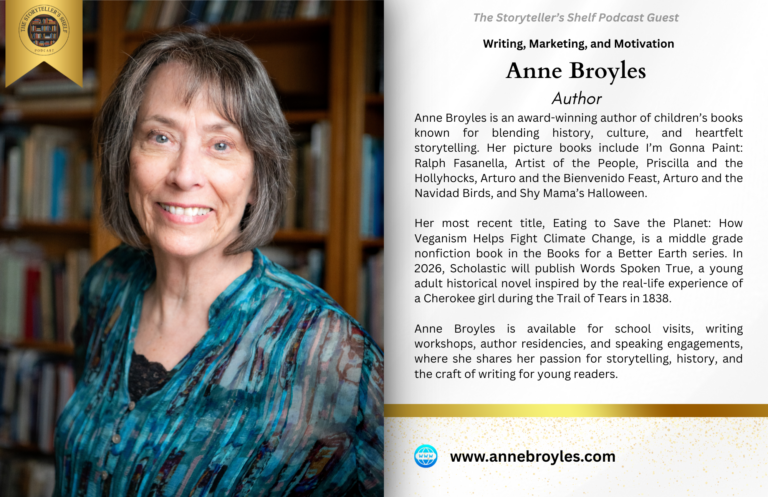
0:07 [music] Hey storytellers and welcome back to the Storyteller Shelf podcast. It's Jackie here with Teresa and we have brought on another special guest. Today we're speaking with Ann Broyals, an a picture book author, middle-grade author, and a young adult novel author. So, she does a little bit of everything and she has been wildly successful. She's going to tell us a little bit about how to do it all today and what her traditional publishing journey was like. Ann, can you please tell us a little bit more about yourself and how is it that you got into writing children's books? >> I always loved to write. I from the time I was in fifth grade on had some great
0:50 teachers um high school, college after I I went to seminary to become a United Methodist minister. I thought I wanted to write books and produce films for the United Methodist Church after I became a local church pastor. I wrote curriculum books. My first book came out in 1988 and did a lot of writing. And then when I had kids, I think this happened so often, I started reading more children's literature and realized how how many ideas that just kept coming to me. So I started writing children's books specifically when my first child was maybe two or three and I was no longer quite so exhausted or working full-time and being a full-time mother that I
1:32 could take a breath and write. >> That is so relatable when you said the ideas just keep coming to you. Don't you feel like sometimes they just keep coming and it's hard to get them to stop enough that you can write them down? >> Yes. And I'm I'm always surprised at the people that say, "Where do you get your ideas? I don't even know where to start." And then I think, "Well, maybe you're not meant to be a writer. If you're if your imagination doesn't flow in that way." I write down a lot of my ideas and I would say probably 90 some percent of my ideas never see the light of day other than getting just written down a little bit or they I work on them
2:12 a little bit and find out that's really not going to go. So yes, I have I think you know I'm in an airport and I'm watching people and I start kind of making up stories in my head about who they are or in the grocery line or I read a book or I I just think ideas for those of us whose minds are open to it. I think ideas are everywhere. >> I love that answer. It's so fun and so true. I think every writer, they're an open channel and the downloads are there and you got to keep going. All right, let's go back to you and all of these incredible books that you've written because you have written for more than one age group. You've done picture books, you've done middle-rade books,
2:47 you've done YA. How is it that you make sure that you're tailoring your writing process to suit all of these different audiences? Do you keep anything in particular in mind when you're writing? probably most important is to keep in mind who's going to be reading the books and not just with picture books that yes, an adult is probably going to read it so it can have bigger words, but the content, the emotional level, what would interest a child or young person of a particular age. Picture books, I really think are the hardest and I love the most because they're they're like poetry. you're trying to to pair down and have it be just the right words and
3:26 no more middle grade. A lot of that is trying to just embrace kids who are able to read on their own and have big ideas and emotionally still are not where they should be. They're not, you know, with up at the high school level. And then young adult, you can do so many more things in terms of subject and theme and action and language. I do think picture books are probably still my favorite because it's so satisfying to get rid of words and pair it down to just the bare minimum. >> Yes, I think we can all relate to that. I love picture books and I would like to kind of pivot where is cultural influence and representation in your work. You're a proud member of the
4:11 Cherokee Nation. How has your heritage influenced your writing and your storytelling? >> That's a good question. My mother was really proud of being Cherokee and brought me up to be proud as well enough that I got in trouble in first grade because when the teacher was doing something about the pilgrims and I raised my hand and said my relatives were here to meet them which was like a Will Rogers who was a Cherokee author and other things. It was a quote that I'd heard that he had said and the teacher came over and said that is nothing to be proud of. Don't ever mention it again. So, I went home and told my mom, and I wish as an adult I had thought to ask her what the
4:52 conversation was like when she went down to the school to talk that through because I I I didn't. It it it never occurred to me. My mom was going to go talk to them fine. But that was one of the first times I think that I realized that whole histories happened that people didn't pay attention to and that some people's histories and experiences were considered more important than other people's. And then got as I got older, you know, the whole thing about history is written by by the victors and knowing that there weren't books, especially for for my age, how old I am, there were not books that showed much anybody that wasn't kind of white, middle class, average,
5:37 you know, parents, two kids, whatever. There wasn't a lot of variety. And so I think that my experience as a citizen of the Cherokee Nation and knowing that I'd say the vast majority of Americans had no clue what happened to our tribe or any other tribes and that they considered that that was like a past chapter and already uh the native peoples had been obliterated. So there were no native peoples. Well, I grew up in Tucson, which is a very multicultural city, and there were all kinds of tribal peoples in the area. So, I knew that there were the Jono Odam, and there were like Apache and all these other and in our tribe, we had in our state, we had
6:23 Navajo and Hopi and Yaki, and I knew that people's stories weren't being told. And so, that was important to me to tell those stories. And I think that's what made me so interested in history and in writing untold stories. >> We need that representation, that diversity. It's so crucial. And I I really appreciate that you mentioned your mom. Moms are awesome when they go in there and they tell it, you know, tell it like it is and say, "No, no, we're not going to do that." So, I appreciate that. What do you think we need more of when it comes to representation in children's literature, especially in terms of indigenous and historically marginalized voices?
7:03 >> Well, I think we're getting more and more history, which is good. So, I'm happy I'm happy about about that. But even so, I would say the average American kid doesn't know a lot of what's has gone on in terms of American history. And obviously, that's very disputed right now. I think it's important. There's there's a native t-shirt that says, you know, like we're still here basically. And I think I love starting to see more and more books, especially say from Heartrum is one of of a fairly new imprint that's doing a great job with this. Having stories about kids, whether they're native indigenous or they're they're Filipino or they're St. Louisis Black or whatever
7:43 that we see kids in their normal situations having normal kid things happen the same kind of struggles that any other kid would have. They just happen to be Lakota or they just happen to have parents who came from Korea or whatever. Uh so that we see so that whole windows and mirrors thing that we want kids to be able to see themsself in the mirror of a book and they want to look through the window of a book to see other kids experiences. I'm really excited that we're getting more and more books. I'm excited that we're getting more books that help all kids see themselves and see other kids experiences. >> We want to talk a little bit more about
8:26 non-fiction. You are one of our first authors to come on and really dive into this. So, we're excited to have you speak from your perspective, but let's think a little bit on your upcoming book, which is Eating to Save the Planet. It's about climate change and veganism, and it's for middle grade. So, how do we take these complex topics, things like climate change and diet, and make sure that they're accurate and engaging for kids? That was a challenge for me because I am not science-minded and I was asked to write a science-based book that needed to provide evidence that eating no or less meat would be better for the planet. So, it was a challenge because I had to do so much
9:08 research. A person who was more science-based and smarter in that way wouldn't have had to do all the research. So I had to do all this research just to understand basic things like carbon emissions that somebody else would have already known and then I had to translate it for kids not because they weren't probably smarter than me in that way but as a way of me being sure that I understood what was happening as well. So once I had all that information and sometimes I would do 20 minutes of research and get one line out of it or an hour worth of research and get a paragraph for those first. It was important to me that the kids would want to read it. And so I tried to make it
9:47 conversational and relatable, you know, like there's a lot in the beginning about why do we eat what we eat? Well, it may depend on our religion or our culture or where we live and and what is grown and available. What did our parents and grandparents eat? There's a lot of So, I try to get kids to look at at what they eat in a non-judgmental way. And I've tried to be non-judgmental through the entire book. I I want kids to be inspired, not guilted about this. And I also tried to make some things funny. That's part of the reality of the science, but I tried to make it something they would think was fun to read. Humor is pretty underrated, even in use for non-fiction writing. It can
10:31 really build that connection between you and the reader. So, I I love hearing that you included just a few bit of laughs in there. I think they're going to appreciate it to say the least. But will you tell me a little bit more about your writing process beyond research? How is it that you laid this book out in a way that you knew would make sense for this audience? >> Well, first of all, this book wasn't my idea. It was um the editor of my book, Ralph Fastanella, artist of the people, she she said, "Let's have a brainstorming meeting." And we did and we talked about a lot of different things. And during that I mentioned Albert Schweitzer who had been one of my
11:11 heroes after I did a third grade book report on him and part of me being vegan and things was part of his reverence for life. And then she said, "Would you like to write a book about climate change?" And I said, "No, I'm not the right one. You know, ask somebody who really knows more about that." But she also knew that I was vegan. So she said, "What about a book on how veganism relates to climate change? So I thought I could do that and I tried then to I I had to do some kind of an outline before they would accept that. And then we we worked on the outline and I just tried to think what were the logical steps of what did you need to know about really about what's
11:52 happening with climate change, what's happening with factory farming and how that affects climate change before I could go into anything about what does it mean to eat a vegan diet? What's a vegan philosophy? how do you eat a vegan diet? You know, the the how-tos. So, I think I just sort of outlined all of that. Um, I wrote a book that I thought she had said it needs to be at least 125 pages. Possibly Miss Herger because I wrote 175 and then she said, "No, it's it's 125." So, I had to get rid of a lot. And that was, you know, that honed the book down more than I had intended. But it it helped me it helped me to really bring things together and make things shorter
12:35 and clearer, I think. >> Do you have a favorite part of the book that you want to share? >> I'm just going to read part of the introduction. When you walk down the aisles of a grocery store, do you think about all the steps it took for each item to get on the shelf? Or how those different stages might impact the environment and your individual health? What about all the workers around the globe who helped get that food to your store? or how a recent drought or hurricane might affect what is available. Our health and the health of our planet are intertwined. What we eat is an important part of that connection. And then it skips down. But some of my favorite words from this book
13:14 are, "How do you change the world for the better?" You start small. You start with your own plate. You save the planet one meal at a time. I struggled to write this book. It was the hardest thing I've ever written. But I'm glad I was the one that ended up writing it. You know, if the three of us were each given the exact same very crisp assignment to write something, we would write three totally different things because we're three different people with different experiences. So, I think I was able to do more of those kinds of things than maybe other writers would have done. And I'll talk about my first published children's book because that's a
13:48 different story and that's what this is about. But my first published children's book was Shy Mama's Halloween. and it set me up for totally unrealistic expectations for the rest of my career. I read an SCBWI newsletter. I had read written this book and it said somebody named Tilbury House in Maine was looking for I don't remember what it said but like diverse books, holiday books, something. I mailed it in and within a week or two I no actually I think I mailed it on a Thursday and maybe on a Monday or Tuesday I heard from the editor saying we would like to write this book. Wow. Okay. And I signed a contract. It' come out in a year and a half. And then, which is which is fast.
14:28 A year and a half is really fast given someone had to illustrate this book. But then for some reason, they made a change and they moved my book up. And there was someone named Leanne Morren who I think she worked in their business office who also was an artist and really loved the book and wanted a chance to illustrate it. So they gave her one day off a week and she worked to to just paint and then she did a lot of extra painting. So the book came out I think about a year after I submitted it. So totally unrealistic because that's never happened before. But I didn't have an agent. I just looked in the SCBWI newsletter and it was the right book at the right time for
15:08 that publisher apparently. So sorry that's not helpful to anyone who's trying to start out now because it probably won't happen. >> You don't have to apologize. We love out ofthe-box stories. I mean, we know the formula and you're right. It's really, really hard today to get published without an agent. But we like hearing the stories where you didn't need one that it just happened. It does still happen once in a while. So, please be on alert for opportunities like this. We're talking to listeners right now. So, storytellers, remember, there's always more than one path to get somewhere. And as long as you're vigilant and you're knowledgeable, you might find those
15:42 small opportunities. So you could be like an although one year that's incredibly fast. It's like lightning. Are you an author, illustrator, or educator looking to better understand the world of children's publishing? Join us. The Storyteller Summit, a week-long master class happening January the 12th through the 17th. Each day offers focus sessions on kidlit storytelling, craft, and the business side of publishing created to support you wherever you are in your journey. The semi concludes with a literary pitch event featuring Serrone Harvey of the Bellcaster Literary Agency. Learn more and reserve your spot at the storytellershelf podcast.com.
16:26 Let's talk about the editing process and what that's like in your traditional publishing environment. Can you tell us more about what maybe surprised you the first time you went through that editing process and how did it help you learn how to write? Well, some of my editors have barely edited at all and it's almost been disappointing and others because I feel like you can learn a lot and I do believe any book can be better with a good editor. My second book, Priscilla and the Holly Hawks, which is probably the favorite thing that I've written so far. It was interesting because at that point I had an agent. She sent it to Yolanda Leroy Scott at
17:04 Charlesbridge who said, "I like a lot of things about this, but I'm just not quite convinced." So, she passed and my agent said, "Do you want to try to revise it for this editor or should we send it elsewhere?" And I thought, "Well, since she likes some things, let me try." And that was October. And it wasn't until March that I could figure out what to do. And then I made some changes. Yo accepted the book. And then in editing, I liked that she sent a one page single space with lots of really interesting comments and things for me to think about. And I like that my best editors don't say you need to do this. They say have you thought of doing that
17:48 or I wonder if and most of them say of course you don't have to change it if you don't want to. But I figure they know what they're doing and I listen to them and at least there's nothing I wouldn't at least consider. Like the book that's coming out next year from Scholastic is the Cherokee Trail of Tears book. And that editor just said simple things, but like at one point she said, "I'd like to see this relationship built up more. This event here up here feels like it came out of the blue. I didn't know they were so attached to each other." And then I went back and realized they didn't appear attached cuz I had like left the love interest out
18:24 for five chapters. And just that kind of uh little little nudge and reminder, I think the editors see the whole project and they know what's needed in a way that the author could get just too close to it. And of course, sometimes we get attached to our words and think we can't possibly live without them. And usually we can, you know, there are some books that I think couldn't have been the same without a few lines. But other books once once those words are gone, you know, we we move on and we have a stronger book. The other thing that makes me think of is when I get an editor's letter, no matter how many pages it is or what's on it, I go through and I read everything and
19:04 there's some things I immediately like, oh yeah, or that's an easy fix or what does she think? What is she thinking? I don't know how to do that. So, I go through and I pick off the easy ones first and I cross them out or check them off like, "Okay, got that done. Got that done." And then I'm left with what I thought was going to be the hardest bugaboo. And often by the time I've done those other changes, I'm more ready to accept whatever small tweak or large the editor has suggested. >> That's a really good workflow. We are fans of listing at the Storyteller Shelf podcast and we love writing things down and checking them all. Well, partly because I I've written several things
19:44 from real life. I had to be more of a plotter because I had events that happened that needed to be in there. So, it's it's different if you're writing something like uh like even my Priscilla and the Holly Hawks or the Cherokee book that's coming out next year. I have one on Ellis Island that I'm working on. you know those I need to be at least have the have the general chronology of it and then I I add other things and I always think people must think writers are crazy when I mean don't don't you find it exciting that you sit down and suddenly think what needs to happen here or this is what happened what would my character do next and then you just
20:21 think of a scene and you have them talk it just sort of comes from who knows where that's that's an exciting thing so probably more of a plotter but like with the Ralph Ainella book I started I I had the idea in 2012 got permission from the my protagonist's son since he's a real life person to write the book. I didn't write it till 2020. Finish writing it and sell it because I couldn't find the way into the book. So that I wasn't plotting that book. I just had to find out what was the heart of the story and what did I want to tell. It had different titles. It had different fosai. And then when I finally found sort of the narrative that Ralph was
21:02 always a daredevil and took it through the book, that's what finally worked for me. Let me steal this thought thread of organization because even if you're not a plotter, you still have to be organized to write a book and you have to be somewhat organized to edit your book. So on production side of the creation of the story, you need some skills to set you in order. But what about after the book? So, this is where we get into the question that Ann and I were speaking about before we hopped on, which is when it comes to marketing after your book is published, how do you keep things organized to make sure that you as the author are able to get your
21:40 book out there to the right people? Well, I would say as soon as a book is sold, start thinking about marketing because when I first started, I believe publishers were able had resources to do a lot more helping on that than they are now. And rather than just be frustrated at publishers for not doing all that I think they could do, not knowing their limited resources though, I make lists of what I think I could do. And I I try to be creative and think slightly out of the box. So it's not just all bookstore, bookstore, bookstore kind of kind of things. And definitely lists. I have a whole July and August list because my book comes out August 20. And I'm I'm
22:19 doing podcasts. I'm doing blogs. I'm getting making Canva things to be putting out, working on a book trailer, new website, all those things. But I feel like we need to be creative. This I think is really important for especially people who are just starting out. The most important thing for you to do is to join SCBWI, Society of Children's Book Writers and Illustrators because they have webinars, they have conferences, they can set you up in critique groups and really help you work on your craft. And part of then what happens is you begin to build a list of contacts. Not just saying you I want to use these people later, but you make friends who
22:59 are also writers or illustrators or editors. And that is so useful when it comes to marketing partly because you can link with people. Like last night I I was at Opera in the Park here in Portland and saw a friend who has just written an adult book on Louise on on Laura Ingles Wilder that's been getting some big buzz. And I saw her and I said, "Why don't we do a book event together?" Now, she's done an adult book. I've done a middle-grade book, but they're both non-fiction. They both involve a lot of research. So, we're going to do an event together. If I hadn't gone through the joining SCBWI, starting to meet people, getting to know a friend of a friend, I
23:43 wouldn't even know her. I wouldn't even know her book was coming out. So, that networking is really important. The other thing is then I have people who can mentor me. They don't even know they're mentoring me. Maybe I'm just looking at their Instagram posts. Maybe I'm just seeing the kind of things they're doing for PR and thinking, "Oh, that's a great idea. I can do that." So, I think all of those things, we just learn to be creative, borrow other people's ideas, share our own ideas. I think it's just it's just the way it is. And I wouldn't want to be anything but a traditionally published author because someone who does independent publishing
24:19 has to then do so much more. And some people have those skills and some people don't. But I don't want to do all my own editing. I don't want to have to choose how it's going to be published and where I'm going to sell it and all of that. So, we probably have to do a little less marketing than an someone who self-publishes, but um I've decided just to embrace it because I have no choice. So, um I'm trying to get good at it, trying to be uh creative. Like like I said, one of my most interesting things uh that I did for the I'm going to paint book was the book came out right around the time that the Portland Association of Teachers were on strike. So it was a
25:00 and there were some other big labor union strikes going on in the country. So it was good timing in that way. But one of my friends was at a Portland Association teachers union meeting and there was a reporter there who talked to him about something and he said, "Oh, you should talk to my friend. She just wrote a book about a man who was a labor union activist and became an artist. So, she called me and did an article for me on I think it was the Pacific Northwest Labor Union newspaper. And then the Oregon AFL CIO asked if I would want to do an event there. And that was so interesting. It was all adults, but it's like if you're going to write about an
25:37 artist, well, artists are going to be interested. If you're going to write about an activist, activists are going to be interested. And these I was also writing about a labor union organizer. I learned a lot from being with people who were actually putting their lives on the line during strikes who had heard of Ralph Fasinella, maybe met him. They brought to me this whole breath of wisdom that I didn't have about my own book. And then when I did other events, I could say things about stories about Ralph that I hadn't known or discovered with research. What you're saying to me is speaking to the publicity expert in me, which is you have to find your
26:15 people. Everybody has some people for whatever you're writing. I don't care if you've written a book about a rock. If you do, you know who to call. You go straight to the people who study them because there's something out there for everyone. And one of my favorite things to do when I was working with publicity is that I like to think out of the box exactly like Ann is saying and I like to say okay what is the core mission here what are who are the cast of characters what are their qualities and then you can relate that to something larger. So there's a club out there somewhere there's an organization out there somewhere there is a someone out there
26:52 that you have to find. It's just using the internet really to find those people and knowing how to pitch yourself. That's really important because I know and before you said something that really hit me, which is we're making friends and networking, like we say, is exactly like cash. It's exactly like sales and income, not a dirty word. Networking is a good word. You're out there to make friends, and you can still make friends with people who help you do things, and you can help them do things, too. So, you're out there seeking for these publicity opportunities in which it's mutually successful. Um, and I'm saying that and I'm emphasizing it because I know there
27:32 are people who used to be like old Jackie where you get afraid to reach out to people because you don't want to seem slimy and then it makes you feel bad and you feel a little guilty. But don't be that way. take a deep breath and keep going because people are usually very happy to help and they end up loving helping you and then you help them write back. So, it is reciprocal. Hey storytellers, if you're still juggling word docs, sticky notes, and 47 browser tabs to keep your story straight, it's time to simplify your writing life. Meet Scrivener, the writing software built by writers for writers. Whether you're drafting a novel, a picture book, or even a
28:11 dissertation, Scrier helps you organize your scenes, research, and revisions all in one beautifully structured workspace. Many of our guests on the Storyteller Shelf podcast have raved about Scrivener and how it completely changed their writing flow. You can move chapters around with a click, store your notes right next to your draft, and even set word count goals that actually keep you motivated. >> Curious? Check out our affiliate link. It helps support the show at no extra cost to you. And let us know if you give it a try. We'd love to hear how it helps your writing process. >> And the other thing is I think sometimes people fear the rejection of what if I
28:53 call this bookstore and they don't want to have me? What if I try to school visit and nobody cares? Or you know, what if I reach out to someone another writer I admire and they don't get back to me? It's it's all possible. And it's just like when we send manuscripts out, we are going to get rejections more than more than we're going to get acceptances probably. And some of those people we reach out to may be too busy or disinterested or not get back to us. And then we just try somebody else. You can't be afraid of no in this industry. If you're going to be an author, like Ann says, you probably get more nos than yeses, but the yeses work out in the
29:28 end. I say it's good to get the nos because then you know who you're not working with and that shortens the list so that you can find your yes. When you hit a creative block or feel discouraged, what keeps you going? If I hit a creative block, it it doesn't happen very often, but I might just feel stuck like I just don't know what to do right now with this particular manuscript. I work on multiple manuscripts at a time, so I just find something else to switch to. maybe just for a day, but just enough so that I don't get mired down and and so I give my brain a little a little break sometimes is what I need or I may go for a walk. I you know it's that often that
30:08 often helps or some other kind of exercise in terms of being discouraged that I've had many many times in my career enough that I don't know how many times I've said to my husband and my my kids who are now adults you know I'm not making any money at this and I would have more money to leave to you kids if I just got a regular job and then all three of them always say things like what would you rather be doing And I'll say, "Well, there's nothing. I love I love working from home. I love living in my head. I love going to writing events." And then they'd say, "Then don't worry about the money. Just keep at it." And when I won the Oregon Book Award for I'm going to paint Ralph
30:52 Fascinella, artist of the people a few months ago. I teared up in my acceptance speech when I looked out and saw my husband, my daughter, my son, and my daughter-in-law. And they were all tearary because they'd gone through this with me and they finally saw, you know, one one award that that said that it was worth it. And so I would say for people who get discouraged and I don't know anybody who doesn't, you know, every rejection is a little discouragement. Even though we can say, "Oh, we get lots of rejections." Everyone just pierces a little bit or a lot. I would say believe in yourself and get back to your work and don't give up. Those are the main
31:37 the main things. But really believe in yourself. If you've got stories that you want to tell and you think you have the words to do that and you have the passion for it, don't let any of this other garbage like rejections or or being stuck, don't let that get in the way, but just believe in yourself and persevere. I think it's so important to have family that have that also support and believing in you. I can empathize with that and I like that you said that keep going, don't give up, you know, don't let discouragement from making things happen. I think that's really important. Um, so I appreciate that. What advice do you have for aspiring authors and illustrators who want to
32:22 break into children's publishing, but they might feel overwhelmed and where to start? >> Find your people, which is kind of in any in any career. Find some people, whether they're all other beginning authors or whether they're people who are uh well published and can be a mentor to you. Don't don't be alone in it. It's enough of a solitary career working unless you work coowwriting. Pretty much you're going to be alone a lot of the time. So find your people. Even if you're introverted, get yourself to a conference, get, you know, watch a webinar, do something where you like with other people who have the same kind of questions and the same needs, maybe
33:01 in the same stage or a different stage that you can learn from. So I think that would be my advice. And are there any new projects, topics, formats that you're excited to explore next? >> I'm in final edits for a book with Scholastic coming out fall of 2026. And it's the one that I started more than 35 years ago. Before I knew about SEBWI, before I had the writing craft, I was already doing research on a book about a real life person who survived the Cherokee Trail of Tears in 1838. It took me a lot of years off and on to get the to get the skills through through conferences, through mentor writers, through critique groups to write that book. So, it's really the
33:43 book of my heart and it's coming out next year and I'm very excited about that. It's called Words Spoken True. Um, I have another manuscript I'm working on right now. I have other manuscripts that are out with editors. We'll see what happens with them. But the one I will work on next is uh sort of a different retelling of the Ellis Island story. And a friend and I are hoping to co-write a hilarious hopefully hilarious. She I asked her on board because she's funnier than I am a chapter book like a a trilogy. So we'll see if that happens. And I have a whole list of books that I've already written. some of them like hundreds of pages or a lot that I like
34:24 one by one I'm going back to see what I want to to revise and what I think might sell now. So I'm I'm going to be busy. I don't imagine retiring. I have no reason to retire because I like what I do. As long as it gives me some freedom to do other things I like, I'm going to continue. >> I think as writers, as creatives, we are not the type of people to sit on our laurels. We are constantly thinking and growing and being creative like who wants to retire? What's that? You know, I think we have had one of the best episodes. It was so insightful and we are so appreciative of you coming on because I think you have brought a lot of insight, wisdom, fun, creativity. We
35:09 we definitely appreciate you coming on today. Is there anything else that you want to share with the audience? >> Um, one question you asked me was interesting. This is the Priscilla and the Holly Hawks book and you said what's my favorite book I've written and this is it. And the reason is because it's the remember I mentioned something about liking charact I like characters are resilient. I like stories about the human spirit and this is you know a true story that I had uh discovered when I was researching 35 years ago the book on on the trail of tears and this is like a side story of that and this is a book that one morning I woke up I had it been
35:50 15 years since I had done the research and then I put it away because I thought it's not my story to tell maybe that maybe this real life person had family members or somebody involved in the story they should tell But in I woke up one morning and I heard her voice in my head. And this is where writers sometimes sound sort of psychotic. But I seriously had I had her voice, her dialect, her story without even looking at my research from from 15 years before. So I've always felt especially connected to to Priscilla. And I'm I'm just going to read you the first line and the last line because I think this is my most beautiful writing. That's my my Okay. When I was young and still wore
36:31 slavery's yoke, I was saved by Holly Hawks and a stranger's kindness. And then the last line comes with this amazing art by Anna Alter where you see this young enslaved girl who is surrounded by the Holly Hawks that helped save her. And this line is, "Grow, I sang to the seeds." Bloom, I commanded the plants. safe. I told myself home. >> Thank you for watching the Storyteller Shop podcast. If you enjoyed this episode, be sure to like, share, and subscribe so you never miss new insights from emerging authors, illustrators, and publishing professionals. Your support truly helps our show grow. And if you'd
37:16 like to support us directly, visit our Kofi page and click buy me a Kofhei. Thanks again for tuning in. >> [music] [music]