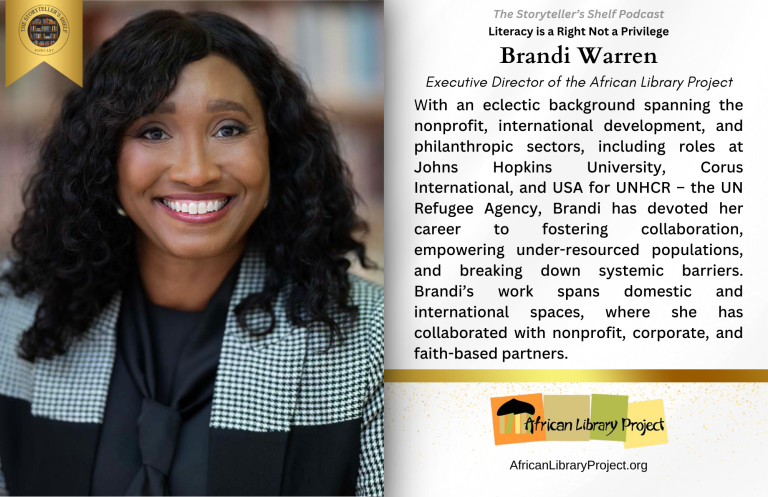
Brandi Warren
The African Library Project changes lives, book by book, together with partners in Africa and North American volunteers, to create, improve, and sustain libraries in African communities.
Follow them on:
The African Library Project changes lives, book by book, together with partners in Africa and North American volunteers, to create, improve, and sustain libraries in African communities.
Follow them on:
This transcript comes from the video’s automatic English captions. Names and wording may contain errors. Timestamps open the recording at that point. References to events and offers reflect the time of recording.
0:01 The Big Bang Notable Book List showcases titles expanding the universe of young minds, one read at a time. Imprints at Holiday House and Simon and Schustster already submitted their titles. Have you submit your books for free for a chance to be featured? Learn more at the storytellershelfpodcast.com/submissions. [Music] Hi storytellers and welcome back to the Storyteller Shelf podcast. It's Jackie here with Teresa and we want to thank you for listening in. It's September and
0:47 we're talking about accessibility this month. Today we're going to have a discussion about how literacy is a right and not a privilege with the African Library Project. The African Library Project changes lives book by book together with partners in Africa and North American volunteers to create, improve, and sustain libraries in African communities. Their grassroots approach mobilizes volunteers in North America to collect and donate gently used books to an international network of partners in Africa. And get this, they've donated over 4 million books. Today, we welcome the chair and executive director of ALP. And as always, I'm passing the mic over to them
1:28 so they can tell us more about themselves and how they came to work in this literacy space. >> I'm Brandy Warren. I am the relatively new executive director of the African Library Project. Um, I always like to tell people above all I'm a wife, I'm a mom. Um, I'm a military spouse. Go Army. And I am very passionate about service. I always say when I was a kid, I was the one who was always volunteering to help somebody, whether it was the unhoused community, whether it was animal welfare crisis situations. But education has always been central for me growing up.
2:15 Education was huge in my family. There was no getting around it with my children. They always knew mom does not play around when it comes to education. And for me, um, literacy is a foundation of education. To be very honest, literacy opens doors and provides the access that people need to be able to create the lives that they want, to be able to problem solve, to be able to change the trajectory of their lives. And it was just a perfect fit for me. Since I decided to dedicate my career to service and helping others, I decided to do so in the literary space since it's important to me.
3:00 >> For our listeners who may not be familiar, can you share what the African Library Project is and the heart behind its mission? The African Library Project, lovingly known as ALP, um is a small volunteer-driven grassroots organization that promotes literacy across um the African continent uh specifically subsaharing um Africa. So, historically ALP has partnered with 13 um English-speaking African countries. Those countries have included South Africa, Uganda, Malawi, Batswana, um, and so forth. So, we work with US and Canadianbased
3:47 individuals who sign up as book drive organizers to collect books, gently used books, and they donate them to school and community libraries among our partnering countries each year. I like to say that at the heart of ALP um are really all of the people that really keep the organization running from our book drive organizers, our external volunteers to our internal volunteers who manage operations to our board to anybody who takes part in our mission. But at the core of ALP is the belief that every child, regardless of where they live and regardless of what their situation is, deserves to have access to
4:34 books because it is a human right to have access. >> Brandy just took the name of our episode, which was that reading and literacy is a right, not a privilege. She nailed it. Yeah, it's a celebratory moment. >> Yes, is a right is everyone should be able to have access to books. Everyone should be able to know how to read and write, especially from an early age. Everyone should. And can you imagine, you know, the brilliance of people that is not shared with the world just because of a lack of books, which is really sad to me. and ALP comes in and and addresses helps to address that
5:19 issue which is one thing I love about the organization. >> For educators, librarians and literacy nonprofits listening, what are some of the biggest challenges that you see in in increasing access to the quality of children's literature in underserved regions? >> First challenge is cost. the cost of books for some of the parents and families in the communities that we work in. It's it's a lot. It it it's too much. And um I believe I read somewhere that sometimes books cost more than the monthly salary that some families are bringing in. I remember during my visit to East Africa, I met a number of
6:04 families who happened to be small-cale coffee farmers and many of their children, they had to pull them out of school because they couldn't afford the fees. So cost out-ofpocket costs um for families is definitely one thing. Funding, it appears to be a lack of funding, whether that's from the private or public sector when it comes to our partnering communities is most certainly an issue. So adequate funding is not being funneled into the communities so that there is quality education and quality quality uh literature, children's literature. The second I would say is representation. I think it's very important that every child needs to be
6:49 able to see themselves in the education that they receive and the stories that they read. And I believe that is lacking whether it's lack of representation when it comes to the main characters in books that look like me. It's also a lack of representation with children who may have disabilities. Um so that's another issue. They don't see themselves in the stories they read and the literature that they have access to if they have access to it at all. And then the third based on my conversation that I've had with individuals especially those involved with ALP is uh a lack of resources in the native tongue. So yes ALP does work specifically in English-speaking
7:35 countries. However, many of the communities they still have a native tongue that they speak and having books and literature available in the child's native tongue that they hear daily that they are even more connected to um and that they can see themselves in it. It validates their experience and their uniqueness. And I think that when we are lacking in cost um and funding that's given to um education and we're lacking in representation and then we're lacking in the native tongue, those are most certainly barriers and challenges in these communities that need to be addressed that do not provide
8:22 children with the most quality education that they could be receiving. That's what I found. Yeah, I can see that like it's so important to have access to books and you know and the fact that there's no there's not the representation and like what you were saying I think that needs to be addressed and that needs to change and I'm I'm just so thankful that you guys have this organization and that hopefully speaking about it more and more and getting involved that'll help to really kind of spotlight and help to provide the representation. And I think it's just that is just so important. Reading for children is like the key to having you know a better job, better
9:07 situation in life. So yes, keep speaking about it. Keep sharing your story. I think that'll help in providing the necessary means to providing that spotlight for the African Library Project. Switching gears though, what does your day-to-day work look like and how does ALP support children's access to books across subsaharan Africa? My daytoday life. Okay, this is an interesting question. So, since I'm still relatively new to ALP, it hasn't even been a year since I've been on board. I have honestly been spending um my time listening and learning to all stakeholders. US-based and Africa based so that I have more of
9:54 a sense of institutional knowledge, a sense of who our partners have been in the past, the initiatives that we've done in the past and figuring out where I would like to take the organization um as we go into the next chapter. So, I've had a wealth of conversations with really interesting, very dedicated individuals from book drive organizers who have helped to be who have helped to donate books to partnering countries literally for the last 20 years. Some of the book drive organizers are high school students, even middle school students who are awesome, who are committed to the mission, board members, partners, uh, nonprofit partners. As I
10:41 move forward, my daytoday really now is focusing on partnerships. Um, because I like to say ALP is a hidden gem. I think that it is an awesome mission and it has done awesome work for the past 20 years. However, a lot of people I don't believe know about ALP and that's one thing that I would like to change as we move into the next chapter. So for me that's what that looks like is identifying new partners. Like I would love to partner more with homeschool families, with um with H.B.CU, historically black colleges and universities, sororities and fraternities, the divine nine, um people
11:27 have connection to the African diaspora. So I'm looking for partnerships like that so that we can diversify our volunteer base and spread awareness among new audiences. So that's what my dayto-day looks like now. A lot of research, a lot of connecting and reaching out to people who have no idea who I am, but I hope that they will take an introductory call um with me. So that's what my day looks like. It's really focused on partnerships right now. >> I think that's awesome. And speaking of homeschool, I homeschool. So, I will be sharing this through my network cuz I love this and I'm a I'm a passion project kind of person and I love that
12:13 you want to have other involvement. Like you said, you have to diversify. Um, and this is a great way to do that. I am excited for you. >> I love that. I'm recruiting you, Teresa. Thank you. >> All right. There we go. Every schooling has a civic engagement portion and >> that should be really in every school. I will say it that way. There is no if and or but. Your challenge is just reach. And that is the challenge that everyone faces which is that we can't do one thing alone as one person or even really as a group of people. You need to have community and you need to have partnership in order to succeed. If not, you'll never get to the scale that it
12:52 needs to be, especially for something charitable like this. Just need all hands on deck. A lot of our audience are creatives. They're authors and they're illustrators. and I'm wondering if there's any way that they might be able to collaborate with ALP to help you amplify reach and impact. Is that something that you thought of before? So I'm thinking I've been thinking about all different types of out ofthebox innovative ways to partner with new people to be very this is exciting because I haven't specifically yet focused on illustrators and publishers per se and ALP certainly does get
13:37 interest from some authors about wanting to get their book to communities. Um, however, I need to think of a way to do that best because of how our model works. So, right now, our model includes shipping a half library, which is 500 books at a time, or full library, which is a thousand or more books at a time. So, you know, all of the books go together versus shipping individual um books to communities that authors may want to share. But one thing that I would love to do that I think that um a way to partner with authors and publishers and illustrators is I would
14:24 love to go more digital in the future for ALP. And by future, I mean very near future. Like I would love to set up I need to think of a better word for this, like a better uh title for this that's more exciting, but like reading time where it's like storytelling time on Zoom where authors from all different backgrounds can host a reading time for our USbased and Africa-based um individuals in school communities. I would love that. I would love to eventually put together like a digital story collection with a group of people where because yes, it's great to get physical books in the hands of students
15:11 and that is that's our focus right now. But honestly, one of my goals that I would love to be able to accomplish is through partnerships is to focus more on digital literacy because that is another type of literacy that is just as essential as being able to read and write to read a physical book in hand. You need to be able to operate technology. You cannot get around that in this day and age and our children need to know that. So having access to books online, I would love to work with authors and publishers and illustrators to put together a collection of books that well represent the communities that we work in with main characters that look like the students we we work in.
15:58 These books can be in English and in a native tongue. Um, so I would I think that's a way to collaborate in the future. Right now, the most direct way to engage for anyone to engage with ALP is through signing up or registering rather to do a book drive and collect the gently used books that are shipped. And honestly, fundraising is critical. Everybody knows every nonprofit has expenses that they we have to run an organization and to expand our reach and funding is critical. So that is another way to engage with ALP is to participate by becoming a monetary donor.
16:45 >> So when you were a kid, what was your favorite book? >> I'm laughing because if you would have seen me as a kid, you would totally get this. So, I loved the Amelia Bedilia series. I loved that as a kid. I And my parents, like I said earlier, my parents were big on education, so I definitely had to I was always reading, but Babysitter's Club, too. Yes. But I liked, of course, my parents would make me read encyclopedias and all that. Amelia Bedilia, I loved her because she was funny. She was goofy, but I when it comes to representation, I saw myself in Amelia Bedil Bedilia
17:32 because I was a clumsy kid. And when I read her stories, while they were funny and it was like, okay, something is wrong with Familia. What is going on here? It made me feel like it was okay to be clumsy and a little goofy and a little silly. I read The Babysitters Club because I wanted to be like my sister who's four years older than me and that's what she was reading. So, I felt like, oh, that's a grownup book. I I want to be like a grownup, so I'm going to read that. But I I was much more of a uh um an Ameilia Medilia character much and I Lord knows I still am to this day.
18:18 >> She is very relatable. I think that we can all find ourselves in an Ameilia Vidilia character. Um especially that she's uh she takes everything literally. Uh so that's yeah it's very relatable uh as a character. So So as a last takeaway um what are you reading now? >> So right now I've been reading more leadership books. especially considering that this is a a new role for me. But I can tell you the books that I am looking forward to reading. How about that? It's actually So I'm also a person of faith.
19:03 So I am reading I'm about to stop. You can actually see it behind me. Um the garden with somebody who's a person of faith and I also take mental health very seriously. And I like how she connects those um two worlds together. So, I'm I've been looking forward to reading um reading that book. Some books that I have started but have not yet finished. Homecoming. I haven't finished that one yet. I'm still in the midst of it's a book called Not Nice, which is more like a like a self-reflection book because I I like books like that. Our last question is, if you could have listeners take away one thing from this episode about ALP,
19:49 what would that be? >> Wow. One thing. >> I'm boiling it down to one thing in my mind. I will say this. If you are passionate about literacy and you believe that access to books is a human right for everyone and you have an interest in providing that access to books to children in Africa who are more than deserving just as deserving as anybody else in this world then ALP is an organization that I strongly suggest. suggest you get involved with. That is what I would leave with you.
20:35 >> And there you have it, story fellers. That's the last golden words. And with this, we thank Brandy so much for being here with us today. >> Thank you. >> If you enjoy this episode, give us a like, subscribe to our channel, and share this with a friend because we know that other people out there could use this, too. And one last thing, if you like freebies, definitely join us in our email newsletter. Pop your email in. It's for free. We don't spam you, but we occasionally send things like career opportunities, awards and contests, and handy dandy things like pitch guides and query guides that you might find very useful. So, otherwise, we will let you
21:11 go today and we'll see you again next time. [Music]