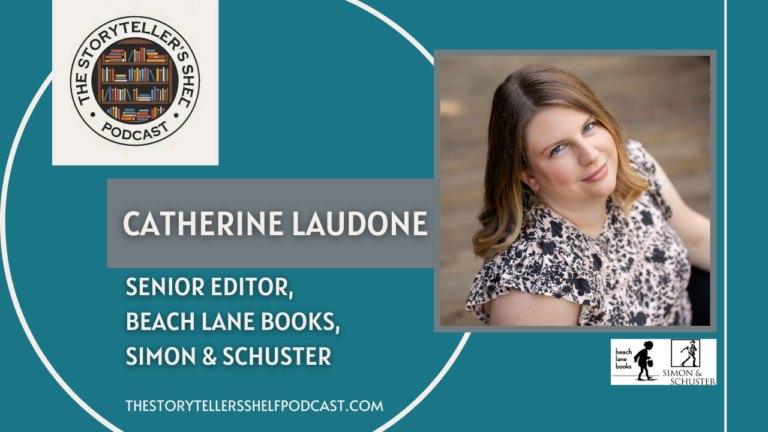
0:06 Hi storytellers. Welcome to the Storyteller Show podcast season 2026. I can't believe it. We're already in season two. Today we are joined by Katherine Leon. Katherine, could you share who you are and can you walk us through your career journey into publishing? Thank you so much for having me. I'm very excited to be chatting with you today. I wear a lot of different hats. I'm a published children's book author. I co-wrote the book She Kept Dancing, a story of professional dancer with a limb difference. I co-authored it with Sydney Masher, who the book is about, and she was the first reader, Sydney Rocket, with a visual limb difference. Um, and it's illustrated by
0:44 Nutell Quack, who did an amazing job with the art. Uh, and then for my day job, I'm also a senior editor at Beach Lane Books, which is an imprint of Simon and Schustster. As you can see, my entire life is children's books, and I'm not sorry about it. Um, I grew up loving to write. I really loved writing, you know, children's and young adult stories because those stories really had an impact on me. You know, my mom started reading to us really young and that love of reading grew and grew. Um, and then when it was time to go to college, I assumed I'd go be an English teacher because that's what I thought you did if you loved books as much as I did. Uh and then my
1:22 AP English teacher uh in high school was like well you know someone has to make the books right and it was like a light bulb moment going off. So after that I started looking at colleges that also had publishing programs and that's where I found Emerson College uh because they had a great writing program as well as a publishing program. And I did a lot of internships while I was in school. I was fortunate enough that I lived close enough to the city. So when I was home on summer breaks, I would usually get a part-time job and then I would also part-time intern in the city. I entered Harper Collins, Source Books, and a couple of agencies. I also did a
1:57 mentorship while I was in school with one of the adult deputy publishers at Sim Schustster, which was a really great way to kind of get an inside look at that track. And so when it was time to apply for a job, she was able to give HR heads up that I was applying which was really appreciated. And uh I got my first job in 2013 as editor assistant at Sims Books for Young Readers. And I assisted the deputy publisher as well as a senior editor. And I was there for a number of years. And then I switched to the Paula Weissman books group. And when Paula Weissman retired just a year ago, I switched over to the beachland books team. So, I've been at Simon Schustster
2:36 for over over 13 years now. Um, but I've been in several different imprint families. So, it's been a really fun journey. And throughout it, I've had the opportunity to edit picture books, middle grade, and young adult. Um, although right now I'm just doing picture books and middle grade. >> What's it like working with a Big Five publisher? And how does that shape your day-to-day work as an editor? >> Hey, storytellers. If you're still juggling Word Docs, sticky notes, and 47 browser tabs to keep your story straight, it's time to simplify your writing life. Meet Scrivener, the writing software built by writers for writers. Whether you're drafting a
3:15 novel, a picture book, or even a dissertation, Scrier helps you organize your scenes, research, and revisions all in one beautifully structured workspace. Many of our guests on the Storytellers Shelf podcast have raved about Scrivener and how it completely changed their writing flow. You can move chapters around with a click, store your notes right next to your draft, and even set word count goals that actually keep you motivated. >> Curious? Check out our affiliate link. It helps support the show at no extra cost to you. And let us know if you give it a try. We'd love to hear how it helps your writing process. That's a great question. Um, you know, I
3:57 I think I get the best of both worlds because working with a big five, you have all the resources that come with that. A full marketing team, publicity, design, um, you know, and and all that support, which is wonderful, but being on the Beachland team is a much smaller team. It's just uh our publisher, editor, director, myself, and then an associate editor and editorial assistant. And so as a result, it's really kind of nice that I get to grow my own list without worrying about my books competing with other books on the same list. You know, some some houses imprints can have 20 editors in them and it's just very challenging to make sure your books are standing out among the
4:36 other editor's work. I really love that I kind of get an intimate feel to my team but have all that great big support behind me. And in terms of just my my work in general, I think the fun part of editing is every day is different because every project is different. There's never one one way that every project's going to turn out. And so, uh, I'm doing everything from reading submissions to going to, you know, meetings and answering emails. People are surprised how many answering emails my job consists of. I think they just assume editors get to read all day and that's not the case. and then working with design and copy editing and just reviewing passes and also giving
5:16 feedback on illustrations that we're working on for picture books. And so, so every day is really a new a new exciting day for me because no day is the same as the previous one. If you could give our listeners what your typical day looks like, acquisitions versus meetings, admin, all of what does that look like for you? >> In terms of my day-to-day, I definitely start my day checking my email. I keep an oldfashioned handwritten list for my to-do list just to make sure I'm always on top of everything. And uh I really just kind of go through and whatever is uh high priority, for example, if I have to review a pass of interiors for a picture book that has to go out in a day
6:02 or two, that has to be done as soon as possible so it could keep routing to the next person. So for example, I might prioritize that over just a query. A lot of times when submissions are coming in, I'm quickly uh filing them into my reading folder to be looked at at some other time because usually in the moment I'm doing something else, you know, uh setting aside time for that, you know, later on is important. And then oftent times I also have meetings scheduled with authors and illustrators. Those are those are always the most fun for me because you get to just have facetime with the people you're working with to create this beautiful book. And I love
6:38 brainstorming with the authors and illustrators uh to get that perfect combination of plot and character going. So that can be a lot of fun as well. We have certainly big weekly meetings or bi-weekly weekly meetings um like our production meeting where we're literally going through two to three seasons worth of books and basically updating on where we're at with them. Uh along with production and managing ed and everything. there's always someone keeping time for for all the books and that's usually the managing editor. Uh so it's really great to have those meanings to kind of all come together, but it's definitely a lot of titles to get through in an hour. So um that's
7:15 always a lot of fun. And then in terms of acquisitions, it's so interesting because I've been at the company 13 years. I've seen so many different versions of acquisitions come through the door. When I first started, we had the the acquisitions you've probably heard about where it's like a big meeting, head of publicity and marketing and ed library and the president is there and everything. Um, and I certainly did that for many, many years, but um, over the last few years, SNS has kind of shifted their acquisitions a little bit where we're really only having those really big meetings if it's like an auction situation or a really highprofile project that we feel like we
7:50 need to bring in those other departments super early. Um, and the reason why they did it is they kind of felt like too too too much discussion was less about how they'd sell the book and more about personal taste on some level. And so they kind of shifted their perspective to, you know what, we hired these editors because they know the market. They know what kids want. Let's trust the editors. Let's trust the publishers. So all that said, while I don't have to go to a huge meeting all the time to acquire stuff, I still do have to, you know, get buy in from my editor, director, my publisher. So, usually if I really love something, I'll first share
8:26 it for a second read with my editor, director. Uh, if she really loves it, too, then she'll share it with the publisher. And if we get the green light from there, we I I can work with her to figure out what that offer will be. We still have to route a profit and loss statement and paperwork, you know, to make sure that financially we're, you know, we're still on budget. Uh, they didn't give us that much free reign. We still have to, you know, show that we're going to be on budget. Um, but you know, with that said, it's really nice because it streamlines the process and and it's great because then when you're launching some of the projects for the first time
8:59 in house, everyone's just super excited to to see them and and just really put everything behind them because it's the first time that they are truly hearing about a project, which is which is really exciting. So, that's kind of how the acquisitions has worked. That said, sometimes there might be a project I'm bringing and my editor director doesn't love it or she has concerns about it. And usually if I have a very clear vision of how I think something could get stronger, I'll say, "Let me try a revise and resubmit, which is when I go back and I give feedback to that author via their agent and ask if they'll try fixing some of the problems we're having
9:37 with it." And there's never a guarantee that you'll still be acquired, but I'd say 99% of my list have all been RNRs at some point. And I always tell agents and authors, if you're asked for an RNR, do it. One, it can't hurt. And two, it means the editor really sees potential or they would not be spending their time giving you those notes. It would just be a form rejection. So even that part of the acquisitions where it takes a little longer to get there, it's so satisfying when you do get that yes to go forward in a way a lot of the editing is already done after you acquire it. So sometimes you can even push it out a little sooner. >> So when a manuscript is acquired,
10:16 can you walk us through the acquisition process a little more and what happens behind the scenes once you say yes as as a publisher? um how does that work for the author? >> I've had the pleasure of experiencing it both as the editor and as the author who got the news. So, so I totally can um relate to to authors wondering how that will how that will feel if you haven't felt that yet. After something's been in the green light to be acquired, I make the offer to the agent if you're agented. And I have had um the occasional where it might have been someone through a conference who was unagented and in that case I'm making it directly to the author. But usually it's
10:53 to the agent cuz we take solicit uh you know uh solicited by agents only. I'll make the offer and usually the agent and I will go through a couple of rounds where they are negotiating on the author's behalf. Some agents I know will be sharing every single round with the with the author. Some agents will try to get a better deal and then share it with the author for review. Um it just depends on each agent's approach to it. In the end, we'll come to an agreement on certain things that we can compromise on. And then there's certain, you know, deal points that we have to stick to just because either their standard for our company or, you know, contract says
11:32 that this is something we just can't negotiate. we get the main deal points hammered out and that's usually the advance or how much you're going to get paid the royalties which is how much you'll get paid once you earn out your royalty your advance sub rights and you know world rights you know whether it's going to be world or whether the author can retain some of those rights uh you know so so kind of more the basics then we send all that contract paperwork off to contracts and then the agent and the contracts team will continue to negotiate on more specific contract act legally ease. Um, so that said, it can take a very long time sometimes, but
12:10 then other times it can it can go really quickly, especially if we've worked with an agent before. Their agency will already have like almost a template with us. So, we're not starting completely from scratch. So, that said, you could have your contract signed in a month or you could it could be several months. So, it can definitely go either way. But on my sizely editor, once it goes off to contracts, my fun part begins with actually working with you because the contracts actually can take a long time to be signed and it can take two years for a picture book, three for a graphic novel, and one for a novel. Like, there's no time to be lost to be working
12:45 on the book. So, we can't wait for the signed contract. But, it's almost a verbal agreement that was emailed saying, "We've agreed. we're not going to suddenly pull out, but we also need to get going on the book before before we get signed on the dotted line. So, usually then I'll jump in and start editing with the author. Uh, and if it's a picture book, sometimes when I am reviewing the submission, I'll automatically have an illustrator in mind and I'll share that illustrator while I'm also trying to acquire the text with my team to get their thoughts. And then other times, uh, you know, I might have a sense of the style I want but not the right illustrator. So, while
13:23 I'm working on the text, I'll be also combing through uh the different agency cataloges and Instagrams and find some different illustrator options. So, the contracts team takes care of all the jargon and I'm kind of jumping into action on the other side with the authors and illustrators. And also, I have to make a offer to illustrators as well. That usually falls on me. Even if a designer uh has found the right person and we both like someone, I'm usually the one actually making the formal offer to their agent, which means more negotiations and back and forth. Um, so, so really essentially for every picture book or graphic novel, I could be doing
14:01 two contract negotiations for one book, unless it's an author illustrator, which is then it's a little easier. You get one contract and you're one and done. But again, it the the the whole technical part of it is so worth it because then we get to the creative part which is the best part in my opinion. >> Okay, speaking of the best part, tell us a little bit more about what your editorial style is and what makes an author a joy to work with during the whole process. >> It's a great question. So, in terms of my editorial approach, I'd say I'd go big picture and then slowly start to funnel down to more minute details. When I'm reviewing a first draft, I'm going
14:42 to be looking more big picture. Is the narrative working? Is the character developed? Do they have a strong character arc? Um, is the plot high enough stakes? Is is the hook high concept enough that it's going to stand out? I kind of give back feedback and usually I'll just see what the author does with it. I always offer a Zoom call or some type of call um after the first draft, especially if it's someone I've never worked with before cuz I want them to have the opportunity to have a dialogue with me if they have any questions about the feedback or if they need to brainstorm a way to deal with it. Um but otherwise, I kind of always just say, "These are just suggestions.
15:18 Let me know what you think." Cuz sometimes I might suggest a way to fix it and they come up with a way that's 10 times better, but still is dealing with the with the issue I brought up. Ideally, with each round, you're going to have less and less big picture. I say problems, but like in a good way, problems, because you're working on on getting it to be the strongest version of itself. And then it becomes about what I call polishing rounds, which is when I'm really getting into more nitty-gritty of, oh, let's try moving this line here for better flow. Okay, have you thought about this different word choice? Sometimes that will creep in a little bit when I'm editing a
15:52 novel, line edits, but I've I've learned to not get too hung up on some of that because a lot more of the grammar aspects are going to be handled by the copy editor later on. And with picture books, it's a whole different process because I want to get the text as as tightened up as possible, but know that we're probably still going to edit a couple sentences once we have the art alongside it. because sometimes we might have a line explaining something and then we see in the art and now we can delete that line from the text. So picture books it's a little more loose. Um and sometimes I' I have worked with a few author illustrators where they have
16:28 to be drawing while they're working on the text. Like I said it's not a one-sizefititall process. So in that case I have to be flexible and be like okay we'll we'll we'll leave the text a little more fluid. let's work on a first round of sketches and then we'll bring in the art director to get a little more fine-tuned on it as well. So, that's kind of my style is look at the big picture and then slowly start to get um more finite in those details. Honestly, I think the best folks to work with are those who are just open to collaboration. I I think the the authors and illustrators who are willing to trust me and also bring their ideas to the table where again it's a dialogue
17:07 and it's a working together to figure out the best solution. I never want an author to feel like it's a us them mentality. You know, I'm very much on your side. I want to make this book a book you are proud of just as much as I will be proud of editing it. And also authors that are just just transparent with communication. if you have a vacation coming up, you let me know pretty early so that we can work around it and not be afraid to shoot me an email and be like, "Hey, like I'm thinking this. What do you think?" Because often I feel like sometimes authors might feel intimidated to talk to their editor. Um, and that's where you can always I'm always happy to talk
17:42 to your agent instead. But I also encourage authors like I'm a human. I'm not going to bite. You can totally email me a question and and it's okay. And I usually try to leave on agents on all communication anyway so that they're always in the loop as well. So I I'd say the best folks uh are the ones who are open to making changes and seeing it more as a collaboration rather than you know unwillingness to to change what they already have. >> Let me take us backwards for a second before we acquire anything and you're going through that very very very full inbox full of submissions and you finally find one. What makes you choose that one? And in contrast, what few
18:24 qualities in a manuscript do you see and you know it's not for you? For a novel, it's always voice. I mean, picture book as well, but especially in pros, having that narrative voice be super strong and immediately pull me into the story is so important because if I'm not being pulled in, a younger reader won't be pulled in. And then I think a high concept hook or stakes especially right now just because the marketplace is is in a tough spot where it's just being harder to break out new projects concept or a hook that will be an easy sell in you know saying this is who this person is for this is this meets this and you know it being really clear and cut that
19:02 way. Um that's always really helpful. Having high stakes where it doesn't feel too slice of life is very important as well. Those are all things I'm I'm looking for. And in terms of a picture book, if it's author illustrated, I'll confess I have to love the art. Like, like the art will immediately be the first thing I'm looking at cuz if I don't love the art style, I'm probably going to say no. Now, there have been a few cases where I loved the text because it was written by a separate person, but they it was presented paired with someone's work. Um, you know, there was one instance recently where I said, "I love this text. I love the topic it's
19:38 on, but this art style won't work in the US market. It's too European. And she was a European artist. And in the end, it worked out that uh they got similar feedback. So, they came back around and that illustrator became a second author on the project so that she could still have that collaboration um in the story and giving feedback on the art, but we were able to hire a different artist who would better fit the project. So, so I am always open to that. It kind of depends on how it's being submitted. >> A little bit before we talked about how competitive it is today in the market in general for kids books. So from your perspective, what makes a story truly
20:17 memorable and likely to sell in the crowded publishing landscape? >> I I think everyone would agree if we knew what in what would make a book successful, we bottle it and just sell that instead of the books. Um, honestly, it it really depends on on the book and how the word of mouth gets out. I remember when book talk became really big a few summers ago, like all these books that were like really deep backlist for some of these publishers like kind of became the new front list again and uh you know just were becoming bestsellers and when they come out they were very modest sales. So, you know, some of it is a bit of luck. Some of it is what catches fire with word of mouth
20:56 or on Tik Tok and and interest. Um, some of it is, you know, for the ed library market, what schools are looking for. Middle grade was really really big a while back. You know, it's tougher because the kids post pandemic are at lower reading levels. So, things have got to be shorter and a little easier to digest and action-packed seems to work a little better sometimes because it just holds the kids interest in a different way. That said, there's always an exception. We still need I say quieter, but like books that have kind of a slow build. And I think sometimes people say, "Oh, I don't want to be on the mid list because it just means I'm mediocre."
21:32 That's not true. It means your books are selling year after year at a steady rate. You're making money. The publishers making money. And frankly, without that steady mid list or even backlist titles, we wouldn't be able to buy front list. Don't get caught up in all those labels or people's opinions. If you have a book out and it's selling, that's a victory. You know, it's a victory for everyone. So, so a lot of times it's finding that hook where it's going to be an easy sellin for our sales reps or sometimes our sal our sales reps will tell us we're being asked for more of this type of book and then we'll rise to that occasion. So again, it's always
22:07 an open dialogue with sales among ourselves and also just looking at what is selling and trying to find something that is appealing to what kids are clamoring for in the moment as well. >> Before we wrap up, are there any upcoming titles or projects that we should be keeping an eye out for from you? >> That's so hard. It's like asking someone what's your favorite movie or your favorite books. I like I love all my book all my book babies that are coming up um with my awesome authors, illustrators. Um, let me see. Well, one I'll throw out there is uh Cas Windness has a third book in the Bitsybat series coming out, Bitsybat Snow Star, that'll be coming out um this fall. And it's so
22:48 cute. Betsy is experiencing her first snowfall at school and she wants to try all of her friends different activities, but you know, a lot of things aren't easy for her. She doesn't like being cold or wet. And so she has to kind of learn during the story that it's okay that if friends like different things um and not to mask too much um since she is coded autistic. Um but yeah, it's super cute, lots of fun. And I give Cass total props cuz when we were trying to decide what this third book should be about in the Bitsy series, I was like, "Oh, she's she'd be so cute in a snow outfit and Cass's like, I hate snow." I was like, "Great. Bitsy can hate snow, too." Um so
23:24 it's it's a really fun fun story. I'm very excited about that. So coming up this summer will be Little Ghost Summerween by Maggie Edgen Willilis. It's about a little ghost that we met in the in the first book in that series, Little Ghost Makes a Friend, and he wants to celebrate his birthday for the first time and he wants to pick the perfect party theme, which of course for him would be Halloween, but you can't have Halloween in the summertime, or can you? So obviously it's playing on that really popular trend of summer. Um, but it's a really fun friendship and birthday story and of course at the end the the greatest gift is your friends, you know, and and nothing else. So,
24:00 those are two very exciting titles. I can't give too much info yet, but my agent's currently negotiating a contract for a new project that I co-wrote. My co-author is her Olympian. Um, so I'm very excited uh for that project to be coming. It's going to be a middle-grade um title and so hopefully we'll we'll see an announcement in a few weeks and to my earlier point, it's taken a long time to get the contract figured out, but hopefully we'll be signing this week, which is very exciting. A lot of really fun stuff both on the author's side and the editor's side coming up. Well, congratulations and for all of your advice and your insights and everything you shared with
24:40 our storytellers. We were so happy to have you on today. And if everybody's listening in now, please remember to give a like and a subscribe. Head to our website for freebies, events, and opportunities like awards and summits. And we'll see you next time. Thanks for listening to the Storyteller Shelf podcast. If today's episode helped you, please subscribe and share it with a friend. In the link below, you can explore our educational library and learn about what's coming up next, including our live summits and the BB Notable Book Awards. We also publish a limited number of curated blog features for authors and publishers who want to spotlight a book we believe will truly
25:15 serve young readers. And for companies and organizations that support Kidlet creators, we offer ways to partner through sponsored episodes and select opportunities that are a strong fit for our audience. Until next time, keep writing your story.