0:00 Illustrators and picture book authors. Entries are open for the Storytellers Shelf podcast consumer awards. Win a cash prize, a featured interview, and more. Get your work seen, celebrated, and supported. Submit now and join the family. [Music] All right. Hi everybody and welcome back to the Storyteller Shelf podcast where we explore the magic behind stories and the people who create them. Again, I'm Jackie Garcia Morales and I'm here with my co-host Terresa V. Rael and we are thrilled to introduce another special
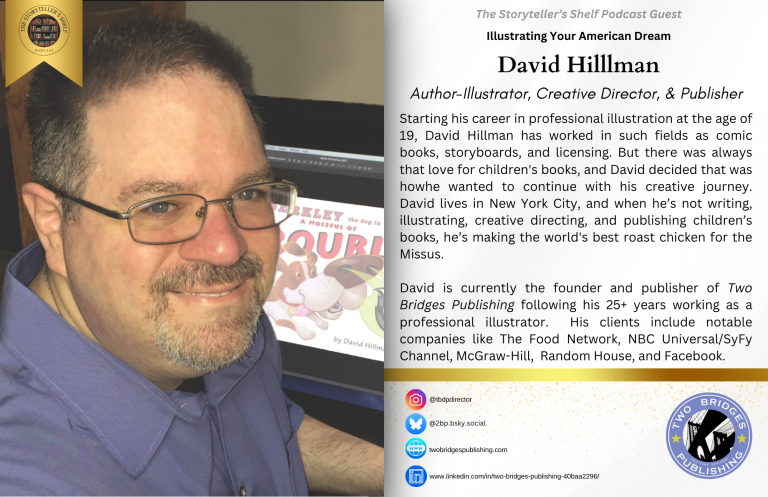
0:45 guest who has turned his passion for art into an amazing career. David Hillman is an illustrator, artist, and picturebook author who began his journey in the world of comics before he transitioned into children's literature. He's also the founder of Two Bridges Publishing, where he continues to shape inspiring stories. Well, thank you so much for coming on today. And to kick things off, can you tell us a little more about yourself and your journey as an artist, as an author? Oh, goodness. Uh, I've been drawing since I was 6 years old. Uh, you guys might be a little younger than I am. Uh, when I was a kid, I used to watch those original Spider-Man cartoons.
1:23 Spider-Man. Spider-Man. My dad would sometimes like do his level best to draw like a Spider-Man for me. I mean, he had he had no drawing ability just like, you know, a little balloon head with some checkered that looks kind of looks like webs. One day I asked him, you know, can you draw me Spider-Man? I said, "Dave, I don't have time. Here's a pencil. Why don't you do it yourself?" And I've been kind of drawing Spider-Man ever since. And it's it's something that, you know, I just took to I enjoyed it. Nobody stopped me. And uh by the time I was ready to go to high school, I applied for the High School of Art and Design in Manhattan and I got in. It was like maybe one of two
2:03 students in the entire junior high who uh went and I went to art and design. It wasn't exactly uh what I thought it was going. I thought it was going to be like, you know, TV show fame, everybody's singing and dancing all the time and temple be like just a regular high school with an extra art class and I was never particularly good and I kind of lost interest. But fortunately, one of my high school friends who's still a very good friend of mine uh was working as an apprentice in an art studio where it was a comic book shop up front and in the back we were learning how to draw comics. So I left high school early like in my junior year. That's where I was
2:40 asked to leave actually and uh I became an apprentice in that comic book studio and then you know we were creating our own comic books and I turned professional around the age of 19 starting out in comic books not necessarily drawing them but doing everything else production uh you know art correction and I end up being a colorist cuz I had an affinity for color as well and it was easier to get jobs as a colorist as opposed to penciling. pencil is very competitive, but you always need a good colors, which is you're literally taking color dye and you're coloring the copies of pages and they put the overlay the word balloons and they print them. So, I was doing
3:18 that for a long for a while and around the mid 80s uh the comic book industry was kind of imploding. So, I wasn't getting work. A lot of companies going out of business. A lot of people I knew were not, you know, not working. So, I had to reinvent myself. Fortunately, it is my early 20s, so I can bounce bounce back easily. So, I was look I was thinking about, okay, what am I going to do? And I think I was looking at like a DVD. You always see those special features like uh that behind the scenes stuff process. There was this thing uh about uh storyboards for film. I was like, storyboards? It's kind of like boats. Okay, I think I can do that. Fortunately, I had a relative who's in
3:59 the film and TV industry. So, I did some samples. has showed to him that Dave I can't use you but you go you know give these to someone who might be able to he was a storyboard artist but sometimes you know if he's too busy he'll give the work to somebody else couple weeks later I got a phone call say hey Dave I can't do this job you want to do story boards I was like yeah sure I'll do it 25 years later I've doing storyboards still doing storyboards or at television commercials and advertising and stuff like that but I got to the point that it was in 25 years pass and pandemic was just about to start and I started thinking I'm not really having any fun doing this anymore
4:39 and storyboards especially for advertising are very disposable. the director and the client see the board and they just kind of toss them away and no one really appreciates them. And I was thinking about you're 50 years old, what are you going to do with the second half of your career? I looked back and I said I don't have much of a legacy here. You know, it sounded more well especially during the pandemic. You have these morbid thoughts. I was thinking you know what am I going to do for second half of my career? What what do I want to be remembered by? And I remember uh my father and I were going to do a ch you know children's books. He was a
5:12 children's book writer as well as administrator in New York City educational you know board of education and but he write children's books and kind of like classroom readers study readers on the side for younger children and we were going to do a project together but unfortunately he passed away uh uh around 96 or so and that never happened but I kept it was always in the back of my head to do children's books and continue that journey that We wanted to start but never did. So I was not working. Fortunately, my wife was still working. She's working at home. And she told me, said, "Dave, we're going to be here for a while. We will be here for a while. I
5:53 think this might be a good time for you to maybe re-evaluate what you want to do. We have the time. We're in a situation where we can get by on her salary. Knock on wood. And uh maybe it's time to like discover what you really want to do." So I took that time to uh revise my portfolio geared towards go picture books and I sent them out to all the usual suspects, literary agents, publishers, directors, etc., etc. And there was no response. You know, I couldn't believe how tough it was to like get a job illustrating children's books. It was much tougher than anything I've ever tried to pursue before cuz I've always had a job. I did the samples. I always getting a job
6:36 somewhere but never happened. I was like, "What the heck's going on here? How come I can't get can't get work?" And it's that was my work is bad by any stretch. So I, you know, I started writing as well cuz I had these stories in my head. And I gave myself a deadline, you know, about a year. So if you can't get in and the gig illustrating children's book within about a year, year and a half, you know, you can do it yourself. We're we live in a great time where you can do these things. So you could self-publish and still and it looks good. It's not like you know the old days where I was doing independent comic books and we had to like know just Xerox copy these books
7:13 and staple them together. So year and a half passed didn't get a gig said I'm going to do it myself. So that's where two bridges publishing was born and then I had three or four stories ready to go. They I had the dummies ready to go. I had found a good editor to help me out and that's really important. find a good professional freelance editor. The first book Berkeley was published and Super Brouses was born and my second book Caleb is coming out in May. My uh ambition is to just put out, you know, good quality books, you know, when I can, you know, even it's just one book a year. That's fine. I'm happy with that. And that's where I'm at right now. But I have to jump in
7:58 just to celebrate what David said because he uses this word reinvent himself. And I I absolutely adore that word. Exactly. You have to do that in this business. And I appreciate you sharing the trials and the challenges of outreach and just attempting to be present and working in this business. And we are in favor of all types of publishing. Anything that gets you to where you need to be, we are supportive of. But that being said, we are really cheerleading for people to find the same inspiration and ingenuity that you did of saying, "Okay, it's not working for me this way. My ex date is a really good time for me to propel myself forward and just keep going and be resilient and
8:41 don't be knocked down." I've reinvented myself so many times cuz you have to be prepared to uh move on like computer coloring. I was hand coloring comic books for a long time. you know, with color dyes and stuff and then computer coloring came into into vogue. So, okay, I guess I have to learn this now. And I did, you know, just you have to be flexible in this business, especially freelancer, otherwise you're not going to survive. Basically, I I've reinvented myself at least three or four times already. I've done it all. I feel like we're speaking the same language because I'm constantly also self-published author here that you are having to learn how to grow and evolve.
9:20 And like you said, if you won't, then you're not going to make it. You won't last. And I I love how you said you have to pivot yourself. So for me, I think that is great advice for for all aspects of the creative side. And could you elaborate a little more about how your experience in creating comic book series, how that prepared you to transition into writing and illustrating children's books? Well, fundamentally the same thing. You know it's storytelling. You can be artist subjective. One person likes one style, the other person likes another style. This person has this ability, that person has that ability. One may look better than the other, but
10:01 fundamentally the common denominator is storytelling. You know, comic books, movies, Broadway shows, television, picture books. It's all symbolism. It's all creating these symbols and putting them together in com, you know, in composition and tell a story. And well first you know I studied film you know while I was studying learning how to do comic books I studied you know mostly black and white films and silent films and stuff like that. It's a great way to learn how to tell a story through black and white films mostly 30s and 40s and stuff like that. I studied that and it's great place to you know cut your teeth because you got to learn how to draw everything. You got
10:41 to learn anatomy, lighting, composition, perspective, fashion. people got to look like, you know, what they are in the modern day or whatever period, you know, you're drawing. And and that's why I was able to, you know, transfer from comic books so easily to storyboards. It's the same thing. It's totally the same thing. And storyboards are even easier because there's only so many camera angles you can use. But nowadays with CGI and stuff like that, you can go crazy, but it's it's a lot simpler than comic books. And you don't even have to be that good to do storyboards. You don't have to be that talented. As long as you know how to tell a story. And the same thing with
11:18 children's books. Even more so is you got to learn how to tell a story through pictures. Especially the audience say from like ages 3 to five. That's what they're going to understand. They may not even be able to read yet or the grasp of reading may not be as advanced. So you got to learn how to tell a story of pictures and then and that is common denominator. So you told us what was the same for comics and picture books, but I would love to know what is different in terms of illustration and writing when it comes to picture books and comics and what did you have to learn on the way that you did not know before? I've never written a comic book. I never
11:58 really written a story that, you know, it was always somebody else's job. I just followed script. But now I realize that if I wanted to publish my own books and illustrate my own books, I was going to have to learn how to write, which to me is the toughest part of the creative process, hands down. I know writers who can churn out dozens of stories in a month and it takes me months to do get one right. And it's not so much the dialogue that's that's that's easy. It's the actual story itself. It's the, you know, the beginning, the middle, the end. and learning the, you know, I hate to say formula, but learning uh how to write the beats that go into a picture
12:40 book and and not write something that would insult any child, too. And that's tough cuz I don't have kids. So, I'm kind of like kind of guessing at it. And so, I had to learn how to write. And I've gotten better at it. And I wanted to start doing more complex stories. And it wasn't easy. It took me years to figure out how to write, but now it's getting a little easier and I understand the formula for lack of better words. It's it's a work in progress. It's muscle. I had to learn how to flex. Drawing is easy for me. You know, I could, you know, sometimes I'll, you know, I'll sketch out the story first and then add the dialogue. So, that was tough.
13:17 Learning to write for children is a whole other beast. And it's that balancing act as an adult, like you said, to make sure you're writing something that's engaging, but it doesn't insult them in terms of intelligence. Kids are a lot smarter than you give them credit for it. You know, you really are, and they pick up on things so well. A very good editor who's extremely experienced. She was writing for Disney Hyperion for 20 years. She was an editor there as well. And uh she just started freelancing and she self-publishes as well. And she's great. So that helped a lot and she she taught me a lot. You know what goes into a good picture book story. So again it's it was tough and it
13:56 was frustrating cuz there's a lot of self-doubt. It's like I don't know this this could suck. Yeah. This does suck, you know, does not suck. Am I insulting a kid's intelligence? Am I salulting my intelligence? Is this something that I want to read as a three-year-old? Since I don't have kids, the only frame of reference I have for children is me as a child, you know? So, I have to remember what it was like to be a four or five year old enjoying a, you know, a children's book. What's the ones that I enjoyed? Let me ask you, you mentioned that you have to learn the beats to writing a picture book. Could you tell us what are the beats in your experience?
14:32 In my experience, well, uh, good hook. Start off start off strong. This is kind of like like a roller coaster. someone told me once and uh you know you start off strong with a good hook and you don't you don't uh beat around the bush. You just go straight to the story. You go straight to the problem. You introduce to your character. You find out what the character is all about. You figure out what the problem is and then how to solve it and there's some sort of discovery about themselves and then there's the ending a beginning, a middle and end. So those are kind of the beats. Sounds so simple, right? But it's not that simple. It's not that simple. Yeah. Someone
15:07 broke it down for us. Wow, that's that makes sense. Yeah, I am inspired by the fact that you have your own publishing house. I think that is fantastic. Especially as an artist, you know, an author, illustrator, all of it. As a creative, you want to be able to have that control. I think that's just in our genetics as creatives. Yeah. I don't take, you know, I don't like people telling me what to do. I'm at I'm at age like, don't tell me what to do, punky. I got socks older than you. Yeah. I love it. What inspired you to create your own publishing house? create a control or where did that come from? It came from like I said, no one was hiring me and I wanted to tell these
15:44 stories. So, the only avenue I had available was to create my own thing. And I've been a freelance illustrator for almost 30 years, doing what everyone else wants me to do. And there's nothing wrong with that. I've had good jobs. I've had fun jobs. And I've had not so fun jobs. But in the end, the common denominator was like people were telling me what to do and what they wanted. And it's gotten to the point where I'm at an age where I want to do what I want. And fortunately, I'm in a position where I can't. Another key thing is having a really good support system. I know I'm kind of segueing a bit, but having a great support system. Fortunately, I
16:21 have my wife who's very encouraging and she lets me do what what I need to do to get this going. And she's been great. I I' I'd be in the tall grass without her really. I'd be in the weeds. That is I'm very lucky to have that. So that allows me to do what I want to do after all these years. And that that's also something very important to have if you're going to do this. You know, you can't do it. You could do it a lot of things by yourself, but there's some things you just can't just you you need help. Yeah. And you need someone to be there and support what you're doing. It helps a lot. Plus, it's a lot of fun to share those triumphs with somebody.
16:58 Yeah. I mean, I'm sharing with everyone on social media, but it's it's not the same. David, can you walk us through a typical day? Day in the life. I usually get up early in the morning, help my wife get uh ready for work. I take her to the bus. She goes, I go to gym for about an hour, get some breakfast or make some breakfast, come back here, clean up, and uh there I start my day. And my day could vary illustrating the next picture book or maybe doing some freelance on the side which I still do but I pick and choose now freelance you know assignments. Uh there's a lot of again it's just me so I'm doing a lot of other stuff say like getting a newsletter
17:42 outdating my website soliciting my books to whomever I need solicit them to social media which is a huge portion of my day trying to let people know what's going on. But if I'm doing a book, I usually I try to get a book spread done at least every three days. I work in Adobe Illustrator pretty much exclusively now. So I try to get one at least every 3 days. Sometimes takes longer. All depends the complexity of the page. And after that, you know, I start prepping dinner, stuff like that. I pick up my wife. Uh we have dinner, hang out, job for a little while. She goes to usually goes to bed early and I do a little more work and I'm probably in bed around midnight or so. and rinse
18:23 and repeat. It's pretty mundane life. It's pretty I'm so boring. It's okay to take a day off and not do anything. Or there's some days during the week it's like I'll just go sit and watch a movie. And fortunately I have that luxury. Uh there there are days where it's okay to take a break, you know, especially it's a nice day, go walk, go to museum, something you need that break time. Yeah, exactly. That should that that needs to be words of wisdom for all creatives to know. It's okay to take a break because you have to recharge yourself. When I was young, yeah, when I was younger, uh I can work like 12 hour days, weekends, holidays, stuff like
19:01 that, and I then go out and hang out with my friends and go to movies and come back and do a couple more hours afterwards. But, you know, you reach a certain point in your life, you're like, I can't do that. That's why that's why I kind of got out of storyboards, too, cuz a lot of it's like these really tight deadlines. You're working weekends. You got to pump out like 70 frames over the weekends. It's like, I can't do that anymore. and like keep my sanity. You know, it it's very stressful mentally and phys drawing is a very physical thing. Oh, you just sit there and draw. No, it's a very physical activity creating a piece of illustration. And a
19:32 lot of people don't realize that and it's a lot of physically, mentally draining work when you come when it comes down to it's work. A lot of people don't realize that like, oh, you do that in 10 minutes. Yeah, but it took me 30 years to learn how to do that in 10 minutes. Yeah, I think that's Yeah. something that a lot of people don't realize that the uh mental and physical exhaustion that comes with it and that actually is one of the questions I was going to ask you is one of the biggest challenges that you might face like what what would you say is there like one or more than one challenge that you owning your own publishing house what would that be
20:05 promoting myself I'm a bit of an introvert and I don't like being upfront but in order to make the connection between the the work and the person that you know If you're up front, that makes the work more personable. You know, see that there's someone behind this. I've never been like the front man. I see sometimes I see what comic books is is like a band. When I was doing comic books, you know, there's the drummer, there's the guitarist, bass player, keyboard, and then there's the lead singer. I never wanted to be the lead singer. I wanted to be the guy in the back playing the drums and the bass was keeping the rhythm. And uh it's that's a challenging part like being
20:43 being upfront and being a performer lack of better words. My dad was a teacher for a while and he hated it. It's like you know he equated being a teacher to like being a stand-up comedian, you know, at, you know, open mic night at 3:00 in the morning in a bar in Ohio and you're being heckled by 30 or 40 really mean drunks. He said, "I never want to do that again, but that's why he he became administrator." And it's like, yeah, I understand that. I get it. Yeah. And I really didn't want to be upfront. But because I'm the publisher and owner of Two Bridges, I have to be. So that's that's a big change. I'm the lead singer now and the roadie and, you know, the
21:22 production manager and bus driver and, you know, the craft table guy and I'm everything. David, I think like this this profession in general tends to attract a lot of those stereotypical introverted, quiet, cranky people and I'll admit we have more than just you here that fits that profile. Absolutely. But because you've you work on this every day, like you said, you've had to become lead singer and every other part of the band to make this work. Can you give one way that you can sort of go past your comfort zone daily to help you support your either authorship or being an illustrator? Like I said, just just having to be upfront and especially when you're
22:04 freelance illustrating and there's nothing going on and you have to basically beg for work and you're constantly emailing say, "Hey, I'm Dave. This, you know, you got anything coming up?" Blah, blah, blah. Fortunately, I just signed with an art rep, uh, Jones Book Art Rep. And yay. and uh she she does a lot of that now. And I've worked with art reps all the time and yeah, they take a percentage and that's fine, but they earn it because they're doing all the contracts. Uh they're making all the the inquiries and you know, the queries and stuff like that. And that that helps, but like I said, being a self-publisher, you you got to do it all yourself. You got to like email, you
22:40 know, 500 bookstores and hopefully one of them will pick up your book. And that's very it's that's discouraging especially you know like you said I spent I think we were talking about this earlier I spent a lot of money last year to promote my first book and nothing happened unfortunately I sold less than like maybe 30 books and that's very disheartening cuz you put your time your energy and your passion into these books and I know I'm I'm putting out a quality product. I could see my, you know, I could see a book of my quality being in a Barnes & Noble or any bookstore in the world, but uh, you know, it's just very tough to get your book in front of
23:17 people. So, you have to do things that take you out of your comfort zone, like being upfront and going to bookstore managers with your book and try and sell it. Thank you for sharing that because sometimes it feels a little secretive, especially for people who are in the self-publishing game. They see what they perceive as success from other people who are publishing. Yeah. But there are stats or data coming out only sometimes. So to hear, okay, this is my first book. It was a quality product and I only sold this amount. That's actually really great for people to know because like you said and Teresa and I discussed this at Nauseium on this podcast, but you can be the best at
24:00 everything in this business. And a lot of it comes down to creating your own opportunities, going out of your comfort zone to be in the right place at the right time with right people. And these are all things you can learn to do, but it takes some time. And it usually doesn't anything to do with the quality of what you do. No. And unfortunately my p I'm not particularly a patient person by any stretch because I'm a New Yorker, you know, immediate gratification. Yeah. I don't think it's even like so much as like good or bad. It's what what's trending. It it there are trends. I mean I mean there's one agent that told me, Dave, you know, I like your stuff, but I
24:36 wouldn't be able to sell it to like a publisher cuz you just don't check in the boxes. Like okay, whatever those boxes may be. Understand that it's about trends, too. if you if your book doesn't fit a certain trend that's at that point in time, they'll pass you over. And I, you know, it has nothing to do whether it's quality or not. So, I I learned that the hard way, too. So, that's another reason why I went the self-publishing route because I'm going to tell the story that I want to tell, trendy or not. And I think the difference between trendy and what I'm doing is my books will last 50 years from now. Long after I'm gone, my books will be will still be there and they'll
25:13 still be readable. I mean, how how many books uh came out during the 5 years of the pandemic about the pandemic? You know, this that those kinds of books only has so much of a shelf life. My books will have an ongoing shelf life long after I'm gone. And I think that's the difference. And that's how I approach my storytelling, my writing. What's going to what's going to have a shelf life? You know, that's I haven't done like a holiday book or anything like that cuz this only like a holiday niche window. when you put out a Christmas book, it's only going to sell Christmas. That's it. So, I try I tend to avoid those and I just try to write stories that be timeless. You have to uh
25:54 keep that in mind when you're approaching a story. It has to be timeless. Good Night Moon, uh Mattaline, Eloise, these books have been on the shelves for decades. And that's I think you have to approach it. My book needs to be on shelf for decades. And that's how I say that's tough. I've I've had to learn I've had to learn patience, too, you know, and that wasn't easy at all for me to be patient. And I sat myself down. I said, "Dave, you're playing the long game here." You know, this is not just put out a book and you'll sell 100,000 copies. Now, this is going to be, you know, what you're going to be doing for pretty much till you can't do it anymore. I'm 56. So, I realized that my
26:35 shelf life is a little less than it was behind. So, I sound more of it. That's true. And if I'm if I'm lucky, I got another 30 years of like lucid, you know, creativity. As long as my as long as, you know, here and this work still works. I want this to succeed. And like I said, there's it's tough cuz there's a huge glut of picture books. Like I said, it's it's easy to publish now. Anyone can do it, but everyone has been doing it. Everyone has been doing it. And like I said, there's like pretty much 98% of what's out there is not ready for prime time. From my personal perspective, from a professional perspective, like I've been doing this 30 years, I know good
27:13 illustration from bad illustration and good storytelling from bad storytelling. And all I see a lot of, especially on Amazon, KDP, it's great, but it's also uh it doesn't discriminate at all. So, anyone can do it. And it's tough to get your your book that you know is quality to get above the noise, the blossom and Jessum. It was a lot tougher than I thought it was going to be. I guess everyone realizes that after a while. I'm going to contradict myself. I usually tell Teresa all the time. Be patient. Be patient. It's that kind of business. You just have to wait. You have to forget about things after you do them and come back to them like a year
27:51 later. But just one time, I will admit, okay, a little impatience can do you well. It can be your impetus to trying to chase those goals. So Teresa is laughing at me right now for people who are listening on audio that I give her permission now to be a little impatient because I did David well. Hey storyteller, you know what pairs perfectly with a great podcast. A great cup of coffee. Set the mood with us. Sip something bold or cozy with free rain coffee. When you grab a bag through our affiliate link, you're not just fueling your day. You're helping us keep this podcast sustainable. And even better, with each purchase, Free Rain Coffee gives back, supporting charities like
28:34 the Special Operations Warrior Foundation and others that stand behind first responders, teachers, and veterans. So, go ahead and join us as a storyteller and a change maker. I am going to put us in another rabbit hole, okay, to get along. Okay. I would love it if you could speak as an illustrator to our new emerging authors. So, pretend you have in front of you someone who is very new to the business. They want to self-publish. They're an author, so they know that they have a finished manuscript that's ready to move on and be paired with illustrations. Could you tell us what the actual illustration process is as soon as you get that manuscript? What happens next?
29:17 Well, what happens next is we start discussing about what the main character is going to look like. uh what they have in mind of course and then I'll start doing some rough sketches of the characters that can go around for you know a couple you know a couple passes once that approved then you know I'll read the manuscript and I'll start doing uh rough sketches thumbnails really and I'll show the thumbnails to the client and then we talk about it I'll do start doing some roughs which are more detailed sketches a little bigger you know you know about uh pass size of a printed of a regular page may maybe printed size and do I do the roughs based on their manuscript and
29:59 then we go for like a round of revisions again then I'll start tightening things up and then I'll start doing tighter drawings and once those are approved then I'll move on to color roughs and from there once those are approved then I'll start doing final illustrations and uh from there they probably get about maybe like one more round of revisions if they want That's why I like working uh digitally in Adobe Illustrator. Very editable and I work in layers and things. I can move things around almost like color form. So, you ever play with color forms when you were kids? And uh you know, I can move things around, you know, any way I want. I love
30:36 it. And so, we do one more of those and then I hand in the uh final files usually like either PDFs or JPEGs. And dep I don't know depending on what the author wants to do they want self-publish because uh if uh if a writer wants to solicit a agent or a big publisher they'll assign an illustrator to the story. So with independent authors that's kind of how I work. Let me ask you about text. How do you use fonts? I usually go with Roman time. It's pretty easy to read it. It's big text. That's simple and I try to be consistent with those throughout, you know, all my books. You have a publishing house and let's say somebody is considering, you know
31:18 what, I'm going to go that route. I'm going to make my own publishing house. What is one piece of advice that you would give them? Have your stories ready to go before you start. Have a publishing plan. I had them stories ready to go. I had the book done dummies ready to go. And I have two more in this phase. I sort of call it phase one. Phase two. After phase one is done, I'm going to take a year and start writing some new stuff while those first four books will be in circulation and I'll start writing again. And like I said, it's just me. So, it takes a little takes a little more time and I'm okay with that. It's it's quality over quantity as far as I'm concerned. So, u
31:56 uh just have a plan. Have something of a plan, you know, and just make sure when you name your your publishing a company, make sure no one else is taking it first. I did that first in New York. Uh you can see if uh no one's taken that name yet and then I copyright it to Bridges Publishing. There's there's a way to do it in New York. There's a like a you can register your name as a business. So I did that first and just have have some sort of like game plan. Even if the game plan like goes off the rails, that's okay. You you improvise that and then you stick to some sort of plan. Okay, David, tell us what is coming next for you and Two Bridges.
32:36 What's on the agenda for the future? Well, like I said, Caleb's coming out. I'm going to promote that. And I got to catch up on some freelance stuff uh next month or two. I also do licensing art. I which is like I create artwork of a product. Let's say like Christmas cards, party goods, stuff like that. I have to catch up. I I got to do some new stuff cuz my rep has been like pounding me for new work. And so I got to do that. I got to catch up on that. I got a couple freelance gigs lined up uh next month or two and around end of May I'm going to start my next book which is called another star and um that is about a young boy who's interested in astronomy
33:14 uh who runs into a friend from another star well through his telescope and after that I have one more book in phase one called clown who ran away from the circus to join a home and that's kind of autobiographical difficult actually cuz when I was 18 I ran away and joined the Big Apple Circus as a remedy and I did that for a summer and I spent the whole summer going up and down the East Coast putting up circus tents and taking them down being an usher. My friends were clowns and aerialists and stuff like that and it was a five-month tour and by the end of the tour all we wanted to do was run away from the circus and join a hall. We were so burned out. It was it was it was
33:56 grueling. It's like uh boot camp and summer camp for adults. And it was fun when you're 18, but you know, you burn out after a while. And it's about a little little clown who's raised who comes from a family of clowns who doesn't want to be a clown. So, he runs away the circus and joins a home. And you know, it's like look a house with no wheels. This is great. And that's the fourth book in phase one. And then after that, I have ideas for phase two. And I got to start kind of like, you know, just jotting down ideas and I just keep going at it till I can't anymore. Would you would you give us a little overview of Caleb for people who aren't familiar?
34:33 Caleb is about a tiny little dinosa, you know, dinosaur whose arms are really small and he's really frustrated because his arms are small. He can't play sports. You can't swing a bat. You can't toss, you know, can't throw basketball. And try riding on a chalkboard when your when your hands are like, you know, so tiny. You got to do this. Yeah. And uh but one day feeling for sorry for himself he discover discovers a dance studio queen in the music and he starts dancing. You ever seen the film Billy Elliot? Yeah. It was inspired by that and uh he discovers his love for dance and uh yeah I don't want to spoil it so that's where it is. Thank you so much David.
35:12 Thank you guys. You guys have been wonderful. your whole journey and is such an inspiration I think for all creatives out there and that like I feel like the motto should be never give up no matter the highs the lows you just keep on going keep on tracking your work is incredible and thank you I appreciate it it's been a long road like I said it it's a skill you practice it's like being a basketball player you know LeBron James spends 30 hours in the gym doing layups every day between games and he's good because he practices, you know. So, it's same thing. You got to have the spark for it. You got to have the love, you know, but love will only take you so far and you
35:58 just have to practice your craft like anything else like singing or playing the piano or, you know, playing the drums or whatever or dancing. Find yourself. It's a spark, but it has to be cultivated. Like any good plant or vegetable, it's feed it and let it grow. I like that. So, could you share before we go uh what keeps you inspired? What keeps you going? Fear of being destitute. I don't want to sleep under a bridge. You know, basically that's I've been a very bluecollar kind of freelance illustrator. Drawing is what I'm good at. I'm terrible at anything else. It's either like drawing or customer service and that's it. It's basically it's about survival. A lot of
36:38 my comic book colleagues are very bluecollar. They're like they get up, they do, you know, they try to get a couple pages out a day and you know, then they, you know, spend time with their family and watch the ball game. That's the kind of how I grew up in that in that generation of like we're not rock stars. We're just like working people who are trying to support our families and this is how we do it. We are working people. A lot of people don't realize because you just read the book at the end of the day. They don't really remember or know or are even aware of how much work daily for perhaps even years goes into the creation of a book. Yeah, I I was in the bullpens and we
37:14 were constantly two weeks behind deadlines and we worked days and nights and stuff like that. It was grueling. I learned a lot but it's grueling, you know. It's work. Yeah. When it come when it comes down to it, it's work I enjoy. it's work uh that you know nothing there isn't anything else I'd rather do but in the end of the day you know you know I want to like enjoy my life as well I got you know things outside of drawing of illustrating so I try to keep in perspective the life work balance is really important can be hard to find that balance but I think if you have a talent and not to go too philosophical but a purpose in life you often feel like I
37:55 can't really do anything else this is it and you're just called to keep working on it and to keep improving and then eventually to just work in that sphere 100%. That's what I'm feeling happened with you and I'm sure a lot of people are going to connect with that. I feel I'm the luckiest son of a gun on planet earth. No, no kidding. I feel I wake up every day and I get to do what I want and 99.9% of the time I really enjoy it and there's nothing I especially now that I can do what I want and there's this wonderful feeling of freedom being able to do that and I am so fortunate to be able to do this and I try not to take it for granted. I'm so fortunate I have a great support system
38:36 like I said you know having that is half the battle. Well, David, we are the fortunate ones today being able to sit down and have a conversation with you. I'm so happy you guys invited me. You know, like I said, I don't get out much, so I I don't get to talk to talk to like-minded people too often. And make sure storytellers to listen again for our next episode of the Storyteller Shelf podcast. [Music]