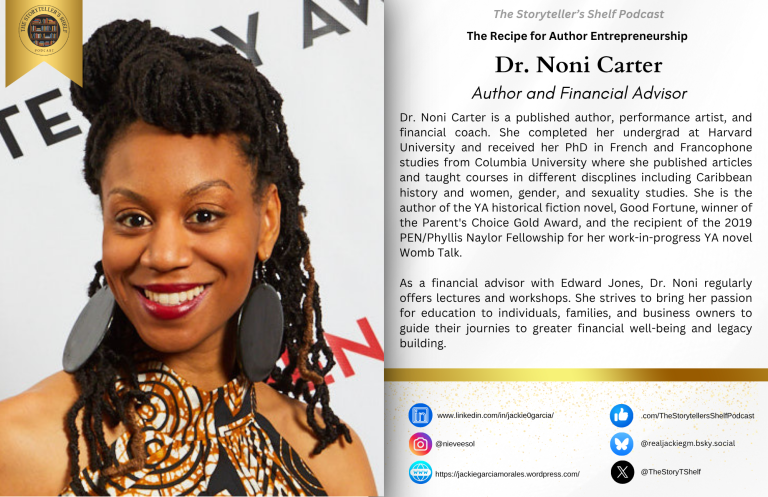
Dr. Noni Carter
This transcript comes from the video’s automatic English captions. Names and wording may contain errors. Timestamps open the recording at that point. References to events and offers reflect the time of recording.
0:00 Hey storyteller, you know what pairs perfectly with a great podcast? A great cup of coffee. Set the mood with us. Sip something bold or cozy with free rain coffee. When you grab a bag through our affiliate link, you're not just fueling your day. You're helping us keep this podcast sustainable. And even better, with each purchase, Free Rain Coffee gives back, supporting charities like the Special Operations Warrior Foundation and others that stand behind first responders, teachers, and veterans. So, go ahead and join us as a storyteller and a change maker. [Music]
0:48 Hi storytellers and welcome back to the storyteller shelf podcast. It's Jackie and Teresa and we are here with another exciting episode, the recipe for author entrepreneurship and we're here with an amazing guest, Dr. Non. And like is our tradition, we're going to pass the baton to her so that she can introduce herself to you all. Thank you, Jackie. Thank you, Teresa. I'm so excited to be here. I so miss talking about all things books and entrepreneurship. So just excited to be here. A little intro uh to myself. So I am I do a lot of things. I wear what a lot of hats. I call myself a multi-hyphen it as a lot of us entrepreneurs do these days, right? I'm
1:28 a published author. I am a performance artist, a scholar and I could talk a little bit about that. my academic background. That's where the doctor comes in. And then also a financial adviser and I really love working with authors and illustrators in this world to sort of teach about money and things that we don't necessarily learn in school and elsewhere. So that's a little bit of me and I I I can dive into a little bit of each. Um, well, before we hop into our questions, I'd love it if you could just tell us a little bit more about that scholar side of you and explain maybe a bit on how you got into writing. Let me just give you the whole background because somehow someway it
2:08 all ties together. People don't believe it, but it's true. So, I've always been a writer at heart. I was one of those eight-year-olds who was publishing sto trying to get my little, you know, short stories published. And it helped me, the way that my brain worked when I was younger, writing helped me process the things that I didn't quite understand. And that might have been like externally history and the world, but also internally like what was going on and how I felt different from others and that sort of thing. So I actually started writing my first novel, which is behind me, Good Fortune. It's a historical fiction slave narrative. And I I remember being 9 years old,
2:44 listening to my great aunt tell stories of our past. And one in particular really caught my attention of this woman must have been in uh somewhere in Alabama during slavery in the United States. She remembers her mother being sold away and her mother told her when you no longer see this handkerchief floating in the wind. Know that your mom is gone forever. And that that hit me so deeply. I remember reading books at the time of this history. And so I started my journey really young. I must have been 10 kind of just exploring this world, researching, reading, learning. And then at around 15 when I had done maybe like two drafts of this book, my father saw it and he really encouraged
3:22 me to sort of really think about myself as an author, not as an author in the making, but like you've written a book and it's a good book cuz I've read it, you know. Um I randomly ran into Kwaami Alexander who not everybody knows his name, but back then I'm not even going to say but I'm sorrywami if you hear this. Back then I actually met him at a music event. It was a music retreat for my little sister who we're all musicians but she was really wanting to perform and everything metwamiwami saw me just off to the side my nerd self writing he's like what are you working on and I told him this was this book that I had written and so he encouraged me to make a galley out of it
4:00 we went out to the book expo of America and um all you know everything went really fastpaced from there so that was my really early journey I was 17 I believe at the time when the book was picked up so by the time I hit college, I was at Harvard and I had I had this book on hand and I had this opportunity to just travel around the world around well the world I was going to say the country but had a chance to really speak about the book in a lot of classrooms. So that was my early journey into writing and um man I could tell you many stories on you know I stopped writing for a while when I was in academia I was doing a French program in literature and
4:35 history at Colombia. I went to an event wherewami was winning an award and he called me up and he called my uh the old vice president of Simon Schustster up Ruben Feffer and we reunited. We sat down for coffee the next week and Ruben was like why are you not writing like so that was the birth of my my next novel. So that was my trajectory in my journey and um I can kind of talk about where financial planning came in but as a writer that uh that's been that's been my journey. That's amazing. I love it because we have a lot of different people who come on this podcast from different backgrounds. And one thread that I see that tends to pop up a lot
5:14 and Teresa might be smiling because I think she knows what I'm about to say that we all have that writing spirit in us from children. So from childhood we have this spark to create and we were writing something and it kind of seems like we end up meeting someone who is really instrumental in encouraging us or motivating us to move forward. I got to get back into the game because I just had so many divine moments, so many amazing people who encouraged me and let me know that I'm also like a big voice in this arena. So I'm on this podcast like uh we need to start writing again. What are we doing? I love it. I hope that we are giving you then a little
5:54 dose of that spirit again and we're excited to see some more from you. But let's take a step back and let's talk a little bit more about melding business and authorship together. So being an author is a creative pursuit, but it's also a business. So how can authors really shift their mindset to embrace the entrepreneurial side of their craft? It could take me hours to answer it. Maybe I'll pick two angles. I'll talk about myself in my journey towards that answer. And then I'll talk about kind of how I'm coaching authors to think differently about their work. For me, I've always had the kind of brain that needed both the creative and the practical, but I didn't always know
6:36 that. So, cuz I I also grew as a pianist. I thought I was going to go to school for piano. And integrated into you learning that is the practical and the creative. Like, you have to be there practicing. But I didn't really realize that. I had fantastic, you know, family members who always told me, "Focus on your passion, the money will come." And I think that that's a really interesting and encouraging way of thinking about things, but I don't think it's fully accurate. And I don't know if I'm going to teach my kids that, right? Um, and I knew like even leaving academia, I was in a room, loved the literary scholar hat that I wore, but it also felt like
7:10 there was a lot of bouncing ideas off of glass walls and I wanted to have a practical hand in the community. So for myself just leaving which was a terrifying experience leaving academia going down the track of being a professor and then it's like you know what I think I want to be an independent entrepreneur I want to be on the ground and make a difference and the the financial side of things which I'll talk about my background with that had already been there you know I'd already been working with individuals off record and so I just had people that kind of led me on the direction and said this is something you're really good at why don't we see if we can make this work so
7:44 for me it was just a terrifying transition to think to myself and realize this practical side of your brain has to come out if I want the creative to have a place in my life and not get lost in it. If that makes sense. So, it's taken and now I'm I've been in this industry for a little bit. Now that I'm coming back to that that nice balance between the two and it feels amazing to be able to have you wear both hats, you know, if that makes sense. Come to think of it, I So, I'll tell a little bit about my story and then I'll get to the other side of the answer. So, same story. When I published my first book, I received what I thought was a pretty large advance at the time, right?
8:18 And um I had I won't mention who, but a person really dear to my heart took the advance, managed it for me, told me, "Don't think about the money. We argued about this. Don't think about the money. Let me do this." You know, best of intentions. But when I say that money was gone in a very short period of time, I realized very early like there's something missing here and I want to explore this industry and understand what it is. So aside from my studies on my own, I was doing day trading and trying to figure out how markets worked and how the full comprehensive picture worked. And then I started managing friends and families portfolios and helping them budget. So that had always
8:56 been a part of my language. I just never understood that I could actually integrate it into a career as a creative at the same time. So Teresa knows I love working with creatives to sort of um even those that tell me this is not how my brain works. It doesn't matter. Like there's always a creative way to think about the practical and integrate that into our lives. And I think it's really important to know that if we want to, we can absolutely wear all of these hats. You know, it's something I do and it's totally possible. I remember the conversation that we had where money is not a bad word and that you have to use it and use it as a tool to help to
9:32 better your writing. And many of our listeners who are authors, who are illustrators, they're trying to create a brand. So what are some of the key steps that you can think of that help to establish that brand especially in the kid lit space? I think the core and this is someone who has had a brand is rebranding. I've been through all of the phases and I'm in the middle of doing a website revamp and everything. I think the core thing is trusting the voice that you have and making sure that you're unique and that's scary because what we have a tendency to do is look at everything that's working. Right now, middle grade doesn't feel so hot, but you never know if you're that Harry
10:09 Potter story that's going to break through. So, I think there's a balance when you're creating the brand at yes, understanding the trends, understanding what's happening, but also being true to the voice that you have because you could be that person that moves us in a a different direction. And that can happen very fast. We've seen that in the literary world. So just, you know, again, understanding what's there, understanding what's happening in the literary market, but trusting your instincts, and trusting the unique voice that you have. Um, I was also listening to the creator of The Lazy Genius, and I loved something she said. I'm going to misquote this so apologies. But she
10:45 pretty much said like sort of as authors have to do the work to understand who our audience is and speak to our audience in a certain way, not be afraid to put ourselves in those rooms and have the conversations and build the connections so that we have individuals who are listening when it's time to put that work out there. So I think that that's important as well. And then I'm always going to come back to the money side of things. Teresa, as you said, not just as authors and creators, but even in the world of academia, I think that we're taught to somehow have some kind of shame around having money, which leads to not being able to manage it
11:20 correctly. And I am the first person that will tell you as a person creating your brand, just making sure that you're surrounding yourself with little tips and tools that'll help you manage things correctly. If that means creating a marketing budget, instead of just throwing all your money at a project, create a budget right up front and tell yourself, "This is I'm only spending this amount in 12 months." I see a lot of people get in trouble with that. They get excited. No. When the when the money runs out, then we turn to our creative brains to figure out another way to get in front of the people we need to get in front of. So, not forgetting the little
11:55 tips and tools. And that's sort of something I coach my people to do. So, you know, feel free to talk to me to sort of figure that out. I'm just going to put that out there. Dr. Ni, you keep saying turn to the creative brain sometimes like we have a little friend on our shoulder that's going to help us out. And I love that because I think it's really true. So, I want to ask you as both an author and a financial adviser, you have a really unique perspective. How have some of your experiences as a writer influenced your approach to entrepreneurship and the other way around? one answer that comes right away. Part of why I spent so much time in academia is because I truly
12:30 believe what I'm about to say. I spent a lot of time, especially in my dissertation, with afroofuturist writers. And um just a plug, I actually explored 18th century scientific work through the lens of afroofuturism. I say afroofuturism, but just science fiction of today who are asking similar questions. I firmly believe that we are creating. It's our job as creatives to imagine something that does not exist or that might have been resonant in the world prior to like indigenous knowledge and that kind of thing that we can remember in ways that this world would call futuristic. I think that that is in every form and fashion of how we move through this world. I think imagining
13:12 new futures is how we get there. And I think that that can be done practically in a lot of areas of our lives. And so to me, that's how being a writer, my ability to because I love writing speculative fiction as well as historical fiction. I think the two go together very well. But just thinking about both past and future and how it can inform the way we make initiatives that can change the world today is paramount. And it's the creative side of my brain that I think helps me get into that mindset in whatever I do. And even on a, you know, on a granular level with my clients, I don't always tell them that we're doing this, but I'm we're always thinking tomorrow. Like, how do
13:53 we create a today? Not to just get past what you're dealing with today, but to build what it is that you're trying to see for tomorrow. That's huge. And I really think it's my right, the writer in me that encourages me to think that way. Um, and then vice versa. I I think I've learned how to become a better writer by moving in the world of entrepreneurship, in the practicality, in my relationship with people, in the necessity of just getting things done, right? Like you can get lost on page and just linger forever, but it's a way to say, listen, there is a is a structure to this. This is a business. As a writer, especially if I want to make money and win awards, this is my
14:32 business. And so I need to sort of apply the practical sides of myself, of my brain in order to get it done. So yeah, that's just me thinking that both of them can speak to each other in the different arenas. I like that you speak in both formats, the creative and then you also have the financial. And then you also were talking about um how you have to think like an entrepreneur. I think that works with anything regardless of if you're a writer or not. Uh, but obviously we're all writers in this room and with that being said, there's something that I feel like, like you said, there's a stigma behind the idea of the money side. But what are some steps that
15:17 authors and illustrators need to take in order to better manage that financial side? I think that that mindset of understanding there's these two sides can be applied to everything including writing and then including the finance side and I love applying creativity to finances because especially when you're fearful of what's happening in the market it's necessary to get us to the next step. Um so I just wanted to say that bit of clarity there steps that authors can and should be taking. I think that there's a lot of fear around some of the simple pragmatic things that somewhere in the back of my our minds we say we can and should be doing your
15:55 budget. Not to tell yourself to stop spending necessarily, but just to get clear on where your money's going. Because again, if we're going to apply our creativity to our financial world, we have to understand and get organized and see the numbers and be unafraid of seeing the numbers. Another thing, I should have said this first, is I'm a big mindset person. Um, and I think being a mindset person means understanding and coming to terms with your emotions that surround certain things. A lot of us have narratives around money that we don't even realize exist. So, step one, if I'm going to back up, is really becoming clear as writers about the narratives that
16:32 surround money. Like, what's your first money memory? Is it painful? Is it joyful? What are some of the habits that we formed that may or may not be applicable and helpful or not helpful to the way that we carry ourselves when it comes to finances? Okay. So then budget, understanding, organizing yourself around the numbers themselves, right? Getting clear. We've talked about little strategies that I have along the way for non-traditional forms of income. So, if you know you're in you're getting income from royalties or advances or that kind of thing and you you don't have a nine-to-five job, there are ways to come up with structure even still, right? To
17:09 make sure that there's some consistency. Maybe that means paying yourself a certain amount each month at salary and then organizing the rest based on whatever you're dealing with. So, there's that. Being creative with the way that you're paying yourself. Debt management is big and it's also not as scary as it might sound. So again, understanding the numbers so that we can clear out the debt and start building and growing for that wealthy version of yourself, you know, that exists in the future. So a lot of people I think we tend to look at our expenses, especially as writers, and we we put paying ourselves first on the back burner. That is essential. Moving that up to the
17:47 front burner, right? and saying, "Even if it's $50 a month, let me make sure that I'm growing something." Whether that's for my nest egg or for my future business, whatever the case may be, I wouldn't underestimate putting aside just a little bit to save for the future. I will say one more thing. I know I'm just throwing out a lot, but I know a lot of us, we might win an award, right, or a fellowship, right? When I won the pin, there was money associated with that. And that's going to happen for any of us that are out here in the writing world. Having a plan before that money comes is essential. standing. We're not taking this money, right, and
18:19 just using it to pay off bills. Coming up with the plan, what is it? Is it a percentage method, right? Do we break it down 25 25? 25% goes here, right? Understanding that before the money starts coming in can really help us create habits that make sense. Let me jump in here with a little plug for us. But if anyone's interested in potentially winning awards, the Storyteller Shelf podcast has two awards out. one for picture books for self-published authors and one for emerging illustrators. And you will get a tiny cash prize courtesy of us. And we'd love to see your work. So, please check it out. And then you contact Dr. Non, and she will help you with all the
18:57 details behind that. Perfect transition. I didn't set that up. It was perfect. But you know what? You mentioned the golden word, which is budgeting. So, I would really love to take us into the mindset of someone who is a self-published author in which they are wearing just as many hats as you are. They have a million things going on. They are their own team. They're their own publicity. They're their own promotion and sales team all at the same time as well as being the creative. Can you give us a little bit of insight for someone who is just trying to budget for the first time as an author? If they're staring at a blank Excel sheet, what should go in that? For sure. All right.
19:36 So, the first thing I'm going to say is don't stare at a blank Excel sheet. It's 2025. You could go grab a little Etsy, you know, shout out to the small business owners. They have Excelss, okay? And there's some really good um products out there that you can find for couple couple dollars, right? So, don't stare at a blank Excel sheet. A second thing I'm going to say which might sound a little more bit more complex but it's very important if you are an author and you have your own business model you know like an LLC and because you know you're succeeding even if that means it's in the future make sure early on that you're not co-mingling funds and so when it comes
20:12 to budgeting you want to separate your personal expenses from your business expenses and it's important to do that early so that when you do start growing and you pull on team members like myself or a CPA an accountant we're off, you know, very quickly to the win because you've already done that homework. So, if you're a business owner, make sure that you're segregating is what we call it. You're not comingling funds. You have two different budgets, one for business, one for personal. Okay. Um, and then third, really just again, there's a reason why this emotional storytelling came up when I mentioned budget. That's going to be the first place to start because 90% of people who
20:49 stare at a budgeting worksheet, there is some kind of fear associated with that. getting comfortable with that fear and then just diving into it. It takes a little bit of time. I tell some of my clients it's going to take you about three months to actually get your numbers accurate. So, just track, you know, maybe carry around a journal, get a sense of where you're spending. Don't tell yourself you're going into a budget to cut your spending. That's not going to help. Just do it with an open mind. Have fun with it and just start filling in the pieces from there. I think that that's really important. From there, you can then start strategizing. But think
21:21 of budgeting as a creative storytelling process. What story is it telling? And think of it as a positive thing. That's what I would say. I like how you said that you could go on to Etsy and get those like the Excel sheets. I think that's brilliant because then that saves you time so that you could focus on how to plan it like an entrepreneur. Sometimes you got to outsource people. when you put on your entrepreneur hat and use that to apply when you start writing again has been really important for me just the things that I've had to learn the creativity I've had to apply to being an entrepreneur you don't have time to do everything so you need to
21:59 start outsourcing and I think it's up to us to figure out in what areas so definitely Edward Jones has a monthly budget worksheet I can send you email me you know Etsy has some amazing ones I have I can't lie and they're very pretty they're much prettier than ours you know because I'm starting to get into that mindset of how can I budget as an author and get into thinking like an entrepreneur as an author. I see Excel might not work for you. It might be a great place to start, right? Um especially for the I mean everybody has day-to-day to week expenses. So that's a great place to map it out. But get creative with your budget, right? Like as you said, a lot of our income is
22:36 non-traditional. So instead of I had a lot of clients who come to me and they're like, "Well, I get paid five times a year. I don't know what to do." I mean, so write down those five times. Write down a range. What is the lowest amount you could receive and the highest amount? Then we want to start averaging those numbers and then we can break it down so that you don't feel like you don't have any money in January because you get paid in April. We can make sure that every month you have something consistent coming to you. And I think that's the challenge for for non-traditional income folks is to find be creative enough to find some consistency in your finances. That's
23:12 key. and it settles you down a little bit. Right. Right. This is great. This is brilliant. And actually, you've already touched on two of the questions that I already was planning on asking you. Um, but you know, there's a lot of to be said about long-term planning if you don't mind sharing. What does the financial sustainability mean? Especially if you're just starting out and your budget, like you said, you might get like I I made $5 this month, right? So, how can you make that spread out? Especially if you're a self-published author, might be a little different compared to somebody that's a traditionally published author. And what does that look like for not only
23:53 self-published authors, traditionally published authors, but you have the illustrators, how does that work for them? And and how can they work towards it in future? That that question is so important. I chose the company I work for because of its relationship to comprehensive planning and long-term planning. I realized one important step I left out was mapping out your goals. And that's essential to the answer I'm about to give. I don't think people do that to the the degree that they should. Understanding what your short-term goals are and understanding your long-term goals. If I ask someone this today, they'll probably give me generic answers. I want to retire. I want to
24:29 that answer looks different for every person. I promise you. and and the plan that you set in place is going to be based on where it is you're trying to go short-term and long term. So the first step is to understand that where are you trying to be, where are you trying to go, what do you want this thing to look like 30 years from now. Those are important to think about today because they inform the strategies that we then put in place. And so then you can turn to the strategies. Saving is a huge piece. I'm really big on what I what I call a percentage method. I kind of uh hinted at this earlier today, but if you understand your goals and you figure out
25:04 what your foundational buckets are, right, having a nest egg should absolutely be one of them. And then depending on what your life looks like, you can go from there. If you know you don't necessarily want to work in retirement, I call it your future self rather than retirement because I am a creative. So if you know that you want to have something set up for your future self, that means we should put a bucket in place today. Even if it means we're putting five bucks in, five bucks over time compounds and grows. So understanding like the back burner idea is is for yesterday. Today we have to start putting these things in place. A good example that I have is when I was
25:39 leaving college or in my uh PhD program, but I I understood very early I'm not making a lot of money. I'm in New York. I'm an academic. But I do need buckets in place for wherever I go later. So right up front, I had my savings bucket. I had my investment bucket and I knew that I wanted to be a business owner, even if that just meant writing books. So, I had a business bucket. And so, when I got paid, I first paid myself. I put money in those three buckets before I took care of my expenses. Some of my weeks and months were not pretty because of it, but I made sure I was taking care of my future long-term goals at the same time as I was caring for my present
26:17 self. So, when it was time to do things for the book, I turned to the account. there's $5,000 there that I had saved over time just very slowly. And so again, just taking into account that we want as creatives, we want to be thinking about multiple selves at one time. How can we do that financially? I want to talk a little bit about scaling and that diversifying income streams. I had someone recently reach out to me. They're a traditionally published author and they said, "The only way I'm getting money right now is through book sales." So that's royalties. And then when my manuscript is acquired, so advances, she did not know what else she could do to
26:58 make this work because she wanted to take her authoring and turn it into a full-time career. I would love to pick your brain and ask, what are some strategies for scaling an author business beyond just book sales? First, again, I'm a mindset person. That first starts with mindset, right? This is something I did not grow up thinking about, and I wish I did, but it's okay. We're here now. understanding that you can't giving yourself permission to be multiple people at one time, especially if you're growing something. I'm really big on the side hustle idea. I'm really big on understanding that there are ways that we don't necessarily have to put in
27:33 a whole bunch of energy to make a little bit of money. So, that might be um freelancing. It might be ghost writing. You know, I have a really good debut author who started her journey ghost writing and it actually got her a really big deal right at the end of the day. I think there are small ways especially in this world where you could hop on LinkedIn right and just use some of the other skills that you have marketing writer you know to take time even if you're at home to do remote work to start building that income stream and then dumping it into the book world. I think a lot of authors don't necessarily talk about this but they have this story. I remember Kwami was selling
28:10 books out of his trunk for the longest and you you sort of figure it out until you get to that place where you can say I'm done. A lot of advice that those who talk about having a side hustle give is just again mapping it out and planning this thing, figuring out your goals. How much do you need to be making with advances and with royalties to say that you are doing this full-time? A lot of people don't understand what that number is. Figure out that number. Understand what that number is. Get a sense of what you're averaging down and then make up for it in some kind of side hustle and then start scaling. Right? Um, I have an illustrator friend who illustrates books
28:49 for people and makes money that way. And then the other piece of it is a side hustle. That could be something that has nothing to do with writing that you do 5 hours, 10 hours a week. Don't be afraid to do that and give yourself that time because you're building something big that you believe in. I personally have found an arena that I love. Like I love came from academia. I was teaching. I really love teaching and educating and coaching people about their money and I will continue doing this even when I win the big book award and I don't have to anymore, right? Uh so it's also cool to figure out what skills you really love is if it's teaching, you know, then do
29:27 something on that uh in that trajectory. I really appreciate that you mentioned like the diversifying and that eventually, you know, you can go into other avenues. It doesn't have to just be a book awards. I feel like this is such amazing insight as an author and an entrepreneur and can you share some examples of how authors have successfully grown their brands into a full scale business? I think you kind of already touched on it but if you can add more to that because that I think would help our listeners into treating it exactly as you said like a business isn't a long-term plan not just a a a hobby in a sense. What I'm going to say to that is I and I'm I' I'm thinking
30:08 about the authors I love and respect and I don't know if their trajectory was ever like let me make this the only income stream. I don't know if that's how they were thinking of it, right? Um I so I'm going to mention a couple names, but then I'm going to say that I also think we're in an era right now where we have so many opportunities to wear a different hat and bring in income doing things we actually enjoy. And the first people I'm mentioning, they didn't have that benefit. So Tony Morrison, Octavia Butler, they were waking up at four o'clock in the morning to write for two hours and then go to their nineto-ive job to build what they needed
30:45 to build. I know Tony Morrison, she has the background as an editor. So, I think again diversifying your income stream and finding things that are either parallel to who you're becoming as an author will help that long-term picture because even when you're publishing books, you might want to have something to lean on on the side, not because you need money, but because it's just a way to sort of enjoy life in a different kind of sense. I'm I'm really big now on having those multiple sides of yourself speak to each other. So, I and maybe that's not a satisfying answer. I know some of you out there only want to write books, but I I'm the kind of person who
31:19 always I want to be engaged in more than just that so that the work I'm doing outside of my writing can inform my writing in really meaningful ways. Another person I'm going to mention, I need to actually see if I can book a interview with her. Um, Vanessa Riley, that's her writing name. I don't know if you all have read any of her books. Most of us are young adult, children's, middle-rade writers. She writes for adults, but she's very inspirational to me. She came from a background in science, I believe it was, and really started to craft a lifestyle where she could just focus on writing. But it took doing the other job and then writing a million books. Like she has so many
32:00 romance books that she she she wrote before getting to the place where she is now nationwide. Everyone knows about her work. Um, and so I think there are many ways to get there. I just think it's important to start thinking again going back to what are your goals? Like what is it that you want to do? I don't think people spend enough time on that question. What does long-term look like for you? Right? I don't think it ever was for me just being a writer. I'm a lot of different things and I want to make sure they all have space and time. And so building a sustainable entrepreneurial lifestyle even with financial planning like there's a way that I build such that later 15 20 years
32:39 in I have more time to dedicate to my work while also serving my clients. I thought about that before I came into this industry. I spent 2 months figuring out what my long-term plan was going to look like before making this leap. Trust me, you are full of a lot of insight like Teresa said because a lot of us as creatives, we forget we have the power to think of the practical. And in fact, the next question I'm going to ask really skims back to that, which is I want you to think of the person who again is just starting out, our newbie, who is our favorite type of person because we've all been there. So, they are sitting down, they have their manuscript, they want to run some sort
33:15 of business with this book. They can see it. They can taste it. But they are absolutely terrified. They're very overwhelmed. What would be your first words to them? Oh, my first words to [Music] them. All right. So, I think at the core, I said this before, if you know that your work is good and you're putting in the work to continuously perfect your craft, because that's important, to trust what you've put on paper like like that's important. I this is I think an old story by now, but I love the JK Rowling story of how many nos she got before she got that yes. Like that's never going to die. That's so important to sort of say. And so I think having that in your heart and
34:00 in your head and surrounding yourself with people who will remind you of that is key. And then you can sort of pivot to all the other things that need to happen as you're building that business because that's not it's not always easy. You do have to build, especially if it doesn't just take off right away. But if you know at the core of who you are that you're a writer and this is going to be a big thing, you have to remember that because that's what gives you the drive, right, to keep going. Surround yourself with the people who will tell you that. Surrounding myself with the people who remind me that there's a talent here even if I need to perfect my craft keeps
34:33 me focused, you know, on where I need to be. So that's what I would say for sure. Second thing I would say though, put on your practical hat because that's important. The entrepreneur and us, we're not trained to be that. We're trained, we're trained to believe that as creatives, we need to starve in New York to survive. That is not true. And I say that not just from my experience, but like top level authors I've heard, listened to, interviewed, spoken about, you know, with, been mentored by remind me that you can make a living with this. It just takes patience and time. And it takes being smart about the business side. Let me just plug someone. I see
35:09 this book in the back that's reminding me. It's called More Than Enough by Elaine Welterof. something I did when I was transitioning from academia. I was scared. I was terrified, right? But I just I went ahead and followed my heart. But I also took some time out to really educate myself on what it meant to be an entrepreneur. It does not matter what path you choose. If you know that you want to build a business, I think it's important to start surrounding yourself with people who are telling you how to do that. Elaine Welter has a class. It was the first thing I listened to as I was transitioning. And she's the one that emphasized the importance of having
35:42 a side gig that's paying for your business until the business can pay for itself. And she maps out even the long-term plans like what are we doing here? What does this picture look like? I think every human being that wants to build a business and is a creative should go through those practical steps to get where you're trying to be. Thank you so much for sharing this because I think that pe people don't look at it like okay you have to look at starting a business you have to have some kind of career that helps in getting the authorship going. So it's sort of like that funds authorship. So I think my question would be where do you look if you're like mid career where are you
36:23 looking to grow as a creative can you go from there or are you going to stay stagnant? This is where that goal setting comes into play. I do this I revamp mine every year and then find myself needing to revamp again. If I set my goals small, then I hit a place where I'm stagnating. If I set my goals large enough, then I'm putting myself on paths and surrounding myself with what I need to hear, whether it's your podcast or whatever the case may be to get there. And I think I can't stress how important this is, understanding, mapping this out for you. Are you trying to win an award? That's very different from wanting to publish 15 books and just making sure
37:03 that it's out there. What does this look like for you? That's so that's I think for those who are mid-career. It's the biggest question because it's going to inform the conversations you have, the rooms that you're in, the decisions that you make, the decisions that you don't make, the compromises you make, is understanding what that future self looks like. And I swear by that. It's so important for me. I know what my writing goals are. And if I'm a year or two off, which I am right now, that's okay because I know at the end of the day that's I'm gonna get there and I know the steps I need to take, then I can start mapping it out. It's kind of like
37:35 there are writers who just jump in and write and then there are writers who outline their books first. I used to be the first. I became the latter because I realized how core that was for my own life. So, same thing that you do with your books. When you put that structure in place, when you figure out the intrigue, when you dream about your characters and have them speak to you, do that with your life. Like I I stress that, do it with your life. You know, create a plan that makes sense for where you're trying to be. Put it up somewhere so you can see it and other people can hold you accountable. Adjust it as need be and commit to it. Commit to it. I've
38:11 had a lot of people tell me, "Stay in your lane or, you know, focus on this." And I sometimes you start to listen and believe it. But I've come to determine that I want to be at the top levels, whatever that means for me in everything I do. And that's going to take a little bit longer than just committing to one thing, but it's going to happen. And so I know to get there, I I'm looking at my whiteboard. I literally plan it out. Even as people who are not planners, just take some time to do that. We are big planners here at the Storyteller Shelf podcast. maybe maybe a little too hands-on with the plans, but you know what? Keeping organized is really
38:49 important. And we spoke a little bit about how there are resources available to people to help them plan. So, I would love it if you could give a few more of your recommendations on what tools, what resources, what systems would you recommend to help creatives stay organized and stay on top of goals and finances and authorship altogether? Before I say that, I was thinking there's there's this thing that I do with myself where I realize there's four phases that I go through. And I've done this enough times to understand how I work, how my brain works. There's the dreaming phase, there's the planning phase, there's the applying fla phase, like the application, and then there's
39:30 the flowing. And I feel like everyone at some point you might add your own in there, but at some point you're sort of in one of the one or the other. dreaming, planning, applying, and then flowing. As a planner, I've understood that if I really want to get these things done and go to where I need to be, organize my finances the way I need to be, I sort of need to have a plan that makes sense for each phase because I'm different in each phase. My flow phase is not planner. I'm in flow. You know what I mean? I don't necessarily want to think about where I'm going. I don't want to think about the long term. I'm creative. I just want to write. I just want to do. I want to talk. and
40:05 then you start to feel what it feels like to move and transition and your own process. So, I just kind of wanted to add that and it's not the answer to your question, but I wanted to add that in there is just understand like who you are and how long you're in each, you know, for the different things that you're doing so that you can really create a plan around it and then build the finances out. Writing apps or organization, I'm a Scrivener fan. I love Scrivener. I love how it organizes your life and your thoughts. I'm a writer who likes to write the end and then the beginning and then the middle and then maybe that chapter. Scrier allows you to do that. So that's one
40:39 tool. In terms of finances, it's a little tricky. So I think there are apps that exist out there for for like kids and organizing. You find budget things on Etsy. There ton of budgeting apps. And I'm kind of putting myself out there to say this is what I do. I'm big on having human being connections to help you walk through the steps or to hold your hand. And so just know that there are people like myself, adviserss who are out there that can walk you through this and take away some of that weight so you don't feel like you're doing this all yourself. There are comprehensive one-on ones that a lot of us do that will literally give you a plan to take
41:15 and to use and to apply and then it'll tell you to circle back when we have enough to start investing. So utilize your resources that are out there offline, right? Uh, I I liked how you said that somebody said to you, you know, stay in your own lane that you didn't listen to them. I actually had the same thing. I've talked to Jackie about this that someone in my family said this to me, but uh I I love how you you were like, "No, I'm I'm going to do my thing. I have my own way uh of doing things." And I and I also It's a side thing is related, but I like how you mentioned using Scriber to create. I'm an outline person myself. When I'm writing, I use Word and I do it old
41:57 school. But now I'm like, okay, now I got to go look at that scriptor. You know, when I stopped using Word, because I'm so old school as well, I stopped using Word when I lost something big that I had written. And I was like, never again. So I use Scriber and I use Google Docs and because Google Docs automatically saves, I was like, you need to come into the 21st century because I never again lose something that I write. I do use Google Docs. So that's at least good. Um, you know, I've shared another manuscript to Jackie. Like she's been my my big advocate, you know, creative the creative side. I'm usually back and forth with her about it. So that's that's at least I'm
42:36 somewhat into the tour century. I'm not quite with the feather pin out there or something like that. I heard Tony Morrison speak and she said if I was so offended, if you're not writing longhand, you're not a real writer. So I think there's an important point that's why I brought up the dreaming, planning, applying and flowing. I use different tools for the different phases and I know when I'm going into a different phase when I'm writing by just getting frustrated scrier it's a planning thing great but I'm not going to be writing the bulk of my book in scrier. It's just not going to happen. In the dreaming phase I have to have a pen and paper. I
43:14 cannot look at a computer screen or I can't think. I need to literally dream on pen and paper that I plan on scriber. The application and the writing is in Google Docs. That's just how my process is right now. And so I just know that about myself, you know, at this stage. I I love that. I'm I'm kind of a mishmash of of of all of that. Um but getting back to what you were saying, two things actually. Um, one, how can authors maintain their creativity and passion for storytelling? I I know you've t talked about this because you you there are different phases especially as a writer and focusing on the business side of things and then also what is one thing that you would
43:57 like our audience to take away from today's segment. So the first question, how do you maintain the passion for writing? I feel like that's such a tricky question because if you're a writer, like you've been doing this since you were younger, somewhere inside that's always going to be there. I know that because of how I when it's time for me to start writing again, I have the funkiest dreams. Like literally probably award-winning sci-fi, if I could remember it, dreams. And it just kind of that's how my spirit speaks to me. For me, like what I see with people around me who are not writers is they turn to novels. They want to get away. They want
44:31 to read fiction. For me, I start turning to my mind just starts working like, well, what if we lived in this kind of world or what if this? And so, I think there's so many opportunities and whispers that happen. Oprah would call them the whispers that if you're a writer, even if you're blocked, they're always there. They will always be there. So, just kind of getting yourself back into the dreaming phase and paying attention cuz that passion it I don't think it dies. I don't think it ever dies. I think it might you might turn the volume down a little bit when you're turning up the entrepreneurial side. But that gets to the practical side of me. I
45:02 think helping yourself, giving yourself time blocks to dedicate to each of these parts of you. And that might look different for everybody. Some of you might be writers who do two hours a day. Others, like myself, I need to like block out a weekend or a week or two weeks or maybe a month and get a project done. That's how I think. That's how my creative brain comes out, you know? And I'm writing a little bit here and there, but when I'm at it's like this this just needs to come out. I need to block out everything. turn off the entrepreneur and get into the writer. So like literally blocking out your calendar based on your flow to allow yourself
45:37 communication with that part of you that will always be passionate about writing is important. Oh, what to leave? Maybe something I started with. I'm looking at I always think about the people that inspire me. So this is one book. This is not a children's book. So, I know this is this might not be for this podcast, but I mentioned this because Alexis Pauline Gums, I haven't met her, but she was in academia, wrote poetry, was able to turn dense theoretical texts into music to my ears. The way that she moved, she left academia to do her thing, and now everybody wants her, and they'll pay her whatever to come back and to speak. I think being unafraid of
46:15 moving in a way that looks a little bit different from what we're used to is really important. And people will tell you, "No, but you have to do it this way." I am not one of those individuals. Nothing I've done has happened based off of the way it was supposed to go. My life just doesn't happen that way. And I'm good with that. And so I think it's just important to be inspired by the people who are making dents and making change, just moving in a way that's inspiring and that looks a little bit different than what we're used to. I think in this day and age, that's what we need. We need people who are brave enough to say, I'm going to move this
46:49 way and I'm going make it work. So that's what I would leave. That's how I try to lead my life. That's what I would leave everybody with. Dr. Noni, this has been an absolute treasure of a conversation. Genuinely, we had such a lovely time speaking with you and we know that everyone listening is probably going to save this episode and we have put all of Non's information on our website under episodic calendar. Find her name. Click her name and you will see everything to know about where she is, where to find her, and where to talk to her because we have a feeling a lot of you are going to want to get in touch pretty quickly. But otherwise, we're
47:24 going to thank you again so much for being here and really hope that we'll see you again on this podcast. Yes, you all are doing something fantastic here. So, I just applaud, you know, to you. Hats off. I'm excited to see what you're doing. I'm going to follow the episode. So, thank you for allowing me to be here. [Music]