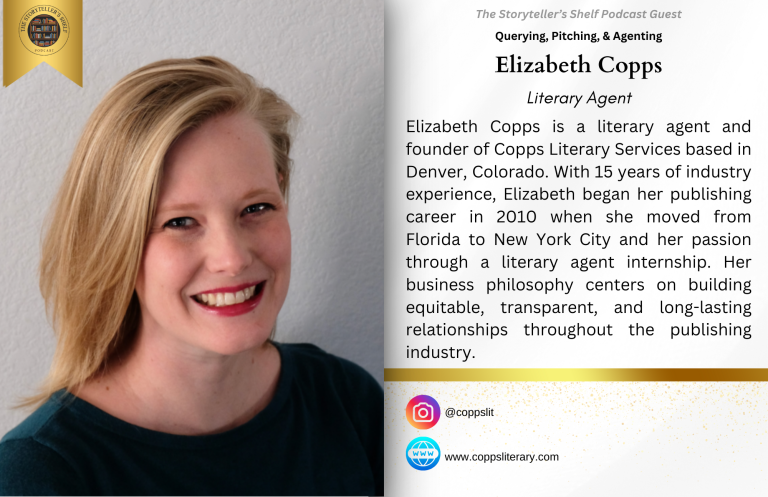
0:16 Hi everyone and welcome back to the Storyteller Shelf podcast. As usual, I'm Jackie and I'm here with Teresa today and we have another amazing guest here to share some wisdom with us. We actually brought you a literary agent today and I know that's what everyone has been waiting for. So, please join me in welcoming Elizabeth Cops. And Elizabeth, we have a tradition here where we don't introduce you, you introduce yourself because you know you the best. So, could you tell us a little bit more about who you are and what your journey was? Sure. So, thank you so much for having me. I'm really excited. I am Elizabeth Cops. I'm the founder and president of COP Literary Services,
0:53 which was founded in 2021. We are based in Denver, Colorado. It's very beautiful outside right now. Um, so we're happy for that. And I have spent 15 years in the publishing industry on the agency side. I started off at a small boutique agency in New York City where I cut my teeth. And it was a phenomenal experience. I wouldn't be able to do what I do now without that. And my agency represents everything from kid lit through adult fiction and select non-fiction. Right now, I'm really leaning into my spooky self, so I represent a lot of horror, but you have to keep it interesting and spicy. I also do romance and just, you know, fiction that kind of crosses all sorts of genres
1:32 and we can talk about that more later, but thanks again for having me. We are so excited to have you on the podcast. And many people are curious about how one becomes the literary agent. Could you walk us through that journey? What led you to this profession? Craigslist is the short answer, which is ridiculous. Back when Craigslist wasn't as creepy, I guess. I don't know. But I was a typical stereotypical English major, communications minor. Had no idea what I wanted to do after I graduated. We were still in a pretty heavy recession. I graduated in 2010. So, the year before I had moved to New York with my best friend for the summer. We'd saved up our pennies and we decided to
2:12 go there with the intent of just finding any job that we could. and we had an amazing summer and I thought, "Oh my gosh, this is my city. I have to go back. How do I do this again?" And so the next summer I went with my little paper resume thinking, "Oh, I'll find a job at a bookstore, you know, something bookish." And then I just happened to see a posting for an intern on Craigslist for Maria Carvanus agency. And so I trotted over at Rockefeller Center and had an interview that I really thought I bombed. I thought I did so horribly. never going to hear from these people again. And they were probably pretty desperate for a reader because they hired me on the spot and it was the best
2:51 summer of my life. And it was my light bulb moment. I felt like I found my industry, my people. I knew that I didn't necessarily want to go into academia. I was thinking about law. I would have been a terrible lawyer. I'm happy that didn't happen for me. So that's the that's the short story. And then I um finished my internship, moved back to Florida, worked for a year for the Department of Environmental Protection as a front desk like administrative assistant, and then I got a call from my old boss saying, "Hey, my assistant is leaving. I thought of you. Would you like the job?" And I ended up moving to New York, and I think like it was a three-day turnaround. Stayed in a
3:27 hotel for a little while before I found my apartment. I was in her office at 9:00 a.m. on Monday morning and then said, "Okay, I want this. Let's go." Yeah, that's what happened. And I haven't left. That's hilarious. I'm not sure if they use Craigslist the same way these days. No, I don't recommend that for any wouldbe professional or wouldbe publishing hopefuls. Maybe don't try to follow in my footsteps to quite that degree, but I'm very grateful that it worked out the way that it did. Well, that's amazing. It's so interesting to hear how everyone's careers evolve. I would love to ask you though, how did you decide to start your own agency? I
4:06 mean, was this something that you had always dreamed of or did it just pop up and you decided to go for it? You know, my husband and I left New York in 2017 for a variety of reasons. And at that point, you know, we we needed different opportunities and the city had kind of run its course. But I was lucky enough to work remotely for my previous agency from 2017 until 2020. And we all know what happened in 2020. So, not just COVID, but I think, oh gosh, like two months before the world shut down, I found out I was pregnant, which was really happy and exciting and and amazing. um it changed everything. And so it's I think my my old boss and I realized that things weren't going to um
4:49 I don't know move forward or be as aligned as maybe we originally anticipated and it just seemed like a really good time for me to um break off on my own. It was terrifying looking back on it now. I wonder what I was thinking cuz I had a newborn and then a new business on top of it. So that was that was pretty wild. There wasn't a lot of sleeping to be had, but I'm still trucking. And it's just been so amazing to be able to run my own ship and make these big creative decisions and I don't know, just be able to say yes and a lot. Um, I feel incredibly just happy and grateful and fulfilled that I was able to do that. Um, so it was worth the risk
5:27 100%. I am inspired by your story. That is amazing. I empathize fully like going through something like that that but the fact that you are doing so well now and successful in your own business. I have a question for you and we're going to kind of pivot. What is the process behind developing the manuscript wish list and how do you come up with a specific types of stories and genres you're looking for? I mean, I think for me personally, it's been a lot of trial and error through the years while also keeping very much in touch with market trends. So, I think when I first started out, I had more of a throw spaghetti against the wall and see what sticks approach. I was really
6:09 kind of genre agnostic. I think I had these lofty ambitions of, you know, oh, I'm going to be known for representing like highbrow literary fiction, which is amazing, of course, and and I love a good literary novel. But I really had to open myself up to a big and important education on genre fiction and what works and what makes the world go round from a publishing perspective. I was the little kid who was obsessed with RL Stein and and then when I got older, Christopher Pike and I think it just it started making a lot of sense when horror took the industry by storm, I guess, because a lot of the work that I was representing had darker themes, you
6:51 know, played to our collective fears and, you know, kind of with that darkness and that that's those scary themes in really interesting ways. So honestly, I think that I also have Jordan Peele to thank for, you know, how I merged into the horror space because he started popularizing through film um in ways that, you know, as a society, we really started embracing these narratives that previously hadn't been seen unless you were Stephen King. And I love Stephen King, but it's nice to see a little bit more diversity, especially women in horror. It felt like a boy club for so long. So, um, I think that that's sort of the path that got me to that particular genre. Um, and if you look at
7:31 my wish list, I mean, whether it's middle-rade, young adult, adult, there's usually, I don't know, some darkness in the wish list, you know, across age groups. So, um, that that's I guess one answer to your question. And then I love love. And so again, kind of the other the flip side of that coin, um I worked for an agency that really did well in the romance space, whether it was Regency or Contemporary or Paranormal when that was having a big moment. Um so I got a great education on that. And I'd never been much of a romance reader, but I learned to super appreciate it. I think, you know, now if you ask me what's queued up on my Audible, it would be like, "Oh,
8:10 the Laya Sage series, the Butcher and Blackbird series, Acatar." Like, and I I love to be surprised. You know, I have my wish list, but I love when something comes across my desk or I meet an author at a conference, and it just sounds like something so different and fresh and evergreen, and I'm always open to things that I wouldn't necessarily say, "Oh, that's that's something that I'm putting on my manuscript wish list or on my website." A lot of authors, a lot of writers, we know we submit it to you. And I think from their perspective, it feels like it goes into this magical black hole where they all mix up together, never to be seen again until
8:47 months later. But we would like to hear from you. What is the actual process like? What's the process for you when it comes to going through queries? How do you decide which ones are a good fit for you? That is a great question and I know that this industry is not transparent and that's really hard especially because writing is a very lonely business. So on top of that to not know what's going on behind the scenes is is very difficult and I'm sorry for that truly. So I use query manager for my agency. Many agencies do these days. It keeps the process very streamlined. And so every agency has a different system, a little bit of a different setup and how they
9:28 review submissions. But in terms of COP's literary services, all three of the acquiring agents with CLS do use, well, it's called Query Manager on our end, I believe, query tracker on the author's end. And at first when I opened up the agency, I just had it open all of the time and I was getting so many submissions that I was absolutely drowning and I couldn't keep track. So, as of this January, I shifted my system. So, I'm only open the first week of every month. So, my most recent sub period was March 1st through 7th. So, I'll be closed again until April 1st. But after, you know, I have that period of open submission, I start going through all of the queries and until the
10:10 end of the month and I try to, you know, get to zero. But I I will say this past submission I want to say season that's not right but submission period I got about 500 submissions across genre across age groups and that is why many times it does feel like a black hole because I do have an amazing reader his name is Milo and he knows exactly the types of projects that I'm looking for. So he'll also go into my query manager and read along with me and flag submissions that he thinks would be particularly interesting. So, I'm the one who is saying yes or no, you know, requesting more material or passing. I think that that that's really important to me to be the one that an author knows
10:52 like, no, no, her eyes really have been on this. And so, I read every single submission. I can tell typically from the query letter um whether it's something that's, you know, going to work for me or not. And what I mean by that is, you know, work for me in terms of requesting more material. So like the first 50 pages or the full manuscript, but there are definitely cases where I'm like, "Oh, this concept sounds really intriguing." But but I don't I don't know, maybe it's kind of a tough cell or, you know, it could be a variety of reasons. But then I'll look at the sample pages. So if the query letter is really strong and that mirrors, you know, the the voice and the strength of,
11:30 you know, the narrative that they're sending in the sample, which for me is the first 20 pages, then I'll request more. But I do look at everything. It just does take me a while unfortunately because of the volume. But I think for me, you know, I'm I'm looking for characters that I can't stop thinking about. So sometimes we have a flagging system in query manager. So I don't like to make snap decisions. I will um have my little like maybe flag or you know like a color system. And so if it's something that I'm on the fence about, if I sleep on it and I'm still thinking about those characters the next day or you know the story or you just something
12:09 about the submission, I know that there's that there's something there and I'll go back and and request more material. Maybe it'll take me more than a day, but that is that is my yard stick. It's like, well, okay, if you have characters that grab me, I think voice is always one of the most important things for me that if you if you captivate me with a good strong voice, maybe it's really funny, maybe it's really dark, maybe it's, you know, just quirky, intriguing, like there's just something about it that won't let me go. I think that's my number one. And then if I know that it's a story that has a lot of like potential marketability and I can see where it
12:45 would sit on a bookshelf next to other things that have done really well but stand on its own, then it's like that's the magic sauce. That's awesome. And that actually kind of that actually goes into a question that I have um like a did does it depend when you're submitting on whether the manuscript is for a middle-rade picture book or a young adult? For example, if you have a picture book, do you submit the whole manuscript or how does that work? So, I'm actually not doing picture books right now, but typically, yes, it would be the full manuscript just because it's so short. You know, it's probably what, like 5 to 10 pages, max 10 is probably
13:22 on the very high side. I don't know what I said that, but anyway, you get it. You're a picture book author. So, yeah. I mean, typically it would be the full manuscript and then it depends if it's an author illustrator duo, if you have some illustration samples, that could be really helpful. But yeah, I mean, picture books are a completely different territory when you're submitting and it's more of a full package rather than here's an itty bitty sample of my 90,000word manuscript. What are the essential ingredients, so to speak, for a successful query letter? What goes in a good query letter? Okay, so one of my red flags is if the query letters is just a complete
14:04 mess. And sometimes, you know, authors will almost want to have it. It almost feels kind of like a chit cchaty conversation before they even tell me what the book is about. Hey, and I was I was online and I was looking at your profile and I also love Taco Bell and can you believe the weather is like this in Tucson right now? and you're just like, "Oh my gosh, just tell me what you wrote." Which is like sweet and lovely, but again, the volume is so crazy that we just need to know immediately in that first paragraph, the genre, the word count, comp titles, and a short elevator pitch. So, if you have those four components, that makes my heart sing
14:43 already. I know that like you have done the research, you have read the articles, you've gone to the workshops, like you know how to structure this because you can think of it sort of like a cover letter. And if you're applying for a job, you do want your voice and your personality to shine through in that cover letter. You don't want it to sound like every other submission, but you also need to follow the rule. And so I think that like you need to learn the theory before you can play jazz, right? Like you have to really get those points really tight. So that would be the first paragraph. And then I would say like the second and third, maybe fourth,
15:18 depending on how long you want to go, that would be the description of your story, the meat of your story. So something that you would see on a book jacket, something that you would see like in a Netflix description. Um, if you can make your plot sound a little bit more cinematic, that's really nice. And then your last paragraph is wrapping it up. This is your bio. This is why you're the best person to write this story. This is where you can tell me that you also love Taco Bell. I think the bio paragraph is like the strongest piece to get a little more informal and chitchaty. So, that is my quick and dirty outline for the perfect query letter. It's really really important to
15:56 include comparative titles because it's a sales tool. So, at the end of the day, we're getting this out there hopefully to a larger audience and especially if it's with a larger publisher, you know, they have a bottom line to look out for. So if you can go to an editor and say hey you know my author's book sounds like X Y and Z which is you know these are all titles that are you know published within the past 3 years like two or three years you you want to find comparative titles that are contemporary so the past two to three years. If you use a film comp that's okay as long as you balance it um with two other literary choices. But if you think about
16:38 it, you know, if you sit down um and you ceue up your Netflix and you're not really sure what you want to watch, but it has the recommended for you section, you know, on mine it's probably going to be a lot of romcoms because I love it or like Regency, you know, romance period pieces or like Bridgetgerton, you know, whatever. Look both ways. Um, and Netflix is so smart about their algorithm. We see you. We get you. We know what kind of viewer you are. So, we want to do the same thing for readers. If publisher A, it's an imprint that really focuses hard on romance titles, we want to make sure that we are saying to them, hey, this book is going to fit
17:19 really nicely into your catalog and really nicely onto a shelf at Barnes & Noble. So, you will be able to appeal to your current readers and they will become new fans of this author that I'm bringing to you. So if an agent can show that, that makes everyone's job easier. And if an author can come to an agent and say, "Hey, I understand the market and I know where my book should sit on a shelf and I want to be a good business partner to you that I know more than just the creative elements of this process." That puts you at a different level. Interesting because I just want to point out from my experience, I have not queried many agents. I've mostly
17:58 queried small publishers. Um, I'll try to change that for 2025. A lot of small publishers that I've spoken to, they tend to look for a marketing summary somewhere in the pitch. And I noticed that really something you said more of just know where you stand. So you don't have to go really on a huge research trip and make a dissertation. You just have to know firmly where your work would be placed so that it's in the correct context. Does that sound right? In fiction, yes, absolutely. Non-fiction, it's a bit of a different ballgame because you're creating a proposal. So, you have a whole marketing section of here's my platform. Here are people who would support me in this, you
18:41 know, story if it got out to a wider audience. So, yeah, I mean, but for fiction, 100% correct. This is really great because like I said, I'm I've already written and published my self-published book, but I'm in the process of quering. promise not to put Taco Bell in there. Okay. And my life story. I think that it's important to cast your net widely. You know, be intentional about who you're submitting to. Make sure that what you're writing actually does fit the wish list, but it's such a numbers game. And it's the same for me when I submit to publishers. I mean, I've built a lot of relationships with editors and publishers over the years, but it's
19:20 never a guarantee. So, I submit very widely, you know, small, medium, and large imprints because you just never know. but it only takes one yes and that can be life-changing. So, it's something that I tell myself when I'm in the submission trenches for one of my authors and it feels like I'll never get the yes and it's like no no no girl light your Dolly Parton votive like it's going to be okay. It just takes one and sometimes the timeline is not linear and you know you might not get the yes that you want on the project that you're currently submitting. But if you're cooking up something else and you're really excited about a new idea, maybe that's going to be the one and you shove
19:56 project A, you know, for a little while and who knows, you know, once you start working with an agent if they'll just say, "Oh my god, give me your whole, you know, catalog. Let's see what we can do here." So, I think it's important to be just like mentally and emotionally nimble and flexible in all of this and know that as much as it feels personal, it's really not. It's just about finding the right fit. and you know tenacity. I think we all have to be very tenacious people to work in this industry. Yeah. Thick skin basically is what thick skin but also like to lean into that creative joy because the world is really hard right now. I mean, I guess the world is
20:33 always hard, but right now it feels particularly difficult. And if we can't find, I don't know, just the meaning and joy and heart of what we do here, then it doesn't mean anything. Like a publishing deal doesn't mean anything if your words and your work aren't sparking something deeply joyful inside of you. And that's why we should all be in this business because most of the time it's it's not going to pay the bills fully. people really don't go into publishing thinking that we're going to be making six figures all the time. So, I think making sure that you retain the heart of what you're doing and um and lean into that intentionally and joyfully, then
21:13 we're doing something right here. I love that. I think that should be like a motto that you carry throughout um when you're writing is that you have to lean into that creative side of course of obviously like you said and I and I completely agree with you but never take it personally because it's only in a sense of growing as a person when you're trying to be creative you are going to have to overcome that and I fully endorse what you're saying. So if you get that yes and obviously it's exciting. So, what's the next process after you accept to represent an author? Could you walk us through that? Yeah. So, I mean, for for all of you authors, just make sure to do your due diligence.
21:54 Um, you know, and that can be everything from, hey, is the agent willing to share the boilerplate of their agency agreement with you before asking you to sign it? Are they willing to connect you to current clients so you can talk through how this agent works? because it's all well and good to hear an agent tell you, but it's really nice to be able to talk to clients who can confirm that. And also, you know, look at what deals they've done recently on Publishers Marketplace and if they if they have a social media presence, make sure that there's nothing problematic there or just do a quick Google search and and make sure that people haven't reported really negative experiences.
22:34 And when I offer representation to an author, I set up a call and tell them all the reasons why I'm madly in love with their book and why I think that they should choose me. And then if they have other agencies interested, the typical turnaround is saying, "Oh, okay. Well, I'm going to give the considering agencies a twoe courtesy to respond." And then if another offer comes in, then the author has the opportunity to consider that, really weigh one right for them. And then at the end of that 2 weeks, if they say, "Hey, Elizabeth, I've thought it through. I've done my due diligence. I really want to work with Cops Literary," then I send them the agency agreement for signature.
23:14 Another great thing is if your agent is part of the Association of American Literary Agents, ALA, that's a green flag. We are all held to the same standard of ethics. So, make sure that an agent is not charging any reading fees. make sure that they're only charging a 15% commission on domestic deals. That's how we get paid. It's typically a 20% on film and television or working with a sub agent, you know, whether it's for foreign rights or something like that. So, um I send the agency agreement, they ask me any questions if they have them, they sign it, and then I would say I'm an editorial agent. So many times if I work with an author, I'll say, "Hey, before
23:54 we put this on sub to editors at different publishing houses, I think that it would benefit the manuscript if we changed X, Y, and Z things. So maybe I see there's a big plot hole somewhere in the middle, or maybe it's um a character whose motivations I don't quite understand or something that feels a little bit problematic to the story." So, we'll do a round or two of edits. While we're doing that, I put together my submission list. I usually do between 10 and 15 editors per round, small, medium, and large size houses. And then I put together my little pitch letter, which is basically a query to an editor. And I get it out there and light the
24:34 dolly votive again and hope for the best. Sometime I mean, you just never know. Sometimes you can get a really quick response. I've sold something in a week. I've sold something in a year plus. Like it just would that I had a crystal ball. But then I ask my author, "How do you want me to relay feedback to you? Do you want it all in a clump? Do you want me to forward things as they come in? Everybody's a little different." And then we just wait and hope that we get that yes while I send occasional follow-ups. And then when the yes comes in, I help negotiate that deal. So I try to get the advance a little bit higher or make sure that um you know the the terms are as author
25:13 friendly and desirable and fair as possible. And if everyone can walk away from that negotiation satisfied, then I've done my job. And after that, it's just going through the process of until publication. So, making sure all the pieces are aligned and, you know, do we have a cover? What do pre-order numbers look like? Are we set up well for publicity? Are reviewers jumping on board? And some of those things I can control, some of them I can't. But I just want to make sure that the conversation is always open and flowing and everybody knows what they're supposed to be doing at any given time. So you give your initial feedback and if there's something that you feel should
25:55 be changed, you work on that with you, the writer and editors. But I would love to know if while you're out there doing your job, you're submitting this manuscript off to publishers. Do you ever get some feedback that you take then to the author and they do a little rewrite to get the manuscript into shape according to what you're seeing in the market? Yeah, I have three projects right now that are under a revise and resubmits from editors. And so, well, I guess there's two parts to that question. There are times when an editor will say to me, "Hey, Elizabeth, if your author is open to making these changes, then we can talk about an offer." And
26:31 then there's other times where it's a flat pass, but they do give personalized feedback that's very useful. And I always send my authors that feedback, but most of the time I caution them not to make big changes unless there's parallel feedback from like two or three editors. I mean, sometimes the feedback is so awesome that maybe they do like, you know, strikes the chord and they want to go for it. But usually because it is such a subjective industry, I want to have that continuity before sitting down and taking the time to make massive changes to the manuscript. How do you choose which publishers to pitch to and what's the process of figuring out which
27:08 publishing house is the best fit for that manuscript? Yeah, I mean, every publisher and and every imprint, especially if you're talking about a big five, specializes in different things. So, for example, if I was pitched like a queer contemporary young adult story, a publisher who would immediately jump to mind would be Page Street. I love working with with Page Street. They're so smart. They're so creative. And I also just know that they are very eager to see more of that material. So, it's it's like that I have a certain amount of industry knowledge that when I read something, I can immediately say, "Oh, it would be perfect for this publisher
27:44 or it would be perfect for this imprint at X larger publisher." that my knowledge is not limitless and I love Publishers Marketplace to um do research. I subscribe to all of their newsletters. I'm on that site all of the time because you can see in, you know, every single genre what has been selling that day, that week, that month, that year. Um, and they also just have an amazing amount of material that you can read and consume, whether it's um, reviews or articles or whatever, just to see what's going on in the industry and who is seeking what in any particular genre. Publishers marketplace is my holy grail. I'd love to pick your brain a little bit more about pitching. So, you
28:28 told us what makes a good query letter to an agent, but can you tell us what makes a good pitch from the agent to a publisher? So, when I'm doing my pitches, I really like to try to start with the comps front and center. So, of course, like now that I'm on the spot, I'm like, "Oh, what are books? I can't think of any comps that work well together." Like, the only book that has come to my mind in the past two seconds is The Notebook. I'm like, "The Notebook meets The Shining. Can you imagine if that was a novel?" Teresa's face is like, "Oh my gosh, why did we ask this girl to come on our podcast today?" But anyway, I try to get really smart with
29:09 my comps. Um, so like front and center X meets Y and then I do my little elevator pitch. So a lot of times, you know, I draw from the author's query or like if they have a synopsis or longer description because I do want it to sound like it's their voice, you know, telling the main beats of the story. I really try to get like the punchiest, coolest elevator pitch I can come up with. So when they're when an editor is is reading this, they're like, "Oh my gosh, like this feels like I can feel this. I can see this. Like it hits all five senses." And then I go into my longer description and then the author's bio and like here's Yeah, it's it's really similar to a query letter. It's
29:49 incredibly similar to a query letter. It's just more me saying like, "You want this so badly? like let me explain to you why you can't live without this book and let me explain to you why I can't live without this book and like as an agent like how it's deeply affected me. So trying to just like bolster that enthusiasm times a thousand. I think this is helpful for both like if you're just starting the querying process as an author and then if you're going into oh how does this work and how what is the timeline? I mean, obviously you're still looking through like you just went through 500 um queries, which I'm going, "Oh my gosh, how do you do it? That's
30:29 amazing. That's like the stamina. You've got to have like coffee like every day or something like that." Yeah, I should start injecting it directly into my eyeballs. And like to be fair, I still have a lot of outstand needed coffee that fuels your day and honors your grit. Free rain coffee co-founded by Yellowstone's Cohauser is crafted for those who drink up. Buckle down with blends like American D, Dark Roast, and Homestead. Medium roast. Each copy is tribute to the hardworking spirit of the American West. Plus, with their buy a bag, give a cup initiative. Every purchase supports those who serve our communities. Ready to fuel your journey? Visit our link tree to explore free rain
31:10 coffee. So, I mean, I really I work seven days a week mostly. my schedule can be kind of all over the place cuz I was telling y'all earlier, I have a four-year-old who needs a lot of attention and and mental bandwidth. And so sometimes I'll get up like super early in the morning or I'll just like be reading through queries until midnight or something just to make sure that I can get those pockets of time because during my workday I'm all up in my author's business and trying to make sure that everything is flowing as it should and taking meetings and so I really don't have time to read submissions during like the normal 9 to5. So that's weekends and nights for
31:48 the most part. I completely empathize with you. Um, if you I know you've mentioned and thank goodness for that about pitches, but if you could think of a great pitch that comes to mind, let's say 30 seconds to convince a publisher um to take a look at a manuscript, what would that sound like? Oo, it's a good question. What if we have a book about a little girl who has a pet turtle and they go to different countries to find different flavors of hot sauce? So, it's very cultured driven, but food oriented and fun. Guliver's travels. Don't use that because it's not contemporary meets hot ones. This is this is why I'm on this side of the
32:34 desk. Um, yeah. Um, so yeah, if I had more time, I would definitely switch up those comps, but for the purpose of this exercise, like in my pitch, yeah, Goliver's Travels meets Hotluns and you would have that oneline elevator pitch about Stella and her best turtle friend Shington who travel the world having grand culinary adventures. It's really helpful um to see your thinking process. I know it can feel a little nerve-wracking because we're making up a book that you've never heard before, but to hear you say it in action really does translate well into learning because people are not always thinking as authors, is my book X meets Y. They're thinking this is my passion
33:18 project. This comes from my life or maybe something my children have experienced or something that I thought was funny. Dot dot dot. Right? I have this conversation. And not that I'm an expert at anything, but we said, you know, nobody should go out there saying I'm it's a book like CS Lewis's book, right? Well, yeah. I mean, you have to be really careful and that you're not choosing something that's so just like part of the literary canon in a way that everyone would be like, "Wait, what?" Or or just such a like bestselling like New York Times bestselling book that it just feels almost silly like nobody's going to say, "I'm the next JK Rowling." I
33:57 think that it is a fine line, you know, to walk picking comparative titles that are common enough that people will know what you're talking about, but nobody's read every book. If you choose something that seems really great and an agent has to look it up, then an agent has to look it up. It's not a big deal. But you can choose things that, you know, it doesn't have to be like beat for and it shouldn't be beat for beat the same story. It could be it shares certain themes. It shares certain sensibilities. there's um maybe a setting they have in common or or whatever. Like you can kind of take these little pieces and parts of different comp titles that where if you
34:33 mix it in a bucket, it's going to be your book because your book should feel new and fresh and different. And it is really hard when an agent is like, "Oh, what's it like?" And you're like, "I don't know. I just made this up out of my own imagination. It's not like anything." But as as readers and writers, we've all been influenced and and just as human beings, like we're all influenced every single day and bombarded with, you know, bits and pieces of information. Um, last question for you, Elizabeth, is as an agent, you work very closely, we've established, with authors and publishers. So, what advice would you give to aspiring authors and illustrators and those working in Kidlet
35:12 who want to get their foot in the door? I think first of all, be authentic. Be your authentic self. I know that sounds cheesy, but because this is an industry of relationship building. And so, it's just as important to get along with your publishing team personally as it is professionally. So, that would be um a huge piece of advice. And also networking because as we touched on earlier, this can be a very lonely and isolating endeavor, especially on the offer side. And so if you can, you know, build community, which is what y'all are doing with the Storyteller Shelf podcast, like you're helping build community, and it makes me so happy and I'm so grateful to you because this is
35:51 what we need more of, not just in publishing, but all around like we got to lean into our community right now. And if that means making friends through, you know, oh, we both we we're listening to the same, you know, podcast or we're at the same conference and we're at the lunch table together and and we're chatting and like you never know who your best friends in the industry are going to be, but you have to put yourself out there um in order to find those people. And it's so interesting like once you know you start going to the conferences or the conventions or um you know having having these moments of interpersonal connection where those connections will lead. Maybe you'll meet
36:29 someone who will introduce you to your agent. Meet the your best friend and like the future godmother to your child. You just like it's really wild. It really is wild. I've made some of my best friends through this industry and it just like I don't know. It makes me miss you. like it it really is special. It's an incredible group of people and every genre has its own vibe. Um, and it's it's really fun to see everyone just cheerleading and and supporting each other. And if we lift one another up from every level of this industry, then that's when important books get made. Yeah, I am so appreciative of this conversation. I I have to say that because I have learned so much already
37:12 and all this stuff is just pure gold wisdom. I'm so glad. Thank you. Oh, I mean you two are such a breath of fresh air and I've loved chatting with you and yeah, I'm going to be rooting for you. I will light dolly in your honor. You're going to do great. Like Teresa said, you kind of give us all the secret insights that everyone is always curious about. So, we really appreciate you and we want to thank you on behalf of particularly the emerging community, all the new authors, aspiring authors, aspiring illustrators. We know they took a lot away from this. So, if you're still tuned in now, we thank you guys for listening. Storytellers, please, if you can give us a like and a
37:52 subscribe, but most importantly, go to our website, click on episodic calendar page, and find Elizabeth's name. You can click on that and see where you can find her on the internet and support her. But thank you so much.