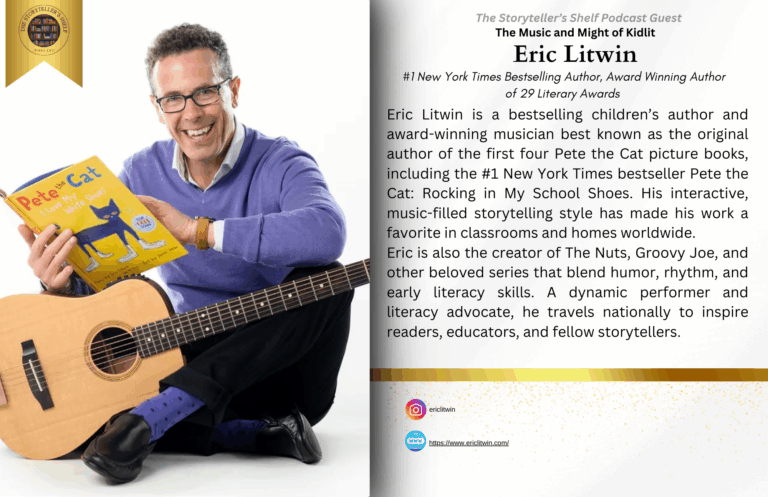
Eric Litwin
This transcript comes from the video’s automatic English captions. Names and wording may contain errors. Timestamps open the recording at that point. References to events and offers reflect the time of recording.
0:00 This episode of the Storyteller Show podcast is brought to you by Harney and Suns fine tees. A perfect companion to every story. Whether you're reading, writing, or just enjoying a quiet moment to yourself, Arie and Suns offers a beautiful selection of teas to elevate this experience. From classic blends to unique finds, every cup is crafted with care. Just like the stories we love to share, shopcarnne.com/disount/stoteller and storyteller is an all cap. Now, let's get back to the show. [music] Hi friends and welcome back to the Storyteller Shelf podcast. It's Jackie
0:47 here with my co-host Teresa and today's guest really needs no introduction. He is a New York Times bestselling author, the guitar strumming, rhyme dropping literacy advocate, and the original voice behind Pete the Cat. That's right. We're joined by Eric Litwin today, the multi-talented author, musician who's made a global impact helping kids fall in love with reading through rhyme and story. Eric, it's awesome to have you here today. >> Thank you. It's nice to be here. It's good to see both of you and I'm looking forward to the conversation. >> So are we. So our first question is we want to rewind the clock a little bit and go back to the beginning. So could
1:30 you tell us what inspired your very first children's book? >> Okay. Well, my very first children's book is Pete the Cat, I Love My White Shoes. And although I have no favorite book, this book holds a very special place in my heart. because this is the book that has paid off my mortgage. It's also the book that's opened up so many opportunities and um it's my best known book. Basically, I was a teacher for many years. I was teaching third grade, fourth grade, and fifth grade. And I noticed that many of my students no longer loved reading. But when I would walk by the kindergarten classroom, they all loved reading,
2:16 right? Demonstratively, they would hug the books. They were, you could hear and see the joy in their faces. And at one point, I started to get very concerned because if a third grader does not love reading, obviously, what will they do less of? Reading, right? Then they'll get worse and worse. Well, they they'll fall further and further behind. Everything in education, the bedrock of it is reading. So I asked a simple question. What happened between kindergarten and third grade? Where did the love of reading go? I became deeply concerned that the problem was that the students who didn't love reading, in my opinion, in my teacher's perception,
3:01 probably struggled with reading instruction. So reading instruction starts about first grade. And my thought was they struggled in first, they struggled in second, by third, they didn't love reading. And I began to become concerned like why were they struggling? And what my insights told me is it's because they didn't have a strong reading foundation. And there's a lot of reasons for this, but I was deeply concerned. the reason having to do with television and video games and electronic devices. And I started thinking, we need to make reading more fun than any electronic device could ever hope to be. And we can. And so I started thinking about how to optimize
3:45 books. This would include using interactive techniques like calm response. Did Pete cry? Goodness, no. Music. And uh I worked on this concept for about 10 years as a entertainer. I would go around to educational entertainer. I'd go around to schools. I'd give performances and I was building my stories, building my understanding of how kids respond to stories. And then after about a decade, it was time to turn it into a book locally. I lived in Atlanta. I worked in Atlanta at all the different schools. James Dean was an artist in Decar right next to Atlanta. Well, he actually was an indicator at that point, but he had been uh a little further south, but a
4:28 lot of his art could be seen indicator. I loved the character Pete the Cat that was a folk art character, and I had a great story called the little girl in her white shoes. And I was always playing with it as a dog, the cool the groovy dog and the white shoes, the cool cat in his white shoes. And I thought maybe these two things could blend. And we uh decided to work together. And that's how we created Pete the Cat. I love my white shoes. So we did it completely on our own. >> That is an amazing observation and I think a lot of our guests have expressed seeing the same thing happen today. But we also have a lot of movements and people like you who are advocates that
5:05 are trying to solve that gap between reading between the grades. If you don't mind, I'd love to ask you a little bit more on the p the publication pathway of Pete the Cat. So how did you get the book published? So, the path for Pete the Cat to be published was completely non-traditional. Originally, Pete the Cat was in a CD I created called The Big Silly. And we put the story in the CD with a little story booklet was the idea, but it came out so well. And then James and I talked about it and we decided, let's let's publish a book. Let's turn this into a book. And once we did that, we got so much
5:50 community support. A book publisher, Elizabeth Dumba, who is a just a phenomenal writer and illustrator and teacher, she kind of took us under the wing and gave us a lot of good counsel. Bookstores were excited. People were excited for us to do this and and and we were both local, both known locally. We spent two years studying books. We studied a lot of Mo Willen's books and when we published, we self-published Pete the Cat and his white shoes. We created our own little publishing company. And the only thing that's different about this book than the one we self-published is the cover. Everything else is exactly the
6:35 same. And uh so it was a collaborative effort. It was a lot of support from the community, a lot of freelance artists and counselors who really helped us because there was no money here, you know, we didn't we were just going to do this. And I had always wanted to create a book because of my interest in giving an example of what a interactive book would look like. as I as we talked about earlier, a book that is more exciting than any electronic device, but also optimized to have the greatest impact. And that optimization has a lot to do with the interactivity between the child and the caregiver and that gets
7:20 built into the book. And this is really important as we as we try to build reading foundations. So, we self-published. The goal was I was going to sell it at my performances. James would sell it at art shows. we would put it in local bookstores and we did we put it in little sop of stories and uh people came in and bought one they come back the next day and buy three or four more and we knew pretty quickly that we were on this and then so little shop of stories and also a bookstore in Alabama oh I've forgotten their name I'm so sorry to this bookstore because we we are indebted to them but they also these both these bookstores were giving our book to their the representatives of
8:00 publishers saying these These guys are these guys are the next hit. And um we got a couple offers and we ended up working with Harper Collins. >> I have to chime in here because that is so inspiring that you first started off self-published because I'm self-published. I like how you take the books so to your shows and then James went to art shows. All of those things. you have to step out of the box as a self-published author >> because there's a number of things we did that I would love to share with people who want to self-publish. The first thing is we spent two years studying publishing, right? We didn't just publish the book. And one thing
8:41 that publishers will say is they can for in a lot of cases they can tell when the book is self-published because you're missing just certain basics. So the first thing we did is we did our homework. We got advice. We got consultation. We hired, they worked for such reasonable prices, but like a book designer and we took our time. Second, we didn't spend an enormous amount of money, right? I mean, we spent a certain amount to buy a certain number of books with the understanding that we were going to sell them, right? You cannot depend upon your local bookstores to sell the books for you. So, self-published folks, I think a lot of this goes back to
9:28 self-promotion. You've got to get out there. If you've got something worthwhile to say, if you have something important to say, you've got to really get out there and say it. And you've got to do presentations and every chance you get, you've got to share your work and you've got to show your work and you've got to sell your book. And the more books you sell, the more people you help. So that's that's that's part of the journey. We, you know, we didn't just write it and then quickly publish it and hope someone else would get it out into the world. It just doesn't for us. It didn't work that way. Hey storytellers, if you're still juggling Word Docs, sticky notes, and 47 browser
10:06 tabs to keep your story straight, it's time to simplify your writing life. Meet Scriber, the writing software built by writers for writers. Whether you're drafting a novel, a picture book, or even a dissertation, Scriber helps you organize your scenes, research, and revisions all in one beautifully structured workspace. Many of our guests on the Storyteller Shelf podcast have raved about Scriber and how it completely changed their writing flow. You can move chapters around with a click, store your notes right next to your draft, and even set word count goals that actually keep you motivated. >> Curious? Check out our affiliate link. It helps support the show at no extra
10:46 cost to you. And let us know if you give it a try. We'd love to hear how it helps your writing process. Also, publishers know what has succeeded yesterday, right? They don't know what's going to succeed tomorrow. So, they base their calculations on pro past success. But the world is changing very quickly. But there is an understandable fear of things that are different. Right now, this is a book, a singing book about a cat that steps in a large pile of stuff. What chance did that have in the committee of folks who look at books and say, "I think this is a great idea. Blue
11:31 cat, white sneaker snaps in a pile of something." You know, no way. And you have to sometimes just understand if you're doing something that's a step ahead of your time or it's just there's no precedent for it, you may have to make your own path. And there's nothing wrong with that. It's just a lot of work. But you guys are doing the work and this podcast is part of that. Getting out there, getting getting to know authors, getting to know audiences. I mean, you got to work hard, but it can be done. and and and I did it. And some of it was luck, some of it's talent, and some of it's just hard work. Don't forget to be lucky. And develop your craft. I mean, develop your
12:18 talents endlessly. Endlessly. And not just internal development. Develop the communication of your talent to others. Right? It's about sharing that talent. It's about how you impact their lives in a positive way and that it's a it's a it's a craft. >> Can I ask about your emotional state during that time with your team when you were in the process of self-publishing and taking in all of this industry knowledge? Did you ever have a point that you felt down or were you resilient throughout? >> It's not an eitheror. You know, it's not like I feel down and then I feel up. I always feel a little down. Even for today, I spend a lot of my time focusing on the impact of
13:04 digital devices on early reading as as well as other variables that affect learning like attention and things like that. And I get up and it's distressing and then I get out there and I do my work, right? I mean, so I'm always a little distressed. I'm also always somewhat optimistic because we can change all these things. There's nothing stopping us, right? You can't do it alone. So that's why you you you do podcasts and you do articles and you go to schools and you and and in this podcast I will talk about the importance of interactive reading for young children and some other things as well that will help with the negative consequences of passive
13:48 screen time, right? Which is a deep concern of mine has been for years and years from when I was a teacher. So do I get distressed? Absolutely. Do I feel optimistic? Yeah, absolutely. And sometimes the best remedy for feeling distressed is shooting for the moon and working towards it. And I keep shooting for the moon. And I never know where I'm going to land. I sometimes miss completely. But that's what I'm going to keep doing, right? And that's what I hope others will do, too. I hope all the creatives watching this podcast, if you feel a little distressed, of course you do, you know, of course you do, but keep on going. Keep get your art
14:33 out there. Make the world better. >> That was really beautifully said. Do you mind if we go into that talking more about screen time these days and how that's affecting children? >> Well, screen time has increased. And what we know about screen time is that it's not actually the screens that are harmful. It's the reduction in interactivity between young children and caregivers. And a lot of this is verbal interactivity. And it has a profound effect. And there's even been research showing a decrease in gray matter in the preffrontal cortex. So it can be measured right now. That's for young children. And this could be because the
15:18 kids are on the screen and not interacting verbally with their caregivers. Or it could be the parents are on the screen or the teachers are distracted or whatever it may be. Or the world is distracted and there's not as much verbal interactivity. That is a a substantial problem that I think we can address by becoming more aware of the importance of interactivity, lang uh linguistic interactivity and basically turning our homes and classrooms into reading and print playgrounds. And there's lots of ways we do this because language is the funnest thing we do. Jokes are with language. Expression is with language. With older children, screens are having a profound effect on
15:59 their ability to focus on social and emotional well-being. And I've actually um began a program for my older students. Now older I mean like the kids who read my books when they were children and now they are um teenagers. And also for grown-ups too. What I'm doing at this time to address this is uh I'm taken mindfulness meditations and placed it in the context of music. So I've taken the idea we'll take a simple pattern. Let's do something like breathe in, breathe out, take it nice and slow. Something like that. And then so you'll
16:44 have a nice chorus which gives you the instructions and then there'll be a guided meditation within that then the chorus and all you have to do is listen to the song and you're on your way. So that will be ready in about 3 to four months. It's taking me some time but again this is the shooting for the moon that I talked about. I'm going to create this program. I'm going to create an app to put it on and I'm going to put it out in the world. That sounds really amazing. I think an F would be really wonderful. Tell me a little bit more about the age group that you think this is for again because I can see like you said this being just as useful to adults
17:23 as young children. >> So I've already started giving presentations on it for teachers and it's going to be for all ages. The basic situation we have is that in our world today in which there is an attention economy. So brilliant people are spending all their time figuring out how to get your attention and they're very good at it and screens are very good at it. There needs to be some form of cognitive training, attention training and it seems that mindfulness is the really the best way to go because it's the most studied. It has the component of insight and awareness and it also really focuses directly on attention and
18:08 social emotional well-being. So, in my mind, that's the way to go. But a teenager and a grown-up have very similar issues in regard to meditation, which is that we are so distracted that the idea of focusing on your breath for 10 minutes seems unachievable. Right? So I take my knowledge of education which began in early education and in early education you uh you scaffold right you can only present the information as the child is ready for it and then you grow upon it and I feel with meditation it can feel so overwhelming
18:53 it's just so much to know and many experts are concerned about narrowing that down because what do you leave in? What do you leave out? But as a former early childhood teacher, I have no problem with that. I'm ready to decide the scope and sequence, create a series of objectives, and achieve it. So, I call it the reverse funnel. Most meditation teachers, most programs come like it's a big funnel, and you just you learn all this information and knowledge and techniques, and then you narrow it down for what works for you. I'm going to turn that funnel upside down. I'm going to give you a little tiny opening right here. Just listen to a song a day.
19:33 That's it. You're fine. Now, if you want, you can go down that funnel and it gets wider and wider and wider and you can take it as wide as you want to go. But the most important thing is it's going to start very small. Here's what I think would be helpful as a way to start and maintain this. how to begin this is how to grow that skill and then once you've got that stick with my program move to another whatever you wish but I just want you to start and succeed and uh enjoy it because we do need to train our attention and our minds to be healthy in our attention economy world that we've
20:20 inherited and these ideas are very similar to the books I've written And you if you want to you can mix it in with a little positivity and mindfulness helps with positivity also. >> I was going to ask about that next if there was a component of positive self-speak and affirmations in it. >> Well, there is in the regard to the loving kindness meditations where um you cultivate loving and kind feelings towards yourself and others. It's also I think a very good approach to positivity. Uh, positivity has gotten a lot of push back recently, right? If you're being positive all the time, you're in denial of what's actually happening. And what mindfulness does,
21:02 it's a perfect balance because mindfulness is training you how to accept things as they are, right? Positivity is how to make things better, right? And it's like two ores on a rowboat, right? If you just do positivity, you know, you're go you're going around in a circle, right? because you're not accepting things as they are. And when you don't accept things, how can you truly appreciate what you have? There's so many you see so many examples of people who have everything and they can't appreciate it, right? So then you have the other of appreciating things. Well, that's great, but if you don't also try and make things better, what are you doing? So you put the two
21:43 together, you appreciate what you have, you make things better, now you're moving, now you're getting somewhere. So I think positivity and uh attention training or mindfulness go hand in hand like two oras of a rope. >> Your books are known for making reading fun. Why is music such an effective tool in teaching early literacy and how can music storytelling support struggling and reluctant readers? >> Okay, so there's a number of reasons. So when we talk about music to some degree we're talking about songs, right? We're talking about music that includes words. So once you say that, you have words, right? And what a great way to experience words. So if songs have words
22:25 and they're interesting words, you're building vocabulary. That's pretty obvious. But you're also speaking the words with expression, right? Oh, and vocabulary is one of the pillars in the five pillars of reading, right? So we so we're bam, we just hit one of those pillars. Now, another one of the pillars that's very very important is phenemic awareness. And the other pillar is phological awareness. So one is your basic sounds and the other is the combination of letters to create sounds within words. So if you take something like somebody's trying to learn the R sound and you sing red roses under our noses, red roses and lovely lines. We're getting the L sound. We're getting the R
23:08 sound. We're getting lots of FMic awareness. We're also getting a great deal of funological awareness because we're putting those letters together to make words and to make parts of words, beginnings and ends. So songs and music help with vocabulary, help with phmic awareness, help with phological awareness. Those are three of the pillars of the five pillars of reading. But now we also have expression, right? Where we're not going to say red roses, we'll say red roses under our noses, right? we're going to be expressive. Expression is probably the most important part of fluency, which is another pillar, the fourth pillar. And because when you're expressive, well,
23:54 that's part of fluency. It's called procity. And a lot of times fluency gets confused as being mostly about the number of words per minute and accuracy. And that's unfortunate. Those are just the things that are easily measurable. But the real point of fluency is the flow of reading. Music also has rhythm and rhyme. So it's helping so much with fluency. Fluency is considered according to Tim Rosinski who's the most respected professors in regard to fluency. Fluency he says is the bridge to comprehension. There's your fifth pillar of reading. Comprehension is the understanding. So when you say something like I love you, you could say I love you. That's one
24:42 meaning. Or you could say I love you and that's an entirely different meaning right? So how you say things how you express things procity fluency leads to understanding leads to comprehension. So everything every pillar in the pillars of reading is impacted by music by song and it's fun and engaging. Now that's not one of the five pillars but it should be right because we need engagement and if you're not engaged how much are you learning right? So there's another way that it becomes important. It also lends itself to people joining you. Right? So music is very good for repetition. So we could
25:28 take a little phrase. Say something like, "I love my white. I love my white. I love my white." All of a sudden, it's a lot more fun than just saying, "I love my white shoes. I love my white shoes." Now you've got you've got movement. Movement gets you engaged. Kids are going to sing along. They're going to I love my white shoes. Right? So you've got you've got participation, engagement, all of this is happening and it just looks like fun. So I have a book called the power of joyful reading. This was published with a scholastic and it's about how we utilize joy and fun to op literacy which is our goal right and not
26:13 just a goal because we want to a goal because we have to because the world we've inherited with an attention economy is going to require call upon us as teachers as parents to fully utilize and optimize early language and princip experiences. So, our students and all students are ready. They have a reading foundation. They can succeed in reading instruction or they're going to end up not liking reading by third grade. And then that is a is a negative feedback loop. We don't want to get to the music is a pneumonic device, memory device. The repetition is a pneumonic device. And this played out in your actual
27:00 experiences and I'm sure other listeners are saying the same thing. But this also plays out in the acquisition of phmic and funological awareness. Right? It's also the type of thing there's not enough direct instruction time in the world to learn all the sounds and all the words and all the combination of letters that you need. So we need to practice. Well, how do you get a four or five three four fiveyear-old to practice? You make it fun. They don't they don't need to know their practice, right? They're just singing songs. They're just hearing poems. We've got my son. I've got a a five-year-old right now. He can't get enough of putting a banana in his ear like Ernie and Ernie
27:42 and the Bert. So, if we say something he doesn't want to do, right, he runs as fast as he can, grabs a banana, and says, "What? What?" You know, and he thinks it's funny. I think we both think it's funny. My wife thinks it's hysterical and but what he's learning he thinks he's getting out of his chores, right? Or whatever it is. We we watch him playing with language, right? So, and but it all involves having fun with language and music makes it easier. Again it doesn't hap music is good but not but other forms of language and expression is are also one >> I I'm someone that has a appreciation for music unfortunately I don't have the gifts and talents for music definitely
28:29 helps understanding >> the only qualifications for doing music with young children is love that's it they don't care how you sound or your tone they don't care but one of the points I'd like to make is in terms of being successful is I have paired what I deeply care about with my books, right? And this is part of why I'm successful. It's also part of why I'm I keep working at it. It's part of why I never give up even if I have obstacles. And the passion that I feel is a combination of I love books and I love creating books but I also love the entire scope the entire topic of interactive literacy and
29:15 I have been able to form a niche and this is important. Publishers only do so much. You have to build your own network and I have a network of people who follow me. many just because of my books and that's great but even larger my base is people who care deeply about early literacy and attention and things like that and this becomes very important in being a professional writer you need to have a base who supports I I say you need I think it's best to have a base to have a base you need to provide them with something that is of great value to them because they're busy right? And they have a lot of people they can listen to or a lot of people that they
30:00 can hire to come and speak at their event. So I think it's very important to be in some ways both niche oriented to have an area where you are an expert and you have something to contribute as well as being able to produce books that appeal to everybody. So you don't you can write books for your niche and that's great but they won't be best sellers. You also want to be able to write a book that appeals both to your niche, right? Both to your base but also everybody else. And Pete the cat I love my white shoes or groovy buttons. You know my niche is obviously teachers and parents who care deeply about early literacy and the challenges that it faces. Well, my books were championed by
30:46 teachers and that's part of my success story and I couldn't have done it without teachers. I still can't. They're still my base. So, that that's one bit of advice I'd give to new authors. What what what is what is it you care deeply about? And what do you want to be an expert in and to share with others? and how can you connect that to your books? Um, and I I think it does great things. It creates presentations and books that are from the heart. >> It goes back to what are you trying to do as an author and so finding your base will help you as a writer as well. Improving your writing. You can't just start writing go I'm now a bestseller.
31:32 >> I gave presentations at schools for 10 years developing my craft. I developed my craft by doing 200 to 400 performances a year for 10 years before I love my white shoes was ready. And I didn't just develop that book. I had lots of stories I was working on. I mean dozens and dozens. But that was the one that stood out after a while. And that's when that one was ready. I knew, okay, I've got something here. But every day I would go and do one or two performances locally in Atlanta was the assembly guy, you know, and so I I worked very hard on the craft. And then after
32:18 my books became bestsellers, I still kept doing the exact same thing. And I still to this day do shows all over the country and conferences all over the country. I don't do quite as many cuz I have a 5-year-old now, but um I want to be home for him, but I still do quite a few. So, you're always working at it. You're always Well, I think it's important to always work at it and also share it. Share it. Get feedback. Not not how did you like my story? And people say, "Oh, it's great." You know, you got to watch the response and it's got to work on good days and bad days. with an audience that can't wait to see you and an audience that they have to be there
33:03 to get the credit, you know, or whatever, like they don't want to be there. And it's got to work on days when people are attentive, days when people are tired. It it's got to work all the time. That's when you know, okay, you got a you got a story here. So, I I mean, I've sold over 17 million books, and that's been a very good thing for my family. And if people are interested in that level of success, one of the things for the books that have done really well, all the books didn't do that well, is that they would work anywhere with any group at any time. No matter if I was feeling energized or not, my audience was energized or not, this story would always work. And that's
33:44 that's one of the ways you know, okay, I got a potential hit. >> Oh. Does your son have a favorite children's book? And does he read any of yours? My son's favorite author is Mo Williams and uh I've come to terms with that. But he also loves my books and he loves my music and he plays he has a playlist. He has a lot of playlists. He he has fallen in love with Pete Seager, Johnny Cash. He listens to a certain song and then listens to it over and over again. like he fell in love with You Are My Sunshine and he found like 20 different versions and that's how he found Pete Seager and Johnny Cash, but he also has a an Eric
34:29 Litwin song playlist and we listen to it all the time. Honestly, I prefer to listen to Johnny Cash at this point. But so he loves my music, but if I'm if he's playing my music and I start to sing along, he'll look at me like, "Dad, I can't hear the music." He calls me Poppy. He's like, "Papa, I can't hear the music." But it's me. Yeah. >> Kids are the best. Cuz I have two kids and my son is he's my critique group in a way. They'll be like, "Well, I like this. Maybe check this out." I >> They're honest. But get more than just feedback from your family. You've got to get feedback from the whole world. And then for even if you're a big success, you're a bestselling author. You're not
35:14 a best-selling author when you're home. your mama or your papa and and and that's good. And you're not a best-selling author when you when you're with your friends, your old best dear friends. You're just the idiot they've always known. And that's good, too. Uh then you go out to a school and then it's exciting and you're a bestselling author and it's like, "Oh, I'm a bestselling author." But when you're home, you just you're just papa. And my son will shush me when he's got music on. He doesn't want me to sing, too. And that's fine. [laughter] Say, you What book do you want to read today? Pete the Cat. Let's do Piggy an Elephant. Oh, okay.
35:59 [laughter] As long as he's reading. >> Eric, are there any other books that you want to talk about? >> Well, not everyone knows all the books that I've done, so um I guess I'll clarify. I'm the author of the original four Pete the Cat books. So, let's see. I think I I have three of them here. Uh, Pete the Cat, I love my white shoes. Pete the Cat in his four groovy buttons. Pete the Cat Rocking in my school shoes. And then also Pete the Cat Saves Christmas. Um, I also wrote a Nut family series. Um, and this was fun because it they're nuts literally. Hazelnut, Wall-E nut. So, the nuts keep rolling. There was one nuts sing and dance in your polka dot
36:42 pants. the Nuts, Bedtime at the Nut House, and all of these have music that goes with it, and you can find that music on my website, and then I have a a Groovy Joe series, Ice Cream and Dinosaurs, uh, Dance Party Countdown, Groovy Joe, If You're Happy Know, Hug a Friend, and then we did a Scholastic did a free book. I don't know, it's hard to find this one. They gave it away. They make a million of them and they give them away. You were going to build a rainbow, but you can get the song on my website. Then the power of joyful reading. This is for mostly for teachers in early elementary who are interested in what I think should be the fifth pillar of reading
37:20 which is engagement and motivation but also how to build the reading foundation right in early education. So we're basically talking 2 3 4 5 6 years old. What do we do in the classrooms? How do we turn it into a reading playground but but intentionally, right? with goals and objectives and those goals and objectives is are to build a reading foundation and then finally the poop song. My wife is a pediatric gastroenterologist for those familiar with that specialty. It's a doctor who is focuses on food coming in going out including inflammatory diseases like Crohn's but also things there are many times where potty training comes up
38:05 especially when it becomes a power struggle in the family when families are uh overly concerned understandably about that you have a certain time frame to be potty trained and the kids aren't they feel going quick enough and then power struggles evolve and then they end up as patients. And so my wife said, you know, it' be great to have a book where it's poop wherever you want, but the big boys and the big girls are pooping in the potty. And I like to say that I'm a romantic, so if she wanted a uh a poop book, that's what you'll get. It's a it's hopefully it's helpful for families in that situation. So those are my books. And I have music CDs. I have eight music CDs. They can
38:46 whatever streaming service people have, they can look up Eric Litwin and they'll find them there or they can find them from my website which is just my name, eric litwin.com. Um, and then I'll have a mindfulness through songs program ready. This is uh we are what date is it today? I hope to have this ready in about four to five months, but I've been saying that for a while now. So uh and people are welcome to sign up for my newsletter where I either will tell you what's ready or give excuses as to why it's not ready and I try and share a little bit. >> Well, we are really looking forward to everything you are doing in the next coming months. Maybe sooner, maybe
39:26 later. I don't know. We'll be following you so that we can find out too. Um thank you so much for being here with us today. If you enjoyed this episode, give us a like, subscribe to our channel, and share this with a friend because we know that other people out there could use this, too. And one last thing, if you like freebies, definitely join us and our email newsletter. Pop your email in, it's for free. We don't spam you, but we occasionally send things like career opportunities, awards and contests, and handy dandy things like pitch guides and query guides that you might find very useful. So, otherwise, we will let you go today, and we'll see you again next
40:02 time. >> [music]