Erin Rodgers
This transcript comes from the video’s automatic English captions. Names and wording may contain errors. Timestamps open the recording at that point. References to events and offers reflect the time of recording.
0:00 Shop customizable picture books that spark imagination. Get 10% off with code storytellers shelf 10 on storyverseland.com. [Music] Welcome back to the Storyteller Shelf podcast, everyone, where we explore the world of books, writing, and everything in between. You guys know me by now. I'm Jackie, and I'm here with my co-host, Teresa, and we have an incredibly important conversation ahead. One that every author, traditionally published or self-published or otherwise, really
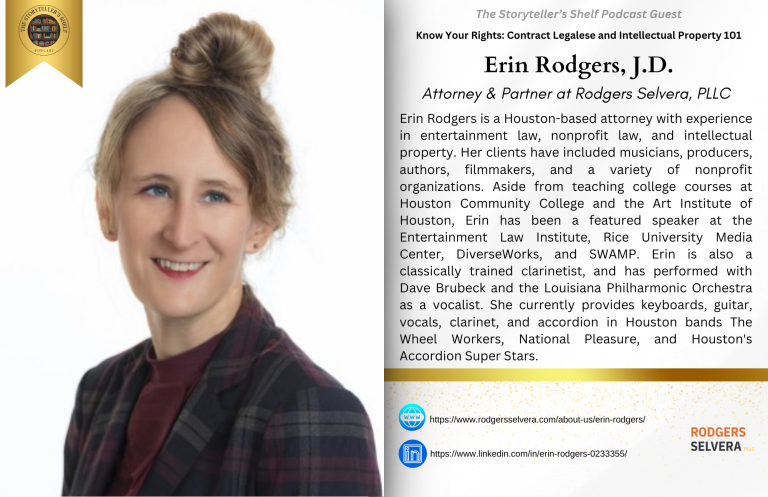
0:46 needs to hear. We are going to talk about all the legal stuff, all the things that can feel really intimidating and really, really hard to even delve into, but understanding them is so important. It's very essential to protecting your work and to making sure that you do the best you can do as an author. So, we have two amazing guests with us. And like usual, we will not introduce them. We want them to introduce themselves. >> I'm so happy that we can talk to both of you today. And uh first, I want to start off with you, Erin. tell us a little bit about the work that you do as an entertainment attorney and how you help authors and creatives. >> Sure. I'm Aaron Rogers. I'm a partner at
1:24 Rogers SA here in Houston. I am also a musician myself. I play in a few bands. That's what I'm doing after this. I have a show tonight. But we help artists of all kinds and all media. So, we work with a lot of authors. Actually, one of my very first clients was a children's book author and I'm still working with her today. So, we don't shop for deals, but we can help with pretty much everything else from protecting your intellectual property, reviewing contracts, negotiating for you, helping you get out of a mess if you unfortunately get into one. But yeah, all of us here are involved in the entertainment world as well in some way or another. So, we really understand
1:58 where our clients are coming from. >> Tiffany, as both an attorney and an authorneur, how has your legal background influenced your approach into publishing? What led me into publishing was actually my son 2020 we're working from home and um it's like okay well what can I do to like kind of just have some sanity during this crazy time and so me and my son he was four at the time we loved uh reading we loved TV and we still love TV like engaging like we run around the living room with these TV characters and so the idea came to mind of explaining to kids including my son, the difference between actors and the characters that they play, as well as
2:42 letting them know that this is a career that they can pursue. And so I went into Andrew Learns about actors, and that was my first self-published book. The reason I went into self-publishing is because I researched and looked around, you know, my legal background, I'm researching, trying to figure this whole publishing industry out. And I realized pretty quickly that just submitting manuscripts to traditional publishing companies is not really going to yield you the result that you want and that a lot of them require um literary agents. I don't know what that is. It's 2020. I'm just now dipping in and I'm non no name. I didn't have a writing background aside from
3:20 legal writing if you will. And so I said, you know what? I can do this myself. So I used my legal skills, waited through the information of self-publishing and I started self-publishing and then I realized that I can really make an impact in the industry and continued on. The legal background helped with not being taken for granted ammed especially when you're dealing with like illustrators because as self-published authors we are doing everything pretty much ourselves. So we're interacting and engaging work across the board ourselves. So being able to understand copywriting, how to apply for my copyright and how to go about an LCCN, like finding things like
4:00 that. What does it mean if someone is to record my book, my entire book as a readaloud on YouTube without my permission? What are my protections against that? Do I have protections against that? So things like that I was able to identify and figure out because of my legal background. Those are a lot of questions that people typically have on their mind, I think, especially when they're a beginning author. But let's let's take a step back and let's start, I guess, understanding um publishing contracts a little bit. So, Erin, I'll start with you. Publishing contracts are notorious for people who are not lawyers for being quite complex in what we see
4:38 as legal jargon. What are some of the most important clauses that authors should always pay attention to? Well, that's a difficult question because it really depends on first of all the type of work that you're working on and also the level of the publisher that you're going to because a self-publishing contract is going to look entirely different than going to a big publisher and publishing a a you hardcover book or a trade paperback. So, it's hard to explicitly answer that question on a general basis, but obviously the most important thing is what rights are you giving them? What rights are you keeping? is whatever they're offering you in line with what's fair in the
5:16 industry. And that is a nice thing about publishing is that's relatively standard. Not the advanced necessarily, but the percentages are pretty standard. And then something else I I think is important to have if you are not talking about self-publishing is reversion rights, if you're familiar with that, which is if you publish or shove my book and aren't doing anything with it after a certain amount of time, I can get those rights back and either do something myself or go to a third party. And then the third general thing that I look for is ancillary rights. So, is this publisher also gaining the right to produce my story into a TV show or to make toys or make a play version out of
5:53 this? Am I giving up those rights? And if so, what am I getting for it? >> That is a great answer. And I was laughing because as lawyers, it's always it it depends. It really does. But since the last time we talked, Jackie, I actually have a literary agent. So, I went through the process of looking through the contract and because I have a legal background to me and I tell other people like when you're reading it, read it to make it make sense to you. You know what I'm saying? Like sometimes you do have the here two fours, there two fours and all those things, but really make it make sense because at the end of the day, it's an agreement. It's a meeting of the minds.
6:26 So the things I was looking for in particular because I do have my uh self-publishing company and so many books under that. The main thing I was looking for was that what I do under my self-publishing company had nothing to do with my agent or the agency that now represents me. That their extension or control is just for what I'm producing for them. Um the manuscript that I produce for them and anything forward like okay well I'm might put out another Andrew book. you're not going to take that, right? So, that's what I was looking for, just making sure that it was two separate things being that I have established a presence in the um self-publishing industry.
7:05 >> Tiffany, let me ask you, just going off of some of your self-publishing experience, we hope that self-publishers have a little more control over their work, but have you ever had to negotiate any contracts, whether it was with illustrators or distributors or even retailers? And if so, could you tell us a little bit more about the process behind that? >> Yeah, so my self-publishing journey is more I would probably say streamlined than others. And by that, I mean my contracts with illustrators are pretty standard and it's through the site that I use. So I have not had to craft a an agreement between me and an illustrator from scratch and think about all the
7:48 provisions that need to go in there. The illustrators I get are work for hire and so we have work for hire contract and so the extent of our agreement is this is how many illustrations I am asking you to do and this is how much I'm going to pay you and this is when you're going to produce it and these are how many revisions I have and then everything is mine like that's the extent of our agreement and that's just standard it's already provided in the offer as far as distribution because I am heavy on print on demand again there's not really any contracts other than the language that's on the website of what my percentage is and what my obligations are and what my
8:23 rights are um to that site to be on that site and what I do work with I do have a state side printer for like very emergency situations and so but again it's just a meeting of the minds a verbal meeting of the minds this is what I need when can you get it and how much is it going to cost I haven't had anyone the state side uh print on demand person like sign an NDA please you know I haven't done anything like that I know some authors who are like I'm sending out NDAs to anyone who touches my book. I haven't done it. I don't know if it's a good practice or not. Erin probably has more to say about that, but I have I guess a streamlined approach where I
8:59 feel protected with the platforms that I'm using. >> Erin, do you have any advice for us with NDAs? Should we be handing them out like candy? I >> I mean, for the most part, it depends on what level your project is at because if you're sharing the book or some portion thereof, you already got a copyright in that. So, you're already protected under copyright law. If you're trying to talk to somebody about developing a new concept, that's not copyrightable. So, at that point, you might want an NDA. I don't see tons of NDAs in this particular universe. It's more used in film, I would say. But that's not to say you couldn't, but I wouldn't be handing
9:33 them out like candy. I did have a note on what Tiffany said, though, about work for hire. So, work for hire as a concept means that the person who's hiring you owns the copyright, not you. And there's a lot of misconceptions about that. It could come out one of two ways. Either I'm an employee and it is my job to do this thing. Like I'm a graphic designer for Coca-Cola. That is my job. Coca-Cola is going to own everything that I do. But it can also come up contractually. So if I'm going to hire you to be an illustrator on a work for hire basis, that means I'm going to own the copyright in the artwork that you're doing and you're not going to own that
10:05 copyright. But I think another thing that people get confused about in that world is that a work for hire agreement has to be in writing. People often think, I paid this person, so it's a work for hire. And that's not true. It has to be in writing for it to be work for hire. And not all illustrator agreements are work for hire, but if that is your intention, you definitely need to have that written down. >> That's really good stuff, Aaron. And I would like to add because I have been a work for hire for a book that was traditionally published by Simon and Schustster, which is the story of Maya Angelou. And so for to kind of put it back into context because authors or
10:41 writers can be paid as a on a as higher basis. So I was recruited to write to provide the words for the story of Maya Angelou and they paid me my money and they said you have no royalty. We paid you now you go bye-bye. So every book that sells no matter how much it sells I was just paid for my words and I have no ownership in that book. Just another example of work for hire. That's a really good example and that's pretty typical, I'd say, from a traditional publishing point of view. So, I feel like you sharing that experience and those words, it's going to help people understand really what that means because when you're an author and you're creative, you sometimes don't think
11:23 three steps ahead to the legal and even the money portion of the business because you're so keen on bringing this creation to life, right? So this is why we love to have conversations like this because we want to make sure that people understand the reality of what they're getting into because something that you really love it really came from the heart. You might have wanted to keep track of right and be associated with beyond one moment could be lost to you potentially if you did not understand what for example work for hire was. I'm wondering if you might have any advice either Erin or Tiffany for illustrators who they're just beginning and they want to
12:02 be able to keep the rights to their artwork a lot of the times but they're not sure what happens once they complete that job and once it moves into a book. >> So that depends very much on whatever the contract says. I've done illustrator agreements where again where there are work for hire and also illustrator agreements where they're not and in that regard to protect the author to make sure they're getting the rights that they need. It's very clear like you illustrator can go do you can make fine art prints of the these pages or you can develop toys if you want but I have the right to put it in a book. No one else has that right. It's exclusive for me to
12:40 have those specific rights. But all of those details are just something to work out between the parties. So I would say as a beginning illustrator, you're probably going to get more work up front if you are willing to do work for higher work for uh for authors because then there's just it's easy. There's no question. I feel like in most cases, authors want if it's not going to be work for hire, it's usually because there's either a personal relationship or that artwork is pre-existing or the illustrator has a lot of clout and the author wants that illustrator to come in because it's going to make their book sell better and then you have a little
13:13 bit more to negotiate. But in the beginning, in the beginning, definitely don't do stuff for free. But as a work for hire, I think that's probably a way to get some more initial work. Do you mind if I throw out a random situation and just see if you have any thoughts about it? Because I of course when you work in this business, Theresa and I kind of joke, we hate social media, but we're always on social media. So, I'm always haunting it to see what's going on. And if you run into a lot of people looking for advice in publishing and one that I saw recently was that we had a self-published author. I don't know what kind of contract she had with her
13:48 illustrator, but she did publish the book herself. I think she used KDP and she wanted to make plush toys from the illustrations and she had the whole thing in process. Of course, she was cataloging her experience about getting the plush toys online and the illustrator she worked with saw that, reached out to her and said that they would like to take legal action because they felt it was not okay. I know this is a very vague situation and we don't have, you know, papers in front of us, but anything off the top of your head that could bring some clarity or be helpful to someone who eventually wants to make toys from illustrations that they did not illustrate. What should
14:27 they be thinking of in the beginning if they know that's a goal going into publishing the book? like you acknowledged, Jackie, we don't know what their agreement was. But, um, assuming that the illustrator was not a work for hire and that the illustrator, as Aaron has said before, owns the images, then the illustrator, to my understanding and knowledge, owns it and can tell you what you can do with it. And you would have to get essentially a license, I think, to uh, plaster the characters all over the place. However, with my work for higher agreement with my illust because I paid them, they don't own them. I get to plaster my characters on whatever I want without
15:08 recourse. So again, like you said, you really don't think about that when you're first venturing into the industry. What all does it mean? They own the images, but that is part of it and that's a very important part. If they own the images, then you only have the the rights or the license to use their images for what you agreed upon, which was to publish this book. And if you want to use it on something else, you got to go back to the drawing board. >> I think that reminds me of something, Jackie. Do you remember when we had a conversation with someone who did hybrid publishing? How does that work exactly? Or if it's a hybrid publisher, the question is, how does copyright work for
15:46 hybrid publishers? What are your rights if you sign up through a hybrid publisher? >> The hybrid. >> That's a good question. So, a hybrid publisher used to be known as a vanity press. So, instead of traditional publishing where they pay you, for example, you would pay the hybrid publisher to publish your book. So, it's like a weird mix of self-publishing assist but under a different name. And we have seen kind of some horror stories online. Not to scare anyone who's listening, but it we've seen some nightmares come out of it where people felt they lost the rights to their book and they didn't know that they were going to lose the rights to the book
16:20 after they signed with this hybrid publisher. And a lot of them often fall into being obligated to pay the publisher more and more to get the work done. And again, super general. I don't have experience with it. This is more of what I'm hearing going on in a very gentle way. But I think that's a good question because like when you're starting out, what is the best route? Should I go self-publish? Should I go hybrid? Or should I try to get an agent? Yeah. And so to understand how the copyright agreement works in the sense of all categories, I think that helps. So that's why I wanted to ask if you have information about for someone that's trying to go the hybrid publisher. It's
17:00 possible that it's an exclusive license because they may not want you to be able to go to a different person or to print that book yourself. So in that case, it's not necessarily that they would own your copyright, but that during the term of whatever agreement exists, that you wouldn't be able to do whatever you wanted to do with it. But as far as these ancillary rights go, like the rights to make toys, the rights to do whatever, it varies so much. I I just wanted to mention one more thing on that uh illustration question is that in a work for higher basis you own the illustrations but the characters are more complicated than that because you
17:33 own those illustrations but if this is a character that that illustrator had used in the past now who has the rights to do what with it and that's a general question I don't have an explicit answer because there's it's such a you know you got two lawyers on here so you're going to get a lot of it depends but but yeah the hybrid thing like I said I haven't seen one. So, I'm not sure, but that could be the the question is, is it exclusive? And what exclusive rights are they getting? >> So, I haven't seen a hybrid contract, hybrid publisher contract or agreement. I have not worked with a hybrid because I don't see the need for it. And I say it like that because newbies tend to
18:09 think or they think mistakenly that if they have a hybrid publisher, that means they're a traditional publisher. or if they get a vanity press, that means they had a traditional publisher. What they don't understand is that if this person, this entity was really a traditional publisher, you would not have to pay for anything. They pay you, you know, and so they're like, "Oh my gosh, they love my story and I was selected and I paid them $6,000 and I don't know when my money is coming and all." And it's like, "Why did you do that?" So for self-published authors who feel like they need assistance with self-publishing, there are options for having publishing
18:52 services. Myself, I provide a publishing services where the person owns the right to all of their work. I've just put it in a package for them. You got to set up your your accounts so you can um actually push publish on it, but I'm setting it up so it can look like a book. At the end of the day, I'm taking your manuscript to book. Other than that, that's all you paying for. I'm not keeping any royalties. It's just a service I'm providing. And so, hybrid publishers, the few that I know, again, I don't know about the copyrights and who owns what, but they do kind of try to operate as a traditional publishing company in the sense that they will take
19:28 royalties. So, you pay them to provide the service of publishing your book and then they take royalties on top of the payment you already pay them. And to Erin's point, you probably have some exclusivity to them so you don't go just to a whole another place or so you don't do it yourself. So I just want people to be aware that if you want to go the traditional publishing route, that is awesome. But if you're paying, then they're probably not a traditional company and you should possibly research heavily andor consider just getting publishing services or just doing it to yourself. >> It's a really important conversation and I know it's a little different than the
20:02 topic we have planned, but I will say two points. The first point is just like Tiffany said, a lot of these companies I believe most of their success is there because they are a little predatory in essence. They do prey on people who don't know. They don't understand what publishing is. They know that you don't know that paying a lot of money isn't how traditional publishing works and that's how they get a lot of their clients. But at the same time, I used to be extremely anti-hybrid publisher until I met a whole group of people who were very pro- it because they had used it for several books. And that's when I realized that everyone sort of has a
20:41 different goal in life when it comes to publishing. And these people, after talking with them, I figured out their motivation was to publish a book and to not really learn how to do it themselves. It was just a life milestone for them. A lot of them, by the way, were seniors, which, you know, could be a point in either bag here. predatory still or, you know, are they making wise decisions? I'm not sure. So, yeah, we might have to continue that in like a part two episode talking about hybrid after Erin unfortunately had like an introduction to them from us right now. She might be even more suspicious following this. Yeah, we appreciate you guys. You guys are doing great. So,
21:19 thank you. I want to start on the copyrighting. So if you are an author that may not understand how the copyright works, what and when an author writes a book, do you automatically own the copyright or there any other additional steps that you need to take? >> Sure. So yes, you already have a copyright as soon as you quote fix something in a tangible medium, which means if you write it down with a pen or if you type it on computer, take a photo with your phone, you already have a copyright in that. You don't have to do anything extra. But if it's something that you're going to go make money off of, I would recommend registering your copyright, which is pretty
21:57 straightforward. So copyright lasts in a typical work for your life plus 70 years. If it's a work for hire, it's different. So it's just a onetime registration, and that price ranges from $45 to $85 depending on which form you have to file, which is not something we need to get into. Regardless, it's under $100 to file. And the benefit that that gives you, well, there's a few benefits. The nice benefit is that if somebody wants to use your work or is interested in your work, you can back it up that you own it, having that copyright certificate is helpful in that regard. The less friendly reason to do it is statutory damages. So, if I write a book
22:33 and uh Jackie steals it and sells one copy and I was going to sell it for $10 a copy, I can sue her for $10 because that's what I can prove that I'm out. But if I have registered my copyright and she sells one book now, I can sue her for between $750 and $30,000 just for doing it and $150,000 if I can prove that she knew it was mine uh and that she's infringing my copyright. So, not that we all want to sue each other all the time. I hate doing that. But it's a it makes it easier to have a negotiation if you're like, "Hey, you stole my book. I could sue you for $150,000. What I really want is fill in the blank. Let's get this over with." Um, so that's a a
23:14 value in having registered your copyright as well. >> So, Tiffany, as both an author and an attorney, how have you approached copyright protection for your books? >> Right. So, um, I do register my copyright and I learned of being able to get a slight discount, if you will, by grouping your unpublished works. And I'm like, okay. Because I publish so many books, you guys, and I publish them so quickly that I'm like, any time I can save some money, let me do so. And so if you're an author who is looking to publish more than one book and save a little bit of coins, then try grouping your unpublished works. But so that's that. But my protection, so in the
23:53 self-published world, people on YouTube love to read children books out loud in its entirety, flipping page by page with no permission from the author or the publishing company, whoever owns it. So I'm like the naysayer. I'm like, don't do that because that's the whole point of having a copyright is to protect your work from being taken, reproduced, recorded in any form of fashion, including on YouTube. Okay, so I've said that I made that declaration. I've been unfriended because someone who was reading people's books for free without permission. I mean, thought I was attacking them when I wasn't. I was just putting out like this is why I don't do
24:36 it. And then when I talk to communities, they're like, "Why wouldn't I have my book read on YouTube? Why wouldn't I have it just play? That's an honor. It's free advertising." But my thought and reason for this and I've read on it and Aaron can back me up hopefully is the once and for all so I can be affirmed is that if you are allowing people to read your material without your permission on YouTube for example then if you decide at some point oh my gosh someone stole my work I want to go enforce my copyright either you'll be limited in your damages or it'll be like pointless. So let me know Aaron. All right. >> Partly. So you're told that's copyright
25:18 infringement. If somebody's reading your entire book, if they're reading a couple sentences as part of a review, that would be fair use, which is a whole other conversation. But if they're just wholesale reading your book on YouTube, that's copyright infringement. It doesn't necessarily limit your damages for that to have happened. That's more of a trademark thing where you have to enforce it constantly than a copyright thing. So, as far as having differences of opinion about people reading your stuff on YouTube, I mean, that's their prerogative. I always think that there's no copyright Santa Claus. And it's the same reason that you can find tons of
25:49 covers of some music and not covers of other music because it comes down to you caring about it. So, if somebody is really happy that somebody read their book on YouTube, great. They don't have to submit a takedown, but that doesn't make it not within your rights to do so if they've read the whole book. So, I think that's just something that each copyright owner can decide how they feel about it. But, but legally speaking, you're correct. If they're letting it happen, it's just because they're not bothered by the infringement. Doesn't mean it isn't infringement. >> Okay, I'll accept that. It depends. But I feel so bad when I do my copyright strikes because I'm like, you're so
26:23 lovely. I'm sure, but you're infringed on my copyright. And then you have a whole community of people like, oh my gosh, why would you do such a thing? It's an honor. >> A lot of people just don't know. and Tiffany, we had this conversation when we initially met and I'll say from working in the traditional publishing sphere, it's a really huge concern to us that you are reading an entire product online somewhere where it's accessible and this is not really legal oriented. But when you speak to a lot of these self-published authors, they think it's free public, it's free marketing for me. But I'll tell you from the number side of sales, sales will probably go down or
27:01 be unaffected by somebody reading your book in entirety online. What can I say? I know I'm breaking some hearts right now. Just like Tiffany said, we're kind of becoming the bad guy. But I generally don't think it's a good move. I'll also say in traditional marketing, we have a little rule handbook and the rule handbook says when it comes to things we're marketing for the Kidlet book, no more than 10% of the book in entirety should be shown. So, we do not 11% is a no. Okay, that's how much we don't want the full book online somewhere. It's beyond someone reading it out loud, beyond potential piracy. It just creates a lot of issues and none of it really seems to impact sales in a
27:43 positive way. So, I can't really recommend you being very gung-ho about story times online, which is sad because I know a lot of them are done with a good intention. They're very wellspirited. It's usually these pathy, happy people that just want to read books for kids. And I know that's so pure. Nobody wants to ruin that. But there are some other considerations that we have to remember when we're doing things, especially if it's not our own work, if it's someone else's. Maybe the money part will be more persuasive than the legal, >> right? Yeah. Yeah. Maybe me speaking dollars will help. I promise guys, really sales either go down, especially
28:21 if you're, you know, an individual or a really small company because these days, it's 2025, right? It's a technological world. Kids have a Kindle, they have a tablet, and they'd rather go to YouTube, press play on the video, and they don't need to buy your book because they have it there, and there's no motivation for them to really take it beyond that, unless they truly are very passionate about the book, and they want to read it every night, and the parent finally succumbs and says, "Okay, I'm going to order it from Amazon." So, you know, do you mind if I ask a little bit about piracy? This is like a thing I'm seeing online, Erin. It goes back to what you
28:55 were saying before about we don't want to sue everyone. We don't want everyone to have to sue everyone, but I'm seeing particularly in groups of self-publishers online that they're posting their book through self-publishing companies, right, that are publishing it for them. They make it up online. They're making some sales and then all of a sudden their entire book has been pirated and sold in other places and they just lose it. A lot of them just don't know what steps to take after that point. Is there I know all these general situations I'm throwing at you too, but is there anything that somebody who's had that happen should think of? Like what's the first step
29:34 that they should consider if they're in that situation? >> I am dealing with one of those right now. Ask me in a couple weeks. But in general, the thing that makes those complicated is obviously you can have them taken down. You can report them. That's fine. But a lot of times the companies that are doing this are hard to find or the individuals that are doing it are hard to find. It's not like they're down the street in the US. They're usually not even in the US. So, it can be really hard to cut it off at the source. Like I said, I'm I'm happy to do a followup later if I discover anything extra, but just stay vigilant on those take down requests. Um, and
30:09 that's really the best tool unless it's differently unless it's a different instance than that. But that is normally what's happening. There's just these like black market instances of people typically not in the US wholesale copying things and just seeing what they can do and it's frustrating. >> Yeah, it's a nasty situation for sure. I can't believe that you're dealing with a client that's having that happen to them right now. So, we are obliged to do a check-in later for all of our hearts and brains to see what the followup is, but we wish you the best of luck for that and for that person because it's one of the worst situations I think that you can be in.
30:44 It's like almost a child being stolen in a certain instance because that's how I that's how I see creatives being aligned with their work. That's their relationship with their work. It's something you birthed, so to speak. So, it's more than a heartbreak, right? It's definitely a tragedy. All right, we're going to talk a little bit now about a hard one. Advocating for yourself as an author. A thing that we all need lots of help with. So, Aaron, we will start with you again. Intimidation. I feel like is something that is felt a lot especially by new and emerging authors. So many new authors can feel really intimidated when it comes to negotiating contracts. Do
31:24 you have any advice that you can offer to them when it comes to advocating for themselves especially if they don't have a lawyer on hand or should that be something that they're doing getting a lawyer? >> Yeah, I had a few things on this and then I'm really interested to hear from Tiffany about this. I would say if you can get a lawyer to especially if this is a a bigger contract, absolutely hire someone to help you. You're going to spend less paying someone to look at it upfront than you are going to pay someone to get you out of a terrible deal later. I see that a lot. Sometimes multiples of 10 in what you would pay me to read the contract versus what you're
31:58 going to pay me to go to court to get you out of it. That being said, there are resources out there that I wanted to mention, especially pretty much every state has a a legal services organization for the arts. Like in Texas, we have Texas accountants and lawyers for the arts. And if you financially qualify, they provide proono legal services. Also, shout out here, the co-advisor of the University of Houston Entertainment Law Clinic. And we also take cases like this where we review things and can help with copyrights and stuff like that. There's also an upcoming copyright registration day in April if anyone's in Houston and needs it copyright registered. But all
32:32 that aside, if you're accepting a contract that's like a click-through agreement on a website with, say, for example, a hybrid publisher, there's probably not much you can do. Just, you know, it is what it is. But if you're working with a bigger publisher, they are giving you that contract the way that it should be best drafted for them and sort of expecting you to come back. And if you don't ask for anything, you are absolutely leaving something on the table. When I represent uh I represent both artists and like some some small record labels. When I'm working for the record label, I'm going to draft the agreement to be friendly to the record label and tell them the artist might ask
33:04 you for this thing. That would be fair. If you want to change it, here's the range. If I'm representing the artist, I'm going to tell them they're asking for this. I know you can get this number lowered. You should ask them for that. So, if you're not asking for anything, you're missing out. Especially, like I said, with a bigger publisher, you're you're absolutely leaving something on the table if you're not talking to them about it. Tiffany, what's your experience? >> On the self-published side, I would say kind of what I said earlier, like just make sure don't be afraid to ask questions. If you don't understand any something, then don't be afraid to go
33:34 back and ask. I know a lot of times people feel like, oh, well, maybe I'm just not smart enough. I don't want to look dumb by asking this question. But when it comes to collecting your coins, protecting your right, protecting your peace, ask those questions. um to an attorney, pay an attorney or treat negotiations with the people that you're working with to create the book or the schools that you go visit and like like you're for a job. Like never be afraid to walk away. And I feel like or I know that with self-published authors especially, we're scared to miss out on an like this could be my big break. So if I say no or if I push back, if I try to um do what's
34:15 right for me, then they might say no and it's going to just end me or so. And so really building up up that confidence and it took me some time, too. Really building up that confidence to know like, okay, this is what I'm worth. This is what my value is or this is what my rights are. These are my boundaries. And if people can't come to it or respect it or whatever, it's okay. You don't want to get in that relationship anyway cuz it's a relationship. But once you get in a contract, you're in a relationship. You're you're in a marriage. Me and my literary agent, we we joke about being engaged and all that thing. So, you're like married at this point, and it's
34:48 going to cost a lot of energy, pain, and possibly money to get out of that arrangement. Just again, make sure that you're understanding what you're getting into. Ask all the questions. Pay someone to help you read through your contracts. Don't go to your lawyer friend asking them to read through the contract for free. And just know that it's okay if they say no, but you'll never know. Just like job negotiations, when they come at you with a salary, you go back because usually they expect you to negotiate. So you go back with something and they say yes or no or they y'all meet in the middle. Like that's the whole point of business. >> I think another advantage of having a
35:25 lawyer or an agent on your side is being able to tell you what's realistic. Because like Tiffany said, absolutely you should know your worth. But are you going to get a $5 million advance on your first book and 90% royalties? No. And somebody can, you know, sort of tell you like this is realistic or they're way undervaluing you. You should ask for this. So that's a reason to to have somebody. But absolutely like know your worth and don't let it go. >> This has been so inspirational. I recently had an offer for a book, which I did take, but I was so nervous about it being my first publishing contract with an advance that I said, you know what, I'm too intimidated to try to
36:06 negotiate anything on the pay. I just saw the pay and I was happy and I went with it. But I wish that I had had a little more faith in myself to at least speak up even if it amounted to nothing. Sometimes trying can help you feel like you've done all that you could do and there's nothing wrong with that. Plus, you never know what's going to happen. I have seen it change on my end working. So, if you're hearing this, don't be like me and just hit the sign button. Please listen to these two experts here and know your worth. Give it a try. You don't know. You could have it. >> Yeah. And Jackie, like you're so right. When I had my work for hire, um I've
36:44 done it a couple of times, but when I had the work for hire the first time, I went back. I was like, "Hey, can we adjust this number?" They were like, "No." And I was like, "Okay, it was worth a shot." You know, so you might get no, but um you have to at least try. You don't want to wonder what if. That's the worst. Being like, "Well, what if I would have asked and they would have done something." So, Jackie, shame on you, but not really. Give yourself grace. You go, girl. Congratulations. >> I'll get it together for next time because there will be a next time. But people need to hear this. Publishing is a very hard and competitive industry. You know, there's a tilted relationship
37:18 sometimes between the publisher and the creatives. And we're all vying for the same positions here. So, it's really easy, especially as someone who is new, to get intimidated very quickly. Um, I've seen it happen personally, of course, to me, and I've seen it happen to people around me. But that being said, please, if you are here today, this is your wakeup call to try to push past that intimidation and find a little more confidence, even if you need not a lawyer friend, but a lawyer friend that you pay to help you find that confidence. I want to mention something that Tiffany said that I think is important, too. She said she asked for more money and they
37:53 said no. They didn't say never mind, like we're not going to sign you now. They still did. So, there's really no harm in asking for something once. They're not going to just be like, "Well, that contract's going in the trash because you asked for more money." So, I mean, hearing no is hard, but it's not going to ruin the whole deal to ask for something. >> This is it. We are motivation central right now. I'm loving this energy that's going on. All right, let's kind of jump into some potential real world scenario Q&As's. We've tried our best here with speaking to some people and again finding those general scenarios. We have three and you guys give me your thoughts
38:30 as professionals on all ends of the spectrum. So first one, let's say we have an author who signs a contract with a small press, but later finds out that the contract includes lifetime rights to publish their book. So they want to leave the publisher, but they're not sure if they can. What should they do? >> That's you, Aaron. >> You're like, uh, read the comma. So yeah, you signed that contract. You've got a few options. Hopefully, if it's something that the publisher is not exploiting, a lot of times you can just have that conversation, be like, "Hey, I see you're not doing anything with my book anymore. Can we just walk away and move on?" And sometimes they just say,
39:12 "Fine." Sometimes if they've expended money to produce your book and to sell it and they're not recouped, which means they haven't made their money back, they might ask for you to make them whole, at least to pay back whatever they have not made back from whatever expenses that they had, especially if they paid you in advance. So that could be a a thing. If they just say, "No, we're never letting you go," then you're just sort of getting into a debate about, "Is there anything in this contract I can argue? Is there anything they didn't do?" You know, sometimes when this happens in any kind of contract where there's something that's stuck forever and we're trying to
39:42 get out of it, I'm like, they were supposed to send you an accounting every six months. Did they do that? You know, that sort of thing. They were supposed to put you on their Instagram three times a month. Did they do that? You can use that for negotiation, too. Like, hey, I know it says you get to keep my rights forever, but you did not hold up your end of the bargain, so what's it going to be? And a lot of times, that can dislodge something as well. And that's even more reason why you should get Aaron before signing than after. She just told us, this is a real example of how important it is to sometimes show out the money if you don't go to one of
40:17 those resources that Aaron mentioned earlier to just have someone say, "This looks just awesome." Or, "No, you you know, you're going to be stuck with them for life." And they might be like, "Oh, but I love them. We're going to be married forever." And they're going to be like, "No, no, no. I've seen this before." if you're working with a specific person, and you may not ever get away with this in the beginning, but it it can be worth asking, is to have a keyman clause that like if there's a person at the publisher that's going to bat for you, and you want to say like, I if Jackie leaves this publishing company, we have the right to have a conversation about whether or not I get
40:50 to stay. If Jackie is really the one that went to bat for my book and is the one is the reason that it is succeeding at that company, I don't want to be stuck with some random person. I don't know if if she leaves. So, that's something you can ask for. These were amazing answers. Okay, scenario two sort of relates back to something we had previously discussed and I have seen people talk about it happening to them online. So hopefully this will be useful to some people listening. Our scenario is a self-published author hires but they don't have an upfront contract. The illustrator now claims ownership over the artwork and they want royalties. What are the steps both
41:28 should take? Um, I mean, it sounds like Tiffany has always made sure that she's working with illustrators where she has contracts up front, which is the thing. But if we're talking about a scenario where we did not do that, then the illustrator is right. Like I said earlier, work for hire has to be in writing. So whether or not you paid them or whatever you did, if you don't have it in writing that it's a work for hire and that those are your illustrations now, then they're not. So in copyright, anyone who contributes to a joint work, an independently copyrightable element, by default, that work is owned equally. So if we have no contracts and I write a
42:03 book and Tiffany creates the artwork and we didn't sign anything and we join those things together into a book, we now own it 50/50. So, it's not exactly fair to say that that person now wants royalties because that would typically be something you would negotiate, but they would be entitled to half of the proceeds because they own half of the copyright. And and of course, you can always agree to whatever else you want to agree to, but if there is no agreement, the illustrator did something for you. There's no nothing in writing, then they own half of the book. >> All right, I have one more scenario, and hopefully it's not too nebulous. So, let's say that we have an author who has
42:39 signed a contract with a traditional publisher for a book series, and they've gotten a few books in, maybe one book out of three, maybe two books out of four, something similar to that, and it's been a couple years, they have not heard from the publisher to work on the next book, publisher ghosting scenario. Is there anything legally that they can do to make sure that their contract is fulfilled? I'm gonna point this to Aaron, but I just want to make sure I understand the scenario. So, they've already been paid up front by the traditional publishing company to produce a series of books and they haven't finished producing the books, but they have a problem with the
43:18 publishing company. Yeah. So, I've seen this actually happen in more than one way, which is how I got this question. In one of them, the author was paid per book. So they signed to have the series produced by the traditional publisher. But every time the book would come up, they would get the advance for that particular book. And after book three, the publisher stopped reaching out to them. Like I said, almost a ghosting situation where they just stopped answering their emails. They stopped answering their phones. The person had no idea what to do. They just knew that they wanted to finish the series and hopefully get paid for the rest of the series or take the series somewhere
43:54 else. And they felt very stuck. in fact, they're still dealing with the situation. >> So, there's a few things there. Again, it all comes down to your contract. Many contracts have a breach and cure period in the contract where it would say if somebody's not doing what they're supposed to be doing, I have to give you some amount of notice. Often, it's 30 days and you have 30 days to fix this thing or fill in the blank happens, the contract is terminated, I can sue you, you're officially in breach, whatever. I think the thing that would be difficult about this scenario is if you've already been paid and your concern is more about being able to put the book out, it's
44:32 going to be hard to show that you had damages because you got money and didn't necessarily have to do the work. Um, if it's about you have not been paid and you have not been doing other projects because you were waiting to work on this project and you're just not hearing from anybody, that would be a little bit different. But yeah, that's complicated. I think the biggest thing is to just keep everything in writing. some certified letters say, "Hey, I haven't heard from you. Pursuant to whatever paragraph of our contract, we're supposed to be working on the next book. It's February now. You've got 30 days to tell me what's going on." But at the end
45:04 of the day, if they just never answer you, that is a messy situation. >> Like writing protects you. That's what Aaron has been teaching us all. That's what I kind of I guess y'all ask me like you as an attorney, how has that helped you along your way? I understand the importance of that. I understand the importance of agreements. I understand the importance of knowing what your rights are, knowing what you're entitled to, knowing what the other party's rights are. I do have a little bit more confidence in negotiating, but not that much. Negotiating on behalf of other people is much easier than on your behalf of yourself. So, yeah, that background did come into my legal
45:36 background has come into play and helped me tremendously. And if I don't know the answer, whereas I might not spend the money to hire Aaron, I do dig around and um use my research skills to try to figure it out to the best of my abilities or I have a network of attorneys who are IP attorneys who I can shoot a quick question to, but because I know about free legal advice, I try not to go too far into things. But that is some of the benefits of having the legal background that I have. If there is something else that gets discussed that isn't in the contract either after the contract signed or at any point to have that also in some kind of writing like I
46:13 will confirm an email like if we talked on the phone be like hey so I just wanted to confirm that we just had this conversation that if I sold 10,000 copies of my book you agreed to pay for my next book tour or up my royalty or or whatever. Obviously adding it to the contract is better, but if that's not going to happen, at least having some sort of email or text that's confirming these other things is the last thing. Or if there is no contract, which hopefully there always is, but the more you can summarize conversations that you had in text or email or something, it's better than nothing. >> I think our list is amazing. To be quite frank with you, I want to open up the
46:48 floor if there's anything lasting on your minds that you might want to share based on what we've spoken about or maybe things that we've missed or things, you know, just about you that you think might inspire other people. You're very welcome to share it with us. >> Illustrators and Picture Book Authors, entries are open for the Storytellers Shelf Podcast Consumer Awards. Win a cash prize, a featured interview, and more. Get your work seen, celebrated, and supported. Submit now and join the family. >> While I don't want to go into the abyss of trademarks, I do want to just point out that copyright and trademarks are two totally different things that
47:31 protect two totally different things as well. Sometimes new authors will be like, "Oh, I'm trademarking my manuscript." I'm like, "No, you're not. That's not what you're doing." So, um, I did want to put that out there. I don't know if Aaron wants I saw her shaking her head. I don't know if you want to add more to it, but I know it can get kind of convoluted, so I'mma pause real quick. >> Absolutely. And in fact, that's a thing. Don't be embarrassed if you didn't know that because I was in a deposition recently and my client made a film and the other lawyer who's like a seasoned litigator kept asking her if she'd patented her movie and she was like,
48:01 "No." And he was like, "Yes, I've discovered this important knowledge." And I'm like, "You don't patent movies, bro." But yeah, trademark is something that would protect your brand name. authors could come up to needing trademarks. If you're creating like a series of books, you might trademark the name of that series. But for the most part, the important thing in this realm is the copyright. But yeah, that's a great point, Tiffany. >> And Aaron gave another great example of how not only have an attorney, but have an attorney who is experienced in the area that you were seeking representation in. Hence why I'm not a contracts attorney or IP attorney, so
48:34 you can come to me all you want to. I did successfully apply for my own trademark, but someone was like, "Oh, I'll pay you." I'm not a trademark attorney. I cannot tell you how I fumbled my way through. So, you might want to go to Aaron or someone else to help you with that. And the other thing I would say and take away is self-publishing is hard work. It is a lot of things that you have to know, but it is definitely something that I empower others to. If they're not going to go the traditional route, I empower you to learn how to do it yourself because a lot of times once you publish one book, you're going to publish more than one. and having to keep paying
49:07 $4,000, $6,000, $10,000 to someone else, even if it was me, is just like, why? Why would you do that? And the margins on publishing children's books is so low that had shelving out that 6,000, 4,000, it could take a while to get back. The statistics say that few people sell more than 250 copies of their title. And so with that in mind, 250, even if you had the highest royalty margin, still it's hard to get to $4,000, $6,000,000. And then also, I would say you can do it. Your story needs to be told. And being able to self-publish is access that wasn't always around. I think it became more of a mainstay in 2013 and then it really took off in 2020. And so
49:51 it is a lane that's available to all. However, just because it's available don't mean you need to take it or take it the way that you're taking it. Still make sure you're putting out quality materials that traditional that can compete with traditional publishing companies. So, really research what's going on in the industry. I'm not saying you have to be a guru in it, but at least have some type of interest in understanding the different different levels to publishing, understanding what a copyright is, understanding how to protect your copyright, understanding that trademark is different from a copyright. Like these bas what I consider basics. My husband be like,
50:25 "That's not basic to everybody." But what I consider basic have that, but you can definitely do it. Just make sure you're putting out a great pop product. The end. >> All right. Well, storytellers, thank you for listening in. We are going to wrap this up and thank Erin and Tiffany for being so wonderful, for being so knowledgeable, and just being here with us. And in case you haven't figured it out by now, the reason we brought Tiffany here is because we want you to know that you can learn the process as you're going and be so successful. And we brought Erin here so that you know there is help and expertise out there available to you should you need it. And
51:02 we hope that you don't need it, but you might need it. So be aware that those resources exist. And with that in mind, please go to our website, the storytellershelfpodcast.com. Go to our episodic calendar page and find Tiffany and Aaron's names. Click on them and you will find where they are living on the internet, where you can learn more about them and where you can support them. And we would really appreciate that. Again, Tiffany and Aaron, it's been so lovely having you on. We can't thank you enough for being here. [Music]