0:00 Hey storytellers, before we start today's episode, we have something exciting to share. The Storyteller Shelf Summit is almost here. A full week of virtual mini master classes to help you grow as a writer, an illustrator, or an educator in children's literature. We are also offering an exclusive pitch event with literary agent Cerrone Harvey, giving you a rare chance to get your work in front of an agent. To participate, you'll need to purchase both the summit ticket and the separate pitch ticket. Click the link in the description. We can't wait to see you at the summit.
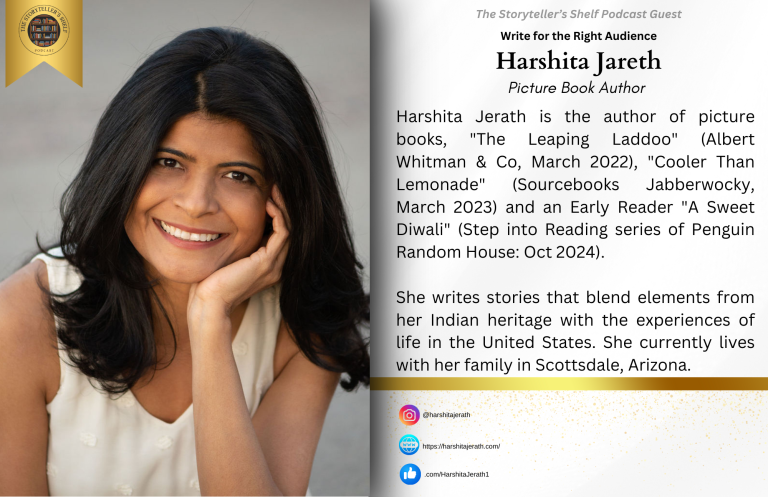
0:48 Hi everyone, welcome back to the Storyteller Shelf podcast. It is Jackie and Teresa and we are back once again with another really exciting episode. This one is called Write for the Right Audience and I'm sure you heard the word play there. We have brought with us an extremely accomplished author here to talk to you. Harshida, can you introduce yourself to our listeners? Hello and namaste everybody. I am Harshetta Jared and I'm very excited to be here on this podcast. So, thank you Jackie and Teresa. I write books for children but it wasn't always like this. I did not uh think writing as my profession growing up. I used to maintain a journal and
1:32 that is what I did for writing at that time. I did not pursue writing as a career. I was a healthc care business analyst and only when I took a break from my corporate career you can call it raising the kids break and I surrounded them with lots of books I took them to library and at that time that's when the desire to write again rekindled and what I did at that time was a very big step I would say because uh I started a blog that was the first time I opened myself up to the public, my writing. So I shared my writing for others at that time. That was the first big step. And then second big step happened when my
2:19 husband he gifted me a writing course, writing for children. It was a group on gift that got me all excited that got me started and uh that was the beginning of my writing journey and that's when I realized that I wanted to learn more and I started taking courses. I explored the community in Arizona because that's where I live. I found out about SCBWI organizations. I found out about other social media groups. I found out about the importance of forming a critique group and from there on and on the conferences their the classes I kept
3:04 going on I found my agent and now I have three books since you've written both picture books and leveled readers which obviously they have two different structures right and different purposes can you break down any kind of key differences between the two and what make them unique Oh yes. See picture books by design they are to be read to the children by an adult. An adult reads it to the children. That's how the picture books are designed. It does not mean that children don't read it on their own or they can't read it on their own but by design that's the that's how picture books are. So you would see some complicated words in it. The story line
3:45 can be a little bit complex. The conflict can be a little bit complex as compared to early readers. the level readers. So because level readers are designed for uh children to read on their own that is supposed to be their first book. It's uh there to build confidence in their reading. Another key difference is they both are picture books. There are pictures in both the books. However, in early readers, the illustrations offer clue to the text that the child is reading so that uh it uh amplifies their confidence in reading. So that's the main idea about early reader and the plot is a lot simpler, very few words on a page and it
4:31 is governed by bunch of rules. So those are the three differences. Did I say three? So the illustration, the plot structure, the the use of words, complex word, that was a wonderful explanation. And with that being said, let's talk nitty-g gritties for a second. Let's go into the details for you as an author. How does your writing process change when you're approaching leveled reader versus picture book? Oh, that's a great question. My writing does change because it has to include all these aspects. For early reader or picture books, I keep my audience in front of me while
5:18 writing. So for early readers, I uh use a lot simpler vocabulary for first. Then the conflict in the plot is not that complex. It is pretty simple. Then the third thing which is very important is that early readers generally happen in sequence. There are they there are series to it. So when I'm thinking stories for early reader I try to come up with the stories that I can expand on. There can be another book that can come out of it. So while I'm doing picture books it would really help to have a series but uh it can be just a
6:04 story on its own but in early readers I try that okay if the publisher likes it then can there be another book related to that story that plot or that character. So writing for children means writing for children. We are all as authors always struggling to put ourselves back in that child's mindset. What do you do to make sure that you're taking on a perspective that actually reflects a child's point of view when you're writing your stories? >> Hey storytellers, if you're still juggling word docs, sticky notes, and 47 browser tabs to keep your story straight, it's time to simplify your writing life. Meet Scrivener, the writing software built by writers for writers. Whether
6:50 you're drafting a novel, a picture book, or even a dissertation, Scrier helps you organize your scenes, research, and revisions all in one beautifully structured workspace. Many of our guests on the Storytellers Shelf podcast have raved about Scrivener and how it completely changed their writing flow. You can move chapters around with a click, store your notes right next to your draft, and even set word count goals that actually keep you motivated. >> Curious? Check out our affiliate link. It helps support the show at no extra cost to you. And let us know if you give it a try. We'd love to hear how it helps your writing process. >> I'm going to tell you a little story.
7:33 Okay. So this particular story is from a Sanskrit epic called Mahabharat. The guru, the teacher. He one day decides to test archery skills of all his princely students. So he invites them. He puts a wooden bird on top of a branch of a tree and he invites them to test their archery skills. Right? So he invites student number one and uh he asks he asks a question what do you see? So uh the student aims uh at the object the wooden bird and he answers the question. He says I see the
8:18 wooden bird. I see the branches. I see the trees. I see the sky. So he he's not impressed. The guru is not impressed. He asked another student. So what do you see? He pretty much says the same thing. The uh uh the bird, the branches, sky, everything around it. Again, guru is not impressed. Then finally Arjun the student comes and he asks the same question. What do you see? He says, I only see the eye of the bird. And the guru is very impressed. He says, okay, now you can release the arrow. The student releases the arrow and of course um you know where it hits, it hits at the bird's eye precisely. That's the focus. So the reason I tell you about
9:00 this story is we as an authors we need to have the same kind of laser focus identifying the audience we are writing for so that we kind of build a boundary around our writing it and then within that constraint we write we experiment we connect with the audience we are writing for. Yeah, we write. We are a picture book authors. We write for uh children. First thing is age which is so much easy, right? Picture books are supposed to be for children. Even though we say it's for everybody which they are 0 to 99 years old but pretty much uh we
9:45 define the age as between 4 to 8 years old. few few years more here and there but pretty much that's the so what it does is it um helps me focus that the main character will be of a similar age right so that is pretty easy when we start so age group is good then another thing I would say uh is um trying to put like you mentioned that trying to put yourself in their shoes empathy you have to See uh once you know the age, what the uh child feels, what are the emotions, what are the challenges they go through, what makes them laugh, what all those things
10:32 just trying to be empathet empathetic as a and that's when you will be able to write stories that would connect with the right audience. So my question is what strategies do you use to ensure that your writing is age appropriate and you know based on that what is one of the biggest challenges that comes to mind when you've been writing and how do you overcome that okay first to answer your part A which is um the strategy I always picture my kids in that age when they're teenagers now but I always when I'm writing I always visualize if
11:19 all the books are laid out in front of them will they pick up my book so that is one thing I always think uh while writing it is there uh in back of my mind because uh my children I know if there is a lesson in the book they will reject it they will not they they're like oh there's a moral I'm not taking that book. So I know those are the things uh that are in my mind while I'm writing that okay there the there has to be a lesson. There is a not every book has to have a lesson but if there is a lesson it has to be so carefully sneaked in that they won't even realize that there is a lesson. So I know that uh is
12:04 true because I've seen my kids uh reject books because outright like oh that's a lesson not taking it. So that's one thing. Then um another strategy is observing other children. Observing um my nieces, nephews, other children that uh how they react to situations. What are the fun phrases they say? They talk about observing kids in the in the playground while doing story time in the library. So observation is another technique that helps to identify um the way to improve on writing for the right audience. I would also say uh
12:49 there are some blogs research on um internet just finding out how reading about what um challenges children of that age are facing. Then uh there is one more thing um which is uh uh watching some TV episodes that kids of that age group watch. So what it does is it uh wires your brain that you are in tune with what uh children watch, what issues are happening and it ends up giving me some ideas too. So those are the few things I remember. Uh uh if I think of something else I'll I'll just add it
13:35 while we are talking. You know, authors sometimes I think we get a little caught in our own minds and we get a little stuck in the process of writing. And it's nice to change it up and consume something that is outside of the written word for inspiration and for guidance because at the end of the day, although it pains us to admit it, books are a form of entertainment. Absolutely. It's so cool. Those tiny, simple stories. Wow. I just love them. As authors, we like to connect with other authors. And something that's very big right now and probably will continue to be, especially the more that uh societies like SCBWR are bringing us together, is that we
14:18 like to comment on each other's work and we like to share our work so that we can get constructive criticism back. That being said, have you been the beta tester for anyone's manuscripts recently? And if so, I'd love to know if you thought you were seeing any particular mistakes that were trending in writers on how to target an age group. I work with a bunch of critique clubs and uh we critique each other's work. The only thing I can say is if for authors who are new to writing picture books, it is very normal to add more words or uh it comes with practice, right? uh writing for children but
15:05 otherwise uh uh I'm not seeing anything as trend but something like leaving space for the illustrator um having uh a conflict that is more of an adult conflict and not of a child. It comes with practice you know. Um while I was starting at that time I met I did a lot of uncool things by the way waiting for people trying just to connect doing a lot of uncool things. So uh one of uh you can say not the mentor but uh somebody experienced in writing in this book area. She told me that keep working on your craft and when you are ready
15:51 success will find you. Not in that I'm paraphrasing our conversation at a coffee shop but uh this is what I got out of uh our conversation that keep working on your craft. Um don't be um after like I'm not finding an agent. I'm not done this. So that uh that is one thing. So authors when they are starting out, it is absolutely okay with the mistakes that you were saying not leaving space for the illustrator or too much words. It's all part of the journey. I also did it when I was starting out. So you realize, you learn from it, you grow and then when you are ready, you will find success. By
16:37 success, I mean whatever success means to you, you will get to it. Beautifully said. So your books, they do celebrate your culture in such beautiful ways and accessible ways. And I'd love if you could give some advice to people who are trying to write more about their culture in their book. What are the small pieces of information that help make that resonate to readers who are not used to your culture? So I'll take a step back and uh for listeners who do not know I was born and raised in India and I moved to the US after my marriage. So um and second thing before even answering the question I want to say is what really culture is. Culture is a mix of lot of
17:24 things, seen and unseen things like uh culture is about food, language, even the way you were brought up, your surroundings, your um uh society, all of those things form a culture and that culture gives a writer a unique lens. It colors the lens through which you see the world and uh that is what gives a unique voice. This is who I am. All right. This is how uh I was raised. I I am bilingual. I speak Hindi and English and um English is my second language. So many things. This is all me. So when a
18:09 writer writes a book, a piece of the writer is always there in any of the story they write. So now with that in mind, my first book the debut is the leaping loo. So this idea of the story was uh brewing inside me for a very very long time. It came to me when my kids were toddlers. Imagine now they are teenagers. So that's how long. So the idea came to me because uh I would travel to India every year with them and uh for those who do not know that uh flight to India is very very long. Imagine traveling with two toddlers uh in 24hour plus flight. U
18:55 I used to do that and I read in mommy parenting books that you have to prepare children in advance uh for what is about to come. that helps ease their anxiety and so I would prepare them that okay we are going to India as soon as you come out of the airport the streets uh will be noisy you'll see lot of cars honking this everything I would just paint a picture for them and that is when the idea was planted I was like wouldn't it be amazing if there was a book about it uh so that somebody else who needs something like this like a mom who going to India would it won't it be helpful for the children so that's when the idea
19:40 was planted but I didn't know how to convert it in a story at that time I was it was just an idea nothing else was happening and after many years um when I was making laddus loo is a round shape Indian desert so I was shaping laddus for my son's birthday and one loo fell out of my hand And that is when it was a aha moment and I thought about Indian gingerbread man and everything came together. It was that moment right the idea and I had the imagery in my mind very clearly and I thought it would be perfect uh for this cumulative story.
20:25 So that's how this book came into being. The first one the leaping laddu sprinkled with Hindi words and um introducing streets of India the readers. So that was my first book and then the second book the uh which is titled cooler than lemonade. The idea came to me it was inspired by my younger son. He came to me uh and he said he would like to open a kulfi stand at a farmers market. So kulfi is a frozen Indian desert pretty similar to ice cream. And uh I make it quite often during summer season. So he was super
21:12 excited. He's like, "Oh, not many people know about it. I would love to have a kulfi stand at a farmers market." And that's when suddenly I thought that it would be a great idea for a book uh to introduce children to entrepreneurial concept. So I just noted the idea at that time and uh the initial draft that I wrote was set up in the farmers market and it there was a lot of mom in the picture. I when in my drafts I always do that. That is one thing I have to remove it later on in my revisions. I plant myself everywhere. So anyway, so that was the second book,
21:57 Cooler Than Lemonade, which uh uh is about a spunky character who wants to open a lemonade stand ultimately who opens a lemonade stand and encounters stiff competition and transitions to Kulfi the ice cream. So that was the inspiration for my second book. And then my third book which is a level reader called a sweet Diwali. Like I mentioned earlier for early readers I was thinking about stories that could have more uh sequence like other other books as well potential for other books. So, I was looking for stories that would
22:45 help me do that. And I always have lots of stories about my childhood pet dog. Always. I would keep tell you ask me and I can really say so many things. He's a little dog with a big personality. So came about a sweet Diwali which is a story about friendship between a little girl and her tiny dog called lion. So that was the genesis of a sweet Diwali. So like I said culture just came in because that's who I am. That's um that's just part of me. That's organically part of the stories that I write.
23:32 So, I think a lot of us were trying to find a way to stand out more and to make sure that people understand why our stories from our culture are important. But I think the best advice is not to get so lost in how to pitch that, but just really stay true to yourself and just be you when you're writing. And if you're writing on your experience, write on your experience and try not to stress too much beyond that. That's true. So write from uh draw from your heart. So if you're true to your stories, readers will know it and uh they will find a deep connection with it. We'll throw in a little challenge here for anyone listening. If you have some
24:18 time, write from the heart and leave us two sentences below on what came to mind. No extra thinking though. You just have to do it. It's one of those writing exercises where you can't plan and prep ahead. All right. When it comes to vocabulary choices, particularly in leveled readers, do you have any advice for people trying to keep it simple and again trying to readopt that child mindset? This episode of the Storyteller Show fun is brought to you by Harney and Suns fine te's. A perfect companion to every story. Whether you're reading, writing, or just enjoying a quiet moment to yourself, Arie and Suns offers a beautiful selection of teas to elevate
24:59 this experience. From classic blends to unique finds, every cup is crafted with care. Just like the stories we love to share, shopcarnne.com/disount/storyteller. And Storyteller is in all cap. Now let's get back to the show. >> There are some rules that govern level readers. I would uh say or writers who are curious about level readers and who want to explore the genre, I would uh urge them to take some classes. The one that I took was uh from highlights foundation. That really helped me. So they guide you about short sentences, about the word count and uh how to go about writing an early reader. And
25:44 another thing besides taking class is pick a bunch of books from your local library or if you prefer buying it, do whatever. But read a lot of early readers. So you will be able to see how different it is and how differently the author has written it as compared to picture books. So the challenge in early readers is that even though it's early reader simple vocabulary so many things but uh what I found really challenging is to maintain the delicate balance because you have to balance the vocabulary you have to take care of the word count you have to take care of the sentence structure the way it's going to appear on the page versus and also uh
26:29 still have a plot a engaging plot for uh children to dive into right so just having all that delicately balanced was a lot lot of challenge for me but that's exciting part right that's the exciting part the challenge is exciting let me pick your brain again as you the author are you a person who likes to structure and write out plot lines before you start writing or are you someone who likes to just begin writing and see where the writing takes takes them. Second one, I am impromptu. I just like the only thing I do is write the idea. Any kind of idea. It could come in as a
27:14 title. It could come in as a particular phrase. Anything that catches my fancy because I keep telling my brain I'm open to ideas. So, anything that's what I write it in my notepad and after that once I'm uh on my laptop wherever the story takes me. So yeah, I'm not organized that way. Everybody is wired differently. It's just that I'm just wired to do things like in just the way it is. Just keep going with the flow. But for me, I know personally that when I do it, story doesn't come out the way I want. At least the first time like I was talking about planting myself in every picture. It requires so many re-revisions and the plot structure
28:00 changes to so many things uh happen in between. But maybe someday I'll learn and be a better planner. But for now, this is what I'm sticking to. We here allow everyone your creative freedom. So sometimes you might grow in one way and sometimes you might be exactly where you're supposed to be. All right. If you could give one piece of advice to our listeners, what would you give them? I would say because this is for writing for the right audience, I would say define your bird's eye and write something that speaks to the audience. Remember the bird's eye, the story I told you. So uh keep your audience in your mind whenever you are writing. And if you're writing for picture books,
28:46 picture books are very unique children's books because you have to cater to two audience, not just one, right? One is kids of course and also to adults because adults are the buyers. So for me personally, put myself in the picture and say will I pick up that book uh for my children. So when you're writing, keep that in mind. bird's eye focus to the audience that you are writing for. Write from your heart and it would help you connect with your right audience. Thank you for watching the Storyteller Shop podcast. If you enjoyed this episode, be sure to like, share, and subscribe so you never miss new insights from emerging authors, illustrators, and
29:30 publishing professionals. Your support truly helps our show grow. And if you'd like to support us directly, visit our Kofhei page and click buy me a Kofhei. Thanks again for tuning in.