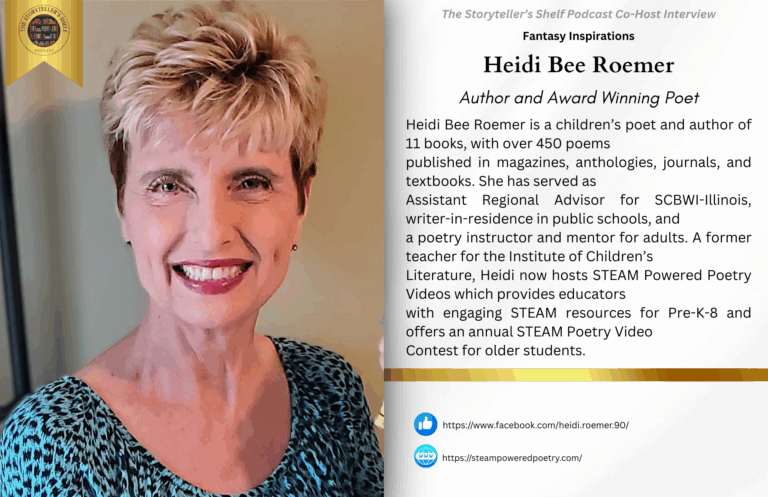
0:00 Hey storytellers, if you're still juggling Word Docs, sticky notes, and 47 browser tabs to keep your story straight, it's time to simplify your writing life. Meet Scrier, the writing software built by writers for writers. Whether you're drafting a novel, a picture book, or even a dissertation, Scrier helps you organize your scenes, research, and revisions all in one beautifully structured workspace. Many of our guests on the Storytellers Shelf podcast have raved about Scrivener and how it completely changed their writing flow. You can move chapters around with a click, store your notes right next to your draft, and even set word count goals that actually keep you
0:39 motivated. >> Curious? Check out our affiliate link. It helps support the show at no extra cost to you. And let us know if you give it a try. We'd love to hear how it helps your writing process. >> [music] >> Hi guys and welcome back to the Storyteller Shelf podcast. It's Jackie here with Teresa again and we have brought you an incredible segment that is rarely talked about. We are talking about poetry today and yes we have brought you an expert. Heidi is here.
1:24 She is a poet, an author and more. Heidi, would you please for our listeners tell us more about yourself, how you became a poet and what you're doing right now? Okay, first of all, how much time do we have now? That could take a while. So, I'll give you the short version. Um, so I'll just start really quick. As a child, I was an avid reader. I loved books. I loved silly words. I love nonsense. Um, I fell in love with language, I guess, at an early age. My mom says that when I was a toddler, she had an old 45 record and it was it played the song um the Hawaiian War Chant. I don't know if you know that, but it was silly. And I'm going to really be brave here and sing a few
2:10 lines for you. Not a I'm not a singer, but it goes it went like this. Wiki wy wy wy wy wack. Wy wy wy wy wy wack. My mom says I would just roll on the floor in fits of laughter and wanted to play it over and over again. So I guess I had what is it a high threshold or a low I don't know what that how that works but I had a threshold for humor and funny words. Another one that another experience what I remember as a kid loving language first of all was uh the poem when daddy fell into the pond. Do you know that classic? My dad wore a tuxedo to work sometimes and we had lakes and ponds by our house a lot of them. And I read the poem. I heard the poem when daddy fell
2:51 into the pond. And I just imagined him coming up with, you know, the duckweed all over him. And I just it just cracked me up. So I fell in love with children's writing again as a grown-up with a mom and when I was reading to my boys and I there were some books I read or poems I read. I go, "That's pretty good." And then there were others I said, "How did that ever get published? I think I could do better." So that was my kickstart. And then I had to learn how to do it all. You know, I learned on my own. I didn't go to school to learn poetry, you know. It was just selftaught. >> That's awesome. I actually have heard that song. My mom also played that
3:28 because my late mother was one of those where she liked the classics, you know, from like the 40s and 50s and she would always play like the music like that and it would always make me laugh as well, you know, and such nostalgia when you think about it and it brings you into like a warm place and I and I think poetry in itself, you're using the five senses a lot of times when you're writing and when you're even reading poetry and it brings back when you're a kid and and that being said, um when When you're writing poetry for kids, what makes great children's poems from an editorial or publishing perspective? What magazines and publishers are looking for?
4:06 Um, editors are always looking for a fresh voice, uh, a new approach to something, whether it's through a humorous twist, um, a clever way to express a concept, strong language that appeals to kids, and of course, age appropriateness is a great theme. I had I have a poem here but I thought uniqueness remember I just said a unique voice. I have kept this magazine since 2022. It is uh Lady Vugger. This amazing poet I don't know if Mickey Wright is male or female. I don't know who that is, but took this idea. She or he sent in three haikus that number one, they're haikus, number two, they rhyme, and number three, they're a riddle, and
4:53 they're all based on a theme. And I thought, is clever. I mean, no wonder this this didn't get passed over. This was probably picked up the minute they found it. Kept it. I when I teach uh adult poets who want to break into magazines, clever. Think clever. And that is one of the best examples I can give you right now. I love that. So good. >> That's fantastic because I think a lot of us who aren't wellversed in poetry, we all know a haiku. We learned it in school. It's one of the starter poetry structures that you play around with. And when you're having a revival and you want to go back into poetry as an adult, it's sometimes good to start with those
5:35 basics again that we were taught in the classroom to kind of jig jog your memory and keep going. >> Yeah, for sure. >> And with that being said, we are going to talk about craft, writing craft. One of our favorite topics here, but kind of a hard question. We're putting you on the spot, Heidi. So, what are some common mistakes that you see newer poets make when they're writing for young readers in particular, and how can we improve? Well, I've made them all myself, so this is an easy question for me. I look back on old work and I go, "Yeah, well, oh my gosh." Um, so poets a lot of times they use didactic language. They look down on the child. They're not
6:19 playful. They don't have clunky rhythm. Maybe the rhyme is off a lot. Some editors are more fussy than others with near rhyme versus perfect rhyme. Nice twist at the end. It's kind of boring or bland. Those are the those are the poems that are going to get rejected really quick uh quickly. So, the way to improve is to just do the opposite. You know, use play playful language. You know, learn the learn how to make the rhythm learn the four basic rhythms. At least I can I'll show you some or share with you some ideas. And then uh read a lot. A lot of learning can be done just through reading. When I was starting out, I would take and I still try to do this as
7:01 best I can. I would take 20 to 30 poetry books home every week plus a stack of magazines and look for the poems in the magazines. And when I found poems I liked, I type them out and I'd actually, you know, mark the accents or I tap it out with the meter out with my finger or my toe. But it's just a matter of learning it. So mistakes are easy to make, but they're also with a little study and practice, you can improve. Anybody can any Well, anybody can improve. If I can do it, anybody can do it. That's all I can say. >> I love this and I love that you're mentioning common theme that we have seen with our guests. reading as authors from poetry to any genre that reading as
7:43 authors will help you improve your craft and I I think that is something that is like the most important thing as an author and uh we're going to pivot into how poetry can connect into steam or STEM and with science, technology, engineering, art, math. Can you share how you weave the poetry with the steam themes and why it's important for readers? >> I love weaving steam steam the theme. Say that three times fast. I love weaving steam themes into my poetry. It just makes learning so fun. It takes a maybe a complicated subject that's over a first grader's head, but it kind of
8:29 you kind of condense it down and bring it in. Think of I think of it like a taco and you fill it with rhyme and rhythm and story and emotion and language and fun and then uh it makes it more memorable and accessible and and and if children do memorize the poem that is a steam poem you know it's a fun way to spark their interest in learning more about that poem. So this is from the collection the poetry Friday anthology by for science by Sylvia Vardell and Janet Wong and it's a collection of poems for what grade is it? I think up to fifth K through five. K through five. And in this book they have the poem and then they have teacher tips on the opposite page which is very
9:16 makes it very easy to teach. And then they also have student guide which is a thinner book with just the poems. And so I'm going to talk about Sylvia again later. So that's why I'm talking about her now a little bit. But math and poetry. I'm going to read this poem and tell me what you think. Maybe I'll put my readers on so I don't, you know, goof up. Hold on one second. I pour some juice into my cup. Eight flu ounces. I drink it up. That's 16 tablespoons. Good stuff. But the juice is not enough. I mix a pint of lemonade, the pink kind that my grandma made. That's 16 oz. Two cold cups. The lemonade is not enough. I chug a quart of chocolate milk and not
9:58 one drop of milk is spilled. That's 32 ounces. Four cold cups. Two pints of milk. Still not enough. I swig a gallon of swig a gallon of iced tea. That's 16 cups of tea for me. I reach my peak capacity. Eight quarts. Four. Eight pints. Four quarts. All gone. Oh no. Excuse me, please. I got to go. And this is actually one of the my favorite poetry videos, which we'll talk about later on my blog, because the student who created this visual for this poem, made the toilet flush at the end. I thought that was hilarious. Hilarious. I love that. I love potty humor in kids books and poems. And I know it's such a hated and debated kind of theme,
10:43 especially by publishers, but I love it if there's I have to use the bathroom. If there's a fart, I don't care what anyone says. I've never met a kid that doesn't love that. So, whenever I pick up a kid's book, yes, I think of me when I was a kid, but I always think of my nephew who is 10 years old, and he is Yeah, he's the perfect age for that. And I can see him loving that poem and picking up the rhythm of it and the rhyme. Numbers kind of make sense to him. And I think actually listening to this would make him more excited to read because he has the numbers aspect. Then he'll be learning the math aspect. But most of all, there's the laughing
11:20 aspect, which I think makes it way up higher shooting star level for a kid. If not, if I showed him, here's a pint, here's an ounce, that kid is gone. Like he's asleep before I started talking. >> Yeah. And if a child happens to memorize it, they it's useful down the road in the kitchen, you know, how much is two cups of milk and you know, you know, yeah, your measure liquid measurements. It's a concept you'll learn anyway in school and get tested on. So you might even ace the test because you know this silly poem. It's practical because kids know, especially in the USA, they know pink lemonade. They know chocolate milk. Those are relatable drinks for them
11:58 instead of something completely foreign that they might not pick up on. So yeah, we can recycle this in the kitchen. >> Yeah. >> And it's and it's a reminder to always flush. >> You know, I actually I can I my own children would probably find this humorous as well because they like the the Now it's not poetry, but it's um and when they were a little younger, they like the Captain Underpants. And so it's something that they're going to remember and it's funny and and I don't it's kind of a common theme with us as humans like we whenever we find something funny we're going to remember it and so that is going to help them. And I love how you you said it like I think I I wish I
12:40 had had this poem when I was teaching the measurements with like cups and ounces and all this. It was more of like okay let's just try to remember it and I was pulling out stuff from the kitchen and that kind of thing. But I think that they would have found it better using or having a poem like this because then they would remember it more and and like you said and they'll remember to flush. Yeah. >> This is perfect. We're going to make sure that we link that poem so everybody can see it. >> Okay. >> And it'll probably teach some adults too about conversions in the kitchen. >> It's okay, guys. We accept you. >> So, you're welcome to memorize the poem
13:18 yourself as an adult. It's okay. I probably will, too. I've forgotten some math along the way. All right, Heidi, we have the question that I know a lot of people are waiting for. You have published in so many iconic magazines. I would like to ask you one, can you tell us what those magazines are? And two, tell us about the submission process to magazines. How does that work? as a new writer. Uh, somebody gave me a bit of good advice when I was starting out and they said, "You want to write books? Write for magazines first because it'll be easier to get in." Uh, first of all, magazines need uh regular material on a regular basis every month, you know, new stuff.
14:02 A book publisher publishes, you know, 10, 30, whatever books a year. So, your chances of getting published are better. You get um you get some experience working with an editor. Get some even if you're rejected, you might get feedback from your work. You know, this is a great poem, but it's not a good fit for us. Try again. Encouragement even if times. I mean, if you bomb, you bomb. But of course, you're hoping you don't you you've been better at sending the best of the your work. So, there's a lot of benefits to starting with magazines first. I took that advice and I took it one step further back and I thought, well, you know, Sunday school papers
14:40 need work, new things, new materials every week. So, while I was also doing magazines and Sunday school papers, my first sale was in a Sunday school paper. Uh, it was a little inspirational thing. A couple poems here, there are a few of them. Uh, the ma then kind of got more into magazines. I have I don't know how many magazines per se. I know highlights has almost 200 of my poems and I think all and told with this and that I might have close to 500 poems published. Some are some have been purchased but not published yet. They're waiting. They have to divvy it out over the time. There is there there were some boom days back when I was doing magazines now have
15:21 I have to say just a cautionary note there's not as many but there are still some iconic ones. I'm going to show you and then I'll give you some talk about the process. So I we call them the bug magazines. There's four of them. I only have three samples. The bug magazine is baby bug which is 0 to three. Ladybug which is four four and six. Spider I don't have and that's in the bug magazine group and that is 6 to9 and then there's cricket for 9 to 14. But we call those the bug magazines and that's from Cricut. And then the other iconic, longlasting, very popular magazines. Who hasn't heard of Highlights, right? Well, Highlights um they they've been around
16:06 for I think 30, 40, 50 years. I forgot. I should have looked it up. I used to know and I forgot. So, Highlights is for the older kids and over the years and they started gravitating toward younger kids with High Five, four and five year olds. And then like Baby Bug, hello, which is zero to three. and they have these cute little poems and you'd be surprised many of them are steambased. They're they're teaching children, you know, concepts at an early early age. There's other magazines that are not as popular, but they're still out there. And some of them have offer their theme list on line so that if you I'm a new writer, I don't know what to write
16:43 about. look at those magazines that have theme lists and maybe you'll maybe you know something about dinosaurs or penguins or something and you'll say oh I could write about that and then you already have a a shoe and a quick way to instead of sitting there anyway so you asked me about the process okay number one research the magazine find out what age group do you want to write for you want to write for toddlers or you more for teenagers you can do your search online the old way of doing thing things was to get the market book that's they're still out there and there's still several of these um companies that purchase that that make them. I like
17:22 that because you can write in it. You don't have to make your copy online. It's a little more practical. But so you research, find the right fit, you look for the age range, you look for the themes, you find out um the poetry length that they want. Keep in mind that magazines have white space little pages and they normally don't want long long poems. They usually have requests for poems that are 12 to 16, maybe 20 lines and then that's it. So if your poem is long and they have a requirement, don't go over it. They're not they're not happy to take things that people aren't, you know, complying. Rule number one is follow the guidelines. Research and
18:02 follow. When you want to get started, you keep your audience in mind. Remember how engaging and playful that poem was. And think about thoughtprovoking. It doesn't have to be silly or happy, slap happy. It could be thoughtprovoking. It could be serious on a serious subject. Rhyme and rhythm and humor are big pluses when you write for kids. It really does make a difference. Makes it sparkle, you know, really, really fun stuff. And really, if you think about it, there are really no taboo topics. I as a when I started out, I was so surprised when I saw a book come out called Dirty Laundry Pile and I thought, how kid-friendly is that? That sounds like a book for grandma, you know? And
18:47 then you think about it, well, a washing machine is a machine, so it's steam, right? Um, a poem about a vacuum cleaner is really cute in here. When I read it to my students, I I have them make the slurp. I have slurp slurp and then my burp, you know, I have them burp as the machine is picking up stuff that's sucking up all the food. I'll read it to you. The vacuum cleaner's revenge by Patricia Hubble. I munch, I crunch, I zoom, I roar, I clipp across the floor. I swallow twigs, I slurp dead bugs, I suck the cat hair from the rugs. My stomach is full of dirt and dust. I gulp your leftover pizza crust. That's a tiresome life. All work and no play. I
19:33 think I'll swallow you today. There's also a little emphasis in reading sometimes, too. Makes it fun. Keep your audience in mind. Follow the guidelines. Oh my gosh, that's so important. Look for those. And then after you write your cover letter, you can go online to see how to do that. This market will give you some tips on how to write cover letters, too. Then you submit it. These days, it's not so much by snail mail anymore. It's by submittable. So then that's kind of easy because then you don't have to print it all out. That's a plus. And then you can look it over. You can see where you sent it. Helps you keep track too. Uh when you have your own account, it's free. And
20:12 then if you're successful, yay. Your online magazine may publish you in a couple weeks, maybe a month. Print magazines, often months. I have waited five, six years sometimes. But but that's maybe unusual. And then if you receive a rejection, you go back, you look at your poem again. Maybe read it again to somebody. What do you what's what do you think's wrong? Is there improve? Is it herky jerky? Sometimes after leaving a poem alone for a while, you go back and you hear it yourself. You don't realize that when you first, you know, get it printed out. Um so then you look it over. Can you revise it? Can you tweak it, make it better? Um can you improve it? Then you write it. Start all
20:55 over. to submit it again to your number two choice and you wait. It's all part of the process. >> If you're writing a cover letter for a magazine and let's say you want to write it for a poetry, obviously it's going to be somewhat different than if it's a short story or like just in general. Um, if you could walk us through the difference between the two. >> This episode of the Storyteller Shop podcast is brought to you by Harney and Suns fine tease. A perfect companion to every story. Whether you're reading, writing, or just enjoying a quiet moment to yourself, Arie and Suns offers a beautiful selection of teas to elevate this experience. From classic blends to
21:33 unique finds, every cup is crafted with care, just like the stories we love to share. Shoph harney.com/disount/stoteller. And Storyteller is an all cap. Now, let's get back to the show. >> Yeah. for fiction or non-fiction a lot of times what they want that magazines don't want makes it more complicated is they want three comparable books that are out there that is then you got to do that exercise you know I guess they might want more of a bio they might want to know more about you when I had an agent for a short time my agent said uh I have to increase my online presence so maybe your editor would want to know well how many copies is this lady is
22:14 this the only book this lady's ever going to I I mean was it just like a one time, you know, wonder one hit wonder or if it's even a wonder. So yes, if you have a magazine credits, we you definitely put that in there as a selling point. It definitely helps a lot because I think as a as authors we get overwhelmed with the idea of writing a cover letter and you once you are um accepted by a magazine. Can you walk us through what happens and what kind of payment can poets expect and how long does it take for them to see their work in print? Okay. After a poem is accepted by a magazine, you'll get a notification, probably an email, not a phone call. The phone call might come
22:56 with a book, but not with an email. Sorry. So, the first thing that the editor will say, editor will say is, "We love your poem. Maybe the editor will say, "Well, but you know, we would like a few tweaks. Would you be willing to look at this closing line again? Is there something you could do to make it better or whatever suggestions?" There is one company that sometimes doesn't ask, just goes ahead and changes it. So, I have a few friends that sometimes get a little um tiff or whatever or whatever the word is because they had they weren't asked, but most of the time you're asked. Uh so, if you tweak it and you answer right, you give them if if
23:32 you have two ideas, share two ideas. Maybe they'll like one more than the other. Uh the second thing that they'll um send to you is a contract. And you'll read it over and it it'll tell you, do you get do they want to take all rights? When I was a new writer, I shied away from submitting to magazines that take all rights. And that still is not my first priority. I would rather sell to somebody that I could reuse my own poem. And so you'll look at the contract if it's uh and you'll know it ahead. You should know that ahead of time if you've done your homework with. So your first priority would be to look that up and then so okay, I don't want to sell to
24:09 all rights. I'm going to look for a magazine that they call it first rights. I'm going to look for magazines that accepts first rights. That means you still have ownership. So if a book publisher sees your poem in a magazine and you have first rights, they will call you up and say, "Can we use your poem in our book anthology and will pay you. If they if you don't have the rights, they'll call the magazine company and the magazine gets the payments." You would be out of a little money and which is why you would prioritize it. And then if you're lucky, you might be told the publication date. Some of them say, "We're so far out there, we have no idea." It could be two
24:47 years. You know, they might just tell you that right up front, but if they have a date, it's nice to know that you can look forward to something like that. And then down the road, some of the magazines will actually send you a copy before it's published. So, you can look at it and give it another check and you'll see the illustrations that go with it. You'll know who the illustrator is, which sometimes is so cool because you think, "Oh, I love this artwork," you know. And then the last thing is payment. Some online magazines often pay zero, but it's again it's another credential. So, you can prioritize. In some cases with print magazines, they
25:21 don't pay, but they'll give you a complimentary copy or two. Maybe you could ask for three or four. If you have a big family, you could ask. And if you are, if you're talking money, the lowest I've seen is like $5. Sometimes it's a few cents per word, $10, maybe up to a hundred. If you have a lot of work with them or you have a book out, maybe you'll get you'll get a hundred or more. Could be more than that. So, it just all depends on their budget, who they are, and I guess in part who you are as a writer, what you've done. >> Do you need an agent to submit to magazines? >> No, it's easy. No, you don't. We always have some librarians and educators listening in who want to
26:05 integrate poetry into lessons. So, do you have any tips for writing poems that really, really work well for classrooms, especially to support steam or literacy? So, let's start with the younger generation, the little toddler age group. If you're early childhood education, a teacher, maybe you teach Mother Goose. A lot of teachers, a lot of classrooms, they're not teaching old-fashioned Mother Goose anymore. So, this might be losing its power, but I hope it doesn't totally dissolve out. But Mother Goose is a great way to start with rhyme. And then there are magaz there are books like Builder Goose, which is adorable. I wish I had written
26:50 this. It's by Bonnie Ashman. I love her work. And these are all to the tune of different Hey didd cat in the fiddle. Do you know the bulldozer? Do you know the bulldozer? The bulldozer. The bulldozer. Do you know the bulldozer? The first one at the site. And I mean it's so adorable. I have I have a I have a board book copy and I have a regular book copy. I love this so much. So starting with them there there are so can you write parodies? Parodies are a great way for new aspiring poets to jump in because that melody is already in your head, that rhythm is already in your head and and then it makes the writing easy until you learn yourself the four
27:34 basic and it just is a great foundation. So this book by Joan Brandstill Graham which I have used. I have two copies of this book too. Hard copy and what um soft paperback. This is about the three forms of waters solid liquid gas. Love love love it. My favorite poem this book again which I've used multiple times is Popsicle. So, when you're writing for kids and you're trying to write steam, you pick a steam topic, whether it's gravity, dinosaur, the water cycle, fractions, whatever, and then you highlight the vocabul. I I always make a word list so that I have and if I if I can't find one, I'll Google for just words. I'll put them on the paper.
28:18 Action verbs and concrete nouns really give bulk to your diet. It's like orange juice concentrate. It's so good. So, this is a good example of a steam topic. And listen to the language. That's another thing that poets will need to kind of keep in mind. Listen to the language. Popsicle, popsicle, tickle, tongue, fun. Lixicle, sticksicle, please don't run. Dripsicle, slipsicle, melt, melt, tricky, stops, popsicle, hands all sticky. That adorable. And she goes on with ice cubes and poems about steam and and liquid. There are so many. One of my favorite steam poems is Encyclopedia by Douglas Florian. If you're a poet who
29:05 likes to write short poems, maybe rhyming, maybe not. Favorites is the daddy longlegs. Here's your science right here. And look how short that is and how non-threatening that is for ch a reluctant reader. There's a lot of white space on there. And now Douglas does his own artwork, too. So there's your there's your spider. And he's done all these books. Mammobilia, encyclopedia. Um, and this poem goes like this. Daddy, daddyo, how did you get those legs to grow so long and lean in size from spite exercise? Do you drink milk or chew on cheese? And by the way, where are your knees? Oh, daddy. Daddyo, how'd you get those legs to grow? So playful, so fun.
29:52 If you're a history buff, maybe you can tie into a steam like Vera K did with Orphan Train. This book is about a train, but it's also about the children who rode the train. And I love Vera Kay's book because she uses something called Turspers, and it's really choppy little sentences. Often you see this with board books, and it's a gripping story. Harold, David, frightened eyes, losy rocking, lullabies, and it's a story about the parents who are sick and shaking and deathly ill and then they pass away and the children go on the train. But it is a train book, so you can hook steam and now you're getting more bang for your buck. You're getting poetry, you're getting history, and
30:36 you're getting techn engines and mechanics. Then there you can write math poems. If you are a math wiz and you did great in high school and you can even addition simple addition math poems, math fables by Greg Tang and the artwork that supports I'm not going to read but you know supports the math poems. Many many different ways to do it. You can figure out your own way of doing it. So listen to the language and make it playful. Um those are all winners. Can you do it? Who wants to try? Let's try. >> Yes, we can do it. Yeah. Right. Heidi, you mentioned very very briefly about non- rhyming poetry, and I feel like a lot of successful poems that at least
31:17 stick in your mind well from when you're a kid to adulthood have rhyme. But can you tell us what your experience is with poems that are free form and maybe unusual formatting that don't rhyme? Are those successful? Are they a little less wanted? or how should people who have that style approach publication? Yeah, they are definitely necessary and I would say that [clears throat] in most cases perhaps that would be for a little bit older child maybe um 12 and up or so depending on the reader of course you know there's all different variations on that but it's also a very great way to access a child's mind more free flowing children who are learning
32:03 to write may find that less difficult now for in my case they say that a poetry with a rhyme is like playing tennis with a net. If you take the net away, you have freevers. So, a lot of people, you know, then the ball goes all over the place and it doesn't come off always well. So, again, my advice is to read that style poetry. Maybe if there's a poetry teacher at your junior college or college that you could look into, there's how-to books, you know, I would look into it and become the best freevere writer that you can be, but you also kind of have to learn how to do it just like with rhyme and and meter. >> I really appreciate all of this. Um, I
32:47 especially love that you have the steam and STEM and that you have this amazing contest. Can you share more information about your poetry contest? The steam powered poetry contest invites older students to create short, engaging educational videos for younger audiences, all inspired by poetry with steam themes. It's a creative way to blend the arts and sciences while building communication and digital storytelling. Best of all, it's free to enter and there are cash prizes. So, it really is a win-win situation where students are exposed to poetry. They uh they can use that as a prompt to use their digital skills and then even if
33:33 they don't win, their poem might still be accepted to be put on the blog to be used as a resource for teachers. That's the short version is I've already shared this with my homeschooling community and they're excited about it. But what inspired you to create this? For one, the books I just shared with you that were so um wonderfully expressive and language and so forth that portrayed I topics that kids have to learn in school anyway and just make it more fun. That was a really a big important thing. Um, Sylvia Vardell, remember I showed you her book. Uh, she's actually was at the time a professor um at the Texas University Texas Women's University and
34:18 at the time your undergrads. She had them take a poem that they chose and create a video about it. And I thought, "Wow, that is so cool, Sylvia. I love that." It sparked the idea to do a contest with that format. Well, the next year I went ahead and started the contest and Sylvia let her students take poems that I had, you know, uh, curated and one by one they were making the poems, sending them to me. We won the they won the prizes that thirsty measures was one of them. And, um, I wanted to do it again and again. I built up the website so it made it more easier for bigger audiences to come in and fill it out. Boom, boom, boom. So she was I would credit her for inspiring me with
35:03 the idea number one to introduce the concept of students creating poem videos. I was hooked and it came to um spark that idea of a national contest to celebrate students creativity through video and verse. Number two was Lee Bennett Hopkins who was a wonderful poet of 100 and an anthologist 100 um at least a hundred anthologies many of them steam this is one of them museum it'd be art of course there science museum different museums but there's poems in here about museums and I was privileged and honored to be asked to write some poems for his anthologies before he passed so Lee Bennett Hopkins also believed in the idea of steam steam
35:48 topics and those two books, those two people in particular and many, many books that were steam, they made me excited about trying it. We are so excited, overjoyed about this poetry contest and we will be putting more information about it in the descriptions wherever you are listening in or watching. So, please look out for the link to Heidi's website so that you can go check it out, get involved. And Heidi, I know you have a pretty incredible team working with you this year for the contest. Do you want to talk a little bit more about who's joining forces with you? >> I'd be happy to. I'm so glad you asked. Yeah, this is not a onewoman show. I
36:27 mean, I'm the one who maybe directs it a little bit, but I have great support. Number one, when I first started out, Kimberly Hutmaker was a homeschool mom who had written, I think, 20 or 30 books. Some of them were works for hire, but you know, still that's not all of them. And some of them were steam. And I I thought she doesn't even live close. She's like you. You know, you you two live for farther distances. We don't live as far apart as you two do, but so Kimberly was with me when we began. And uh she's still with me with every poetry video. We have classroom resources. We have five activities, five recommended books on the subject, and a craft and
37:06 often usually a special craft. So Kim writes up many of the book lists on the theme and the activities because she was a homeschool mom. Then along came Lanne Brown, a former art teacher who's very involved with SCBWI is a poet and a writer herself has a book out. She uh joined us and she does a special craft called doodleoo's because her name's Luen. So that's a special craft um for depending for Z ages zero to you know 14 which is our basically our range. And then last not but least is Sheila Herwin who has been like my guiding angel. Um she's a poet. She's a early childhood education teacher retired. She does our we steamer segment which is a whole
37:51 another story which she narrates that and sings and does steam for kids and she also creates her own book list for that segment. And then she's a great supporter and helping me get the word out. They all are trying to help me share the good news. I'm just so blessed. And then we have the judges. The judges I'm telling you this is not a onewoman show. The judges help me out when it comes to deciding the vid. And that is Barb Scanland and Linda Dryheart. And again, Sheila is on that committee to judge the video. So, in a nutshell, there you have it. Poems poems are on the website when once a person registers, all they have to do is click and they can access those poems. They
38:30 read them, they pick one, they make a video, they send it to me, and maybe win $100. Win-win, right? One thing, the uh contest actually closes at April 30th, but they can still register over the summer. Do it in the summer and submit it in fall when we're open again. Got all summer to do it. keep them busy. Keep them out of trouble. >> You heard it here, guys. You have time. And if you don't make it this year, you also have next year and the year following that as well. So, we are urging everyone listening in to get involved or if you can't do it yourself, try to share this so that Heidi's competition can reach other people, too. So, before we close, we would love to
39:07 know what's bringing you joy right now in your work. So, one of my greatest joys is writing, especially steam poetry. Uh, both writing for books, writing for magazines, and sharing it in person in classrooms. I love to teach adults who want to, who are aspiring poets. I do have an online kind of a class. I'm especially interested in the contest because it's so fun to see what the students create. Looking ahead, I'm excited to feature more poems by acclaimed poets. Currently we have two poet former poet laur children children's former poet laurates who have submitted poems and the other poems. So I'm I'm looking forward to gathering new poems for fresh start in fall and it's
39:48 just a wonderful contest and I'm passionate about it I guess you could tell. So I'm excited about a lot of things. There's a lot of good things. I got my fingers in a lot of pots but it keeps me busy and I love it. >> We are so appreciative of you coming on and to all of our fellow storytellers, educators and creators. Keep writing, keep dreaming, and keep amplifying those voices for young readers everywhere. Be sure to subscribe and leave us a review so we can keep growing in our community together. My last words would be never give up. Never give up cuz it takes a lot. >> If you enjoy this episode, give us a like, subscribe to our channel, and
40:25 share this with a friend because we know that other people out there could use this, too. And one last thing, if you like freebies, definitely join us in our email newsletter. Pop your email in. It's for free. We don't spam you, but we occasionally send things like career opportunities, awards and contests, and handy dandy things like pitch guides and query guides that you might find very useful. So, otherwise, we will let you go today and we'll see you again next time. [music] [music]