As we wrap up this enchanting month of fantasy here at The Storyteller’s Shelf Podcast, we’re thrilled to bring you a final spotlight that’s as inspiring as it is imaginative. Meet Sarah, a British illustrator whose work breathes magic into every page and whispers wonder into every creature she draws. With a love for nature, storytelling, and all things whimsical, Sarah invites us behind the scenes of her creative process—sharing how everyday moments and childhood memories spark fantastical worlds where dragons sleep under leaves and teapots might just have a temper.
In this Q&A, Sarah opens up about the joy of illustrating for children, the craft behind building relatable fantasy characters, and what keeps her inspired in a constantly evolving publishing world. Whether you’re a writer, artist, educator, or passionate reader of children’s literature, Sarah’s journey is sure to stir your own sense of creative adventure. Grab your art supplies, a cuppa, and get ready to get artsy!

Podcast: How did you get started as a children’s book illustrator? What draws you to illustrating fantasy?
Sarah: I have loved to draw for as long as I can remember. As a child, I remember copying so many pictures from books and magazines. Art was always my favourite lesson at school, and I went on to study art to degree level (fine art sculpture). When I entered the world of work, I had a few jobs in the film and TV industry making props. Then I decided to retrain to become a primary teacher. Art played a big role in teaching, I taught mainly 4 and 5-year-olds, and they inspired me a lot.
After having my own children, and buying picture books, I really fell in love with the worlds and characters in the books. I didn’t go straight into the world of publishing from there though, I started my own business designing greetings cards, something I could work on around my children, and they often liked drawing and painting with me too! My little card business was fun, and I still have an Etsy shop selling my cards and prints. I realised after a while that the drawing, painting and creating characters for my cards was the part I loved best. Customers sometimes asked me if they were from children’s books, so I started looking into the kids book industry.
I created a portfolio, which, looking back, was terrible! But I have learned a lot since then. I have practised and refined my skills, and built a body of work which I am now really happy with. I still add new pieces regularly and swap things around. With regard to fantasy, I think that also stems from my childhood, and cartoons and toys I loved in the 80’s, like Dungeons and Dragons, She-Ra, and Cities of Gold. I also loved playing with Sylvanian Families.
I am really interested in exploring the idea that ‘just because you’ve never seen it, doesn’t mean it’s not real’. I enjoy imagining secret worlds existing alongside our own—what would it look like? Who would live there? How would we get there if we could? That’s why I am inspired to draw dragons, fairies, and unicorns and so on. They are so much fun to draw as you can let your imagination run wild.
Podcast: What are the key elements of designing human characters in fantasy children’s books? In your opinion, how can an illustrator make them both magical and relatable for young readers?
Sarah: I think the main thing to really practise and consider when creating human characters, is drawing humans. It has taken me a lot of practice myself, as drawing people is a lot harder for me than animals (which I find relatively easy). You really need to look to see how young children move, interact with each other, and how their bodies are put together. I think that once you have that skill, you can play around with extra traits and features you may like to add to your character to make them look more magical, or have extra magical skills or tools.
I think you need to figure out the age range of the market you are drawing for, and work on perfecting drawing children of the same age. I think children love to see themselves in stories, and if you can give them that relatability through your illustrations, it’ll definitely help add so much to your work.
Podcast: How do you create visually stunning mythical creatures and fantasy animals that capture kids’ imaginations and fight off cliche or “overused” character types?
Sarah: I will often get an idea for an illustration or character I really want to draw when I am not at my desk! Most of the time, these ideas and images come to me whilst I am out walking or running in the forest. I can often see exactly what I want to draw in my imagination very clearly; I then probably can’t stop thinking about it until I get it down on paper!
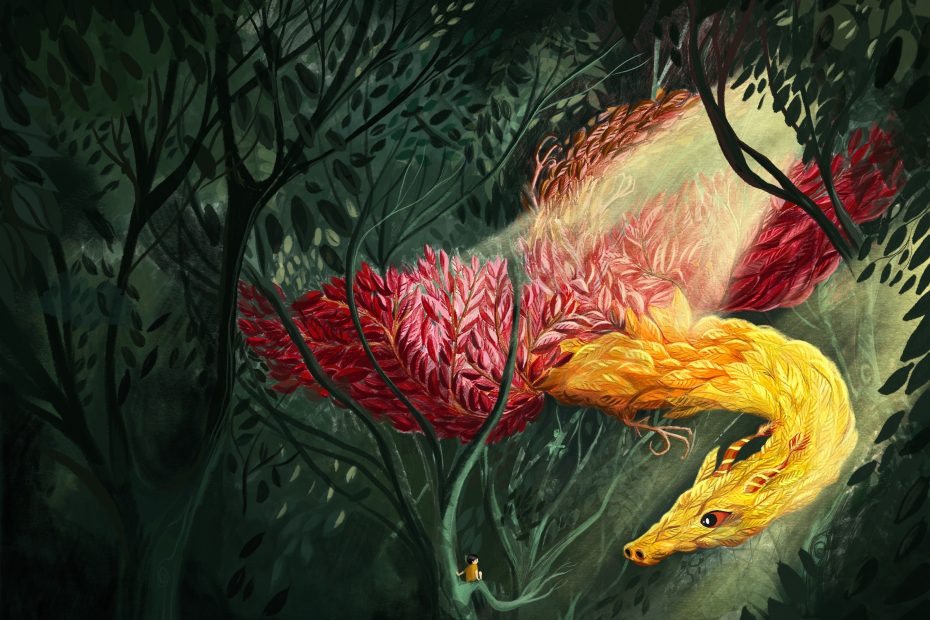
As a lot of my work is inspired by nature and wildlife, the colours and details come from there. For example, I have a drawing in my portfolio called The Leaf Dragon—she came to me during autumn, and is a huge dragon made up of all the different coloured autumn leaves.
I love to use a mixture of mostly traditional media, and a bit of digital media for my artwork. I think the textures of the paint and pencils can contribute to the overall look of the finished artwork, which I really like.
Podcast: What techniques help bring personified objects to life in fantasy picture books? How do you give inanimate objects personality and emotion through illustration?
Sarah: It is quite difficult, but a lot of fun to turn an inanimate object into a character. I think that a good starting point is to look at the shape of the object and think about what personality it would have.
For example, a tall angular vase could lend itself well to an angry or grumpy character, whereas a round teapot could be kind and helpful. From there, the shape can also determine how the object moves and what situations you could find them in.
You can also use colour to help with this, using cooler blues for the more unfriendly characters and oranges and pinks for the more approachable ones.
Podcast: What are the best strategies for illustrating immersive fantasy worlds in children’s books? How do you make settings feel magical yet believable?
Sarah: I think a good place to start, even if the illustration doesn’t end up in the final project, is with a map. Drawing the different areas of your imaginary world, so you have a good overview of how places exist next to each other, can be a really helpful tool for creating the world and story you would like to build upon. It is also very helpful to refer back to if you need it.
Young children have such amazing imaginations, and love to be transported to new worlds where anything can happen.
I like to use features from our own world, then build from there, so some places are familiar, but then there’s an extra unexpected element that appears or that can be discovered. For example, a tiny doorway in a tree which could be the entrance to a fairy world, or a pile of leaves which is a sleeping leaf dragon, or a gap between two fallen logs which can transport you to another realm. Using these ideas can encourage young readers to imagine themselves finding these places, and so inspires them to explore their local environment with a new perspective.
Podcast: What skills or portfolio elements are most important for landing illustration projects?
Sarah: I have been working on my illustration portfolio for a long time and it is an ongoing and ever-evolving collection of illustrations. The more projects I work on, the more sure I become of the strengths I have and the projects I would love to work on or create. For me, this would be projects about nature, wildlife, animals, and magical things, so that’s what I try to add to my portfolio—adding new, standout pieces to keep things fresh and give art directors something new to look at.
I think you have to be able to show that you can create characters and keep them consistent across a series of consecutive images. I think you have to show confidence in the materials you use and an ability to illustrate a variety of different scenes, worlds, objects and characters from different viewpoints.
Podcast: You’re currently querying yourself. What’s your opinion on the current market for fantasy illustrators when it comes to literary agents and publishers?
Sarah: There is so much talent in the book world today, you only have to scroll through Instagram, or walk into a bookshop or library to see that.
Sometimes it can be daunting, as you can feel everything has been done before. But I think you have to remember that no one can have the exact same idea as you, and execute it in the exact same way that you will.
I think there is always room for a new idea for a book—I have to believe that, and I have to believe that my idea will be successful, and concentrate on that feeling, or there’s no point in continuing. I have a postcard on my desk which says, “You’ve come this far, don’t back away now.” Which is a great reminder each day to never give up.
Podcast: What advice do you have for illustrators looking to break into fantasy children’s book publishing?
Sarah: I would say to just keep going.
Keep looking for inspiration in the world around you, try to imagine the magical things that you could create—what would they look like? How would they feel? What would they smell like?
Immerse yourself in a world of magic, let your imagination take you to unexpected places—you never know what you might find!
Sarah’s insight into the art of fantasy illustration reminds us that the heart of children’s publishing lies in curiosity, courage, and creativity. Her journey from greeting cards to querying her debut book proves that success in this field is about staying true to your passions and growing your skills with intention. Whether you’re an illustrator building a portfolio, a teacher looking for creative inspiration, or a publisher scouting magical talent, let this interview serve as your encouragement: there’s always room for more magic in the world—especially the kind you create yourself. Keep drawing, keep dreaming, and keep discovering new ways to bring fantasy to life for the next generation of readers.
About Sarah:
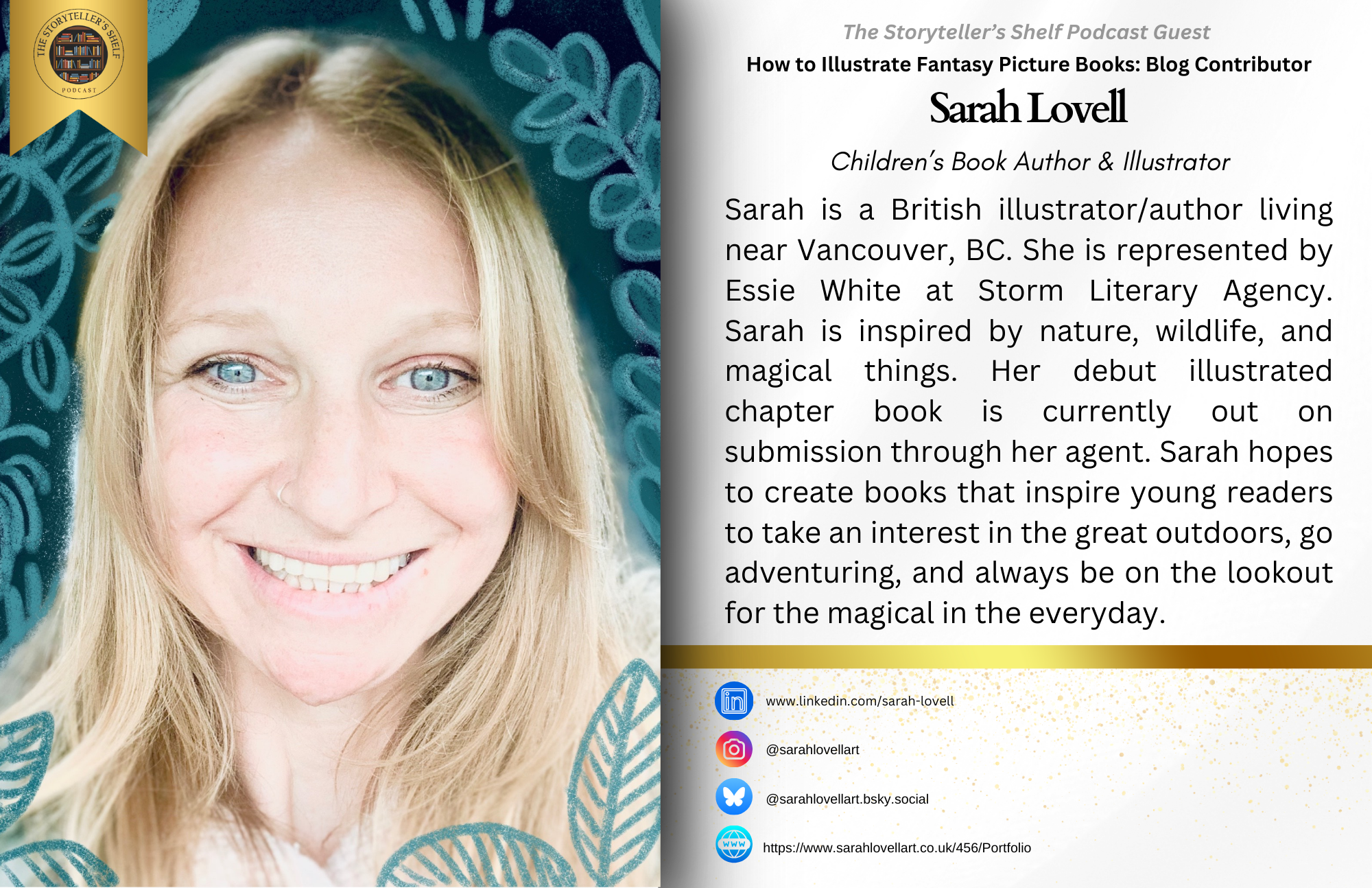
Sarah is a British illustrator/author living near Vancouver, BC. She is represented by Essie White at Storm Literary Agency. Sarah is inspired by nature, wildlife, and magical things. Her debut illustrated chapter book is currently out on submission through her agent. Sarah hopes to create books that inspire young readers to take an interest in the great outdoors, go adventuring, and always be on the lookout for the magical in the everyday.
Keep up with Sarah by visiting her:
