0:01 The Big Bang Notable Book List showcases titles expanding the universe of young minds, one read at a time. Imprints at Holiday House and Simon and Schustster already submitted their titles. Have you submit your books for free for a chance to be featured? Learn more at the storytellershelfpodcast.com/submissions. [Music] All right, storytellers. Hi and welcome back to the Storyteller Shelf podcast. It's Jackie and Teresa and we are in September and we are talking all about
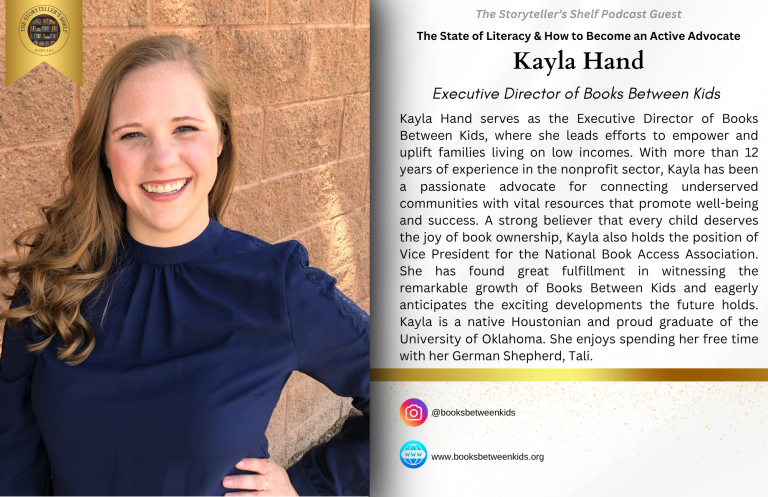
0:47 accessibility. So, we are here trying to help you find out how to be active in the world of literacy and how we can actually make books available to people. So, we have brought you another incredible guest, Kayla Han. And Kayla, let's just jump right into it. So, let's start by getting to know a little bit about you and your personal journey. Could you share a bit more about your background and how you got to where you are, where you're working now? Well, first off, thank you so much for having me. I'm really excited to chat with y'all today. My name is Kayla Hand. I'm the executive director at Books Between Kids and I've been there um four years.
1:22 Books Between Kids is based in Houston, but actually my nonprofit journey started way before that. Um for nine years prior to that, I worked in affordable housing and fundraising and marketing. >> Wow, that's incredible. Nine years and still going strong. Okay. So, could you tell us a little bit more then about Books Between Kids because that's kind of how we got here. >> Absolutely. So, Books Stitching Kids was founded 13 years ago now by two moms who saw that their kids have books and other kids in surrounding schools didn't. So, they started hosting book drives, collecting books, and giving them to neighboring schools. Um, and this is a very funny random story, but one of our
1:57 founders actually made a call to a company called Better World Books, and before you knew it, they said, "We're sending an 18-wheeler full of books your way." And so, they gathered all of their friends. They they had some temporary warehouse space for just two weekends. They sorted a whole truckload of and not long after that we became a 501c3 nonprofit. They really saw the need um in the Houston area for book access and that need is still strong today. We love Better World Books. It's such a happy feeling to see how you came together and how there are always other organizations out there ready to support new initiatives. What brought you to Books
2:31 Between Kids specifically? My passion is really for connecting families with low incomes to the resources they need, helping to connect people with housing. But I also saw the struggles that families have when they don't have spare income, spare money. So if you're already fighting to afford food and clothes and medicine and rent, there's no money left over for books. On the other side of that, my mother was also an educator. So I was raised with tons of books in my house and know how important that has been to me in my personal journey. Um, and so really Books Between Kids merges those two perfectly. >> That's beautiful. I have to just say Theresa and I have conversations a lot
3:05 about the cost of books, especially when we're talking about self-publishing and trying to find out what's an ethical cost for you to make a profit, but also to sell a book responsibly. We know a lot of people right now are having hardship in general. Working people, they still can't really afford a $25 book. So, it's just inspiring to see that books between kids started with this idea and you saw that happening in real life, in real action, and hopefully we're going to see as we speak with you what you've been doing on the ground on site. >> No, I love that. And one of the things we talk about was our books are getting a second chance. Most of them are used.
3:43 Maybe they've been read once, maybe they've been read several times, but it it's giving another owner a chance to love them. Maybe an owner who otherwise couldn't afford that $25 book. I think that's beautiful because there is that need and we have to keep that literacy going. And it's funny that you mentioned that because I homeschool and I was actually just talking to a mom. She said that her daughters and her Girl Scout troop, they actually just helped out um with their with for you guys. Their Girl Scout troop was sorting the books and everything. So that's like the coolest thing ever. I was like, "Yay, that's great." So, um I love like what
4:20 you guys are doing, your mission and everything like that. Could you tell tell us a little more about how Books Between Kids promotes the idea that every child deserves to be a book owner? I I really like how you've been talking about that. Could you add to that and why ownership is such a critical part of the mission beyond just access? So, that is the whole reason Books Between Kids exist. We want every kid in Houston to be able to be a book owner. And then hopefully once all those kids are book owners, then we can expand outside of Houston. But we started with that mission. We we believe that book ownership, it means something to a kid. It's not a borrowed book. It's not
4:54 something they have to return. It's something they can do what they want with. But also, we promote choice. And so we want those kids choosing books that they love. So whether it's a comedy or a non-fiction book or a large chapter book or a small numbered reader, we want them to choose. And that choosing really marries well with the book ownership because then they're taking that book that they chose home and they're going to read it over and over again. It I think they stack well on top of each other. So, first off, access is important because the kids we serve, they're in neighborhoods where there isn't a bookstore. There's not a Barnes & Noble on the corner. The Walmart might
5:28 have a couple of books, but not a huge selection. Neighborhood libraries here in Houston are dwindling. School libraries are dwindling. So access is important, but then on top of that, having books that are in the home and stay in the home. Our hope is that they're reading them over and over again. They're reading them with a parent. They're reading their siblings books once the siblings graduate up or down depending on the level. And so that's why ownership is so important is it puts it in the home. >> I love this. I think it's so important. I mean, seriously, because as a as a mom and and also an educator, literacy is the key to helping improve everything in
6:03 society, everything. Could you tell us what impact does not having books at home have on a child's educational journey? Yeah, absolutely. And I'm going to actually start at the adult level. So, and this statistic shocks me every single time I say it, but one out of every three adults in Harris County is functionally illiterate. And those adults were at one time kids. And so it's really important that we promote literacy early when they're young and get them reading from a very young age. So even just a baby holding a book, they're learning how to turn pages, which in the day of iPads and stuff, turning a page is different than a swipe. And so we really want those books
6:38 in their hands. And I I just think about how much I read on a daily basis without even realizing it. Street signs, grocery store labels, prescription bottles, anything we do requires reading. And I can't imagine not having that. And so that's why it's so important that we get those kids reading from a young age. And I will just say books between kids really does a good job focusing on book access, but there's so many others in our city who are focusing on teaching the kids to read the literacy skills. I think that is great that you're this is available and especially because of the fact that you said that when you don't have access to that that is a big issue
7:14 like in society like you said for let's start at the adult level. And I I like that you brought that up. What do you think people often misunderstand about literacy gap and underresourced communities? >> One of the things that I think is a misconception is that the parents don't want books for their kids. And it's not a matter of if they want them, it's just that they can't afford them. And so it becomes lower on the on their priority list because they're they're trying to survive. But every single parent I have run into wants books for their kids and is glad that they have access to books through our programs. >> Okay. I am gonna go off script for a
7:50 second. Don't kick me, Teresa. Teresa's gonna throw me out one day. >> Well, I don't know. We'll see. >> All right. I am just thinking what came to mind, a little thought experiment when you were talking about book ownership as this keystone of your mission. But I am fortunate in the way that I never had to worry about book ownership. To be honest with you, I probably didn't even want to own books when I was a kid. I hated reading. But my mom was that kid where they couldn't afford food, let alone books. And she was also a really poor reader. And she told me that when she got older into kind of that tween teenage time,
8:35 she finally got enough money selling things on her own to start buying books. And it wasn't until she started doing that that she actually began to enjoy reading. And part of it was exactly what you said. It was the freedom to choose what captures your interest. So that's something that really made an impact on her starting to enjoy reading. And then I think there's a second part of that that we never really spoke about, but we will now that I've had this discussion, but when you get a book from a library or you get a book as part of school, it feels very much like homework. Especially in a kid's brain, right? It starts to become an obligation. Oh, I
9:13 have to read this and I have to read it quick back. But when you've gone through that process of choosing your shopping, you say, "I really like this. This sounds interesting. The cover is really pretty. The text looks like I can read this." And you pick it up. That changes your attitude towards whatever it is indefinitely. So, I am just imagining all the kids participating in your programs, which now we're going to segue right into that. So let's talk about what these programs are. Can you give us an overview of things like book celebrations and the community partner distributions? So our book celebrations is our cornerstone program. It's the
9:50 very first program that we started when we started books between kids. And if you will just imagine a book fair. So I bet we've all been to a scholastic book fair or something very similar. So it is a collection of all the books. We lay them out. Every kid gets to choose six free books to take home and keep. There is no cash register at the end. The difference is these books are new and gently used that come through our programs, but that's what all of our volunteers help us with. They help us sort the books. So, we're sorting out all the icky books, the sticky books, the books that a kid wouldn't feel good to own. And Jackie, to your point, we're
10:21 really focusing on pleasure reading books, books that excite them, topics that they love, not the book report books, which are great and have a totally different use. Um, but we're really trying to get them excited about reading. And so, um, we sort them at our warehouse, we box them up, and then we send them out to schools. This year we were in over 55 Houston area schools which we're really proud about. And then we also have a community partners program that was born after Hurricane Harvey when we saw that other nonprofits in our area had a use for books. And so now we partner with over 75 partners who serve kids in need and they help distribute books through their program.
10:53 And it's a really great way to leverage partnership because they're not wasting their time, not I say wasting, they're not spending their time holding book drives and trying to figure out how to sort through the books. That's what we're good at. and we're not spending time trying to hand out food or housing or medical services. That's what they're good at. And so we partner together in those ways. And through those programs, we'll our goal this year is to hand out 300,000 books. So we're on our way there. We still have a little further to go. >> I know you're going to make that goal. >> Absolutely. And I know people here are going to help you along the way, but I
11:25 really feel that's kind of ping in my heart when you're telling me about this type of book that you're bringing to kids. You're making sure you're making sure that these books are gently used and new. What I'm getting from that is it's not only an aspect of functionality that they'll be able to read it, but also perhaps there's an element there of self-worth to show them that they're worthy of something that's new. Um, I'd love to ask you, do you have any more details on the type of books you get? Is everything welcome? Are multiple languages welcome? Does it matter graphic novel versus regular narrative novel that people are donating? Great point. And Jackie, I
12:06 have to say that was something we were really proud of because when we very first started, we were handing out every book we got in. It's just what we knew how to do. And over the years, we've really refined our sorting process so that every book feels like a gift and it elevates that child's self-worth. We don't want them to feel like this is a a handout or handme-down. Um it really feels like a new book to them. And one more thing before I answer your question about what kind of books we look for. I when I first joined Books with Tankas, I thought we would have so many kids who were just like too cool for book celebrations. You know, books aren't
12:36 cool. Almost every single kid we serve is elated to receive books. And it's cuz they truly don't have them. Um and often they're like they're given food, they're given clothes, they're given this, and they don't have choice. And so it's opportunity where they get to come shop and they get to pick what they want. So I could talk about that forever. Um but the types of books that we look for, we serve kids um from birth to high school. We primarily focus on elementary school. So that's our biggest need for books is elementary age books. Um we're looking for anything your kids would love to read. Um so we're not really looking for your book report books or your textbooks
13:12 or your cookbooks or your adult books. Um, we're looking for anything with appropriate content and anything that is still in um, good condition. I'm looking for those books, too. I don't want the But I see the joy in your face when you're telling us a bit about this from a kid's perspective. Do you have any special specific stories that you've seen maybe or that you've experienced um, you know, from your participation in these programs on your side? Have you seen a specific reaction in a kid that made you happy and proud to be where you are? >> The one that I keep thinking about having just a couple weeks ago, I was out at a book celebration and he was
13:53 holding it was a some series in a um some book in a chapter book series and he's shaking and he's just holding it and he goes, "I've been wanting this book since Christmas." And I said, "Well, did you think you were going to find it today?" And he goes, "No." And the entire hour he just was walking around shaking, just so excited. And that excitement is that's why we do what we do. >> I just want to jump in and say like however we can help with the podcast and doing our book drive again. We're going to do that and you guys are going to get so many books. You're going to be like stop you know. >> No we won't. We're on >> like just you telling me that I'm like
14:32 okay that's it. We got to help more jockey like let's as much as we can because the eye like I'm gonna start crying again you know because when it come like when it when I hear that that >> that that means so much you know like when I said like I'm being a mom and and also educator like that is important like when kids get so excited to read that's why we did this podcast we wanted to help kids like want to have that excitement again to open a book instead of an iPad let's get let's get them reading right? You know, this morning that I was reading and it's, you know, saying, "Dear Books Searching Kids, thank you for the books. Now I have a lot of books, blah, blah, blah." And
15:09 then she says, "Whoever started this, it was a great idea." I said, "I think so, too." Goodness. Well, I was going to say like we're both Houstononians, you know. Um, yay, Houston. I You and I understand like Houston is a unique landscape. It doesn't even make sense. I was just telling Jackie this earlier, how Houston is not really mapped out like a normal city. I don't think they really thought about it when they were discussing how to do the construction of a city when they made it. Um, but when you think about that as far as when we're talking about literacy, um, what's the landscape like when it comes to book access in local communities? I think Houston is a very well I say
15:55 this I'm a native Houstononian so I haven't there's a lot of other places but if you're not familiar with Houston we have a lot of pockets of wealth next to a lot of low-income communities and it's just scattered throughout Houston there's really no rhyme or reason and the beautiful thing about that is we have a lot of areas with books to help support a lot of areas without books but books between kids becomes that bridge because otherwise people are just you know maybe donating their books to a resale shop or sometimes they end up in a dumpster, a landfill or other places. Um, we do have a lot of economic disparity here in Houston. Um, and a lot
16:30 of communities that need books. Well, as you mentioned that, I have a ton of books that I need to donate. So, I might be coming and buy just me personally. Like at our house, we're like we're, you know, in that phase of I got to get more of like more middle grade and YA for in our household. So, you'll be getting more of like the picture books in my from me personally. They're well loved, but they're well taken care of. But you can tell that it's been read quite a bit in our household. So, you'll be getting those. Sometimes moms are the ones that have a hardest time getting rid of them, and I always say they're going to another kid who's going to love them.
17:05 >> Getting into that, what are some specific challenges you've encountered in trying to get books into children's homes? >> The the one that comes to mind is one that we're working really hard on, but we can't give out books if we don't have books. And so our biggest challenge right now is really getting the word out in Houston, making it accessible for people to drop off books to different drop off locations so that they can make their way to the warehouse and then we can give them out to kids. >> Yes. And I know from us and our standpoint, we're going to help you guys like get get that sort of advertised as much as possible because we want to help
17:38 as much as we can. >> Awesome. And I do have some exciting news. We did sign a lease on a warehouse expansion. So, we'll be expanding our warehouse by 4,000 square ft, which means that we have plenty of room for all of those new books. >> Oh, that's awesome. Yes. Okay, listeners, did you hear that? Bring in your books for books between kids so that they can get more books to kiddos. What type of books are the kiddos most excited about when they get to choose? Sure. They love the popular chapter book series. And I think I think that's what I mean. I was a Nancy Drew fan and once I read one, I wanted to read them all. And I think that's what we still see
18:16 with the kids. So the popular characters, popular titles. They love non-fiction books. So anything about bugs, marine life, different places. They love things with engaging pictures. So the front cover is often what grabs the kids. So something with an engaging cover. In Houston, we have a lot of Spanish speakers. Spanish books are super popular. We also never have enough Spanish books. So, if you're listening and you have Spanish books at home or you know the publisher who publishes Spanish books, that is something we're interested in. But what's funny is every kid has a different interest and sometimes I think like I don't know if a kid's really going to want that and it's
18:52 on the table and that is the exact book that they want and they are so excited and so while well while we definitely have some very popular popular books, it really depends on the kid. >> I have another thought so you guys have to hang out with me because you're my captive audience. So, very much in my neighborhood, I'm not sure if you guys have the same problem, but when we have parents who are cleaning out books and trying to get rid of items that are cluttering the home, the tendency is to just kind of dump them in a box. And you want to do a good thing. So, they always give it to Goodwill almost every single time. like nine out of ten times everything gets
19:34 dropped off at Goodwill or picked up by them in our area. So you are kind of fighting a battle between you and everybody else who wants people secondhand things. So what is your strategy and your tactic I guess maybe marketing wise just to get your voice heard so that people know about you so that they know they have this option that what they give actually can go for free to someone. lot for books between kids to become my household name. We're still many years away from that, but we've come a really long way in our 13 years. And so really word of mouth is what helps us spread the book. We see our we see ourselves out in in the wild now, which is really
20:15 really fun. So somebody on um the neighborhood like information trading groups will say, "Where can I donate books?" And we'll see somebody else post books between kids. And it's amazing to watch that spread like wildflower because once people wild flowers, whatever the saying is, once people know about us, then they keep bringing their books back again and again. That's fantastic. And I love wild flowers. I know it was an accident, but it was such a good one. I think you invented a new phrase. I like it because we are from Texas and our state flower is a wild flower. It's the blue bonnet. So, I think it kind of works for us as as Texans, you know. And in April,
20:54 everybody goes out to the Hill Country to go take pictures in the middle of a of a field of flowers for like their family photos or something like that. That's what we do in Texas. >> Yeah. I think it's in my mind because just yesterday I had the dog out on the bayou and they're like waist high. >> Oh, yeah. So fun. >> Yeah. Harry. All right. Well, we might be renaming this episode book spreading like wild flowers. I like it. I like it. I like it a lot. Okay, let me hop us over into talking about again engaging the book community which are different from people who are just parents or even just educators. So, a lot of our listeners
21:40 are children's authors and illustrators and book publishing professionals. How can these people really support your mission? I would say reach out to Books Between Kids or organizations like us and start a conversation because a lot of times there's so many publishers and authors and illustrators out there that we don't always know what's available. Um, and one of the things that we're always looking for, most of our books come through donations, but we do sometimes get restricted funding to purchase them. And we're always looking for bulk discounts. And so that is one way to help nonprofits particularly who are purchasing books. And I will throw in
22:18 there for our listeners, you know, a lot of especially our self-published authors and illustrators. They're very Teresa's waving. If you can't see us, she's waving. So, she's here representing the self people. But we all know money is on the mind. Profit is really important. Our podcast is very candid and that we say sales is not a bad word. We want you to make money or what you're creating. It's so vital. But when you hear the word donation, don't get scared and pass on it because there are a lot of ways to make sales and make a donation at the same time. So you as an author, you can go to your community, go to local business owners and say, "Hey, I want to
23:01 make a donation of my book this many, this quantity to books between kids and you can start acrewing sales so that you have a huge bundled order that you can give over to a nonprofit." Yeah. And there there's so many different options there. And I I speak not just for Books Kids, but for my other fellow book access nonprofits. talk to them and see maybe you could do something marketing wise where you donate books and they post on their social media and it comes out of your marketing budget. There's all there's all sorts of different ways to partner. >> Yes. Yes. Um I I think we can both say that there's a lot of ways that we can help to take action especially I want
23:43 our listeners to do that. What are the top three ways someone listening today, whether they're in Houston or not, can help support book equity? >> Yeah, great question. And first off, I just want to say thank you to all of your listeners for having some involvement in this community because we can't give out books if we don't have books. And we can't give out books if books aren't written or illustrated or published or any of that. But the three biggest ways people could help books for kids are give books, give money, or give time. And so give books, we've talked about book donations. We accept them at our warehouse all year long. And there's more details on our website if you have
24:16 questions about that. To give money, we do have operations staff in a big warehouse to support. Um, and so that's what our our funding helps us do. And then give time. We utilize the help of many many volunteers every year to support our small staff. We could not sort all the books by ourselves. And so giving your time and volunteering is another way to give back. But if you're not in Houston, there's not only books between kids. I am part of an organization called the National Book Access Association which is nonprofits all across the country doing what we do or similar things. Their programs might look different. They might operate a little bit different but all of us are
24:52 working to get books into the hands of people who need them. I love that you also work with another nonprofit outside of books between kids and and helping helping to spread literacy across the country. But for those not in Houston again, what advice do you have if they want to replicate something like book between kids in their own communities? I would say the first thing is look and see if there's already someone in your community doing it. There might be a nonprofit or an individual working in your space that you don't know about and you could come alongside and support them. And if not, I would say learn from others. I am still learning so much from
25:29 other organizations around the country doing similar things whether it's how they stack boxes in the warehouse or how they sort their books or how they keep their financials. Um there's so much we can learn and so I would say find a friend and grab a cup of coffee or grab a Zoom. You mentioned volunteers though. Um how can someone go to fullon advocate? So, schools, corporations, individuals, um there's two different ways you can support us. The first is book donations, which we've talked about. A lot of people clear off their own personal bookshelves, but a lot of people also host drives. So, we have a lot of drives hosted in schools, a lot of corporations
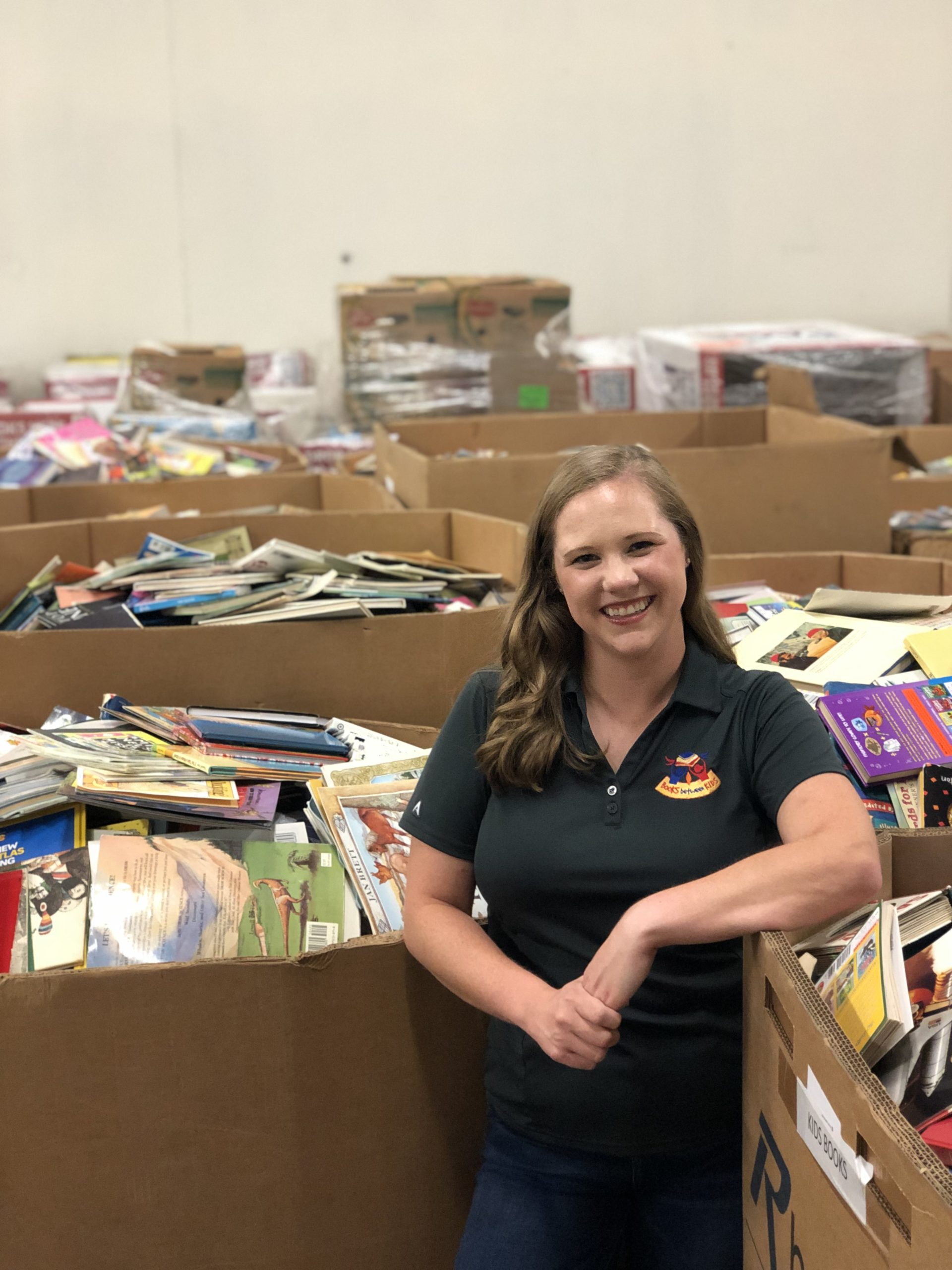
26:07 who put a bin down in their lobby and collect books. That's the first. And then once those books arrive at our warehouse, they're all counted by volunteers, which is a really big thing for us. We used to estimate all of our books. And now we have an actual count on every book end. and every book out, which really helps us serve more kids. We know the amount of books we have. Um, and after the books are counted, then they're sorted. So, we're sorting for quality and by category. So, we're going to sort out the sticky books and then we're going to put it in a container that says chapter books, picture books, non-fiction, Spanish, board, high school, all of those different things.
26:41 And then they're going to get a books between kids sticker and then they're going to get counted and boxed. And then they're going to be um in an area with that category. So, there's many, many different steps to our process, and it requires the help of lots of hands and lots of volunteers. And then, how do you go from volunteer to full-on advocate? First off, I I love for people to spend time with us, learn our mission, see what we do, um learn why it's important, but really spreading the word within your own community, with your friends, with your family. Maybe you have connections to a corporation who has some grant dollars or a family foundation. Really spreading the word is
27:15 how you can help us and become an advocate. It's taking a whole crew to do this and I can probably bet you guys are smiling every day as you do it, even hauling books. >> Lots of moving boxes. >> Well, we are sending some strong people your way hopefully. This is the fun part where we get to ask you some extra questions. So, what do you think the book world needs more of these days? We think just from a books between kids standpoint, I think more Spanish books. We don't see a ton in circulation. Even when we try to purchase them, we have trouble finding them. And we Spanish books that are particularly popular titles in English translated into Spanish is super great. So, you
28:01 mentioned that you like Nancy Drew when you were a kid, right? But do you have a favorite children's book today that you see going on even though you're an adult? >> That's a good question. I still go back to my favorites as a kid. So, this one is not really in circulation anymore, but it was called Jelly Beans for Breakfast. And my grandma used to read it to me, particularly at her house. And so, I have very good memories of that. And then the picture book that I remember reading at my own house is called The Mysterious Tadpole by Steven Kellogg. And every once in a while, I'll see it come through books to 10 kids. That is so cool. Yeah, I think it's
28:35 pretty normal for all of us to go back in memory and choose a book because we grew up with them, right? and that holds a special place in your heart and that's exactly what you guys are creating now. >> Do you both have a favorite children's book either from old or not? >> I do. Okay. Mine is actually I think a newer one. I think it was 2019. I'm looking around to see if it's near me. It's not. It's over there. But it's I talk like a river. Um, and it's a poem about a child who has a stutter and he has to learn how to kind of accept that he has this stutter and that it doesn't keep him down even though he is different. So, it's a story about empowerment, right? It's really lovely
29:16 >> that that's what books are about is they're helping support kids through their own journey. So, I love that. >> I agree with you because when you're reading, you're understanding yourself. I feel like, you know, a little more. you're you're sort of like well that's what that means or something and it helps you to process. I appreciate that. As far as for me I don't know like I have so many I mean I'm always either writing or reading and I have my own kids so I'm like oh I like that. So right now my kids my daughter loves the Shannon Messenger books. You know the Keeper of the Lost City series. It's kind of like she's obsessed with that one. And then my son likes Percy
29:59 Jackson. So yeah, so that's where we're at. And to be honest, I really like the series that my daughter is reading right. Even I'm like, can I go to the next page? So if Shannon Messenger is listening to this, uh, we could use a few more of those books at our house. Do you have any memorable moments from Books Between Kids that stands out in your mind? I really think it's a general memory, but just watching the joy on their faces and hearing the screams and hearing how loud it gets in the room really, it's special every single time I get to go to a school. I still am not over it. I actually have an author event next month and I get so excited when I see kids and
30:42 they look at my book and they're like, "Oh, mom, look, this one has a dragon in it or something like that." And they get excited. And when you and they're also looking around at all the other authors because it's a plethora of authors in different genres and subg genres and all of that. And it's like a fun event that they do every year. So I get excited when I just see that their faces light up and they want to read and it's like yes. And sometimes they just they can't believe that it's free. They ask about are you sure it's free? There's no money like I can really have it. I really get to take it home. And like those are the moments where I'm like this is why we do
31:18 what we do. We have gone through this several times now where we're talking about how these books are free. And I think this is really crucial because there are a lot of organizations that do sell things again, right? Even if they sell things, which is fine. It's just a different type of mission. But I'm always thinking, Teresa will tell you and confirm this in terms of my nephew because I am not a mom. I'm an aunt and he is very rambunctious and nearly 11. But I pay attention to what he does because his childhood is so different from my own. They're very much tech kids. Like they spoke about iPad kids, Oculus kids now, which is wild, but it's
31:56 happening, guys. These kids are definitely cyborgs, I think. But that being said, I think of the things that he likes to do. So, he's on that Oculus all the time. And all of the games on there, they have some form of currency. I'm not just talking about how it costs money to buy the game, but in the game, you're working towards something that costs this many gemstones or this many coins. It's almost like kids are very much aware of the value of things now through gaming. And then they're aware that social media exists and that it's a way to really make money, not just be popular. So, I think it's very crucial to have something somewhere, whether
32:33 it's books or not, that is free for them. I can see how they're shocked and probably coming up to you more than once and saying, "Are you sure you're giving this away because that doesn't happen very much nowadays." >> Yeah. And I would think just kind of playing this out in my head, if I couldn't afford a book and I was a struggling reader anyway, I'd be like, "It's okay. I don't need one." But when someone puts it in your hand for free and you have it, then you start flipping the pages and it opens doors. >> I very much agree with that. I think it kind of goes back to, you know, this is an obligation. If I'm renting it, if I see a really big cost to it and kids
33:12 aren't aware, if they know what a dollar sign looks like, they know what the price tag is. It becomes a burden, right? So, it's easy to say, "Oh, well, maybe my mom won't let me get this. It's over $20 or I was doing chores and took me forever to make $20, so I'd rather spend it on something fun." But when you take that out of the equation, yeah, it becomes super special. Then you're just, it's more than books, right? You're curating experiences for kids. That's why we're here talking to you. I could go on and on about the emotional benefits of books. But like you said, it creates experiences. It they take it takes you to different places. It takes you under seas. It
33:50 takes you to space. It takes you into a magical mystical land. Um, and that's really special. One thing I really I just want to say I'm honored that you came on today because I think we both are and I feel like this is beautiful because you're not only giving a it's not just giving a kid a book, you are curating, you're helping them, you're helping them to understand being a critical thinker and you're just you're helping the next generations. I really I really do. We appreciative of having this conversation today. All right, let me ask you kind of a little more of a professional question and then hopefully we'll stop interrogating you lovingly.
34:34 So, we like to provide some sort of advice to people who are trying to work in the book sphere and the book sphere is really big because it's everything from authoring and illustrating to being an educator, being a librarian, working actually in publishing itself to nonprofits. So, if you were trying to have a conversation and offer some advice to someone who wanted to one day be in your shoes working and doing what you do, what would you tell them? >> Probably a lot of things, but I think the first would be be a sponge. When I came into Books Between Kids, I knew about fundraising. I knew about nonprofits. I knew about nonprofit management. That's what I studied in
35:14 school, but books and books book access wasn't something I was super familiar with. And so, I got on the internet and I called friends in other cities. um and I learned all I could. And so my advice to anybody in any of those fields would be learn all you can. The other thing that someone um keeps telling me, which I think is really good advice, is she goes, "You've never done it before." So you have to and and she means that is like you have to try and you can't. I mean you might fail, but you're going to learn from that. And so just like like there was one point in your life where you weren't an author and then you were or we managed a nonprofit that was this
35:45 size and now it's this size. It's just different. And so um don't be afraid to try new things. Don't be afraid to fail cuz failure is never failure if you learn something. And so um yeah that that's my that's my advice today. >> Well it was beautiful and I think on that note we are going to end it very sweetly here with this reminder that failure is a tool and also there's a lot of things that you can do. So if you're having some anxiety going back and forth about that instead hang out with books between kids for a while. be filled up on positivity, be inspired, and then go back to thinking about what your next steps are. But we will thank our
36:24 storytellers so much for listening in and for making it this far. As always, we appreciate you. And please, please, please go to our website, the storytellershelfodcast.com. Go to the episodiccal menu. I know this is a lot of steps, but you can do it. and click on Kayla's name and that will take you to her landing page where you can see where she lives on the internet and get in touch with Books Between Kids and again get out there and start making change. So, thank you so much everyone. Let's give Kayla a huge round of applause. Thank you for being here and please if you enjoy the conversation give us a like, maybe a subscribe and definitely reach out to her.
37:03 [Music]