0:00 Hey storytellers, before we start today's episode, we have something exciting to share. The Storyteller Shelf Summit is almost here. A full week of virtual mini master classes to help you grow as a writer, an illustrator, or an educator in children's literature. We are also offering an exclusive pitch event with literary agent Serrone Harvey, giving you a rare chance to get your work in front of an agent. To participate, you'll need to purchase both the summit ticket and the separate pitch ticket. Click the link in the description. We can't wait to see you at the summit.
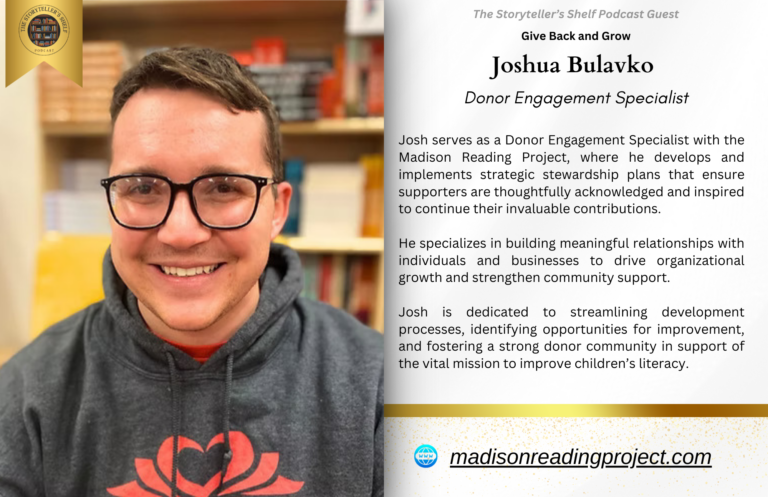
0:48 Hi everyone and welcome back to the Storyteller Shelf podcast. It's Jackie here with Teresa and we are celebrating a monthly theme transformation. So we are looking at transformation on the community level today through children's books literacy and access to those books. So we have two extremely special guests here with us today from the Madison reading project which I think everyone here is going to know who they are. So let's just hop right into it. and Griffin and Josh, could you each tell us a little bit more about who you are and what your roles are? >> Uh, my name is Josh and I'm so happy to be here with Jackie and Teresa and be joined by my great colleague Griffin. I
1:28 am the donor engagement specialist at Madison Reading Project and basically my job is to steward our donors, make sure that they feel appreciated, that they feel comfortable giving, um, and give again. Um, that's what we're all looking for is a sustainable donor base to empower our programming team to continue to do the great work in the Madison community. It's been a bit of an interesting path to get here. Um, I got my bachelor's degree in history from a very small liberal arts college in Virginia and then I uh went on to grad school. I got my master's in indigenous studies from the University of Kansas. And then I uh did a little bit of stint
2:09 in politics. um for about a year. Um and that's actually when I met my current boss, Rowan, the co-executive director and founder of Madison Reading Project. Um so that's originally how I got connected uh with the work of Madison Reading Project. And then um I found out that there was a job opening here and um have been here working uh since November of 2024. And it's been such a great journey um and a great it's been a great team to be a part of. I'm happy to be doing the work that I am and I'll I'll let Griffin introduce themselves now. >> Thank you, Josh. Hi, I am Griffin. I use they them and I'm incredibly happy to be here with you guys. I am the books for
2:50 educators coordinator at Madison Reading Project. So, I mostly deal with teachers. We have a couple different programs that that revolve around teachers. So, mostly I just like run communications with them and make sure they're getting the things that they need out of our programs. Let's see. I've been here since the summer of 2022. This is my fourth summer and I came right out of undergrad as a I started as a programming assistant just driving the bus around giving books out to kids and then decided to stay on full-time and I originally managed the book center which is the the space where we get all our donations and we have teachers shop for
3:30 books in there. We have teachers shop for books in there and I've just found that that was what I really enjoyed doing was helping teachers get the great diverse titles that their classrooms really needed. That's so inspiring. So, you both work at the same place, of course, in two different positions, but you've also both taken really unique paths to get there and we love sharing that because we're all about unexpected journeys here and we speak to a lot of people who are career changers. So they might have gone to school for one thing and then they want to work in books. What comes next? Literacy, advocacy, writing. So I think we're going to find a lot of inspiration
4:09 in the different ways that you got to where you are. But before we dive into that more, I'd love to kind of go back in memory lane for you two and see if there were any book memories or moments from your childhood that really shaped your connection to literacy. So, I was really fortunate to grow up in the home where it w it was my mom is an educator, still is, and it's really amazing. She's actually now a reading specialist and has been for like the past 10 years, I believe. Our house was always a place where we had books. My parents were always like, "If you want a book, just ask." Basically, u whenever we went to the bookstore, whether it be used or
4:49 new, um they were always willing to buy at least one book. Um, which was a really fortunate thing for my childhood. And unfortunately, a lot of kids don't have that kind of experience growing up. I I always remember my mom reading to me books like There's a Monster at the Sent at the End of This Book with Grover. Um, I remember that being like one of my favorite books cuz my mom used to do like all the voices for Grover and it was just the best experience. Um, I also remember Frog and Toad books. Those were a big favorite of mine. Um, I actually just bought a shirt yesterday with Frog and Toad on it because it's just such a special memory of mine. My mom read to
5:24 me all the time, my brother and I, and um, my very fond memories. Reading has been such a central tenant of my life for a long time. >> I think um, similarly to Josh, I grew up in a house where um, reading was highly encouraged. My older brother was a huge reader. He always had his nose in a book. My mom also read to us a lot. I remember the first picture book that I really loved was Love You Forever about the little boy growing up and then Harry Potter was the first like chapter book that she read to us and I don't know if we ever finished it together but I went and read them on my own a bunch of times. Then I kind of fell out of love with reading for a while in school. And
6:07 it wasn't until a little later in high school when I made kind of like friends with my librarian and she started recommending me some good books. And I have one that is sitting on my nightstand here. It's called The Gift of Rain by uh Tanto and I highly recommend it. I read it again just coming out of college and it was so beautiful and I now I always keep it with me and I'll never forget how powerful stories can be. >> That's really beautiful. And I in the past we've shared kind of our own journeys into reading and how we learn to read and our habits for reading in the past. And to reiterate, Teresa, you're going to have to jump in here and give your story about your grandmother.
6:53 But for me, I would say reading was definitely encouraged at home, but I did not pick up that encouragement. I was not much of a reader. It was really difficult for me and it took me a really long time to really find stories that resonated with me well. And part of that was I didn't really find characters that were like me or that had my home experience. So, that made it really difficult. >> Yes. Um, I had a very feisty grandmother, God bless her. She was the most amazing lady in the whole world, because she was always trying to get me to read. I had trouble reading as a kid. My mom was the same way. She was always like trying to help me read. And my mom
7:33 was the one that was a big advocate in that as well. But my grandmother, she liked mystery books, even like a recipe book. She made it an adventure. I know that sounds funny, but that's kind of what Jackie is talking about is that she'd be like, she wasn't a good cook, but she always would pull out any and every little whatever it was, she's like, "Here, read this to me." And cuz she knew I struggled with reading. She was very funny lady. She's from Arkansas. She was very like old southern lady that and she Here's the thing. She didn't get to finish school um because it was during World War II, but she was a very big advocate for her grandchildren on reading and learning
8:14 and education and everything like that. And so I a very much inspired by her and the same with my mom. My mom was a huge advocate for reading for me. all of the Harry Potter CS Lewis Tolken uh especially CS Lewis though cuz like the horse and this boy or Madam Langel like um we always had the audio books and I don't know if I'm probably saying my age here but I'm I'm probably older than everyone in this group. Um, but I was born in the 80s, raised in the 90s, and we had the cool audio tape. So on road trips, we would always have um the uh Wrinkle in Time, and my mom would play it, and it was,
9:00 you know, you're the echoey voice of Mrs. Who and Mrs. What's it? So that's like for me like, and that and I too had a falling out with reading, but then I came back to it. So, I think we have those es and flows with books, but as long as we come back to them, they're like old friends and they want to they want us to open the book again and learn about them and, you know, I look at it like an old friend, you know, but I am excited to talk to both of you today. Um, especially the fact that, you know, Madison Reading Project really advocates and helps and really inspires. And so if you could share for those that new to Madison reading project, can you
9:42 share your core mission in your own words? >> Madison Reading Project is all about promoting equal access to books and promoting access to diverse books that actually reflect the the readership of the the kids and the communities that we serve. Book joy. Just going off of what we were just talking about, we're always trying to inspire those like interactions with books and with stories that are, you know, joyful, they're happy, they're fun, and they make kids want to pick up books more in the future. And that's really what we're about. >> Yeah. Of course, we're all about affirming the unique unique identities of of the readers that we're serving
10:22 here in Madison. So, we're we're really trying to get books in the hands of kids that represent them, characters that look like them, stories that represent their lived experiences, things like that. So, we're making sure um that children in the Madison community have access to those stories that they really want. Really, I mean, the results show that kids are more likely to read when they see and have access to those kinds of books. Then, they become more comfortable with reading other things in school and things like that. That's really what we're all about is building a curiosity and building a trusting relationship with with the kids that we're serving.
11:00 >> That's awesome and very inspiring. You know, were you talking about finding identity in the books and that gets people into wanting to go back and read that book again. I think that is amazing. And you're mentioning joy. It's funny that you mention it because that goes into my next question. Josh, can you talk about how do your values like joy, curiosity, and collaboration, how does that translate into everyday work of book distribution and programming? >> Yeah, of course, we're we're a team of joyful people. I think um from our founding back in 2014, um we just found that um joy can be found in books. Um, it's just about, um, giving books that
11:45 kids want to read, um, that represent them. Like I said before, um, we're we're all about that. Um, and we also have two book buses that we take out into the community. Um, and you can just when kids see the bus pull up, they get so excited because one, they're like big vehicles and, you know, there's there's fun books on board and it's colorful. It has kids on the side that look like them, different races, different backgrounds. Um, it's just so important to see and when kids see that they they know it's for them and that it's it's there as a resource for them and we're the fun book people. I remember I pulled up to a site one time and a kid said,
12:25 "It's the bookman." Um, and they were just so excited. So, every now and then people in the office call me the bookman. So, it's it's a fun I don't think there could be a more fun nonprofit to be a part of. It's it's so important right now in our social climate to make sure that kids are having access to any book that they want to read. That's that's just what we're all about is joy and inclusivity. >> You mentioned that you uh when you first started you drove the bus around and could you share kind of how that translate into book distribution and programming? >> So we use our buses for all sorts of things. We just got our second bigger one. The original big red reading bus
13:12 was just kind of like a big cargo van outfitted with bookshelves and we can take it to like community events at parks where the the parks districts are putting together some wonderful events and the community all comes out and they can just file on the bus and get a free book and then see us the week after that at the next park. And then we also take them to like community centers where just like out of school time educators do amazing work with kids there and we really are just there in support. We bring the buses and offer programs where we go and hang out with the kids. And like Jooff mentioned earlier, we build relationships and we read to them so
13:56 that they can kind of connect the whole fun experience with reading and then at the end they get to pick out their favorite book off the bus and take it home and keep it forever. >> Josh, can you tell me more about the book center? What does that look like daytoday? Like >> Yeah, the book center has been really busy lately. Before we started the show, I was mentioning that we just came off our biggest fundraiser of the year and it was all hands- on deck. Programming team, development team. We all came together um and rallied behind each other um to have and put on a really successful fundraiser called Ready to Wear. It's our all paper dress fashion
14:36 show held at a really cool venue in downtown Madison called the Sylvie that's been filling a lot of space. Um, we've had arts and crafts going and things like that. But on a normal day, I'd say our book center is like a really small warehouse. It's where our programming team kind of packs up boxes, puts them on the buses or packs them into their own vehicles um and takes books uh directly to where kids are. That's essentially what the book center looks like on a normal day. We also have some office spaces where our programming team is able to plan and able to communicate with each other, kind of bounce ideas around for what other events we could be doing. Really, it's
15:16 just it's all about collaborating with each other, finding new partnerships. The development team has their own office in the back and we kind of work on the fundraising aspect of it to make sure our programs can keep on running. The book center is a really fun place to be. It's just all these books coming in, whether it be from donors, from members of the community who uh want to give back. We also get a lot of financial contributions where we're able to purchase from wholesale partners, and from other resources to make sure that they're new books going out into the community as well. We're really all about highquality books and new books cuz if a child were to receive like a
15:54 book that's beat up or a little tattered, that's not as special. Um, so we want to make sure that they're able to get a new book that's theirs to keep forever. Um, I think that's a really important aspect of what our mission does. Hey storytellers, if you're still juggling Word Docs, sticky notes, and 47 browser tabs to keep your story straight, it's time to simplify your writing life. Meet Scriber, the writing software built by writers for writers. Whether you're drafting a novel, a picture book, or even a dissertation, Scriber helps you organize your scenes, research, and revisions all in one beautifully structured workspace. Many of our guests on the Storyteller
16:32 Shelf podcast have raved about Scriber and how it completely changed their writing flow. You can move chapters around with a click, store your notes right next to your draft, and even set word count goals that actually keep you motivated. >> Curious? Check out our affiliate link. It helps support the show at no extra cost to you. And let us know if you give it a try. We'd love to hear how it helps your writing process. >> I realize this might not be completely aligned with your work duties, but could either of you tell us a little bit more about how you choose which books you purchase? So, how do you know what your community needs more of when it comes to
17:16 the topics, themes, and representation in books? >> Yeah, I only do a little bit of that. That's mostly on some of my co-workers. We do have a great early literacy specialist on our staff who really has her finger on the pulse of new releases, what like publishers are putting out good books, what authors are doing good work. Um, and she sends us great recommendations and puts together lists on our website that people can use to like donate books that we know that we'll need. And then we also respond to just like general requests from mostly like teachers. I guess that's what I can speak to cuz that's the the program I run. When when they come shop for books
17:59 or when we pack them up for them, we generally send them a questionnaire. What grade do you teach? What kind of books are you looking for? Are there any topics that your students have particular interest in? And we really get a a really wide range of things that that kids are into these days. Being on the development team, I I don't have as big of a role in purchasing books or I go to a limited number of events compared to Griffin and and my other colleagues. But um I do remember going to a school visit recently where a child asked for a cooking book and I hadn't got that request. I haven't received that request before. So that was really interesting. So we're always adjusting
18:41 to the demand. We we listen to kids, we listen to teachers, we make sure that if we keep getting those requests, obviously there is a need there and we try to make sure that in our next round of purchases we we make sure that we get those books for future events. I love hearing that you kind of get input from everywhere and everyone because that just tells you how connected the community is and that they really trust in what you're doing. They feel safe in saying yes, we need books about this, about this culture, about that identity or even just about this genre. And you're able to actually process that individually. It's really beautiful to hear that wherever you go,
19:25 whenever you're answering those emails, you do get that personal request and you try your best to fulfill it. I love that someone asked for a cookbook, too. My daughter has a Disney princess cookbook and she always like for her birthday, she always likes to make the the Disney Brave or they'll have like the Mulan or, you know, can we try these? So, I love that cuz and it gets kids into trying new things as well. So, I I think that's awesome. I mean, it's really cool. I haven't heard yet of a kid asking for a cookbook, which is sad because, you know, a lot of them are actually watching like cooking YouTube. This is a tangent, but I just want to let you know
20:03 I'm seeing it happening. So, they're all going to be much better chefs than we are. I think we can leave it at that. But, all right, let's move on to the next question. So, you're listening a lot, right? This is a communitybased initiative. You guys had a lot of programs that you do. So we would love to ask you if you had any details on how did these things come about. Okay. So can you walk us through how the team designs these literacy access initiatives to reach the communities? What are the back behind the scenes small nitty-g gritties that go on? >> I can speak a little bit to how the organization started and then how kind of the programs evolved. In 2013, I
20:46 believe it was when the Race to Equity report came out in Dayne County, Wisconsin. Um, and that report kind of found a lot of disparities between African-American children and white children um, in schools. And I think it was that African-American third graders were four times more likely to not be reading at grade level when compared to white students. And those that disparity is like one of the worst rates or discrepancies between the two in the entire state and the entire nation. So that kind of led to Rowan, our founder, putting together Madison Reading Project and finding it as a nonprofit or establishing it as a nonprofit. And our programs can have kind of started from
21:29 this small pirate pilot program that we had at the Salvation Army of Dayne County all the way up to like having five or six programs program areas as a whole. So um we have bookmarked which is our school age literacy programming that kind of involves school visits free book fairs in schools um and and seam programming and then we also have books for educators which is Griffin's program and that allows teachers to come in and register u or sign up for the program and get 25 or more new books for their classrooms which is absolutely amazing. It is one of our biggest programs right before the school year. And then we also do programming throughout the year with
22:07 educators. We also have our early literacy programmings. We have a great partnership with Meridor and St. Mary's Hospitals in Madison. Um, and that allows us to get books and literacy packs to newborns and their mothers. So, they're coming into the world and they're they're able to have access to highquality board books and their mothers are able to take them home as well and read to them and really start them early, which is which is a great partnership. It's one of my favorites. We also have Dolly Parton's Imagination Library where the local affiliate of that. So, that allows children who live in Dne County with an address, they're able to sign up um and get a free book
22:46 every month up until their fifth birthday. that is a great initiative and we're so happy to be a part of that um and and run that locally here in Dne County. There are some gaps that result from that program. So we also have um my first pages which allows those children who may not have an address who may not um you know have easy access. Some apartment buildings here in the city you're not able to fit those big books into mailboxes and then they're not able to get to them which really stinks. So we're we're able to have a lot of partnerships. We have over 200 partners in Madison. Um, and we're able to get a lot of book and book packs to to our
23:23 partners. So, we're we're making sure that no no child is as many children. We're able to serve as many children as we can. We have our community access program. So, that involves the book buses that we take out into the community. It also involves our little free libraries that we help stock across the city. Um, we're not stocking uh books in in people's yards or anything like that. uh mostly just ones that are in public locations and we make sure that uh we're getting inclusive titles into those outlets as well. We also have our family literacy program that's kind of a newer initiative. We are starting it to kind of make reading an intergenerational activity. We're we're
24:00 still fleshing out all the components of it, of course, but we're kind of trying to make sure that we're also helping parents who are really a child's first teacher as well as caregivers. We're trying to empower them as they are really educators as well at home. Um, that's another initiative that we're kind of still getting off the ground, but we're really excited to to see where it goes. Wow, a lot going on. But I have to tell you, it's so wonderful to hear you lay those out piece by piece because as you do that, we can really envision how many people it takes to get this mission realized. So, it's not just you, it's you and the whole communities backing
24:40 you up. That's incredible. That's so inspirational. So, Josh, you mentioned a statistic, so I'm going to use that, bounce off of it. you had some stats that helped you create programs and see that there was a need to do something. Have you gotten any statistics back recently that show you what you're doing is working? >> Yeah, of course. I think they put out a 10 years later report um after that report came out in 2013. I unfortunately don't remember the exact statistics um that have come out, but I will say we we do get anecdotal evidence of our work having an impact all the time. We see teachers um who are visibly emotional when they're able to get access to to
25:25 these highquality books. Some even break down into tears, happy tears um that they're able to get these resources free of charge um and they're high quality. So u and they're also representing the students that they're serving. We also um we see children smiling when they're able to pick out their books because they're they're they see a character that looks like them, that they are so excited to get their hands on the next Dog Man, things like that. Everyone loves Dog Man right now. It's all the rage. And that they're so excited to read books that they want to read that they keep hearing about from their friends. Um and we give them out for free to to communities in need. And and
26:00 that's just that's just so important. Um, and obviously if kids are reading things that they want to read and they're not being forced to read, then they're more likely to really comprehend things more. Um, and and get on track in terms of reading levels. That's that's really what we see as like our result results are there. kids are becoming more excited and I am hopeful that those gaps are becoming less and less and more kids are able to have the tools that they need to to read on grade level and achieve anything that they they set their mind to. So, speaking of those happy tears and the big smiles, we already spoke about Josh the Bookman, but do either of you have one memory
26:44 that just sticks with you no matter what of somewhere that you went and you brought books and something happened, big emotions, excitement, or anything else? >> It's difficult because there are actually a lot of experiences like that which I am incredibly grateful to be able to say. One of the first ones that came to my mind was the first time we went to disability pridefest here in Madison was I want to say two years ago and we still only had our little big red reading bus, but we were able to bring some really great books about characters with a variety of abilities and I just had a great experience there. Everybody was so kind and it was just such a a
27:29 bright, affirming, sunny event. I don't know. Um, and at that point, we had already secured the funding for our bigger redder reading bus, as I personally call it, though that hasn't quite caught on. And so, we were able to tell everybody about the the bigger fully ADA compliant reading bus coming next year with a wheelchair lift. it would have been it's wider and the the shelves are at a variety of heights so everybody who wants to get on and look at books is able to. And then last summer I was able to show up with that big bus and bring more stories that people wanted. And it
28:14 was just such a happy day. It helped that the weather was beautiful both times. Um, and I I'm looking forward to uh another great disability pridefest this year. >> Personally love that we go to that kind of event. Um, my mom um is one of the bravest people I know and she grew up with cerebral palsy is um had a minor form of cerebral palsy all of her life and she's never let it stop her. um she's been such a inspiration to me in terms of well all of my life but really she's a big reader and empowered me to read as well. It's just so important to serve all all of our community members um regardless of their ability. So that
28:59 that's that has a special place in my heart as well. And I would say my favorite memory came about maybe in my second week of working here is also a big bet big red reading bus bigger and redder right Griffin when we took the the bus out into the community and we made a stop at one of our partners and it it I think it was a kid who came of course it was a kid that came on board um and um they they were just dressed in these bare pajamas and they were just so excited to get on board of the bus um and we found a book that had bears um on the cover and they were just so excited and I remember um they were with their um caregiver um and it was time to get
29:44 off the bus and they ran over to me and grabbed my hand and we stepped down the steps of the bus together and they were just so excited to come on board of the bus and pick out a book that had their literal favorite animal on the cover. That was just a really precious moment and and that really came at a perfect time when I was just starting starting at the organization. Really allowed me to see that what we're doing really matters. >> Yeah, we get to work with some very bright, very cute little kids. That just reminded me of another story. Part of our bookmarked program like Josh brought up is uh free book fairs. As part of those, every student in a school will
30:25 get a free book. We'll set it up like a the Scholastic book fairs of old if you remember. Except then the kids don't have to pay anything. They each get to come in and look through all the books and pick their favorite one and take it home. And I was at one of those a couple months ago, I guess, and there was this little kid who just could not find anything. And they asked for help and we started looking around and they eventually found something and they sat down and started reading it. And then when they had to leave, they walked back up over to me and they just hugged my leg and they said, "Thank you." and I could have cried right then and there.
31:02 >> They're the most heartwarming stories we've heard so far. And there's really nothing better than when you're working towards something that has to do with kids. Could be publishing the book, could be working in literacy and advocacy, whatever it is. The best part of it all is when it actually reaches the kid and you can see the happiness come through. That's whole next level. But what I'm hearing as we're talking is that you found these needs for things like black voices and disabled voices in books. You also have kids come in with a general topic idea, right, that they might want. So maybe they want a Dogman book, maybe they want a bear book, or
31:40 maybe they're just not sure. But do you have any idea of what kids in general seem to be gravitating to? What do they want in books lately? talk about this a little bit. The first thing that immediately comes to mind is graphic novels. Those have exploded in like the past 10, 15 years and I think it's amazing. They are still getting some push back from some parents when kids come on the bus and grab them. They're like, "Oh, come on. Can't you get a real book?" But they just make reading so much more accessible. They make it fun for a whole new audience that might not have ever delved into reading before. But then other than that, like we said, kids are into
32:26 everything under the sun. There's some who only want books about penguins. I have one that I work with who really only wants books by Judy Bloom. Yeah, I you can never really predict it. We try our best, but I I think we're always going to be maybe a half step behind the kids we work with. Yeah, of course. We have so many great members of our team who are always listening to the kids and are able to act quickly and make sure or check with our wholesaler, see if we have any uh titles available. I remember there was a kid that came on the bus. Um they were not really interested in being there and they they didn't really want to pick out any books, which is totally
33:08 understandable. you know, when kids are in school, they might have some experiences where reading becomes really a pain for them. Um, and it becomes really unenjoyable and they were really into sports. And of course, being in Wisconsin, the Packers are a really huge deal. Um, and I showed him that we had a Packers book and they they were so excited um that we had that. And yeah, we have a great sports selection as well. So any interest that that a kid might have, odds are we have a book for them. That's that's that's really important um to make sure that we are delivering to meet the needs and interests of our of our community. >> How do you promote that reading joy for
33:50 early literacy and engagement across age ranges especially at this time when there is that co slide with reading? Yeah, I would say the biggest thing that we do is just try to show up and set a good example. Whether it's reading a book to kids or with kids or when I'm at public events, I do a lot of just reading my own books. Um, and I get to sit there and I get to mingle and help people pick books and then in my downtime I read. And showing how fun the experience can be is what we we try to do. We try to make it seem like reading is more than just homework. >> Yeah. And I also remember also right when I started working, it was kind of
34:36 the holiday season and we had our one of our biggest um holiday giveaway events for families in need called Empty Stocking Club. Um and it's set up at this very large convention center and families um are able to come through and and pick out a book for every child for the holidays, which is a really important time of year. they're able to also pick out a toy to go along with those books. So, it was a really important event to be at. But I remember a similar situation in which kids or parents were coming up to us and saying, "Do you have any of these titles? I'm not sure if they I should get them a graphic novel." But again, we really stressed graphic novels are books and
35:15 they empower children to be more confident readers um and get excited again about reading. So, so that's that's all really important to us and we're able to have a discussion with the parent and be like, well, I understand your concern. There are more pictures in this, but there's also great narratives. There's compelling stories within them. And say a child really likes this graphic novel, then they're going to want to read something else that might be similar um with longer longer words. So, it's just about building up that confidence. I I know one series that kids really like is Wings of Fire. Um and they have the graphic novel, but they also have the chapter books. Um,
35:51 so, so kids are able to kind of dip their toe in with the graphic novels and then maybe move on to the chapter books. I think that's really important. We see the Harry Potter books now being turned into graphic novels as well. Um, we see that authors and publishers are seeing the value in that and I think it's going to take time for parents to kind of catch on and see that that's that's all really important for um, uh, empowering kids to to keep reading. I agree with you guys. We were talking about how can we empower kids to read and this is just one way and I really appreciate that you mentioned that you show by example by reading while the kids are there like on
36:32 your off time and I think that's that's amazing. I think I think kids go by example and so when they see that they appreciate that and then they're going to read. I love how you guys have the the book drive. We do the same thing. So, how do you balance promoting the books both culturally relevant and age appropriate? >> We cover all age groups, birth to 18. So, that's a wide variety of uh age groups to cover and to serve. And as kids get older, sometimes it's it's a little harder to get them excited about reading. We're we're really all about making sure that when we accept donations, they are what kids want. They are of higher quality. So, we want to
37:14 make sure that they're newer, that they are not derogatory or stereotypical. We're really trying to make sure that we're getting books into the community that are empowering um and not kind of telling some falsehoods or kind of putting people down or just putting out some racist tropes or something like that. We we're really all about making sure that kids, no matter who they are, no matter uh what age they are, they feel able to read a story that they want. There's some parents as well out there who um might feel like a book is too babyish or too um too small for them. Um, and we're we're all about nipping that narrative in the bud and being like, well, this this is a
38:00 book and, you know, if they feel comfortable reading, they're reading, which is there that's that's what we should be aiming for. Um, that's that's number one on our list is to get kids reading and to u make sure that we're fulfilling their interests and um making sure that they're not being turned away from a certain book because it's too babyish or something like that. That's that's really important to us and we have a whole set of donation guidelines for our donors to look into u when they're making donations. We we try to sort through them and um you know put some out in our book center, put some out in our little free libraries to spread the wealth around. And when we
38:41 get financial contributions is the same kind of thing. Um we're we're going to be purchasing books that represent the community that we are in. fill books with diverse children together because we are in Madison which is a fairly diverse community and we want to make sure that that every child is feeling represented and that children are empowered to learn from different experiences from their own as well. >> This episode of the storyteller show funcast is brought to you by Harney and Suns fine tees. A perfect companion to every story. Whether you're reading, writing, or just enjoying a quiet moment to yourself, Harian Suns offers a beautiful selection of teas to elevate
39:19 this experience. From classic blends to unique finds, every cup is crafted with care. Just like the stories we love to share, shop harney.com/disount/stoteller and storyteller is an all cap. Now, let's get back to the show. >> So, touching on donations, that's a really great segue into this question. How can people get involved with what you're doing whether they live locally or not? >> Yeah, I love this question. If anyone is interested out there in getting involved in donating, you can just go to madisonreadingpro.com. At the top right of the page, you'll see a button that says donate. Um, and that should take you to um our our financial contribution page. Um, and we also have
40:03 a drop-own menu for donating books if you're local. There are some donation guidelines there for donors who are looking to do that. There are so many ways to donate, whether it be a direct donation, whether it be through employee giving, whether it be through um uh donor advice funds, that kind of thing. We also have legacy giving. So, um that's another really important thing that we're kind of getting off the ground now, leaving Madison Reading Project in your will for to continue the legacy. That's just so important to have that intergenerational impact. We have fundraising events throughout the year um that we'd love more folks to attend. We love growing our uh our base of
40:41 donors and there's so many ways to get involved um whether or not you live in Madison. Of course, we serve the greater Dane County area, but really anyone in the in the country, around the world can get involved in our in our very worthwhile mission. >> Yeah. And if you're local, you can also donate your time. We have projects going on all the time and are usually looking for volunteers. Like we talked about at the the top of the episode, we just finished up with one of our biggest fundraisers of the year. And that is also one of the times when we have the most volunteers of the year. Whether it's just tying paper leaves together or painting set pieces, we can always use
41:20 extra hands around the book center. And drop by if you see the bus. Come come grab a book. talk to us about the books because we're reading them and want to talk to you about them >> storytellers. So, you heard it. There is a lot of opportunity for you to get involved. And if you didn't catch everything, as usual, please just go to our website and click on Madison Reading Project and we will lay out all the links for you so that you can get to where you need to be so that you can help out. Thank you for watching the Storyteller Shop podcast. If you enjoyed this episode, be sure to like, share, and subscribe so you never miss new insights from emerging authors, illustrators, and
42:02 publishing professionals. Your support truly helps our show grow. And if you'd like to support us directly, visit our Kofi page and click buy me a Kofhei. Thanks again for tuning in.