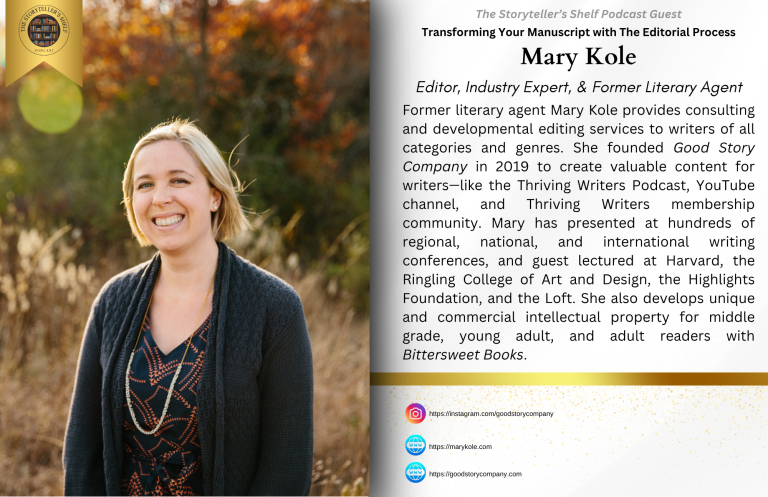
0:00 [Music] Hi everyone and welcome back to the Storyteller Shelf podcast. I'm I'm Jackie and I'm here with Teresa and we have another amazing guest joining us today to talk about the editorial process. So we have Mary Cole and I'm sure most of you might have heard of her before. So, we're gonna swing it her way and ask, "Mary Cole, can you tell us more about yourself?" >> Yeah, absolutely. So, I have been working in publishing since about 2009. I was a literary agent at Andrea Brown Literary Agency. I've also worked at Chronicle Books when I lived out in San
0:46 Francisco. And since about 2013, I have been a freelance developmental editor. In addition to that, I have a podcast of my own. I write writing reference books. I have the thriving writers community membership and I develop intellectual property with my business partners John Cusk who is a literary agent and Julie Murphy who is a number one New York Times bestselling author and that venture is called Bittersweet Books. So I have just fingers in every pie that is within publishing and also supporting people on their own publishing journeys. So let's start with the basics. What is the editorial process and where does it
1:32 fit in the overall publishing journey for authors? That's a great question. So there are a number of ways to answer the question based on where a writer is and where they feel like third-party feedback might fit. Now a lot of writers wonder, well, why would I work with a third party editor? Because if I sign with a literary agent and my manuscript gets acquired by a publishing house, well, don't they have editors there, right? Why don't I just wait for one of those people to usher me through the editorial process? But the reason that careers like mine are possible is that the slush pile, which is the unsolicited kind of submission bucket that awaits
2:18 every agent and every publisher like Chronicle Books that takes unagented submissions. It has been has gotten so competitive that writer by and large been doing whatever they feel they can in order to prepare and make sure that their manuscripts are competitive and of course it's a very subjective business. So these questions of am I ready to query? Is my manuscript done? You know, is my manuscript strong enough to sell to a publisher, which is a determination that a literary agent might make. These are all very subjective questions, but especially over the last 10 years or so, and especially for clients who decide to self-publish, they're using third party
3:05 hired editors more and more. And what I see in my spread of clients are two scenarios more often. One is if a writer really wants help from the very beginning. Maybe they've written a manuscript before or maybe they just hear that working with an editor is a way to put rocket boosters on your learning curve and your progress or they want to make sure that they're developing their idea as robustly as possible. there. I like to maybe consult with them over the phone, look over their idea in broad strokes, maybe help develop it, maybe do an outline edit for them so that they can anticipate or even correct for any plot
3:50 holes or logic holes or character development issues before they start writing. So, they don't pants it for 3 years and then figure out that, you know, there were a couple of issues that maybe could have been avoided. So that's one scenario and it's perfectly valid. However, more often than not, writers have already written a draft, maybe revised it themselves a couple of times, maybe already used a critique partner or a beta reader or another trusted source of feedback. they feel like they've gotten the manuscript pretty well where they want it or at least to the limit of their imagination for it or maybe they can't even stand to look at it another
4:32 time and then they send it off for third party feedback which is where I would come in and in this case either do probably a manuscript overview which is a summary report or a more comprehensive full edit a line edit of the manuscript and offer feedback there. But it really just depends. Would you benefit more from bringing someone in earlier in the process as you're still shaping the idea? That's definitely one way to do it. And if that's helpful, that is something that a lot of editors would provide. Or is it more concrete and maybe more actionable to talk about a manuscript once it already exists and you sort of already know the broad strokes of the story in a way that is
5:17 again more concrete than it would be at the idea stage. But those tend to be the two inflection points. And also thirdly, if you have gone on submission and maybe the submission hasn't gone as expected, you haven't seen the sort of response you were hoping for from agents or from publishers, sometimes people do seek out an editor at that point to maybe do a post-mortem on the submission round and try to figure out what might be working, what might not be working, and how their work is being perceived and if there's any revision that could help them achieve a better outcome. We always love to bring in the perspective of someone who's new to the
5:57 game. So, could you in your own words from your experience tell us a little bit more about what the types of editing are? I know you mentioned developmental editing and line editing. Could you break those down for us a little bit? And this is a really great question because a lot of people don't know that there are different styles of editing or different outcomes for these various types of editing. So as I mentioned developmental editing is plays at the idea level, the structural level, the storytelling level. So, anything from your plot arc to your character development, these kind of bigger suggestions that I might make about the storytelling itself, the story, the
6:40 premise, the themes, the voice, it can be granular at the sentence level, too, but it has a lot to do with the bigger points of your story. And I strongly recommend getting somebody, whether it's a critique partner, a beta reader, a developmental editor, to comment on the broad strokes of your story first before you start messing with some of the other types of editing, which I'll define in a second, that have more to do with the sentence level. Because if you're still playing around with the structure and maybe the third act is going to get rewritten or you're going to have to get rid or not have to, right? Any editorial suggestion is just a suggestion. You
7:23 don't have to necessarily follow it, especially if it doesn't resonate with you because you're the one who knows the integrity of your story better than anyone else. Um, but if if you decide to get rid of a subplot or a secondary character that is currently taking up a lot of real estate in the manuscript as is, those beautiful scenes, those beautiful sentences might not be there anymore. So, if you jump right to a line edit or a copy edit, which I'll talk about next, you might be working harder, not smarter, and you might actually be perfecting individual paragraphs, individual turns of phrase and images where that scene might be problematic.
8:04 And so, developmental editing addresses these kind of zoomed out concerns in the story, the narrative, your narrative choices basically. Then you go to line editing and that's when you zoom in to concerns like voice structure of individual sentences, paragraphs, individual scenes, how you're using dialogue, scene setting, imagery, all of those kind of page by page considerations of your writing. Copy editing is one step zoomed in and that is mechanics issues just any uh any kind of continuity elements in your writing. A copy editor is a great person for calling out for example, oh you said
8:51 this character's eyes were blue on page 73, but here they're brown. So they really are in the nittygritty of your story, not necessarily the storytelling of it, but again, making sure that brands are spelled according to the way that brands are spelled. Right? If you write P L A Y D O U G H, they might come after you and say, "Actually, the brand Playo spells it P L A Y, I believe, dash D O," or something like that, right? You can you can put like a little asterisk on the screen if I got that wrong, but no. Or um or kind of voice consistency notes. Copy editing in a professional publishing setting usually is one of the
9:38 last things to happen before a manuscript goes to print. So you do all the big picture work first, then you drill down into the line level. And finally, copy edits are a completely different department in most publishing houses where they're just really concerned about the nitty-gritty, making sure that everything is spelled correctly as it should be. They use uh Chicago or they use um a APA. Um they use their in-house style guide and to make sure that the manuscript really aderes to their style guide. When you work with a third-party freelance copy editor, they don't necessarily have a house style guide that they're serving like they would in-house at a publisher, but a lot of
10:23 the same considerations are what they'll bring to the table. It has more to do with proofreading rather than kind of story level feedback. So, if I were a beginning writer and you get this idea to work with an editor, but you've never worked with an editor before and you're still early in your project, a developmental editor makes much more sense. If you hire a copy editor, you're going to get very clean copy, right? You're going to get a manuscript that is very nicely sort of polished and consistent and all of that, but they're not necessarily going to zoom out their lens and talk to you about your story choices. That was awesome. That was I feel like that was a whole blog post in
11:06 one answer. It was so great. Something that we try to do on this podcast is we like to make sure that we represent questions for people who are self-publishing and traditionally publishing together, all in one place, all on equal footing. So we'd love to kind of draw from your personal professional experience in publishing to see if you could tell us a little bit more about the traditional process. So for people who are traditionally published authors are looking to be traditionally published, how much input does the publishing house and other departments have in the editing process? I mean, does it ever happen that editors at publishing houses request major
11:49 structural changes or minor ones to manuscripts? So, one of the things that I will say is if you want total control over the substance of the project, the marketing of the project, the cover, all of it, self-publishing is made for you at that point. If you don't want that big picture developmental editing feedback, you should still at least work with a copy editor or proofreader to make sure that your manuscript is exactly as clean as possible because your readers are going to tell you and they're going to tell you in reviews and that negative social proof could impact your book sales. So, I would say anybody self-publishing should at least work
12:35 with a copy editor or a proofreader. If they don't want that big story level feedback, right? But when you get into the traditional shoot, you should set your expectations that you will be doing some revision with the agent if you go the literary agent route. And a lot of writers do work with literary agents if they want to target the big five publishers because those houses are considered closed to unagented submissions unless you meet an editor at a conference. But that that tends to be kind of a wild card. So, if you are approaching the traditional publishing route, an agent will likely give you some feedback and they should preview
13:20 this feedback with you before you guys sign together. They'll usually say, "Hey, this is currently positioned as a romantic comedy, but I think women's fiction might be the stronger category for this project. What do you think?" And if it's something you agree with and you can really imagine yourself working with that agent, then that's a great thing, you will revise with them and then now that you have kind of the strongest possible version of the project, you will go out on submission. But as I said in the very beginning of our conversation, there are also editors at publishing houses and the same process is going to repeat. If a publisher wants to make an offer, an
14:02 editor, a specific editor at a publisher wants to make an offer on your book, you will have a conversation and the substance of that conversation will very much be, hey, I was envisioning this more along the lines of Emily Henry, which would take you back into the romantic comedy vein, right? I'm using kind of adult examples because that's where my mind is right now. But let's just say, you know, you thought you had this upmarket middle-grade and the editor is like, oh, you know, I think we should really make this more of a Kate de Camilillo, you know, thoughtful, heartfelt middle-grade coming of age story. And it's up to you to decide if that aligns with your vision. Now, of
14:43 course, any writer would prefer the publishing deal, right? But this is how writers get into some trouble if they decide to sign on with an agent whose vision doesn't match theirs or they sign with a publisher or an editor whose vision does not match theirs. It's very rare that an editor will completely take over a project and kind of force you into an approach that you don't like because ideally these are conversations that would have happened before the book deal, before the contract was struck. No editor wants you to feel terrible about working with them and about the product, the outcome of your collaboration, right? So to me, in my experience
15:25 listening to writers and kind of sitting in on some of these conversations, it's pretty rare that a book would go completely off the rails after acquisition. But it definitely can happen where an agent's feedback doesn't align and then maybe they're not the right person or an acquiring editor just doesn't seem to get the project even though they're offering on it, which seems so weird, but my business partner was just telling me the other week they there was an auction situation and one of the editors just didn't seem to really resonate with the project, you know, which which is so strange, but ideally ally everyone who's championing the book all throughout the process is
16:10 really sort of aligned with your vision or if they present a a change to the vision you could really get behind it and be enthusiastic about it too. >> So in the sense of a self-published author though how does a self-published author manage that process and what advice would you give them into making a polished book? So, I'm obviously biased because I make part of my living working as a freelance editor. But when I tell you that you need third party feedback, I'm not trying to enrich myself. I don't care if you talk to me about it. I don't care if you talk to a critique partner about it. I just know that a lot of writers, they have blind spots about
16:53 their own work. And if they're hoping to learn, hoping to grow, hoping to improve, hoping to put out the very best book that they are capable of, it's very very tough to see your own work objectively because we all have blind spots, we all have biases, we all have, you know, an emotional investment in our own work. So for self-published authors especially, because there's really nothing standing between you and pressing publish, right? You could do it this afternoon. You know, dust off that story you wrote and you're like, "Oh, this is probably fine. Upload it. It'll be available on KDP in less than 72 hours." Because there is kind of such a low threshold to bringing
17:37 something to market, you have to be really, really vigilant of some of those biases and blind spots. And if you really are committed to your craft, not just to an individual book, but also learning and growing for all the books that you hope to release in what is ideally a long career. You need to have at least a critique partner or beta reader, if not an editor that you work with regularly, but somebody who can keep challenging you in a way that you like about your storytelling choices who can understand, especially if it's a series, understand where you're coming from with the series and get to know the characters and maybe keep some of that
18:21 continuity going. So, you know, you're like, I have the fifth book in my series. Can you please read it and give me notes? And they're already in a relationship with you. They can comment intelligently based on what has come before. So whether that's a free or kind of a barter relationship with a critique partner where they read your stuff, you read their stuff, whether it's a paid relationship with an editor, I really do think that every self-published person owes it to themselves and to their readership to make sure they have at least some kind of check and balance before they start just releasing to their heart's content and at the very least a proofreader because I so I
19:04 self-published A lot of my writing guides, I've been traditionally published with writing guides. I self-publish them. I am an editor by profession and my colleagues are editors. I still give all my manuscripts to my colleagues because I can't trust myself even though I do this literally for a living. I can't trust myself to catch everything. And my colleagues sometimes miss stuff too. And they are also professional editors. So it's not there are I notice typos and especially things that don't come up in spell check but it's the wrong word. So in context it's wrong but the word is correct so it didn't trigger any kind of
19:49 grammar check or whatever. I notice those mistakes in published works all the time. the the burden isn't perfection, but if there's nothing standing between you and the publish button, I really do think that some story feedback, yes, but you could get that with a critique partner. You don't have to spend money. Proofreading at least one round for every manuscript is just a great is just a matter of course kind of best practice to engage in if you're self-publishing. as a self-published author, you want to represent yourself in the best possible like like you were saying. Um, with that being said, I feel like editing is both an art and a science. And in your
20:32 experience, how do editors balance their personal tastes and being objective? That's a really good question. And I have seen editors kind of all over the spectrum. I try to be as objective as possible. I have maybe kind of a funny example and like a very tragic example of this which I will share. For example, I have so my political leanings are to the left, right? Not a surprise there. Media elite blah blah blah. But I have people, conservative clients approach me that are like, you know, can I work with you? Because I have editors like I I've had editors tell me no. You know, they
21:18 see my email address, which is like mag45aol.com and they just refuse to work with me. I'm not taking a position either way. But I'm like, you know, how I feel about politics doesn't get in the way of me understanding your intentions, understanding your vision, your integrity, and reacting to the question of did you do what you set out to do as successfully as possible. Right? That's really the only answer that I am trying to give when I deliver kind of an editorial take. I would never say I hated this because you're different from me. You know that the value judgment,
22:05 this is bad, this is good. That doesn't belong in editorial work as far as I'm concerned because it's not helpful. And I tell my clients all the time, I'm like, if I glow about your work, please take that as genuine. Because while it feels good for somebody to tell you like, "Oh, this is so great." I don't blow smoke because it's not helpful for you and it's not helpful for me. I'm not standing in my integrity if I do that. Um, another example was, you know, I've seen editors who have trigger warnings that they will not work on XYZ. Um, unfortunately, I had a newborn pass away in 2017. And yes, the all the faces. Exactly. Um,
22:50 I had a very interesting uh gynecologist, like a doctors without borders type of memoir approach me shortly thereafter and she was like, "Hey, this has infant death in it because unfortunately when you do gyne, you know, OB work in Africa, that is that is just part of the equation." And was it difficult to read some of those scenes? Yeah, absolutely. But storytelling is storytelling. And if anything, her sharing that story was cathartic for her. Me reading that story was cathartic for me. But I know some people who would outright refuse to engage with things
23:35 that they that they don't like. I may be kind of unemotional to a fault. I kind of, you know, distance myself from those very, very personal things, maybe almost to a fault. But I like to challenge myself to embibe as many different viewpoints as possible and interact with as many perspectives as possible and not really get in my own way with my opinions. And don't get me wrong, I am not against trigger warnings. I am not against people, you know, blocking those parts of themselves off and protecting their peace and protecting their mental health. You know, I have just decided that for me as an editor that that would
24:21 be a liability if I if I decided that I needed to distance myself from from anything in my work. But it's completely valid. It's just not for me. You know, from a lot of the things you say, the silly cliche phrase that keeps ringing in my head is that it takes two to tango because you have two people on either side of this. And I know that one of the most difficult things for most of us about being an author is really just learning how to accept feedback, especially when you're new to having even just a friend read through anticipating what they're going to say and anticipating something not so good can be very scary. So from your
25:06 experience, how can authors learn to take criticism and apply it constructively while still advocating for themselves and what they're writing if they need to? >> That's a great question. So as I said earlier, I really try to understand the writer's intentions and then the question I'm asking, the kind of implied question behind a lot of my feedback is, did you accomplish what you set out to do as well as you possibly could? Is it effective? Is it going to have its intended effect on readers? That sort of thing. So that takes some understanding of what the writer set out to do. Thing that I tell clients is to take the wisdom and leave the rest. And that goes
25:47 for my feedback. It goes for feedback they might receive in the slush pile. It goes for feedback they might receive from other editors, other beta readers, whatever. Because only you know your story best. Now, if everybody who attempts to give you feedback is an idiot who doesn't understand your genius, right? You're maybe a little early in your growth journey and maybe interpreting feedback, reacting to feedback is not exactly for you yet, right? So, if you can genuinely and honestly check in with yourself and say, "Okay, I'm not having a knee-jerk emotional reaction here." then I would say yes, you should absolutely advocate for
26:34 your vision. And if somebody is giving you overly prescriptive feedback like you absolutely need to do this or you should that and don't ever this and always that. That's the kind of stuff that you need to take with a grain of salt. As I say, you need to, right? But that's the kind of stuff I would take with a grain of salt because instead of like taking the feedback so literally, ideally you are able to step back and maybe see what the feedback is saying, especially if it's prescriptive. If you get a piece of feedback that's like, you know, I don't like Jack, right? That's not very helpful feedback. Jack is a character, right? But is there something
27:18 to be unearthed from that feedback? Maybe Jack is unrelatable or maybe Jack's actions put a wall up so readers can't really kind of get over that transom and learn who Jack really is. So if somebody's like, "You need to get rid of Jack," that's kind of noise. But if you can filter through your noise and understand what the signal is, maybe you, the creator of the story, can figure out a way to make Jack a more nuanced character, a more compelling character, a more relatable character, a more multi-dimensional character with, you know, a more interesting relationship to the protagonist. For every note about writing, there are a
28:05 number of different ways to address it. For example, pacing. Information is dense. Action moves quickly. Pacing is the perception at which the speed of your story moves to the reader. So, if somebody says, "Your pacing is slow," you could insert more scene and dialogue. You could shorten your chapters. You could remove a lot of imagery and setting description. All of those either individually or together could address the problem of pacing. And there's this book called Novelist as Vocation by Murakami where he says, "If an editor ever tells me what to do, I guarantee don't do it." But I notice
28:52 where they're talking about, like what tripped them up. and he'll likely do a blank page revision of that section because that all that tells him is that something isn't working there. It's on him to solve it right, but it's good feedback that something about that spot isn't quite clicking. And I would much rather a writer take my notes. I try not to be very prescriptive like get rid of Jack kind of traffic and absolutes like that. And then the writer can synthesize the bigger picture of the feedback and kind of make their own revision plan from that. What I've given them is a reaction
29:37 of how their intentions are or are not coming across to a qualified reader. Right? But also I am one person. I'm not the end- all beall. But what they take from that can be a synthesis of, you know, all of the various points that I've made, their own reactions, other feedback they may have gotten. They're the ones who need to make the revision plan and choose what to act on and what not to act on. >> This is great because this actually happened to me like what you were talking about. I did a critique group and I I I know Jackie knows what I'm talking about because I told her about it. I had sort of like that kneejerk reaction with my critique group where it
30:19 was like they read only the first paragraph of the of the second book and I had to actually step back cuz I was like hold it hold it. This was a lot of work and then I shared it with Jackie and you know she said that's just one person's perspective. So then I did exactly what you were saying where I analyze, okay, what is it that they're talking about here, you know, and just kind of avoid taking it personally. So I can definitely empathize with what you're saying with with that and using that analogy. I do feel like at baseline whenever you enter into a partnership with an editor or with a critique partner or a writing group or a community whatever ideally everybody's
31:03 on the same page which is my my favorite bad publishing joke um with the intention of providing actionable feedback and helping a fellow writer out. But that's not always the case, right? Some people are in critique groups to sound smart, right? and they are devastating and cutting because they're like, "Ooh, this this means I'm the best writer. Don't look at my writing, but I'm going to make such incisive critiques that, you know, I'll be untouchable." Right? People show up with all kinds of motivations. And ideally, it's in the spirit of learning and growth. But if we find that something is not done in that spirit, remember that we can kind of take a step
31:47 back and reenter ourselves and again take the wisdom and leave the rest. >> I like that. And that should be like on a shirt. Take the wisdom, leave the rest. You know, with that being said, with with that being said, let's pivot into the um the timeline as an editing process. I found from when I take it to an editor my own work that it can take several weeks. Is that typical or how long does an editorial process usually take especially in traditionally published work and is there a difference between that and or self-publish authors? >> Yeah. So, traditional publishing is the slowest industry ever. From getting an agent's response to your query to
32:33 getting an agent's response to a manuscript when you're already their client to getting editorial notes from a publishing house editor. A lot of these people read on the weekends because their jobs are very different from just sitting there marking up manuscripts, right? agents are networking, editors are promoting their books and and putting together P&L pro uh profit and loss sheets for, you know, new acquisitions and going to meetings and all of this other stuff. So, they're actually editing a lot on weekends and evenings outside of business hours. So, even if you are agented by an agent and you send them your next manuscript, it might take
33:18 weeks to hear back. With a freelance editor, and this is more along the lines of the indie track, it could take weeks. For me, I usually run about 6 to 8 weeks for a project return, like a novel length project return from submission simply because I have other people who have agreed, signed the client agreement, put down a deposit, inquired ahead of, you know, whoever's inquiring today. I've seen that. I've seen a time frame of a couple of months. I have seen people who only open up for clients once a year and you kind of get a very very you know far ahead time slot reserved.
34:04 Publishing again moves very very slowly. It's not like ordering something. I mean you can get an editorial review on Fiverr that you know may have a 3-day turnaround. You can have something fast and cheap, but then it's not good, right? So, there are kind of trade-offs. And I think because of how slowly publishing moves, a lot of freelance editors and other providers in publishing are fine taking their time because it's just baked into the expectation that the turnaround will be a little more than anybody wants. Reasonably, >> my picture book took three months to edit. Reason was this. >> Wow. Yeah. But, you know, it was okay. >> That doesn't that does not sound outside
34:51 the realm of normal to me at all. Unfortunately, I am a very impatient human being and it's the that I've lasted in publishing for this long is shocking to me because just every day I have to fight with my own nature. Like, why is this taking so long? I think that's why it's good to have multiple projects going on at once so you can distract yourself and cultivate that >> faith. Exactly. Because if you are just going to sit there every day refreshing your email like when you're on submission, writing something new is the best antidote. Otherwise, if you're anything like me, you will go crazy. >> I've been querying my picture book, right? And um to agents and small
35:33 presses and I'm always checking my email and she's like, "It'll happen. It'll happen." and she's usually calming me down. So, yeah, >> it help it it helps to have a buddy who knows the crazy publishing world, too. So, >> let me ask you another sort of influence question of things that can influence the editing process. Does it ever happen that the current market of what's selling, what's trending, what's not selling influences how you edit a manuscript? Have you ever seen maybe a particular book revised to fit particular market demand? >> This is something that happens more frequently with agents and publishing house editors because part of their job
36:19 is to trend forecast, right? And for example, a bunch of romantasy sold last year and it's starting to come out on the heels of, you know, Aotar and all of that just touched off this giant trend. But I think that we are over the hill on that trend right now. And it's very possible that an agent or an editor with one of these manuscripts is like, "Hey, is there any way that we could revise this more toward a fantasy rather than a romantic fantasy or a fantasy romance?" because our sales and marketing team is telling us that, you know, romantasy is over the hill a little bit, has peaked, and we think that we will get better buy in from our book sellers and librarians
37:07 and our actual purchasing accounts if we uh wrap this up as a fantasy. So there are definitely things that can happen along the long road to publishing the book where different creative decisions are made. Again, ideally everybody's on board with the book. Big big changes won't be being made, but sometimes when you are between trends or if a trend is a flash in the pan, these conversations do happen, right? And one of my jobs is to know the market for the work that I do with Bittersweet Books, which is the IP development. We develop book concepts, marry them to writers and try to sell them to publishers. I tend
37:53 to keep an eye on the market and what it's doing and try to figure out what the trends might be for the next 6 months, year. Publishing does move slowly, but sometimes trend pockets tend to come and go more quickly. So I instead of in my work as a editor instead of again making these big proclamations like romanticy is out you absolutely won't sell it as is just tend to give an overview of my understanding of the market whenever I do notes you know romanticy seems like it's waning but this is in good shape try quering it anyway and see what the agents say because they're the ones who are going to be tasked with selling it and their understanding of what editors are buying
38:38 need to be part of the conversation, especially in the traditional track of things. But I'll give my opinions all day long, but again, I'm not going to say, "Oh, there's no way that you would sell this." Because I remember when I was a literary agent in like 2009. It was at the height of Twilight Mania, and I went to have a meeting with this executive editor at Harper Collins, and she was like, "Uh, I hate vampires, right?" And I was like, "Great. I hate vampires, too. And then like two days later in Publishers Marketplace, there's this big threebook deal announcement for her new vampire trilogy that she just acquired. So, you know, there's no black
39:17 and white in publishing. She may have hated vampires and then the perfect vampire story fell across her desk and she just had to have it. Or maybe her boss was like, "We need a Twilight Killer." And she was like, she held her nose and acquired it anyway. So there are so many variables that you know all I can do is advise what the trends might be as I see them and then the writer can make a decision. If it's already acquired and we're making pivots after that with a book contract on the line, maybe it's a little less of an artistic decision and more of a marketing decision and there's less wiggle room if a editor who acquired the book is saying
39:57 that we need to make a pivot. But at least in the freelance editor space, you hired me, right? So, I'm not technically the one calling the shots. I should hope that you respect my opinions as a professional, but I'm also not going to really wedge myself in there and and kind of make these black white proclamations. Let's pivot into cost as far as editing goes, you know, because obviously it varies bit depending on traditional and you go into self-publish and I understand that completely and empathize with all self-published authors because I am one and you know how it is. It's like you're shopping around like you're shopping for all kinds of things and in the same sense
40:36 you're like shopping for a quality editor but also you have to keep in mind budget, right? So, as far as that goes and editing can be expensive, what goes in the cost of editing and what should authors budget for? And can you um shed light on both the traditional and the self-published? >> Well, in terms of traditional publishing, the editor is paid by the publishing house. They are on a meager salary. Uh, as many editors will tell you, if they ask you for money to pay for any components of the publishing service, it is not a traditional book deal that you're getting. You are paid by a traditional house. And they also
41:21 pay the individual service providers, the editor, the cover designer, the um interior designer, all of the stuff that you need to add individually to your shopping cart as an indie author. One of the benefits of a traditional house is that they do cover those costs, especially for picture books. Picture books are one of the most important uh sorry, most expensive things to self-publish because you're paying for illustrations which tend to be if you want quality ones more expensive and also full color printing and production because you know all of this stuff. So, so traditional route, let's wipe that off the table because there is no cost to the author. If you have gotten a book
42:04 deal from one of these publishing houses that has names like Summit Publishing that you found when you were googling get a publisher for my book, if they ask you for money, you've actually landed hybrid publisher, which is kind of a payto-play outfit, right? They take money, they produce a bookshaped object for you, and then you're on your own. For self-publishing, you are either going to a company that bundles all of these services together or you are seeing individual service providers. Again, the cover designer, interior designer, formatter for ebook, whatever, including an editor. So, general rates can be found online. There are a bunch
42:50 of articles like on ReadZ, which is a marketplace where you can find editors that will give you sort of spreads within the range of normal. My rates are way on the high end of that because the behind-the-scenes experience that I bring as a former literary agent. Some people will pay a premium for that and I love them and they're my clients and you know I I do less work for the living that I need to make. Um, but I would say for developmental editing, which tends to be the most creativity and experience intensive, you can see anything from I I'm much more versed in per word
43:35 charges because that's how I charge rather than per hour. I'm a little bit lost in the woods on that one because I do less kind of comparative research there. But for developmental editing, you can see anything from like 3 to 8 cents a word for obviously the longer your manuscript is, the more expensive it'll be. And that's because this is so kind of inherently creative work. This is so timeconuming work because you're really sinking into a story and you are generating a lot of creative feedback and a lot of just really complicated notes based on structure and plot arcs and character arcs and all of these all of these kind of it's a lot to juggle in
44:19 one head at once. For copy edit for line editing you can see maybe between 2 cents a word and maybe 6 cents a word. For copy editing, again I would say two cents a word to maybe four cents a word is kind of range of standard. For proofreading, maybe half a cent per word to 1 and 12 cents per word are um are but again you can if you hire an editor for a copy editing pass, you may not need a developmental editor if you feel like your story is strong, right? So set your budget accordingly for only a copy editing pass. And if you hire a copy editor, you may not also need a proofreading pass because any copy
45:04 editor worth their salt is going to catch some of those individual errors in a manuscript. Or you could do a developmental edit on your manuscript, then go back to your hideyhole. If you're really happy with how the manuscript turned out, just get a proofreading round at the end before you hit publish just to make sure that the copy is clean. There are many different ways to combine these services. And for shorter manuscripts, some people, like I do, charge a flat rate rather than per word because then for a hundredword picture book, it's like $8. So, all right. Now, we have a hot topic to kind of jump into. There's been a lot of talk about AI recently, right? Maybe a
45:48 little too much talk about AI. So, >> speaking of trigger warnings, >> yeah, trigger warming AI. Um, and we're going to jump into it, too, because that's what we do. So, some authors, uh, they're really starting to rely on AI tools for different types of editing softwares like Grammarly, which I think is more familiar at this point, to proriting aid, to chat, GBT, and claude, the whole collective. And we would love to know your opinion on AI. Is there any type of editing that AI can handle well or does it still fall short compared to the real deal? >> I mean, honestly, and again, I'm an editor. I benefit when people go see an editor. But what I'm about to say is not
46:33 biased at all because I really truly believe this. For copy editing, proofreading stuff, Grammarly is great. just do yourself a favor and use it because it helps you tighten up your sentences. It helps you notice things maybe a little bit differently at the sentence level. It's a great tool, but again, you could get screwed if you've spelled a word correctly. It's just not the word that you intended. And there are certain things that do fall through the cracks, right? But it's not a creative engine, right? It analyzes material. it doesn't sort of think about the material. So when it comes to developmental editing and I have all of these things because again I like to
47:18 keep an eye on my competition but I from a story perspective I do not feel like I ran a manuscript through autocrit and it was like oh this doesn't you know this doesn't have a lot of emotional engagement cuz the word feel or felt appears 37 times you know so you're telling when And the sentence itself would be like she felt like he was an idiot. You know, like more voiced driven rather than explaining about feeling, right? All it's doing it's counting words. It's looking at the frequency of various words and it is extrapolating from that various patterns that have been programmed into it. Right?
48:03 But I think when it comes to understanding the story, when it comes to making recommendations based on that understanding of the story and when it comes to sort of brainstorming and I use sometimes just to mess around with I have a software called pseudorite and it's sudded toward fiction writing actually whereas things like Jasper and Claude and chat GBT are geared toward more non-fiction. marketing, copy, all that stuff. So, pseudorite has like a brainstorming engine and you're like, what are the ways in which a heist can go wrong? And it'll just fart out um endless ideas, right? So, I think that AI can be a tool, but you are still the prime mover,
48:51 right? This is what I tell writers all the time. Nobody's coming from your job for your job, sorry, because you are still the one originating the idea. You are sort of writing the prompts. You are telling the AI the parameters of what it should be doing. And for editorial work, it's like how this lands with a human reader. AI is incapable of understanding that. It can count word frequencies and match those to a pattern like if I run my thriller script, then you're using a lot of the words that are consistent with a thriller. Good job. But zooming out to the big picture and understanding the creative intention of a piece and reacting to it like a human might,
49:35 there's there's no opportunity for AI to really win in that way. It's helpful. I mean, go get Grammarly. Absolutely. But for the bigger picture stuff, I I I I see it as a tool. I don't see it as a replacement. >> I have a question for you. um because you talked different ways on you know how the editing process works obviously cost and I I really appreciate the fact that you know there's so much involved in the editing process with that being said though are have there been any challenging editing processes with different clients not naming names how would you navigate those difficulties so there are two scenarios that have
50:21 happened to me over the years I've been doing this for a very long time. One is when a writer hires an editor, but it is immediately clear based on their reactions to notes that they weren't expecting notes. They were expecting a gold star, right? They're looking for someone to just validate or fall on their hands and knees and just be like, "This is perfect. No notes. Here's your money back. And also, let me introduce you to an agent." Yeah, I don't know what the mental game is with hiring an editor when that's actually what you really want the editor to do, but I have had a number of people, a handful of people that just based on their reaction, I could tell
51:07 that they they just wanted the gold star. They just probably weren't prepared yet in their own craft, own maturity to take those notes like we talked about. The other difficult challenge in an editorial relationship is just setting expectations because a lot of people who are new to publishing, especially those early writers who come see an editor before they've had a lot of time to work through things on their own or they've already been out on submission. A lot of people have this very rosy romantic view of the publishing industry, how long things take, you know, what publishing a book can do for them. And when I talk to one
51:52 of these writers and they're just like, "Oh my god, publishing a book is going to change my life and d" and it's a yes and. But when somebody has stars in their eyes, publishing and any creative endeavor really is a difficult road to take because there is a lot of setting of expectations, resetting of expectations, lowering of expectations. You know, the truth is eight out of 10 books, seven out of 10 books don't earn out their advances. So everybody's kind of bestlaid plans for acquiring a book and bringing it to market and making somebody's dreams come true, all of that doesn't pan out in the way everyone would hope more often than not. And so
52:36 just seeing somebody's skyhigh hopes get dashed or seeing how much a person invests in external validation from the publishing process can be tough to engage with because you don't want to poop on anybody's parade. But publishing isn't going to be your mommy either. You know, it is a business. It is still an industry. If you are looking for publishing to validate who you are as a person or who you are as an artist or yourself, right? I'm not a therapist, but sometimes my work takes me to the verge of being
53:21 somebody's therapist because they're they're investing too much of themselves into the publishing industry and creatively absolutely invest your creative self. You know, be creative for the sake of being creative. But when you decide that publishing is going to make meaning for your life and give you everything that you you might be missing currently, that's a really tough sort of starting point for for me counseling a writer sometimes. >> That makes a lot of sense. I feel like one of our main goals on this podcast is to especially help out people who aren't familiar with all the ins and outs of the publishing industry. And a lot of us
54:07 come in with those roset tinted glasses and we just don't know what we don't know. And I like that you mentioned that it is a business at the end of the day because I have that conversation a lot with authors which is that at the end of the day it's a product that we're selling and it it's a sales business. It can really be a tough pill to swallow but knowing it and knowing the ins and outs can help you be more prepared and can help you be more resilient as well as create a better product that you'll be proud of. Right? So it all kind of works together. But I guess this question is more a what to look for question. So once in a while we like to
54:44 gear something that's towards people who want to get into editing as well as people who are shopping for an editor. So this one touches on both. What makes a person qualified as an editor? If an author, for example, is looking to hire an editor, what should they look for in terms of credentials or experience? Or if you're looking to become an editor, what experience do you need to be successful? >> So, a lot of freelance editors have come through the traditional publishing industry in some way, shape, or form. Maybe they left a publishing house. Maybe they were an agent like myself. But there are also a lot of passionate English degree people or even really
55:28 passionate readers. So people who maybe used to review books and maybe had a popular blog back when that was a thing or were book influencers and so internalized a lot of story and storytelling structure and craft and then kind of fell into editing that way. Maybe somebody asked them to beta read and they did a great job and they kind of started gathering clients in that vein. There's no I mean there's a professional freelance editorial association right but there's no test there's no degree there's no you know to be a doctor you have to get your MD you have to go to medical school and residency and all of that there it's much more loosey goosey for editors and
56:11 so I would say for writers who are choosing an editor try and pick somebody who has a track record who has social proof who can point you to clients or to titles that they've worked on. Not everybody can link themselves to specific titles because of confidentiality with their clients. This is very true of ghost writers, for example, but they should at least be able to show you some testimonials or connect you with a client. Ideally, they work in your genre so they understand the conventions and tropes and expectations of your genre and target audience. So whether it's a picture book, whether it's middle-rade up market for adult readers, they should
56:53 have demonstrated success or really have a focus in those specific areas because not all books are the same. A hard sci-fi book is very different from a sweet coming of age middle-rade. and they should be able to really be comfortable in what you're writing because then their feedback will be more qualified and more useful for you. And then for people who want to start a freelance editing business, the good news is you don't need to go to medical school. you know, you don't need to, you know, pass all these hurdles, but you may have to work for free or cheap or start out as a critique partner or a beta reader and work your way up from there because there are uh a lot of
57:38 unemployed English majors out there or undermployed English majors out there who are, you know, hoping to do a side hustle in in freelance editing. If you intern for free at a literary agency, for example, that could get you an inside track into the industry and you can tout that as experience. Anything that legitimizes you as someone who can really speak to people's goals, which a lot of the time are to publish traditionally. Luckily, now internships happen remotely all the time. That was less common when I was an agent, but now it is very common practice. So just whatever you can do to either legitimize your own writing or legitimize your insights and your
58:25 level of experience in the industry, those are both very good things to do if you want to attract editorial clients. >> Um, for our listeners working on their manuscripts, what's one p piece of advice you'd give them about the editorial process? to go in with an open mind and tempered expectations, but also to have really developed a strong sense of what the project is, what your intentions were, what it means to you, so that when you do get those notes back, there is going to be an emotional reaction, right? That's unavoidable. It's only human. But if you really understand what your mission statement is, it'll help you pitch down the road, right? Or write
59:08 marketing copy for your indie published project. But the more you understand your own intentions with the piece, your own intentions as a creator, your own themes that you're interested in that brought you to the project in the first place, the more you kind of have crystallized that for yourself, the better. Because when you run up against some feedback and it's maybe unexpected, you can do that comparing, take the wisdom, leave the rest thing that I discussed earlier. Unless you really know what you set out to do, you might be a little bit lost when it comes to interpreting that feedback later. >> What was the best piece of advice that you've ever received when you were
59:51 working in the publishing business? >> That's a great question. I would say it's not advice I received while working in the publishing business. It's just something that I've found over the years that really differentiates the writers who tend to, you know, grow by leaps and bounds versus those who maybe take longer or remain stuck where they are. You can collect knowledge all you want. I put out tons of resources, write books, I give advice all the time. I'm giving advice right now. Internalizing, gobbling up, and storing away all of that information is great. It means you are growing. You are learning. you are becoming savvier. However, there are writers who don't put
1:00:35 it into action, right? They just collect the information or for example, this is this is classic to demonstrate this. I will have somebody who's like gets their notes back and then they're like, well, should I do this in first or third point of view? And I'm just like, try it. Write rewrite the first chapter in first. Rewrite the first chapter and third and see what reads better to you. see what's more natural for your own voice. There are writers to whom that does not occur, who are just like, "What should I do? I'm a babe in the woods. I have no idea." Well, try it. Don't just dwell in the theory. Don't just learn the stuff and put it away on a shelf to gather dust.
1:01:17 Actually put it into practice. Play around. Nobody's looking over your shoulder when it's just you and the page. So, write the chapter in first person. Write the chapter in third person. put some elbow grease behind it. Nothing is going to get done when you just sit there and hypotheticalize like, "Oh, what what should I do? Try it. Try it this way. Try it that way. Maybe omnisient is going to be the point of view that you end up choosing." You know, maybe it's neither A nor B. It's some option C that you haven't even tried yet. But the writers who just sit there and wait to be led or spin their wheels with all the theory and the craft that they're embibing,
1:01:57 they tend to make less progress because they don't go out on a limb and just try it and play play around and let it be a creative exercise, right? And it's a tough thing to balance because I'm in a position of authority. So people look to me for answer, but a I'm just a helper, you know? I'm on the sidelines. The answers ultimately are going to have to come from you. >> I think that that as the last line is going to be perfect because hopefully everyone listening is going to take that and spring into action today because you can't do anything with advice unless you do anything about the advice. But Mary, we're going to thank you for being here
1:02:37 with us today. This has been such an insightful conversation. Thank you so much for sharing your expertise and all of your opinions. And for everyone listening, give us an extra like. And please go to our website, the storytellershelfodcast.com, find Mary's name, click on it, and see what she's up to and where she is on the internet because she just came in, she showed up, and she had strep throat, and she's still here helping us now. So, she deserves all of the hugs. Thank you. You can find me for developmental editorial services at maryc.com and that's Cole with a K. And also my latest initiative is uh the thriving writers community at thriving writers.com
1:03:20 if you want to come have have unhinged fun with a lovely group of people for accountability and community. If you guys enjoyed this conversation again please leave us a message somewhere so that we can show Mary and say that you found something beautiful and actionable from this conversation. Otherwise thank you everyone and we'll see you next time. If you enjoy this episode, give us a like, subscribe to our channel, and share this with a friend because we know that other people out there could use this, too. And one last thing, if you like freebies, definitely join us in our email newsletter. Pop your email in, it's for free. We don't spam you, but we
1:03:58 occasionally send things like career opportunities, awards and contests, and handy dandy things like pitch guides and query guides that you might find very useful. So, otherwise, we will let you go today, and we'll see you again next time. [Music] This episode of the Storyteller Show podcast is brought to you by Harne and Suns fine te's. A perfect companion to every story. Whether you're reading, writing, or just enjoying a quiet moment to yourself, Harne and Suns offers a beautiful selection of tees to elevate this experience. From classic blends to unique finds, every cup is crafted with
1:04:44 care, just like the stories we love to share. shop shockhornne.com/disount/stoteller and storyteller is an allcap. Now, let's get back to the