0:00 Hey storytellers, before we start today's episode, we have something exciting to share. The Storyteller Shelf Summit is almost here. A full week of virtual mini master classes to help you grow as a writer, an illustrator, or an educator in children's literature. We are also offering an exclusive pitch event with literary agent Cerrone Harvey, giving you a rare chance to get your work in front of an agent. To participate, you'll need to purchase both the summit ticket and the separate pitch ticket. Click the link in the description. We can't wait to see you at the summit.
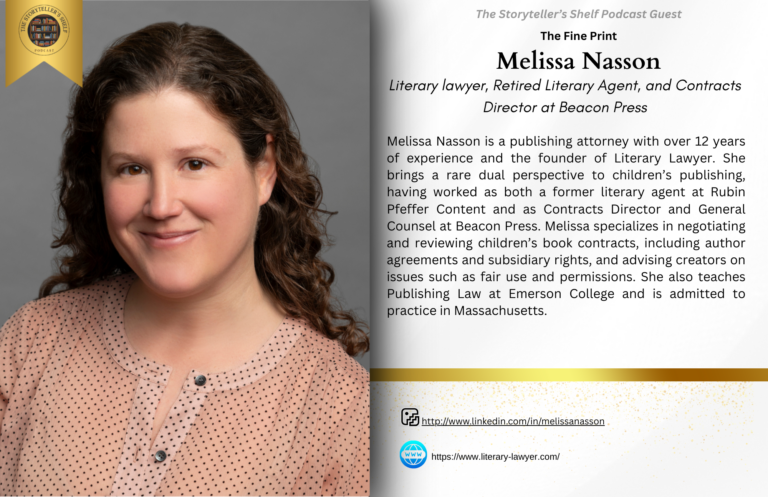
0:48 Hi everyone and welcome back to the storyteller shelf. I am Jackie here again with my co-host Teresa and we have brought you another incredible guest here to tell us more about the kind of difficult side of publishing which is all the legal ease and legal bits that none of us went to law school for. So of course we have here with us someone who did get a JD. Melissa, will you tell us a little bit more about who you are as a person and your journey in publishing because we know that you've done more than one thing in this field. >> Well, first of all, thank you both for having me. I'm really excited to be here on the podcast. So, I didn't plan to
1:27 work in publishing when I went to law school. I sort of had it never occurred to me to sort of combine I'd already always had a passion for books, obviously, but it never com occurred to me to combine it with the legal education I was getting until I was going into my last year of law school. So, I sort of had a lucky break that year. I was doing an internship during the summer and a friend and a fellow intern mentioned that he used to work for a literary agent who was also an attorney and my response was what's a literary agent? I had never heard of an agent before. That was sort of once I found out what an agent was and that there were jobs for lawyers in
2:12 publishing that there was no real looking back after that. um it was thanks to him and thanks to all the people who I spoke with after that who gave me this sort of crash course into this industry that I was trying to enter. So I owe it all to them. But um after that I started interning for a couple of agencies and then I got my job at Beacon Press and I still work at Beacon today and I also have my own solo practice on the side called literary lawyer. >> That's amazing. like you know like I think that's something that when you start out when you're in college you think okay this is how it's going to be but then you you also pivot into other things you've worn a lot of hats as an
2:56 agent a lawyer contracts director and for those that are unfamiliar with how publishing works behind the scenes what exactly does a literary lawyer do >> good question so and also this is hot off the presses but it's going to be known soon that I'm adding a title at Beacon press. I'm going to be contracts director and general counsel. So that's cool. Thank you. So the main parties who need legal services and publishing are obviously authors and agencies and publishers. I work with all three, but most of my clients in my practice are are authors. So most of what I do every day, I work on contracts. So contract review and negotiation
3:42 um with all sorts of publishers, you know, for big five to academic and university presses, hybrids. I review author agency agreements for authors who are fortunate enough to have an offer of representation. And I also do a lot of drafting of agreements. So I draft co-authorship and ghostwriting agreements and interview releases and those types of documents that are needed to keep the publishing process moving. And I consult with clients more generally about legal issues and I help them strategize. That might mean helping a client navigate a non-compete situation. They might want to write a book and they're not sure if they can
4:27 under the terms of a contract they already signed. Or they might want an exit strategy from a current publishing contract and they need help sort of negotiating a buyout or some other early termination with the publisher. So situations like that. I do permissions work. I help authors evaluate third party copyrighted content for inclusion in their books. And also I do pre-publication legal reviews quite a bit. When authors are worried that some of the content in their manuscript might be defamatory or otherwise unlawful, I will review it and offer my recommendations as to how they can minimize their potential liability. That's it in a nutshell. But
5:09 I do a lot of different work every day and those are sort of the ma the major categories of my work. Melissa, you said the magic word, which is contract, which is what everyone's thinking. I know because a huge chunk of our listeners are illustrators and authors who are looking to traditionally publish. So, they're going through the route of querying, hoping to get that big deal. So, I would love to ask on their behalf, what is it that they should be looking for in a publishing contract before they sign? >> That's a that's a big one. That's a good one. There's much to consider. Well, one thing I wanted to bring up is that a lot of times the basic deal terms that you
5:53 are agreeing to with a publisher are sort of agreed to upfront. So any author who's gotten a publishing contract, the publisher has made an offer. They've offered hopefully in advance and royalties and where are they going to sell the book. Are they selling it throughout the world or just in North America? And the rights they're going to have to the book. So, a lot of times authors come to me after those terms have been agreed to. And I guess what I wanted listeners to be aware of is that sometimes publishers are not willing to renegotiate terms like that at the contract stage. So, it's sort of like a upfront you have to do a preliminary negotiation of those core deal terms
6:39 because publishers don't like to reopen those types of terms later on. Uh but once you're at the contract stage, there's a few categories that special attention should be paid to. Um in terms of royalties, that's a big one. Um the sort of biggest question is are you getting paid based on a percentage of the list price of the book or a percentage of net receipts? So, if it's net receipts, which is pretty common for smaller publishers, indie presses, you just need to make sure that there's a definition in the contract of net receipts so you can understand what the publisher is empowered to deduct from their revenue before calculating your royalties because that can really impact
7:24 the amount that you take home at the end of the day. Another big one is reversion. And so understanding the term of the agreement you're signing, a lot of times it's term of copyright, which can feel quite overwhelming to some authors because that's your whole life plus 70 years. It's it's a long time. Um, but most publishing contracts have ways to terminate earlier than your whole life plus 70 years. So that is an area that authors should pay attention to. For example, the out of print clause. There's almost always a clause that says that if sales of the book are low enough that the author can ask for their rights back and then you can self-publish or try to get another
8:07 publishing deal. Some publishers, a lot of publishers actually have a very narrow definition where the book has to be basically completely unavailable for purchase before they will consider it out of print. But in today's day and age with ebooks and print on demand, the book can virtually always be available in some format. I always encourage authors to sort of try to improve the out of print clause. Whether that means trying for a sales threshold, like the book needs to be selling a certain number of units, or a revenue threshold, like the author has to be earning a certain minimum amount to keep the book in print. Rights is a huge issue to pay
8:49 attention to understanding what you're granting and making sure that it's not too broad. A lot of publishers will try to acquire every possible right to the book. Um, authors should try to avoid catchall categories like all other rights now known or hereafter develop and try to retain rights that are traditionally held by the author like motion picture and television and commercial and merchandising rights. Those are three big areas, but I hate to say that only some areas of the contract are important to pay attention to because they really all are. Let's focus on for indie authors and self-published authors. We have that print on demand and we have different uh hybrid
9:36 publishers, etc. Are there any red flags that might signal a contract is more of like a predatory or unfair, especially for debut authors or indie creators? Absolutely. I wish it weren't so, but there are a lot of um bad actors out there. Whether it's just straight up scams or um predatory is actually a great great word to use for a lot of these companies. Many authors come to me, they're very excited because they have a quote unquote publishing contract, but in actuality, it's a self-publishing company that is promising a whole lot. and charging a whole lot of money for those services,
10:22 but when you've been in publishing long enough, you know that a lot of it is sort of empty and a waste of the author's money, quite frankly. So, some things to look out for. Well, first of all, grossly one-sided agreements, which also some of these self-publishing contracts are. It's always so confusing to me when I see one like that because the author is paying them and yet they're reaching for the stars in terms of their rights to the book and what their creative control over the book and it's just sort of backwards. Obviously, a contract drafted by the publisher is always going to favor the publisher to some degree, but if the agreement is so
11:04 grossly one-sided that it just is blatantly unfair. Um, I just always think authors should follow their gut when it comes to that sort of thing. Also, either hybrids or self-publishing companies that don't really promise much, if anything, more than you could do yourself as a self-published author. So I often find myself telling people to just do it themselves because and I I mean so not all people are sort of savvy enough or they're not as internet savvy as they need to be to be able to do it themselves. But for people who are, it's definitely a good idea to just go it alone sometimes because these companies are charging an arm and a leg for, you
11:51 know, marketing services. And what that really means is they're putting up a Facebook ad or they're listing the book on their website. I mean, things that are just the bare minimum that any author with any kind of internet savvy can do. And so it can be challenging to go it alone and you know find those reputable people to work with illustrators you know people that do the interior design and you know all those other elements but there's a lot of companies out there that should be avoided and so I I think authors should make sure to do their research. A lot of times these companies are on writer's beware or they're they've otherwise been put on blast somehow for taking
12:36 advantage of authors even if they're not outright scams. Sometimes they're just they're predatory. That's that's the bottom line. Kind of jumping off of this idea of red flags, is there one clause or portion of a contract that tends to get overlooked by creatives, but can really have big consequences later down the line? >> Absolutely. So, a really good example of that, I actually mentioned a little earlier, was the net receipts, the royalties clause, which is, frankly, kind of a dull part of the contract that's easy to glaze over, but it is very important because some publishers, including these self-publishing
13:21 companies we were just talking about, they will either not define receipts in the contract, so you really have no idea how they're calculating your royalties, or the contract will let them deduct all their expenses, their cover design expenses, their overhead, their the printing costs, the shipping and freight costs, the distribution fees. I mean, at that point, the author is really footing the bill for most of these services, and it'll be very difficult for them to make any income from their book at all. So that's something that I think a lot of people overlook because it is dull, but it's very important to pay attention
14:06 to and and make sure you understand. And then there's also some other parts of the contract that have fees that can be charged to the author that I don't think a lot of authors realize at the outset. So things to look for an index if and this is obviously only relevant for some types of books for non-fiction usually but if the publisher is empowered to add an index to the book usually that's charged to the author and it can actually add up to quite a bit of money if there's a legal provision for a legal review in the contract. Sometimes the publisher will try to put some of that cost onto the author or all of that cost onto the author and that's within the
14:48 publisher's sole discretion as to whether they're going to do the legal review that then the author is paying for. That's a big one. Another big area is revised editions. Making sure that the publisher needs the author's approval before having any other writer work on the book. A lot of contracts will say that if the author is not willing or unable to revise the book, if the publisher wants them to, they can hire somebody else to do that work and deduct the cost from the author's royalties. That sort of loss of creative control is a big a big issue. Um, and even if another writer can work on the book with the author's approval, it's also important to make sure that
15:33 you never lose your right to author credit and that your royalties are never diminished or diluted. Yeah. Especially a lot of academic presses and university presses take a much more expansive view as to what they can do with the text even though they're paying very low if any advances and lower than trade industry standard royalties. They're sort of seeing the text as even if the author is retaining the copyright that they have the right to sort of make changes to the text in perpetuity and have other authors partly because they need to make sure that the text that they're publishing as academics is up todate and accurate and stays that way. It is understandable to some degree, but
16:19 authors need to pay attention to those issues. That's great advice because you're looking at on both sides. I think it's really important to understand that, you know, sometimes it could be overwhelming. But we're going to turn to how to negotiate. And is it true that everything is negotiable? No. [laughter] Um, everything is not negotiable, but more is negotiable than you might think. So, a lot of authors are very hesitant to negotiate at all. Um, they think that the publisher is going to say, "Never mind. I don't want to work with you any longer because you're paying." But that's just not true at all. Negotiation
17:06 is a standard part of the process that all publishers expect. All reputable publishers expect, I should say. Um, if a publisher is not willing to negotiate, which has only happened a handful of times in my whole career, that's a red flag that should be taken seriously. But most publishers will negotiate and a lot of the terms are negotiable. So, as I mentioned earlier, those core deal terms, the advance, the royalties, the selling territory, and the rights, those should be negotiated upfront because those are terms that can become non-negotiable once they're agreed to. At the contract stage, it's can be hard to open those back up for negotiation.
17:52 There's, you know, some industry standard terms that no publisher will change. And the warranties actually is a good example of that. A lot of publishers have warranties and indemnities that are industry standard and appear quite one-sided and are in fact quite one-sided toward favoring the publisher. But that is industry standard and it's usually not negotiable. But otherwise, in terms of the rights you're granting and royalties you're getting to some extent are usually negotiable and terms like the option, if you're going to be showing your next work to the publisher, that's almost always negotiable in some ways. The non-competition clause is almost always
18:39 negotiable. The publisher will present something that's quite broad and the author's job or their representative's job is to try to narrow it. So the author isn't prevented from doing other similar works in the future. So more than you would think is negotiable is really my the bottom line. So let's kind of take a step back into your history. A lot of people assume that their literary agent is going to handle all of the negotiation for them. But as someone who is a lawyer and a former lit agent, can you help us clarify what exactly is in an agent's capacity when it comes to negotiating contracts? And when might an
19:25 author or an illustrator want to actually bring a lawyer into the picture? >> Hey storytellers, if you're still juggling word docs, sticky notes, and 47 browser tabs to keep your story straight, it's time to simplify your writing life. Meet Scriber, the writing software built by writers for writers. Whether you're drafting a novel, a picture book, or even a dissertation, Scrier helps you organize your scenes, research, and revisions all in one beautifully structured workspace. Many of our guests on the Storytellers Shelf podcast have raved about Scriber and how it completely changed their writing flow. You can move chapters around with a click, store your notes
20:04 right next to your draft, and even set word count goals that actually keep you motivated. >> Curious? Check out our affiliate link. It helps support the show at no extra cost to you. And let us know if you give it a try. We'd love to hear how it helps your writing process. >> Definitely. So, the biggest difference between agents and attorneys are that agents sell books to publishers. I'm often asked to perform that service and I and I don't do it because that's an agent's core function is to to sell the book along with other roles before and after acquisition, editorial development,
20:50 proposal writing, schedule tracking, publisher checking in, all of that stuff. That's the agent's role. agents do also do the advocacy of trying to negotiate the best deal and the best contract for their clients, but most agencies are quite clear that they don't offer legal services. A lot of agency agreements will specifically say that the agency is not providing legal services, that their services should not be considered legal services regardless of whether employees of the agency are attorneys. Um, and agents actually commonly encourage their clients to seek outside counsel. So, I
21:36 often work with agented authors and whether that's because their agency told them they should seek outside counsel or they just want to be extra thorough because a lot of agents are not attorneys. And many agencies don't have attorneys on staff. And agents are great at understanding industry standards and they know what to ask for for the most part. But first of all, it can't hurt to have an extra set of eyes. I work with authors who are agented by smaller agencies, but also the big commercial agencies. And there's always more to ask for that is not being asked for. And the other sort of thing to keep in mind is that agents are in, and I know this
22:18 because I used to be an agent, there's this tricky spot that agents are in because they're interested in getting the best deal for their client, obviously, because that's how they get paid, too. But they also want to keep a great relationship with the publisher for future deals. And many don't want to be too difficult. They'll they'll advocate aggressively for their client, but they might not ask for certain things or push back on things necessarily that I will push back on or another attorney will push back on. And that's sort of I see the role of the attorney being. It's sort of that scapegoat, for lack of a better word.
23:03 I'm always cordial and not overly adversarial, but I can be that person who can try to get the best terms possible without jeopardizing the long-term relationship between the publisher and the agent or the publisher and the author. >> So, obviously, the literary agent is one to help to sell your book to a publisher. Now, with that being said, do you sort of look at it like you double team together with the agent into helping like to kind of you're the push back to the publisher and they're the one that's helping to sell the book. Is that like you work together in tandem? Is that how it works? I'm just curious. >> Yes, absolutely. I mean, most agents I
23:48 don't think I've ever worked with an agent who didn't want me on the author's paying for my services usually in the scenario that you're talking about. So, most agents are happy to have the extra review and the extra help. Um, and yes, the agent usually acts as the primary liaison with the publisher, but I'm copied on everything and then we sort of tag team it and work together. And I'm not trying to say that we're trying to manipulate the publisher, but I think that's just how it naturally happens. Sometimes the agent might be like, "Listen, I'm ready to let it go, but Melissa is just really dead set on this." So, yes, that's that is how it works in practice. I appreciate you
24:34 saying that though because a lot of people, especially people who are new or emerging creatives, they're not quite sure what the function of a lit agent is and some of them don't even know. There are lawyers that work in the literary and publishing spheres. So consequently, they also don't know where allegiances lie. And it's really crucial that they remember or learn that agents are working, like you said, ongoing with publishers. So they are really obliged to maintain that good relationship for them to keep their job. And that's just something that I'm sure there's no malice most of the time with them negotiating, but if they're working for more than one person, you should know so
25:15 you can bring someone else there for your team. It's all >> Exactly. It's exactly right. I was just looking and thinking of the visual of like somebody in a wrestling mattress literally was going through my head. I think this is actually really really important with the fact that we have audiobooks and ebooks and things like that. Have publishing contracts changed in any way, shape or form because of the ebooks and the audiobooks and what should creators have the knowledge about digital and multimedia rights today? So this was a huge issue at the very beginning of my career. Um, I started in publishing at the beginning of 2013 and many publishers at that time were moving
25:56 ahead with publishing ebooks without the express right to do so in the contract and it was very controversial at the time. Now it's just a given that every publishing contract includes electronic rights. But then audiobooks came along and it was kind of the same thing. Audio books have become a huge format and the publishers's position is that like print and ebook audio is a core publishing format that they need to have in the publishing contract. Whereas the authors and the agents position is that these are valuable rights that the author should get to exploit for themselves. So publishers have mostly come out on top in this debate. A lot of publishers have made it
26:40 a deal breakaker that they require audio rights in every deal. But there's still things that authors can do to maintain some level of control. So the first would be pushing for reversion clauses so that audio rights would revert if the publisher hasn't exercised them within a certain period of time. And also making sure that the author has a consultation right on the narrator of an audio book or even ideally an approval right because I think anyone who listens to audiobooks knows that the narrator is critically important or if the author is interested in being the narrator themselves making sure that they have an opportunity that the publisher agrees to give them an
27:23 opportunity to narrate as well. But now next up is there's just more and more push on the publishers side to expand the rights in the multimedia space that they're granted. So actually very apppropo to what we're talking about right now. Podcast rights. I keep seeing podcast rights popping up in contracts and publishers binging when they're asked to strike them and reserve them to the author. I mean, to me, it's a no-brainer, but publishers are obviously seeing podcast as a big future revenue stream, and so they're trying to attain those rights. And then another thing to keep in mind is that if the author
28:08 retains dramatic rights, motion picture and TV rights, and they end up optioning, if they're fortunate enough to option or sell those rights to a third party, to a production company, for example, the production company's going to require a certain suite of rights that often conflict with the multimedia rights that a publisher may have acquired. So that can be tricky as well. So making sure bottom line that there's a first of all that there's a reservation of rights clause. There's got to be a clause in the contract that says that any rights that are not expressly granted to the publisher are reserved to the author. And then also making sure as we touched on a little
28:51 bit earlier that there's not just an over broad grant of rights. Sometimes there'll be a contract that says publishers acquiring any and all publishing primary and subsidiary rights in existence throughout the universe and then there's a reservation of rights clause and then that just makes no sense because the publisher has acquired every single right possible to the book. But it can be important later on if it does come to a battle over rights which it did with the ebooks and audio books back then. Melissa, I would love to swing us over to the self-publishing corner again. So, sometimes when you're self-publishing, especially a picture book, you get to the exciting part,
29:33 which is trying to get your illustrations in order. And I am seeing a lot of people online just move forward with it like a regular click and buy and not even considering that they might need a contract in place for the future. Could you elucidate what someone looking for an illustrator might want to think about when they're trying to get those illustrations for their book? I work with a lot of authors who are in this situation that they've written a picture book, they want to self-publish it, they're looking for an illustrator and they want an agreement or an illustrator has provided them with a contract and they don't understand it and they want
30:12 to make sure that they understand it before moving forward. And then I have a lot of clients and prospective clients who had a handshake deal with an illustrator or another party that did not work out as they had hoped unfortunately. So it is really important to have contracts in place to establish basics like delivery dates and deliverables. Making sure that the author and the illustrator are on the same page about what is being delivered, whether the author is going to have any right of approval over sketches or before the final coloring gets done. Just sort of laying out that schedule up front is really important. Payment also
30:57 is obviously really important. Understanding whether the illustrator is going to receive a flat fee or whether they're going to have any ongoing right to receive royalties or bonuses tied to sales. But the big one is rights. As you might imagine, understanding who owns the copyright in the illustrations. Is the author buying the illustrations outright as a work for hire and owning all the rights? for is the illustrator retaining the copyright and just licensing certain rights to the author to use the illustrations. And that's when it can get tricky because then authors come to me and say,"I don't know if I can use these illustrations for to for marketing
31:42 and publicity because we had this very narrow agreement that just said that they were for the book to be published in the book or I don't know if I can use these for sequels or spin-offs with the same characters that I developed in the story that I wrote, but the agreement was not clear as to whether the illustrations can extend and beyond the one book. Or where where it can get really complicated is if there's any subsidiary rights sales. So let's say, wow, Disney has decided to option my book and they're making a TV show or I want to make merchandise based on the characters in my book. Can I use these illustrations in these deals? And so if
32:28 you don't have a contract that has all these issues laid out up front, it can be very complicated later on. >> Take us back to also like one thing about the revision rights and royalties and subsidies. Can you kind of break that down a little more for our audience because that is a lot of legal jargon and they might not quite understand what that means. >> Yes. When I say primary and subsidiary rights, primary rights refers to additions and formats of the book that the publisher is publishing themselves. So, we talked about this a few minutes ago. The publisher always publishes or not always, but most of the time publishes in print, whether that's hard
33:09 cover or paperback or maybe it's just print on demand and they won't hold any inventory. They won't print, you know, many copies of the books in advance. and then ebooks and audiobooks. Those are sort of the three core primary formats. And so all publishers and every contractor buying those primary publishing rights from the author. Then there's always subsidiary rights as well or subrights and those refer list of rights that the publisher probably isn't exercising themselves but they are licensing to third parties. One example, some publishers will buy audio rights, but they don't have an audiobook ed um division. They don't have an audio
33:54 imprint. What they're doing is licensing audio rights to, let's say, Audible or Blackstone or Tantor, which means that they're just entering a contract between the publisher and the audio publisher for those rights to the book. And a few other examples of subwrites are serial rights. First and second serial. First serial means excerpts from the book that are printed in a periodical. Let's say the Atlantic before the book is published. So that's a great thing for everybody because then audience for the book starts getting developed before publication even starts. The second serial is excerpts that are published in periodicals after publication, which is
34:40 still great. It's just all good exposure for the book. Book club rights is another common subright. Permissions, which means the publisher is granting third parties the right to publish excerpts from the book. Not in periodicals though. Usually it's like in textbooks or u might be a chapter in an anthology. So permissions is a big one. Translation rights is a big one as well. A lot of publishers will buy world rights to the book, which means that they can publish the book anywhere and they might distribute their English language edition of the book throughout the whole world, but they usually will try to license translation rights to foreign publishers. So they might
35:26 license French rights to a French publisher or Spanish rights to a Spanish publisher. Um, and then UK rights are also a big subright. So, licensing an English language edition in the English- speakaking world in the British Commonwealth really. So, there's a whole bunch of sub rights. And as I mentioned earlier, a lot of publishers will use this as an opportunity to kind of stick in a catchall category that basically just says and all other rights. And that could be tricky because number one, the author can be giving up rights that they don't realize they're giving up or that might not even exist yet. A lot of publishers actually relied on clauses like that when they went ahead
36:07 and published ebooks without the express right to do so. And then also, you're usually locked into a royalty as well if you do that, if you agree to that. So you might be agreeing to a 20% royalty upfront for a right that you don't know what is going to be worth down the line. So those are primary and subsidiary rights in a nutshell. So reversion basically refers to how to terminate the contract and get your rights back as an author to be able to republish or self-publish. So there's a few ways that those that your rights can revert. Number one, if the publisher doesn't publish on time, you got to make sure that the contract
36:53 has a date by which the publisher has to publish the book. If it doesn't have a date or if it's vague and it lets the publisher change the date at will, the publisher can delay publication indefinitely. And you might say, why would they do that? But it happens a lot and I have to intervene on the author's behalf a lot to say you haven't published and it's been two years and you haven't you know done anything. It happens more often than you might think. So, making sure that there's a date and if the publisher doesn't stick to it, then you can terminate and get your rights back and try again with a different publisher. Or you can usually get your rights back if
37:36 the book goes out of print, which we talked about earlier. Um, and then sometimes there's a default clause, which I always try to stick into a contract, which says that if the publisher doesn't pay you on time or if they don't deliver your royalty statements on time, they'll have a certain amount of time to fix the problem or to cure it. But if they don't, then you can get your rights back. So, there's a there's usually a few ways that you can revert rights earlier. >> Yeah. But it it's very helpful because um you're realizing there's a lot more to a contour than just oh let me sign right here. Like it's more than just that. And I think it's great that you
38:19 broke it down in the way you broke it down because it helps people to be able to not only have someone else in our corner, right? But also to advocate for ourselves and be like, "No, no, no. What's this about this ebook going on here?" uh before we do any signing, let's, you know, renegotiate. I think we as authors, we're just so excited that someone has taken an interest in our work, right? Um then we're not looking at, oh, do I need to change this? I don't want to be that person, a sort of Karen so to speak for the author world. But I think it's important to have that voice and also to have somebody basically to break this down for our audience. Make sure to get yourself a
39:05 literary lawyer like Melissa and she'll be there and in your corner and making sure that everything is fair for you as an author working with a publisher. Also, if you don't want to get a literary attorney, this is the whole this whole thing isn't just a plug to come to me or come to a different literary attorney. There are also a lot of great resources online. The author's guild is an amazing resource and there's a ton of articles explaining all these different parts of the publishing contract and it can be a bit of a slog to get through it, but it is the information is out there and attainable to authors. One thing I will mention though, this is a little controversial I
39:49 guess, but the author's guild has a model publishing contract. I hope they don't come at me with torches for this, but I don't I don't like it because it's not realistic in my experience, in my practice. It's basically the the fantasy contract. If the world was a very perfectly fair and equitable place, this would be the model publishing contract. But in my experience, no author gets all the terms that they're recommending. So I guess it is possible to overnegotiate if you are relying on the model contract and assuming that that's what the contract is supposed to look like because I can say I've worked with authors with
40:34 $500,000 advances and they're not getting those terms. Nobody does. So, I just want authors to be aware of that there. The author's guild is amazing. I'm a member and I highly recommend them. But don't take the model contract as gospel. That's all I'm saying. >> So, don't look at it like those are the addendums that you can use and when you're negotiating a contract. >> It's like this would be great, but don't be surprised if publishers won't agree to them because some of them are just very offm market. Again, it's sort of like a wish list, you know, reach for the stars, but I wish it was a little more aligned with the reality of the industry.
41:20 >> Melissa, this has been just a fantastic interview because you were so real with us. You were kind of playing professor for us, which we really, really appreciate because like we said, a lot of us are starting from zero when it comes to legal terms. But we want to thank you for being here with us and we want to tell our listeners that although this was not a plug Melissa said we would really appreciate it if you go to our website the storytellershselfpodcast.com episodic calendar page click on Melissa's name and please go support her and find out what she's doing. You can see her website and all her social media. And I would love it if somebody
41:56 reaches out to her and you let us know that you found her through the podcast. Yes, Melissa, thank you so much for helping us to decode the fine print. This was very practical and it was fully packed and it was very empowering for us as authors as well. And we're going to take that and we are going to take it to gospel, but for our listeners and from classroom educators, we're going to take this as to heart to what you just said and we're very appreciative of you coming on today. >> Thank you. I'm very appreciative of both of you. I loved chatting with you and glad that you got something out of it and I hope the listeners do too. Thank you for watching the Storyteller Shop
42:37 podcast. If you enjoyed this episode, be sure to like, share, and subscribe so you never miss new insights from emerging authors, illustrators, and publishing professionals. Your support truly helps our show grow. And if you'd like to support us directly, visit our Kofhei page and click buy me a Kofhei. Thanks again for tuning in.