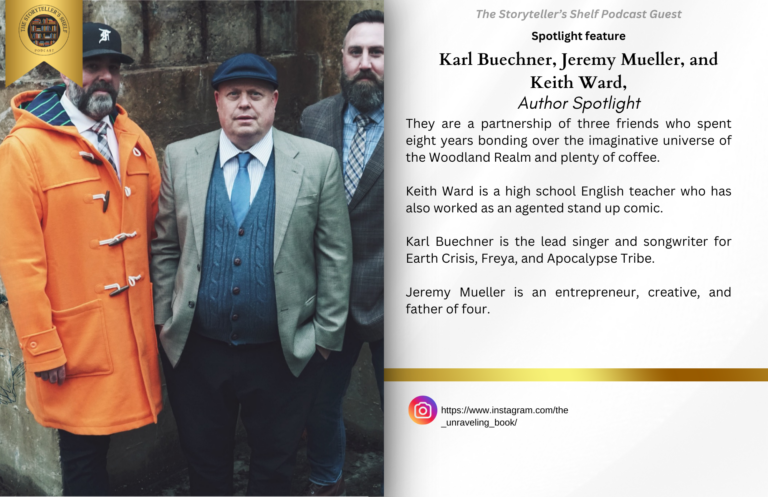
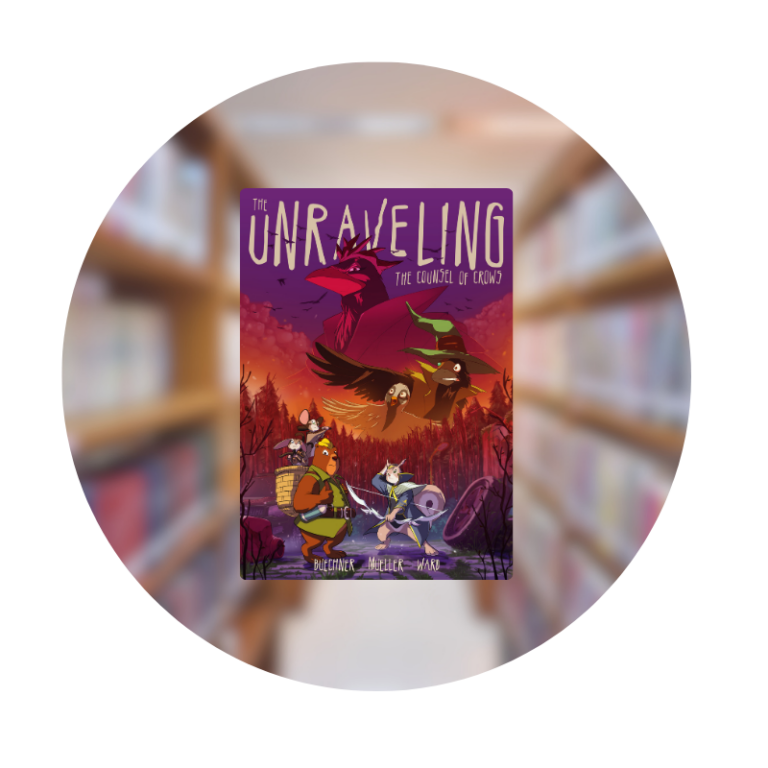
0:13 Hi everyone and welcome back to the storyteller shelf podcast. We are here back for middlegrade marbvels where we get to know the authors behind the epic reads and as I'm sure you see we have brought you not one author not two but a group of three to talk to. So, we are going to jump right into it as usual and start with our famous question. Can each of you tell us a little bit more about yourselves and whoever would like to go first? >> My name is Jeremy Mueller and I am a father of four. I um I'm a Mason. I've done a lot of different things in my life. Um and uh I'm very proud of the book that we have written together as a group on the unraveling the council of
0:55 crows. My favorite color is green. It's always been my house is green, my eyes are green. That's my favorite color. Always has been. And you'll notice that when we sign our books, I always like to sign my name in green, which is also one of the colors of the Yberhan stones in the book. >> This is funny. I'm laughing because I feel like Jeremy was biologically given the color green as his favorite because his eyes are green. So, you had no choice, but you ran with it. >> I I love it. And it drives my wife nuts because if I could have every piece of clothing in green, I would. And thanks to her, I don't. So that I I look different every day. >> All right. So, my name is Keith Ward and
1:36 I am an educator. I've worked teaching a bunch of different high school classes for 20 years. Had the privilege of teaching one of the first comic book classes in the United States for English credit. Um, I've taught how to design board games to students and work in a a space that's really, really clever and cool. About six years ago, I started writing professionally. I have ghostritten projects. Working on another project with these dudes now that has nothing to do with this world. Wrote a board game that's a like kind of choose your own adventure meets strategy. Worked in standup comedy for a while. Yeah, I started a sneaker store in town. I'm I really just like to put my sales
2:11 up and see where the wind takes me. And it, strangely enough, brought me right here, right now. And what a privilege to be here. And now his bio is way better than mine. >> No one wins, but you can add more if you want. I like that. A sneaker store. Okay, so Teresa, more places on our list to go. Um, I want a CD sneaker store. Add that to the list. All right, Carl, what about you? >> I am the son of an opera singer and an architect. I am the father of one and the uncle of nine. Um, I'm a musician. I've been in five bands and almost all of them have toured the
2:56 states and internationally. I've put out, I think, 23 records over the last 30 or so years. So, I, you know, kind of sharpened my skills as a lyricist and I've written short stories during all those decades. And so I, you know, I feel like I was I was on my way to where I am now. >> That's awesome. I think you guys all have unique talents and I think that helps to add to your book, your story. Each individual talent and that actually leads to my question which is you all can answer. If you were a superhero, what would be your super name and why?
3:42 >> That's a tough one. So, if I if I was if I was a superhero, I think just based on what my kids think, I think my name would be the fix because they think I can fix anything. And I do try to fix anything. I'm one of those people that I won't just go and throw something in the bin. I will try to fix it or and I will not let it defeat me. I always say that. I I always tell the kids. I'm like, you know, just calm yourself. There's there's always fix. Plus, we have this beautiful thing called YouTube, so you can pretty much look up how to fix anything now. So, I'm constantly fixing toys or TV sets or, you know, holes in the wall or windows, you know, stuff that gets broken around
4:27 the house. So, that's that I think that's what my superhero name. >> J, that's such a good superhero name. With that in mind, I think I would go with Captain Broken because it seems like my job is just to break everything. Someone reads a part of a story and I'm like, "What about this?" And they're like, "Dang, I'm regularly the downer in the room. I'm also the one that wants to kill characters and perpetuate our bad guys further. So maybe maybe I just am accepting something right now with you all, which is I might be Captain Broken. Otherwise, I'm a pretty happy dude, but I it does seem to be my role in the crew, so what?" If we were being serious, I would want to be the type of
5:08 superhero that could save animals from people that hurt them. And if we were joking around, I would want the power to um I don't know, magically turn anything into a casserole. But the bad news would be the casserles would be vegan because I'm vegan. So, they wouldn't make everyone happy, but they'd make me very happy. >> I got to back up. He introduced it as the bad part is the bad video of the vegan. This is great. All right. >> Well, once in a while, Carl will surprise us with a pizza and we will always forget that it's vegan and take the first bite and go, "It's so good." >> The truth is coming through. Hey, I like the vegan cheese though. You know, like
5:49 what is it? The diet cheese. That stuff was pretty good. >> As a matter of fact, when Carl got into the room tonight, he said, "Hey, Jeremy, I've got a pizza downstairs. Do you want me to bring you up if you're hungry? And I just looked at him. I said, "No, I'm I'm good." >> Guys, Captain Casserole, I mean, he'd have the power, but would he be able to use it? I don't know. Okay, let's hop to the next question. Although, I'm taking notes as we're talking here. Jeremy said that YouTube is an awesome thing we have. And by the way, if people are listening on Spotify, remember that you can actually be watching this on YouTube. So, run over to YouTube and
6:26 give us a like, please. All right. Next question, y'all. So, we're obvious here. We're here as all authors. So, all of us here know how to write. We've been writing for a while. We have books. So, what inspired you to write for this age group? Why middle grade? And how do you tap into the perspective when you were actually sitting down and writing words? Well, so I think when we when we when originally when the three of us got together to to write um and we had all agreed to to work on a project together, believe it or not, it was actually with a different project in mind and it was it was in middle grade. Um, and Carl actually brought a peace to the room and
7:10 you know it was it was a short that you know that we that that inspired the story. He read it to us and Keith and I kind of got convened and you know we were like what do you think? And it was it was pretty powerful. So we we decided to do that. So it was kind of happen stance you know when it came to writing for the genre. But I think it also came easy to us because like Carl said, he's he's a father of one and uncle to nine. Keith is a teacher. I have four kids at home. And so it's it just kind of came naturally. Plus, I think when I was when I really started reading, it was that age group at that time. And those are the stories that will never leave my
7:51 like I just I I would just eat them up, you know, and I just and it really just kind of like activated my brain. So it was so much fun to to work on a project for this for this age group. >> I remember we got our first couple of illustrations in from Zuluakar Rockman who ended up doing our cover and the illustrations on the interior of the book. And I remember showing it to them on a print out. And I don't know which one of them said it, but they're like, "Uh, Uncle Keith, can we color these right now?" And to this day in their bedrooms are still pegged up those those first illustrations that we did rough with their colors on them. And that to
8:26 me just felt like, "Oh, okay. We I think we know who our audience is. Like they fell in love so hard so quick. And then I think once we knew who we were writing for, it made the process of editing and cleaning up feel a lot more focused. And that was that was a a special moment I think for each of us in our own way. Yeah. >> For me, I grew up in love with Tolken's Middle Earth, CS Lewis's Narnia, Frank Albombs, Oz Stories, and Star Wars Indiana Jones. like imaginary worlds were just as fascinating to me as history, folklore, and mythology were. You know, I dreamed of of one day creating a a magical world. And to be able to do it as an
9:11 adult with friends like Keith and Jeremy who have incredible imaginations and drive is it's a gift, you know. It's it's like a miracle that we get to do this over all these years and create these characters and just build the world deeper and infuse some of our own perspectives and experiences into the the characters personalities. It's it's a lot of fun. It really is. >> I like that cuz I think we as storytellers, we have an idea and then as we start writing it might change. And I and I also think I I too am a mom. So kids are the best audience into letting
9:58 you know uh what is a good story. And I like that they took the drawings. That's awesome. And they're like, can I color this? I have two kids that are just like that as well. And they give you the best advice. I am probably and Jackie will tell you, I am the biggest Tolken fan. Actually, last year for my Is it? No, it's Christmas, right, Jackie? That you got me the book? Yeah. So, she got me a cookbook with Hobbit recipes. I have to do it. I got to break the fourth wall Deadpool style talking to the audience again because if you're listening, you have seen my face every time somebody comes on and says, "I love CS Lewis and Tolken." And I go, "Here's the counter."
10:39 And right now, considering all the cuts we've made to videos, I guess we're technically only on three for three. So again, if you are Hulkin fan, CS Lewis fan, you have to sing something this time. We can't keep it quiet because we're finding your people. Talking about this, it goes into what inspired you that goes along with that. What was one moment or a scene from your latest book that you loved and why does it stand out >> for me? Well, there's there's there's so there's so many so and it really is and this is not a cheap way of trying to get out of the answer because there are so many moments that we we've written that we just and it just gives you know we
11:21 just being in the room and writing them and laughing and just you know all of the discussion over everything. You know, there's so there's so many moments, but I think one of my absolute favorite moments is when when the company meets Randall and they go into the cave of the chasm and they have they see the possum prints hanging and he's so foroding and you know like and it just for for me it just it brings me back to being a teenager and just you know being like that when I was younger and just you know just wanting to be this certain way and then there's this reality of your parents just right right above you and you're trying to be pool or or whatever. And it's just one of my
11:59 one of my absolute favorite moments especially when Randall's mom opens the door and says the cricket poppers are getting you know like it just that's one of my f because the company's like oh we've heard about this guy like oh he said then they just realize it's just some you know teenager you know full of angst. So, as Carl mentioned, he he's the lead singer of some just wonderful punk and hardcore bands, and he's toured the world, and I toured as a stand-up comic for a while. And there's a scene where Boswell is going into the city for the second time in his life, and he's getting ready to perform. And unfortunately for him, he's a children's
12:36 performer. and and he wants to break into the mainstream of musical success, but accepts the fact that like this is a great audience and they they cheer and parents love him and kids love him. And so the main act that night are a couple of opera singers and they're performing an opera called Squirrel Love in Springtime. He knocks on their door on the on the green room door to meet Diamakulus and this other performer. And one of them opens the door and looks at him and the other says, "Who is it?" and the the one at the door goes, "Oh, it's the one performing for the children." And he closes the door on Boswell. And then Boswell turns to his friends and
13:13 goes, "I don't think that they've heard me." When you're opening or when you're building your set or you're trying to get into a world that's you want to be yours, but you're not quite there yet. That unending desire to be respected by your peers and fighting for that and also accepting like I'm not there yet. And Boswell does it with such charm. I wish that that was my response the first time. >> As far as as far as my favorite scene from the book goes, that's the question, right? I think it's probably the opening chapter of book one because we kept going back to it to try and get it where we wanted it. And when we finally finished it, I don't know, to
13:59 me it felt like we were on the rails and we were just like moving forward at like a high speed, like you know, because a lot of the book was written, but we kept going back to that one chapter and revising and editing and and when we got, like I said, when we got it to the point where where we were all happy, it just felt like a like a a genuine victory. I like that. I think we can all relate as authors that there's that one chapter that's like this could be better, could do that, you know, been there. I think as authors, you know, we're kind of perfectionists and but in a good way because we want quality. we really care about quality and and and
14:45 what the audience what your reader is going to pick up and and that that actually adds value and I think it's just one of the most important things because it means that you care about what your readers think and that gives um something for them to actually enjoy and go yes let me go back to that book. And for me, like I love Scarecrow and his pet caterpillars, Dragon and Hickory and Twig. Like they're some of my favorite characters in the book. So it was like, okay, we're introducing our friends to new friends and it it has to be as close to perfect as we can get it because it's important. There was a moment when we thought
15:31 chapter 1 was done and then Carl came in and goes, "Wouldn't it be really cool if Scarecrow told the history of basically three universes in a shadow styled puppet show on the wall?" And I think Jeremy and I were both pretty bent that there was only going to be two authors on this book, like there was going to be harm done that night. And we went home and puzzled and puzzled and puzzled. And then I remember we brought back a draft and and Carl heard it and then we realized like oh this is might be the most technical writing that any of us have ever ever done and it proved to be just this flawless seamless moment where you get you know like Tolken has his his
16:11 his different realms right he's in the Middle Earth mostly in his stories but he has all these other subsidiary worlds and we were able to deal with generations eons of history in like three pages and to Carl's credit. It was a It was great. But I do Yeah. That to your m to your tech to your moment about perfectionism. It's wild when you're trying to be perfect on your own. It's intense when you're trying to be perfect with three people. >> Yeah. Cuz I I think at that point too, I think we'd already rewritten it like five or six times already. >> I think we can relate in that. And I'm kind of in that same boat right now. And I've actually sent my newer version of
16:52 my manuscript cuz I too am a perfectionist. And I think that's the way you can only be as a creative because at the end of the day it's like okay am I satisfied with the work? But you can always go back and change it because the work itself matters in that does it make sense? Does it is it concise? Does it flow? Does it have good pacing? Um, and I like that you added a backstory. I'm I'm into that where it because it adds to the the story itself, I think, cuz then it pulls the reader in more, I feel like. So, yeah. Yeah, exactly. I have one other question. if there is a one trend, challenge or opportunity
17:40 you see in the world of middle grade. >> When we set out to try to figure out how to bill three authors as an author, we initially relied on the trend of two initials with periods and then a last name. And then we started to look around at how many people were two initial last namers and decided, nope, we're just going to be Mueller Ward. Like that's who we are. Let's just put it in alphabetical order and treat it as what it is. and not try to cash in on, you know, whether it's in the ' 60s or now, everybody. That to me feels like one of the trends that's prevailent that I could also live without. I think one of the biggest opportunities is to tell an
18:20 honest story, to tell something that's like I remember John Green's first book, Looking for Alaska, and as much as I have loved his work forever. I think I I think I've been waiting to get back to that level of honesty, that level of confession, that level of compassion, that level of profound needing to tell a story. And for as much as I've loved everything else that he's done, that book to me just sits in the hierarchy of great texts. And I think if if I was setting out to to write a story today on my own or with this crew, it would be what's the thing I most need to admit? what am I most dealing with
19:06 and how do I express that through characters in a really genuine and thoughtful way? And I I think that's the opportunity and the opportunity never changes. It's just can you be honest in spite of demographic? Can you be honest in spite of your editor, in spite of your publisher? Can you tell something that is an honest confession about the way that you see the world and also the good and the bad of that? Right? Can you be weak in the spots where you're actually weak and allow that weakness to give a character a chance to be redeemed maybe in a way that you haven't personally been redeemed yet? And that for us, this book is a confession. And there are
19:42 places where I'm still hoping to forgive, hoping to learn, and hoping to be as compassionate as some of the creatures that walk this world for our readers. And they regularly encourage me to more of that mindset. >> Good luck, Jer. Yeah. Um I mean to to piggyback off of what Keith was saying, um also like I think you know you know the with like with middle-rade readers too just like keeping in mind that you know like they can handle you know a lot of the the stuff that we're talking about you know and and you know we were trying to be delicate but we also wanted to elevate the language a little bit you know just to kind of push like some of my favorite stories you know growing up
20:24 you know they were a little bit more challenging. I loved like taking, you know, like a dictionary with me and like looking words up. It helped me grow and, you know, and we just kind of we set out to write this, you know, at first, you know, because, you know, like I, you know, read a lot to the kids, you know, and a lot of the books, I mean, they're they were so much fun and, you know, but some were, you know, a little bit more on the basic level and I was like, ah, you know, it' be fun just to kind of push them a little bit, you know, and just kind of help help them along and, you know, that's how that's how they're going to learn and grow. And you know,
20:55 when we have, you know, you know, the ideologies that we have in in this book or or whatever, you know, like it's it's okay to to be, like Keith said, to be honest, you know, and you know, and and you know, like the kid, you know, kids might not pick up on some of the stuff that we're we're putting down right now, which is some of the fun of like, you know, the like water ship down, right? you know, or Secrets of Nim, you know, like when I, you know, like read that stuff when I was younger, you know, like I read it for the fun, you know, there were fun adventure stories that they were, it wasn't until I was older that I started to really kind of understand some of the
21:33 things that we're talking about. And I think that's what makes our our story fun. You know, it's like it's not in your face because in my parents will tell you this that uh if you were to tell me to do something, I just simply won't do it. So it's like we tried to have this like you know just kind of like a little bit of a message you know and in an elevated way for you know for kids and understand that you know you know they are smart you know and and and don't don't play dumb like you don't need to you know it's not if that makes sense. >> What is one trend or challenge or an opportunity that you see in the world of m middlegrade literature today?
22:10 I think there are parts of our story that are a challenge to conventional thinking when it comes to how we view the natural world and the animals. When Keith was talking about, you know, the honest expression of of writing, like I do feel as though our story does have a very specific message and it is about, as as Keith and Jeremy have both often mentioned when we've done these interviews, it is about forgiveness, accepting, and understanding like those are, you know, you can't you can't just let someone talk and listen. You have to understand them and their perspective and their background and what it is that they're dealing with in order to be
22:55 in order to live in peace with other other beings whether they're humans or animals. But the message of our story is about the the cyclical nature of violence and how feudal that is and how if you simply forgive things can come to an end when it comes to oppression or exploitation. So that's that's one of the strongest themes. That's one of the strongest messages we try and forward when you when you read what the how the villains are are viewing the world or how they're viewing the beings that they're oppressing. It should, you know, it should kind of shine a light on as to how there's things that humans are doing and have been doing that don't need to
23:35 continue anymore. We can be better than we are right now. I think that's a growing trend and I I like how you all three had unique answers but they kind of all go encompass the story that there's like there's this theme you know forgiveness, understanding, respect and that going into honesty. I love that. This is a great I you know we need more stories like that. when you mentioned I I I think you said this that it was like the rats of Nim and um those were the stories I grew up with as well when I was young and I think it helps to shape somebody and that you know brings into that critical thinking and I like that you guys are expressing that in your story to bring about
24:19 critical thinking. My brain is going through so many like timelines right now. I'm trying to remember the last time I saw a dictionary was one of them. Well, that that's funny, too, because one of the other things I was going to say when I thought about this question is, you know, the world that we live in right now is is it's so different than the world that we we lived in when we grew up. And I think one of the other challenges to writing is like how do you grab kids because their attention right now because of the technology that we have is just it's so different. I think I and don't quote me on on this, but I I think that I was reading something where
24:59 you have like something like three or four seconds to to really like grab somebody's attention when they're on their phone or doing whatever. And it's like, how do you write a story like and really like with with heart and soul and everything? They get trying to get everything in there to grab that attention when it's so easy with all the other technology that's out there for, you know, for kids today. So, it's that that is challenging. >> You know, it's funny and sorry, I'm just gonna go on a little tear here, but it's fascinating right now, too, because in schools, you're starting to see across the nation cell phone bans in classrooms. And my district recently employed one
25:38 that started this year. And I read this great article the other day. I think there was a school in Texas, maybe it was Houston. Forgive me if I'm wrong. Much love Houston either way. But they their librarian noticed that in the opening 3 or 4 weeks of school that 40% of the student population library to consume them. And so in the absence of a 1 second like or the the shift of Tik Tok that in the absence of those just in a school day the number of of students intuitively returning to the entertainment of generations before them. The old school part of me is like that's so nice. >> Yes. I I I think I know what you're talking about. I don't know if you guys
26:18 have ever heard of College Station. I have friends that are teachers there and they see a huge improvement in that there is no like during the school day, the kids are actually talking to each other when they're having a real conversation and they are taking books out. So, I think this is going to be a positive thing for the youth. You know, sometimes the conversation runs itself, but Teresa has been with me for over a year now, and she knows my rant about technology and growing up in a very tech dependent time. A lot of conversations about screens and screen addiction. And we all know as people in the bookish world that books are the secret
27:05 ingredient to getting people off the phone. The question is, how do we bridge it? How do we sell and package the book in a way that the kid is actually going to pick it up? And one way of course is by taking away the phone. But that is not a solution that will last, right? Because that's only sometimes if you go to school, if they take it from you, then if your parent says, "Okay, no phone now." But what happens in the in between times? That's the question. So this is one of my favorite discussions to talk about. But we'll come back to it because actually we might have to invite you guys on just to talk about it because as parents especially, I think
27:37 you have really valuable opinions just seeing right your children grow up now. Like you said, it's so different. Your childhood Teresa's and mine and then your children. It's almost like if you wrote books on each, they would each be a different universe. That's how different it is in terms of technology now. >> For real. >> But I think one of the things that's also important to remember about every technological leap is that to the to the generation adopter, it's obvious and it's important. And to the generations that are coming on late, it's frustrating and it challenges and it intrudes upon the tried andrue. But I'm regularly given like when it comes to
28:15 reading and and text. The biggest piece I take in my life is being reminded that once Socrates accused books of being anti-nowledge that they were aing that they were not wisdom unless you knew it, it was not known. And I and I I would if look if he was around I have a lot of things to say to him because weird life dude. But I would also like to know more about why he was so nervous about books because that was his technology. I think oral storytelling persists. It persists in standup comedy. It persists in podcasts. It persists in documentary film. And also man the book is just I feel like it's finding its second life. There are genres of books now that are
28:57 doing things that haven't been done in a long long time. And I'm just so excited to be here and watching it happen. It's It's really cool. I know. Sorry, tangent. >> It's such a good tangent though. I mean, we could have a huge discussion about also the positives that tech brings in multimedia formats of books, different accessibility of books, helping children actually read books. Like if you have a learning disability, you can actually use your tablets, right, with different fonts like dyslexia to be able to read and enjoy. Um, yeah. This is a conversation that we're actually going to have to have y'all on again so that we can sit down. All right, let me ease
29:35 us into the next question. And I think this really actually goes into kind of what we were talking about in a way because you're all more than just authors. You have your own life, your own life experiences, your own businesses, your own careers, your own backgrounds, but you're also authors in addition to that. And we love interviewing people like you who have done more than one thing because you bring a really unique lens to the writing world. And a huge portion of people who listen to our podcast are people who are newer creatives or they're aspiring creatives. So they want to write, they want to illustrate, they want to create stories in books. And we
30:15 like to offer them something, a little piece of advice from people who are a little more established. So, if you could travel back in time, what's one piece of advice that you would give your younger creative self, so that author side of you, what would you tell them? >> I honestly, it's funny because I love this question and I would go back and I would just tell myself to be a little bit more fearless and way way more confident. Um, and that that's that's it in a nutshell because I I have been writing since I was young, but I didn't share anything with really anybody. I did share a couple pieces of poetry with my my wife that she still has from high school, but I was always
31:00 afraid. I was afraid of what people were going to say or people were gonna like make fun of it or I so and I just wish wish I I didn't have those fears, you know, like it just just have more and more confidence and just do it because the the only way that I I got better at at doing what we're doing. It was by getting into a room with these two guys and listening to that that critical feedback and you know just and that's that's what made me a better writer. And you'll you will not get better if you if you don't share it. And you have to be willing to accept you know that you know it might be a little wonky at first but that's okay. that's how you learn, you
31:41 know, like and and you know, just take take the advice and you know, and just really just push yourself and and get what you have inside you out because every you know, that's what art is, you know, like you know, just I think right now I mean we we live in a world that there is I mean when it comes to like movies or you know there's a lot of reruns, you know, like a lot of repeats and and stuff, you know, and you know, there's that, you know, there's a lot of creativity that doesn't get out because of, you know, big media or whatever, but it's like just do it. That's how Tolken did it, right? You know, like just did it. And that's what I would tell myself. Just be more
32:21 confident, you know, and don't be afraid to to share and be accepting of any and all feedback. >> We had the privilege a month or so ago to write um a piece for Writer's Digest and we wrote that the way we write everything. We got in the room, we looked at a couple of ideas, we debated, and in the end, the article ended up being titled, "Be patient, but don't wait." And I think if I could have learned that 20 years ago, it would have been really wonderful. There is an element to this work where you have to be patient. We have to be patient with your characters, with your settings, with your stories, with yourself as an author, with your publisher, with your
33:02 editor. God bless them. They're overwhelmed. And you have to be patient with those things. But you don't have to wait. You don't have to wait to start acquiring art assets. You can use tech at your disposal and find a wonderful artist from around the world. And I mentioned Zu's name before, but we met him on 99 designs and we had 50 people from around the world give a book cover to us and we've been working with Zuul ever since and we were going to be working with him going forward in the future. But if we waited for a publisher to say you meet a Merida set, if we waited for our publisher to say, "What's the cover going to look like?" if we waited for our publisher to say, "What's
33:37 your social media going to be about?" We just started sharing because we were compelled to share. And I I do really hold to the maxim that authors spend so much time creating beautiful worlds and then when it comes time to tell people about those worlds, they get so quiet. And I would encourage you be as loud as you can and as expressive as you are in creating the flora and fauna of your environment to bring that to audiences that are ready to consume. You just have to meet them where they exist. And so that creativity has to go into how you understand your communication about your piece and developing that and being willing to take that risk. And also you
34:15 got to be willing to like only have three likes for a long long time. It hurts your soul, right? It does. It like you bleed a different way when you're like here's a beautiful thing I shared and it's like your mom and then Carl and Jeremy like it and then that's it, you know, for a minute. But I think the more consistent you are in not waiting, the more that patience really begins to pay off and you get all the other rewards that you've been hoping for. And we're still we're still being patient, but Lord knows we are not waiting. Both Jeremy and Keith are are naturals and as I mentioned earlier, they their imaginations are phenomenal. So, you know, for me to be able to team
34:57 up with them and to work on these three stories and and hopefully more after is it is it's my dream come true, you know, because like you mentioned, I have done I've done other things. Keith's done other things. Same for Jeremy. And Keith's done things that he hasn't even mentioned, like he backpacked through Southeast Asia. He's the only one of us that's actually ever eaten a cricket popper. So, you know, that's part of his experience and his background and all those things get woven into the the fabric of the story. But for me, you know, as far as answering the question, like if I could go back in time, what would I tell myself? And skateboarding
35:38 and having a halfpipe in my backyard when I was a kid and and falling and getting hurt in front of other people or, you know, tripping in puddles on stage or crashing into a barrier. I mean, all those things got me to the point where it's okay and I can be mature enough to know how to write a story and take some of the the slings and arrows that will inevitably be sent our way and to take them in stride, you know. So, that that's I guess that's one thing I would say. It's like you do have to learn how to have a thick skin if you're going to tell something that's and you're going to write what you know because I think when you do that kids can feel it. People can
36:24 feel it. >> That was so beautifully said. you know, this type of creative, this type of art, I feel like from our experience and the people we've spoken to, it does attract a certain personality type and we all come in with this idea of creation, world building. We have a story to tell. We want to get it. do want it shared with people, but there's a huge element of the fear of perception that I see, especially in a lot of new people who are newer to the business because they don't know all the risk-taking that it takes just to even get someone to hear your story to say, "Oh, well, this might be somewhat good for the market. Let's move it forward." So, like Carl said, it
37:05 takes thick skin to be in this business. It's really not easy. It's not for the faint of heart. And a lot of us really have to grow that thick skin over time. But as we do, we find out exactly what Jeremy and Keith were saying, which is that writing at the end of the day becomes a team sport. Even if you're a solo writer, you end up finding that audience who propels you forward and helps you create and precedes what you create. And you also find your team on the professional end that helps that growth and develop so that you can finally get that idea that is like a child inside of you finally out and into the hands of readers. What if the publisher doesn't like my cover? What if
37:43 they, you know, were the editor this and that? I c I think we as authors can relate to that because and also to basically put that aside because we all have our own ideas. And I was thinking about the fact that there's three of you writing this B series and the fact that I think that actually probably helps to draw more information. Are you an author, illustrator, or educator looking to better understand the world of children's publishing? Join us the Storyteller Summit, a week-long master class happening January the 12th through the 17th. Each day offers focus sessions on kidlit storytelling, craft, and the business side of publishing created to support you wherever you are
38:28 in your journey. The summit concludes with a literary pitch event featuring Serrone Harvey of the Bellcaster Literary Agency. Learn more and reserve your spot at the Storytellershelf podcast.com. Yeah, I will definitely say that, you know, Jeremy and Keith, especially Keith, has pushed the story in directions that I wouldn't have necessarily taken the first steps towards that made things so much better and made the case for environmentalism and animal rights. So that right there is is kind of a prime example of having a team member that is offering ideas that are making things more compelling.
39:13 oftentimes, you know, for us, we we we always say, you know, like, well, we'll we'll have these great ideas or, you know, like, you know, we'll think on a weekend or, you know, think throughout the course of the weekend like, "Oh, I can't wait to share this with the guys." And you get in and you're just so pumped. And then you, all right, guys, this is what I think. And then you get a blank stare from the both of them and you're like, "Oh, that hurt." So, you know, it it is it is very humbling to, you know, and it's also, you know, like, you know, not to I don't know, like just to to be able to work with these two is is a lot of fun. They're they're so
39:44 creative and like they they've like I said before they've made me so much better, you know, at writing and just the way I think of, you know, like think about things and it does bring so much more to the story, you know, like because it really does and it's hard to explain. >> You book followup book, the non-fiction book of writing the book. Well, you have all written a piece that is, I think, really representing the full spectrum of emotion and of the human and cultural societal experience is very profound, right? It's very incisive. It's very entrenching. It has a lot of depth to it. So, my next question would be, what's one thing that you would like the
40:27 readers of your book to take away from this work or from you as an author? Well, I think, you know, from my perspective to to answer that question, we touched on it earlier, you know, it's that when when you look at how humans view and treat animals or the natural world or each other for that matter, we can be doing a lot better. We can be extending a lot more compassion and consideration. >> Yeah, absolutely. you know, um, you know, like well said, Carl, but you know, and and it is the truth. Like I said before, you know, it's like, you know, when we set this out, we we did we wanted to write a like a fun adventure story, you know, but with with, you
41:10 know, with an underlying theme, you know, being kind and being compassionate towards one another, you know, and, you know, like it just and hopefully that came across and that that was our goal, you know, and I, you know, I just also I hope this inspires like kids, you know, just, you know, on a on a different level to to get out there and write their own stories, you know, like I for me, you know, when I started, I had a teacher, his name is Mr. Han, and he's actually the one that really got me into reading because he would read to us every day in the class. And he read to to me like one of my favorite stories to this day, which is Summer of the Monkeys
41:49 and just the way but it was the way he read it, you know. I think that's really what kind of like entranced me, you know. So then I would get into like, you know, all of this, you know, this stuff. And then we also had another author come in to our school. His name was Bruce Kovville. And he's written a lot of children's stories, you know, he's from our area. And just when I I remember just seeing him, he was doing like magic tricks and doing all this stuff and reading his stories and I was like, I I want to do that. That's what I want to do for a living, you know? And then I I kind of lost sight of it, but you know, like getting back into into the the
42:21 literary world and and this, you know, like it really did I hope that our story inspires, you know, like the minds of kids and hopefully they can create their own stories and worlds and, you know, because I'd love to hear them. >> I think for me the maybe I just keep coming back to this and I want to blame it on the Wii, but maybe it's me. I think there's a balance between forgiveness and the repetition of mistakes. And I think what I hope that this book could communicate and maybe what I'm taking away from the writing of this book is that it's it's a wonderful gift to be able to forgive a person of something, however they've hurt you. It's a wonderful gift, not even just to
43:05 the person, but to ourselves. But there's also a responsibility to not fall into the trap to allow forgiveness to be the catalyst to remake mistakes. And I think a couple of our characters deal really explicitly with that. And I as we're now deeply into book two and outlining book three, there's a there's a reckoning for me in terms of what is well that's what that means. Oh my gosh, thank god these characters are so much smarter than a lot of us. And they're able to teach us things that are far better than all of us combined. And for me, I I really think that's been my takeaway from the project. And if there's anyone else who feels that way, yes, please forgive and forgive readily
43:45 and don't let that be an excuse to allow the perpetuation of a mistake or your own suffering. That is not the role of forgiveness. Forgiveness can also be an exit. It can be a moment of change. And I hope that it is because what I'm learning from our characters is at its best that's exactly what it is. >> For our listeners, would one of you or all three of you give us a little summary of what the book is about? >> Humans are gone and and life carries on. Our world is humanless and we don't offer the human reader a chance to find themselves explicitly in that form. There's not the one good one who will bring the species back. that's over. We missed our time. And animals develop
44:31 culture and magic and technology. And they walk through our world and ponder about human mistakes the way that you and I might ponder about Greek and Roman gods and monsters. Fascinated and confused, desperately trying not to repeat those mistakes. And how frustrating to find ourselves regularly repeating those mistakes. Also, the queen is missing and we really need to find her. Yes. At the same time, right, where is she and can we get her back? And uh is there a quest to do just that? >> Thank you so much all three of you. Our last question is when is the next book coming out? Any estimate? >> April 22nd, 2026. >> All right, folks. You heard it.
45:15 Storytellers, that's the date to mark down on the calendar. So, please get your copy of the book. Well, I think I'd like to if I could say like I'd like to thank, you know, some of the people that helped us like push the project along like Keegan you know, he's great documentary filmmaker. Um, and he really just guided us, you know, like we got to his point and, you know, we he gave us some great notes and because of Keegan, we have art in our book. Um, he had and he just he's been an amazing amazing help to us. Andy Hurley from Fallout Boy for for giving us a beautiful pull quote is along with Moby for giving us an awesome poll quote and and Ingred
45:55 Newkerk um of PETA for for giving us a great poke. You know, without their help, you know, we you know, it it means a lot to us. Um it's all I have, guys. >> Yeah. the the fact that people from the animal rights community connected with our book and were willing to help us let people know that it had been released and you know that that's been a tremendous help and we're you know endless gratitude to them for that and also just want to mentioned that there is an audio book version that's out as well and that was released back in July and we had a fantastic uh narrator come in. He's done some some of the Star Wars novels and he
46:40 uh Peter Bradbury he really brought his agame and it's pretty amazing because that was one of my goals. You know, the first goal was for us to write our book together and then have an audio version. And the dream is to one day, you know, hopefully in future editions when when everything's complete, the reader would open the first pages and see a map just like all of us did when, you know, we read the first Oz books of the first Middle Earth or Narnia stories. So, that's what my fingers are crossed for >> from my side. Honestly, just a a thank you Teresa and Jackie for opening your digital doors to this conversation, for also being willing to find a space to
47:24 have a conversation, right? And to give authors and readers a chance to coales over a conversation that we often don't get to have because we're so isolated. And so honestly, just what a warm thank you and and really deeply appreciated to have this hour to chitchat with you and to get to know you a little bit more. And it honestly has been a pleasure for all of us. We've been looking forward to this for a couple weeks. We were downstairs debating what superhero could you be and we didn't even know what we were going to say and Carl crushed it. Honestly, such a joy. So, please keep doing this. And also to your listeners, do this too, right? This is also an
48:01 honest expression of creativity. And thank you so much for bringing us to your world. >> Thank you for watching the Storyteller Shop podcast. If you enjoyed this episode, be sure to like, share, and subscribe so you never miss new insights from emerging authors, illustrators, and publishing professionals. Your support truly helps our show grow. And if you'd like to support us directly, visit our Kofhei page and click buy me a Kofhei. Thanks again for tuning in.