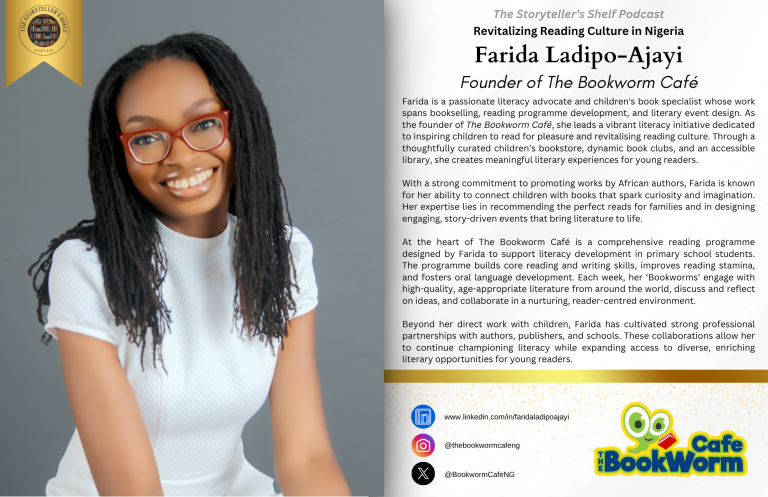
Farida Ladipo-Ajayi
This transcript comes from the video’s automatic English captions. Names and wording may contain errors. Timestamps open the recording at that point. References to events and offers reflect the time of recording.
0:00 Illustrators and Picture Book authors. Entries are open for the Storytellers Shelf Podcast Consumer Awards. Win a cash prize, a featured interview, and more. Get your work seen, celebrated, and supported. Submit now and join the family. [Music] Hi storytellers and welcome back to another episode of the Storyteller Shelf podcast. We are as always super excited to have you here back together and we are exploring literacy today across the globe. I'm Jackie here with Teresa and
0:47 our special guest is Farita the founder of the Bookworm Cafe in Nigeria. Karita big welcome and we are going to hop right into the first question which is could you tell us a bit about yourself your personal journey your professional journey and what inspired you to start the bookworm cafe >> okay um my name is Farida Lady I'm from Nigeria um Nigeria is a country in Africa and um um I was originally an engineer so I went to school to study engineering And um and then when I wanted to have children, I started thinking a lot about um how to get children reading because I saw that children around me were not reading. It wasn't really a practice
1:32 that they were, you know, taught. And I wanted to do something about that. I wanted my children to have access to books and also enjoy reading. And I wanted the same thing for my nieces, my nephews, my friends children. So I decided to start um what was originally supposed to be a library. Um it was supposed was I started as a library to lend books to kids and um make sure they have books available. Um but it grew because people wanted to buy the books that we were lending them and um people also wanted reading experiences that their children would enjoy because they were not getting that at home or in school. And but one of the things that I noticed was access. So we
2:13 don't have public libraries in Nigeria like you would have in other countries. So I decided to start a lending library. So it originally started just as a library, very simple library in my home. Um children will come and borrow books and take them to their houses. But then people started asking me how can I buy these books that you're lending us. And then also my children do not love to read. How can I get them to read? So I realized oh I needed to add a book club so that they have that reading experience that will encourage them to want to read by themselves. And so that's how the book cafe was birthed originally in library and then became book clubs and also bookstore.
2:48 >> That is amazing. And I love that you are an engineer by study because I also have a STEM background that had nothing to do with books. And now look where we are. But before we dive more into the rest of our questions, could you give us a little rundown of what the Bookworm Cafe is? So, what does it offer? What's the mission? You mentioned there's book clubs, there's a library aspect to it. Give us the commercial spiel for it. >> Okay, so we have this um tagline that we use at the Bookham Cafe that says today's readers, tomorrow's leaders. And
3:33 that's just um an understanding that when children um develop that culture of independent reading, the love for literature, it helps them to be to be more empathetic. They're more confident. They they they learn about other people's perspectives. They learn about the world beyond what they learn in the classroom. And so that's like who we want an ideal child to be. So um everything around encouraging children to love reading and also to get the most out of the books that they are reading is what the book on cafe is about. So, so what we had today is a children's bookstore largely focused on books by African authors because we see that when children see themselves in books and it
4:15 validates them and they want to explore, they want to learn about their culture, they they also are more confident. So, we want that for children. And then there's also the library as well. So, children can borrow books, take them take them home and return them. So that's kind of like helps the problem of access to books because like I mentioned it's hard to find um libraries where children can walk into you know have a good experience with books, borrow books and take them home especially in the very underserved communities. You would hardly find a library that is well stocked for children. So um that's we have that part of the book on cafe and
4:49 then there's also the book club which is my um the the favorite part of it for me because I love to see the joy in children's faces when they discover or when they start their reading journey when they um when they pull books that they really love that changes something for them. I really love that. And so the book club is about those kinds of experiences for children. So in terms of literacy for children in Lagos, Lagos is a very diverse city. So you have the urban quite wealthy parts of Lagos and then you have the not so urban quite underresourced parts of Lagos. So we have children in school um the children who are in the more urban parts of Lagos
5:27 have schools that are well equipped. They have library libraries in their school. They can borrow books and take them home. But we also have children in schools that don't have any libraries. So they don't have any books that they use in their schools. We also have a lot of homes where there are no books. Children don't own any books. And so that um um that would I say um difference is something that we are there to address. Children should have books at home in school wherever they are they should they they need that experience. So um so even so apart from access to books which is what we are there to do there's also the part of children not being taught or brought up
6:05 with the culture of reading. So even for the children who have access to books, some of them were not read to were not encouraged to pick up books and not allowed to choose the books that they that they enjoy. That's we also bring that enjoyment part of reading. And so that's where the book club comes in. So even for children who have access to books, we have a part to play because we have to teach them how to enjoy books, how to choose the books they will enjoy, um how to get the most out of the books, how to share the books that they enjoy with their friends. So that reading joy is spread around um for every child. Yeah. So that's that's like what
6:38 literacy is in Nigeria. Access is a major issue. What that's the major issue we're battling and also that culture of reading. >> I I appreciate you sharing that and I I know how important it is to have that access to books. Um when you're talking about that though, I I was thinking about what you said to give not only the access to but to make a child feel like they're part of the books. And you know what, many of our guests that have come on have had a similar um tone when they're talking about that because it seems like diversity is what really gravitates them to want to read and grow as a reader to adulthood and even beyond that. So how do most children learn to
7:21 read both in English and local Nigerian languages? If you could go into more detail about that. Yeah. So, interestingly, Nigeria is a very multicultural country and Lagos as well. We have people from all over Nigeria in Lagos, but the official language is English language. So, children learn to read in English language. And I feel like that's kind of like a missed opportunity because I also know that when children are taught to ring their mother tongue, um it strengthens um they are more um what I say strengthen their early literacy skills strengthen faster when they um learn to ring their mother tongue. But we don't have that. We all learn to read in Lagos specifically. We
7:59 all learn to read in English. That can be challenging because a lot of teachers who have been trained as teachers do not necessarily have the skills to teach foundational reading skills to children. So yes, we have to learn to read in English. But that skill that you need to teach children to read in English is not especially in the very underserved communities is not a a skill you will commonly find. So a lot of children struggle with learning to read. Some just get the hang of it, but a lot of children really struggle and needed and need a lot of support. And we've seen the difference that the PCOM cafe has made in just you know supporting children in learning to read just doing
8:36 things like basic phonics. Some of them never even had access to that. So that's like the state of um literacy and how they learn to read in in Lagos. >> Can you share some solutions or practices that are working well in your community? >> Okay. So what's working well? One of the things and that's why I say the book club the book club is my favorite part of the book on cafe because it's working so well because we see children come to our book clubs and let me explain how the book club is. It's not in one place. We have um at some point we partnered with 17 different communities and so we could set up like small book clubs work with volunteers in the community to work
9:16 with the children and some sometimes you see a child who comes has zero affection for reading and just because they see other children reading. We we we carefully curate the books that we use in the book club and we make the activities so much fun. It just transforms reading and experiences um for children and the demand is very high. People want to come to a book club and we don't have space to accommodate everybody. So that works really well. So that we see that children actually do want to read if they if they get that opportunity. The library also works really well. there's a high demand for that and for a library that is run um I run I started as with
9:55 my personal funds and then got a grant um so there's also there's there's a huge difference between a library run privately and a public library funding is is the major difference you know so there's a demand people want books they want new books they want books to be circulating and I can't meet the demand that is available so just seeing the impact that the little we are doing is making shows that is working well and And if we do have public libraries working, it will make a huge difference in Lagos. >> Are there any particular barriers in terms of infrastructure, technology, or even book supply? I know you mentioned a few of them, but if you could go into
10:33 more detail about that, that would be great. >> Now, uh, we have a few very good children's publishers in in Lagos, but the books are expend they end up being expensive because printing cost is really expensive in Nigeria. So you find a lot of publishers having to take books to places like Asia to print at a lower cost. So even though they print it at a lower cost, it's still quite expensive and out of reach for a lot of people. Um that that that's the the main challenge is access to books. Then infrastructure in terms of libraries, I mean just having a decent library in a community where children can use, where families can go so that parents are involved. You
11:12 won't find it's not it's not a normal practice in Nigeria especially in the not so urban communities. So you find libraries that do not have adequate seating arrangements, don't have good books in circulation. Children won't want to go there even if you beg them to. So they won't want to go there. So that gap is also there. And also okay if you if you say you want to explore digital options because books are more accessible via digital tools. we have internet connectivity issues in these communities. So that's another challenge that you face. So these infrastructures somehow it just makes encouraging people to read so hard that sometimes I'm like
11:51 oh my god what do we do? What do we do? Yeah. So those are the kind of um infrastructure issues that we deal with every day in literacy in Nigeria. A lot of those challenges sound really familiar to ones that we have here in the US, particularly in rural areas where there's not a lot of connectivity, especially something you said was something that Teresa and I have spoken about before on the podcast that really sticks out to me, which is publishers, and from my experience working in US publishing houses, they also really struggle to find printing. They tend to print abroad. But still, even with the printing abroad that is supposed to be more economic, the cost of books is
12:37 really high. It's kind of something that I'm hoping we'll have more solutions to in the future, but I'm not sure what they are. The only thing I can think of that I've spoken with families who struggle to spend that amount of money on one book that a kid may or may not read for the next couple of years is they tend to buy the ebook version. If you're in an area that has connectivity issues, you have Wi-Fi issues. That's also not very helpful. We'll need more engineers have to put Farida and Paresa's family together to solve this problem. But Arita, can you tell us what a typical day looks like for you at the cafe? What does work look like?
13:22 >> I love this question. Um, because well, it actually it actually varies. Right now, we're going through like some kind of restructuring. So, it's it's different now. But a typical day in the book cafe depends on the day of the week. So, during the week, children are in school. So what we're doing is mostly selling books, having book chats with parents, teachers, recommending books to them. But my favorite day in the week is Saturday because that's when we have book club and the children come. And before Saturday, we spend a lot of time curating the books that we're going to use to ensure that the books are books that reflect the children, books that
13:57 and with really strong themes that the children will want that will make an impact on the children. And we also do like lesson plans linked to the book. So for each book that we use in the book club, we do like a lesson plan on different things. It could be a lesson plan focused on roleplaying for instance. It could be a lesson plan focused on comprehension activities, just different reading response activities. And it has to be fun because if it's not fun, the children are going to let you know. So we spend a lot of time planning the book club sessions, picking the books, um putting together the activities, and we have different groups. So it's like a lot of different
14:33 activities to suit the groups that we work with. So that's what takes up the bulk of my week. And now we also since co started we started a an online book club. So we also have the online version of that as well. So it's basically doing book club plans like week in week out. I I I enjoy it so I'm not complaining but that's like typically what takes up my entire week. And then we do a lot of advocacy as well. So we do advocacy on social media platforms just on around things like encouraging parents to be engaged or involved when it comes to their children's reading, how they can pick books for their children, how they can arrange books on their shelves. Just
15:12 basic things that when parents see they pick up and you know want to implement. So we spend a lot of time thinking about how to pass that message on so that it's easy for them to use. Has there been one book recently that children really love in book club? >> Um, one book that children really love in book club. We have this is a British Nigerian Nigerian author. So I don't know if you um you and people in the US are familiar with it. And that's also my favorite book actually. My favorite author and book series. It's called Anna Hibiscus. And it's about this young girl who is African. And it doesn't specifically mention Nigerian, but you can tell that it's Nigerian. And she's
15:55 very bubbly, very joyful, gets into lots of mischief, but it's just it just reflects everyday life for the children that we're with. So, it's fun. They, you know, they're enjoying the stories, but also really seeing that I can be in a story and do amazing things. Travel, make my cousins, meet my friends, have a new a baby brother, have a baby sister. That's what the series is about. So it's it's it's absolutely wonderful. >> That's beautiful. I love everyday stories that are just regular activities because sometimes, as much as we love the creative stories, kids need to see something that they can do and that they will do. That's very fun. I want to go back to what you were just
16:40 saying and something that you mentioned before, which is that you try your best to focus on stories from authors who are local and culture and who are living geographically near you. Can you tell me a little bit more about how you curate those books for book club and for the library? How do you find these local authors? >> So, it's been a journey. When I first had the idea for the Bookcom Cafe, most of the books that were in in circulation or in book stores or publishers that I knew or had heard about were publishers, you know, like um or foreign authors. So all the popular authors, we we had so many of those kinds of books. I didn't even know anything about books by
17:27 Nigerian or African authors because there was a general misconception then that books by African authors were lowquality books and we hadn't really done our research. So when I started see I I started to learn about representation in books books just from listening to or you know following communities of authors literacy experts and people that are keen about children's reading and I started to learn about representation and I decided to just implement it just test run it in our book club. So I started looking for local authors, authors around Africa, joining forums of African writers and I started speaking to a few of these authors and just starting from one book,
18:06 two books. I started, you know, experimenting. I'll bring these books into our book clubs, into our bookstore. And the interesting thing is you would have a child come in and say, I want a book like that book. And that really made the difference for me. That made me see that there's something about this book that children resonate that resonate. And when you have a discussion with them, they will say they will mention that character in the book that you know made them see themselves in the book. And I thought I have to expand on this and that's how I started speaking to more authors and it's been such a fruitful journey. I've discovered so many amazing books in the process just
18:38 by being open to working with authors from Nigeria from across Africa even Nigerian authors abroad as well. It's I cannot tell you the kind of discoveries I've made just from doing that and it's been such an amazing journey. You are doing 10 million things at one time. You have built a library. You are leading book clubs. You are running all of this plus your social media. How do you jumble all of this? >> That's a good question. So, I try to stay organized. I do try my be very best to stay organized. So, I have a very strict to-do list. Um or of course um in a day I might have like let's say 10 things to do and most times I don't get
19:23 up to six done but I prioritize them so I know that once I've done this I've done my work for for the day and I also use um Google calendars a lot. It helps me to block time for different activities. I can't I don't know how I would function without Google calendar. So every meeting I have, everything I know, every task I know I must achieve, if I have to do something today that cannot go beyond today has to be on my calendar. And if it's not ticked off, then I can't I'm not I'm not done for the day. I try to rest. Like on Sundays, um we're doing this interview on Sunday. Yes, I know. But on Sundays, I really do not do any work at all because I'm
20:02 working Monday to Saturday. Saturdays, we have book club, so I have to work on Saturday. So Sundays are my I'm reading my from my Kindle or reading a book. I'm just enjoying myself basically. So staying organized really helps me as much as I try to stay organized um prioritize use my calendar but I also do not um play with my Sundays. You know I try to make sure that because I'm really I find that I'm very refreshed when I take Sundays off and Mon and I'm you know very gingered for the week. But I also enjoy what I do. So sometimes um when I say I try to stay organized, I actually work really long hours, but I enjoy it. It's fun. So yes, >> uh like we have the long hours as well.
20:46 Sometimes we'll be texting at the long hours. So yeah, I think definitely the blocking of time and prioritizing is one of the key things and loving what you do also I think is the other key thing, you know. Uh so yeah, I I admire that as well. something that really struck out to me in that you have just this beautiful smile and that you seem so happy when you're talking about the book club and just seeing those kids go in there and they're excited to read. What has been one of the most memorable moments working with children, families, etc. in the cafe? >> I'll just, you know, give give an one
21:32 one of them. um is I'd mentioned one about um a want someone a a child coming to the bookstore and say I want a book like that and just that first experience it became it sort of became viral other children would tell me so I kind of felt like the genie when it when it comes to recommending books for children because I felt like I was doing something right I recommended a book and then the child comes and says I want a book like that one but also we've had cases where a child will come to the book club so reserved and it happens all the time when they come for the first time and they're wondering what's going on here. H why are people coming together? I mean
22:09 what's you know they're completely lost and you know they feel like they don't belong there and then you know they might sit on their own and watch what's happening and next thing you see that they want to I want um who wants to do this role play and you know they put their hand up and they're wondering oh how do we switch from being the reserved child? So I always see that when children book environments make children really confident. I don't know if anyone has noticed that has had that experience, but I noticed when you when you have an open environment where children can discuss their book choices, they can discuss what they are reading, they can share their what they're
22:42 reading with their friends, they're so confident, they they you know, they want to help you lead a book club session themselves. If you allow them, they want to do that um and lead a session. We've also had children who came very reserved and um started to write stories as well. just maybe we'd ask them to summarize a book or do a book review and next thing you hear they're telling their teacher they want to be an author because they enjoyed that writing session so much is I don't I don't I don't forget those experiences at all. >> Can you share a story of the young reader whose life was changed by engaging with book clubs at your space? We have multiple multiple experiences of
23:22 cases where a teacher would say um we had um so and so child goes to your book club. Um we've seen the improvements in their literacy skills. We we've we even have a lot of them. So in Nigeria when um at the end of the school year we have this like prizes where they recognize children for best in literacy. I can tell you that a lot of the children who are in our book clubs win those prizes and it's almost like we're doing something right and it's just we're we're not a some people think we're an English lesson class you know it's not that it's just getting children to read enjoy reading um learn how to respond to what they're reading so in terms of
24:06 comprehension like think about the characters think about the certain so we're getting children to do all that and it reflects in how they approach their their academics. They they know how to think through a text and how to bring out the main ideas in the text. They know how to put together their thoughts in writing. So, we see this from children in our book clubs and it's definitely as a result of the impact that the book club is making. >> I do want to ask what has been the hardest part about running a grassroot literacy movement in Nigeria? Yeah, the hardest part first of all because the demand for um literacy experiences like the one we do is very high. People want
24:47 us to be in every community. Why are you not in our community? But we need funding to be able to spread as much as you want us to do, you know. So that's the hardest part is is is grassroots. We want it to be everywhere. For me, I want every community in Lagos to have that same experience, but we have limitations. And also that it's tricky to expand to so many places and still maintain that originality because I'm working with volunteers in these places. I'm constantly worried. I hope um the children are getting the kind of experience I envision even though I've trained the volunteers, but I can't be everywhere. So that goal um I can't be everywhere but I want them I want to
25:27 spread the reading joy to these misses. I hope that's what's happening. Trying to put things in place measures in place so that you know the the experience is similar everywhere. It's it's just um it can be challenging sometimes. >> What keeps you going when things get really tough? >> I think just seeing the impact that what we're doing is making is something that keeps me going every day. There are hard times when we have, like I said, we are in different communities in Lagos. Sometimes you have issues with the community you're working with and it just makes you feel like, am I stretching myself too much? But when I see the children, when they talk to me
26:06 about the books that they're reading, when they're recommending books to their friends, when I catch them in corners reading books, it does everything. I mean, it's it's everything that keeps me going. Let's talk about community support, global and local. How can families in Nigeria get involved with the Bookworm Cafe? >> We need books like we don't we can never have enough books because children when we have a lot of children who are avid readers and to encourage them, we always want to have lots of books in circulation, different genres of books, like everything they need. We want we want to have that. So we we always need book donations also things like um we
26:52 also want parents to support events that we run and I don't and I don't mean just financially sometimes when we run we we do a lot of free events and you find that the turnout is low and it's a free event you know and I think we do communicate the impact of the event but I don't know sometimes it seems like it's lost and parents think we have a lot of parents who are but I I would say working-class parents they always, you know, busy during the weekend. So during the weekend when we're running a an event, they want to rest and all of that, but sometimes you have to push yourself a little bit to support your child in terms of literacy, in terms of
27:27 reading. The impact is phenomenal. We also try to make the spaces where we run these events very safe so that you can drop off the children, you know, go back and, you know, rest or something, but take these events seriously. It means a lot to us when we run for events and you show up. It it's very encouraging. And then uh if we we don't really often do calls for funding support but if you do see anything from us please you know support us in terms of funding and then also reshare the content that we post on our social feeds. I think a lot of thought goes into it and it feels so supportive when we have someone resharing um to their stories or resharing to
28:07 their own communities what we're doing. It's it's one of the biggest ways to support the work that we're doing. For those of us who are listening in from other parts of the world, how can we support the work that you're doing besides sharing on social media? >> We need books, like lots and lots of books. Yes. We also are very happy when people put the word out about like what you're doing now for the book cafe. It's it's a platform that we would not have had access to if we are not on here. So, this is like, you know, supporting us. So telling people about the work that we do and also helping us discover authors, African writers all over the world. If
28:46 you have them in your communities, we're happy to connect with them, see how they can so that children can attend there or get to meet them because we we want to dis we want to discover as many books by African writers as possible. So getting the word out that we this is what we do. We love working with African authors is is something that will really help us. And books, back to it again, books. We need books. We need lots of books. Children read so some children read tons of books in such a short period of time. And I'm wondering how are we going to cope with, you know, providing books for them. So we always need books. Yeah. >> Yes. At the end of the day, the answer
29:23 is always books in some shape, way or form. Kids read like lightning, even when they don't like reading. If you had one wish, only one, >> for the Bookworm Cafe this year, what would it be? >> I think my one wish will be for us to reach a thousand more children than we already have access to. Maybe not a thousand, but I mean like lots of more children getting the book bomb cafe experience or their parents purchasing a book from the bookstore. Yeah, just reach is is what is my my wish for the book on coffee. >> I have a feeling you will accomplish that wish this year. They'll keep our optimism at the top of our head for it.
30:11 Okay. Now, a vision for the future. What is your your biggest dream for 10 years from now? What do you see? >> My biggest dream is expansion for the Bookham Cafe in in Nigeria. We currently have a lot of measuring communities in different parts of the world. Um I want the book cafe to be in those communities. Um and I also want a um you know a scenario where children in all of these diverse Nigerian um Nigerian African children in all of these diverse communities have a way to communicate. So if it's part of a if they part of our online book club, I just want them to exchange experiences, you know, um make friends. even if it's pen pal that there's a need for to help children who
30:56 especially African children who are not in their home countries to discover books by authors from their home countries so we want to be that bridge that would help them do that bring those reading experiences to them I don't want it to be said um that such communities have children who do not like reading no >> so this is the fun part we have rapid Fire questions. Think about your childhood. What what's a children's book you loved as a kid or one you love reading with children now? I think I mentioned one I love reading with children now. The Anna Hibiscus series is it's so joyful. So so joyful. The first time I discovered it, I was
31:41 like, "Oh, where has this book been all my life? I didn't read it when I was small. I read it I discovered it much more recently when I started the book Cafe." and it's a series so it has picture books, it has chapter books, it's a whole range of books. I love reading it to children uh because they are funny, they are relatable and just such a joy to share with children and they have lots of some of them have movement so the children get to dance, sing songs and yeah I really love the the series. The author is British Nigerian. Yeah. So it's it's so much fun. Are you currently writing a book or thinking about writing a book in the near future?
32:22 >> I have a a book I'm working on. It's still it's it's not near future, but it's in the future somewhere. Um I feel like all the all of this joy I've discovered in literacy and working with children and getting them to read. I want to put it in a book and let them read it. Let them let me tell their own story for them to read. So yes, I definitely would be a writer children's books. I'm just not there yet. I had a target for this year, but we're still far. There's so much to do. >> Yes, but we need more authors, so please keep writing. If you could open another bookworm cafe anywhere in the world, where would it be and why? >> Zanzibar. surrounded by trees, nature,
33:08 just children running around and something like the little free library that you explained, you know, like a tree with a shelf and they can come and pick up books, sit there and read. Just an open space like that. Lots of trees, windy nature and children taking off books and doing anything they want with the books. Just that that's like my dream. I call it like a beach beach bookwarm cafe, beach library kind of thing. Yes, it will have a beach theme. I love beaches and I know children love beach as well. So yes, it will have a beach theme. I love it. I love it. That's so cool. Thank you so much. And we are so thankful to have you on. And everyone
33:48 who has stay tuned so far, thank you so much for listening and watching. This is the sad part because we don't want to let you go. We wish we could keep you on forever. Thank you so much for sharing your really powerful story and all the beautiful things that you are doing. Again, we have overused the word inspiring throughout this interview, but there's really no other way to describe who you are and what you're doing. >> So, thank you for being an inspiration and we are going to encourage everyone who's listening in to go to the storytellershelfodcast.com episodic calendar page. Please click for Rita's name and find out where you can follow her on social media and hopefully
34:33 reach out. But we will definitely be checking in again to see where we can help. [Music]