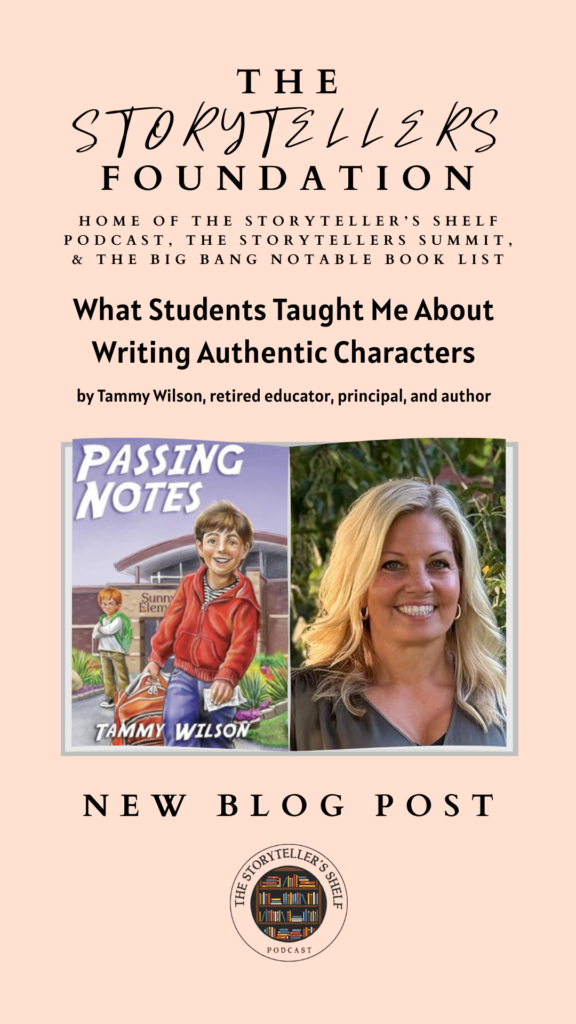
What Students Taught Me About Writing Authentic Characters
Before becoming an author, I spent more than thirty-four years in education as a teacher and elementary principal. My work centered on school climate, student behavior, and helping children feel seen and understood. When I began writing middle-grade fiction, I didn’t leave that mission behind. I simply carried it into story. My novel Passing Notes explores empathy, bullying, and belonging through the story of a boy navigating asthma and the social challenges that come with feeling different. The same questions that guided my work in schools now guide my storytelling. What is this child feeling? What is this behavior communicating? The story that became Passing Notes began not at my desk, but in a hallway conversation with a fourth grader.
He didn’t say anything during class.
It was after the bell rang, when the hallway had thinned and students filed out of my classroom, that he approached me. I was substitute teaching that day, newly retired after thirty-four years as a teacher and principal. Earlier, I had casually told the class I was thinking about writing a book and could use some ideas.
He waited until the room was nearly empty.
“Could you write a book about a boy who has asthma and gets bullied?” the fourth grader asked. Then he added, very specifically, “And at the end, there should be an assembly to celebrate him.”
There was no elaborate plot. No dramatic villain. Just a simple, heartfelt request.
I told him I would try.
And I meant it.
That hallway conversation became the foundation of my middle-grade novel, Passing Notes. Over the years, many students taught me to listen. But this fourth grader gave me a story.
Why His Request Mattered
When he described a boy with asthma who was bullied, he was layering vulnerabilities the way real children experience them. Having a physical condition that sets you apart makes the social terrain even more complicated. Add bullying to that, and isolation deepens.
And when he insisted there be an assembly celebrating the main character, I initially wondered if it felt too tidy.
But the more I reflected, the more I understood.
Children with asthma aren’t always seen for their resilience. Students who are bullied rarely experience affirmation.
What he wanted wasn’t perfection.
It was recognition.
He didn’t ask for a superhero.
He asked to be seen.
He wanted a story where the child who had struggled, who had felt small, isolated, and targeted, would be recognized for his courage and character.
That request reminded me of something essential: if we want to write stories that resonate with children, we must first respect them. Their emotions are real. Their social stakes are high. Their inner worlds are layered.
The most authentic characters aren’t invented in isolation.
They are built from listening.
How to Write Authentic and Relatable Middle-Grade Characters
Over my years in education, and while substitute teaching during the writing process, I learned that authentic middle-grade fiction comes from observation, not invention. Here are a few principles that shaped my approach.
1. Start with Motivation, Not Plot
Before deciding what a character does, ask why.
In real classrooms, I learned there was almost always a purpose behind the behavior. I noticed the student who withdrew during recess. The child who lashed out. The new student who seemed guarded. The classmate who became the target.
Labels formed quickly- troublemaker, sensitive, bully. But punishment alone rarely changed a child. Understanding did.
Instead of asking, “How do we stop this behavior?” I learned to ask, “What is this behavior communicating?”
Was the child embarrassed? Trying to belong? Protecting pride? Afraid of being exposed?
These motivations – fear of embarrassment, desire for belonging, and protecting pride – drive authentic behavior in fiction as well. When I began shaping the character who bullied the protagonist, I carried that same lens into the story.
Understanding behavior shaped the bully.
Affirmation restored the bullied child.
That balance became foundational to the emotional structure of my novel.
2. Layer Vulnerability Thoughtfully
Real children rarely struggle in only one area.
The fourth grader understood this instinctively when he asked for a character who had asthma and was bullied. Each layer influences how a child reacts to the world.
Having asthma creates visible vulnerability.
Being bullied compounds isolation and fear.
And the added element of being new means navigating uncertain social ground.
Don’t add struggles randomly. Consider how they interact and intensify one another. Depth creates empathy.
3. Listen to Real Dialogue
While substitute teaching, I paid close attention to how students spoke to one another – 4. what made them laugh, what embarrassed them, what felt unfair, what made them quietly proud.
Children interrupt. Exaggerate. Shift from serious to silly in seconds. If dialogue feels too polished, it probably is.
I would sometimes ask:
- “Would that really happen?”
- “What would you say in that moment?”
- “Is that funny, or would that actually hurt?”
Their responses refined dialogue and emotional reactions. The characters began to sound less like adults remembering childhood and more like children living it.
4. Avoid Flat Villains
A child who bullies is not simply “mean.”
In schools, I watched how quickly hierarchies formed on playgrounds and how new students navigated fragile social systems. Children who hurt others are often protecting something or compensating for something they lack.
Give your antagonists the same depth you give your protagonists. Complexity makes characters believable.
5. Respect the Stakes of Childhood
What feels small to an adult can feel enormous to a ten-year-old.
Forgetting your lunch isn’t just inconvenient – it’s mortifying.
Not being picked for a team isn’t just disappointing – it’s devastating.
Being celebrated at an assembly isn’t just nice – it’s transformative.
Authenticity doesn’t require bigger drama. It requires deeper observation.
6. The Most Important Lesson
That student may never realize how much his hallway request shaped my novel, Passing Notes. But he taught me that the best stories come from understanding what children actually need, not what we assume they should want.
He didn’t ask for fantasy or spectacle.
He asked for a story about being seen. About overcoming vulnerability. About being celebrated for who you are.
If we want to write stories that matter to young readers, we must listen to them- really listen- and trust that their experiences, their fears, and their hopes are enough.
The most powerful middle-grade fiction starts with that kind of respect.
BIOGRAPHY: TAMMY WILSON spent over 30 years in education as a teacher and elementary principal. She has always believed that every child has a story worth telling and every action has a purpose. Now she brings that relationship-first philosophy to her writing, creating authentic characters who navigate challenges of friendships, family, and identity. She lives in Rochester, Minnesota, and enjoys traveling, exploring the outdoors, and spending time with her children and grandchildren. Please support Tammy by reaching out to her on her website, IG, TikTok, Amazon, and requesting a copy of PASSING NOTES on NetGalley.