There’s something magical about discovering your first real library. Those shelves stretching high with stories waiting to be unlocked, that particular smell of books that promises adventure. For Nontuthuzelo Nikiwe, Chair of the African Library Project, that moment didn’t come until she left her rural South African primary school and moved to a more urban area. It was there, surrounded by books for the first time, that her love affair with reading truly began. But more importantly, it was there she first understood the profound gap between those who have access to books and those who don’t.
Today, Nontuthuzelo Nikiwe channels that early revelation into work that spans continents, connecting North American volunteers with African communities to build libraries where none existed before. In our latest podcast conversation, she opened up about the complex realities facing schools across Africa, why cultural representation in children’s books matters so deeply, and how a simple book drive can transform not just a school, but an entire community’s relationship with learning.
Whether you’re an educator, parent, or someone who believes in the power of stories to change lives, Nontuthuzelo Nikiwe’s journey will remind you why access to books isn’t just nice to have. It’s essential. So grab your favorite reading spot and settle in for insights that might just inspire your next act of literary activism.
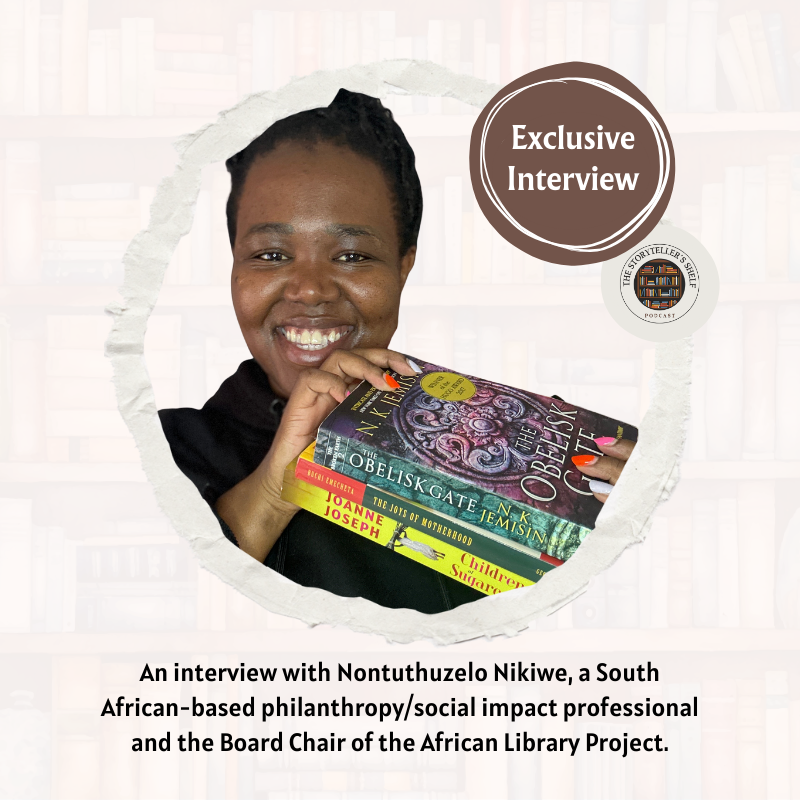
TSSP: Tell us about your background and what drew you to literacy work.
Nontuthuzelo Nikiwe: I’m a social impact professional working in South Africa’s nonprofit sector, focusing on education, literacy, and early childhood development. Through this work, I’ve seen firsthand the stark inequalities in educational access across our continent.
My personal story really drives this passion. Growing up in rural South Africa, my primary school had no library. It wasn’t until I moved to a more urban area that I discovered what a school library could be, and that’s when I fell in love with reading. That experience showed me how dramatically different social circumstances can define a child’s educational trajectory and future success.
Across South Africa and the broader African continent, countless children struggle to access books and libraries in their schools due to budget constraints and competing priorities. I became determined to close those gaps, ensuring every child can access quality education regardless of their social status.
TSSP: How would you describe the African Library Project’s mission?
NN: For me, the African Library Project represents reduced inequality in education and improved access to educational resources. We’re focused on sustainable development, supporting both teachers and students with reliable literacy resources they can maintain long-term.
Our mission centers on reducing literacy gaps by providing age-appropriate books that genuinely advance children’s reading and learning capacity. What makes our work special is the incredible passion of our volunteers who envision a better world for children and education professionals in communities that have historically been excluded from educational opportunities.
TSSP: What challenges around book access might surprise people unfamiliar with African education systems?
NN: Most people don’t realize how uncommon school libraries actually are here. Very few schools have active, well-stocked libraries with age-appropriate materials. Many schools sit in remote rural areas, far from urban resources, making access even more challenging.
Beyond geography, there’s a heartbreaking reality: children often don’t complete school due to complex social challenges, including their struggle to learn and develop at expected paces for their age groups. Early childhood development suffers because of systemic gaps rooted in social and economic inequality.
That’s why we partner with established local organizations that bring educational expertise to the table. These partners represent the interests of children, schools, teachers, and educational systems. They help us engage with schools, government, local funders, and publishers. They coordinate book distribution to even the most remote schools and ensure we have trained teacher-librarians who can sustain these libraries as genuine assets for improving learning outcomes.
TSSP: Why focus on North American volunteers when many African communities need culturally relevant literature in local languages?
NN: North American communities have abundant library books, often in excess of what they can use. We connect with willing volunteers who want to give books that might otherwise be discarded a meaningful second life in our partner schools across Africa.
For culturally appropriate literature, we rely heavily on our local partners in each operating country. They guide us in ensuring children access books in local languages that reflect their experiences. This remains an ongoing development priority, strengthening local African capacity for culturally relevant publishing and distribution.
TSSP: Walk us through how someone becomes a volunteer.
NN: Volunteers sign up through our website and select which country they’d like to support through organizing a book drive. Once registered, one of our team members guides them through the entire process and requirements.
Most of our volunteer outreach happens through California high schools, where many of our volunteers live. After books are collected, our container managers work with African partners to coordinate shipping and arrival logistics. We maintain regular monthly meetings with partners to track progress and ensure book drives meet actual demand on the ground.
TSSP: How crucial is representation in the books you provide?
NN: This is deeply personal for me. Growing up, I rarely found books that told stories about my culture, my country, or the world from my perspective. These elements profoundly shape how you see yourself, build ambitions, and value your culture, people, history, and identity.
Providing children with stories that reflect their experiences helps them understand their stories matter and there’s inherent value in who they are. There’s genuine beauty in celebrating ourselves, our cultures, and the diverse ways we exist in this world.
Every volunteer organizing a book drive receives detailed outlines of what schools need—specific age groups and story types we hope children will access. This helps volunteers meet these needs as effectively as possible. Many volunteers have even helped establish “cultural corners” in libraries alongside our partners and teacher librarians, creating spaces where children see their heritage reflected in their school environment.
TSSP: What might surprise people about literacy challenges in the countries where you work?
NN: The complexity extends far beyond reading instruction itself. Many children face severe social and economic challenges: insufficient food at home, families removing them from school due to financial constraints.
Even when reading is taught well, these systemic socioeconomic barriers prevent children from thriving educationally. We’ve found that literacy itself isn’t necessarily the barrier, but rather the layered complexities affecting children’s fundamental ability to learn and stay in school.
TSSP: Can you share a success story that illustrates your impact?
NN: At our 2024 biennial Summit in Kenya, teachers shared incredible news about improved pass rates in school reports. This included not just English, but other subjects where reading comprehension had enhanced overall learning.
What moved me most were children taking leadership roles in running their libraries. They talked about how this responsibility developed their leadership capacity and inspired them to consider teaching careers themselves. These stories remind us that while our work might seem small against the massive challenges these communities face, literacy access is genuinely transforming children’s lives and possible futures.
TSSP: What childhood books sparked your love of reading?
NN: Enid Blyton was my earliest memorable reading experience. I was spoiled for choice with her many series! The Hardy Boys were favorites too, though quite dated by the time I discovered them. But Roald Dahl truly captured my heart. As I’ve grown, my interests have diversified across genres, and now I read pretty much everything.
Currently, I’m reading Dust Child by Nguyễn Phan Quế Mai. It’s a beautiful exploration of Vietnamese-American experiences that continues expanding my perspective on global storytelling.
TSSP: What’s your dream for African literacy in the next decade?
NN: Every child having access to diverse cultural exposure and knowledge through well-stocked libraries in every school, regardless of social standing. Children completing school because they and their families recognize education’s power to transform futures. Children inspired by teachers to become educators themselves, building lasting legacies through this vital work.
As we wrapped up our conversation, I found myself thinking about that African proverb Nontuthuzelo Nikiwe mentioned: “It takes a village to raise a child.” The African Library Project embodies this wisdom beautifully, creating villages that span continents and cultures. Through their work, a teenager in California organizing a book drive becomes part of the same village as a child in rural Kenya discovering her first library book.
Nontuthuzelo’s journey from a girl without access to school books to an international advocate for educational equity proves that personal experience, when combined with determined action, can create ripple effects that transform thousands of lives. Her work reminds us that literacy isn’t just about learning to read. It’s about access, representation, opportunity, and the fundamental belief that every child deserves to see themselves and their possibilities reflected in the pages of a book.
In our world of abundant resources alongside persistent inequality, organizations like the African Library Project offer concrete ways to bridge those gaps. They remind us that sometimes the most powerful tool for change is surprisingly simple: a good book, placed in the right hands, at exactly the right moment.
About the African Library Project:
The African Library Project partners with North American volunteers and African communities to establish sustainable libraries in schools across the continent. Through coordinated book drives, volunteer networks, and local partnerships, they work to reduce literacy gaps while ensuring children access age-appropriate, culturally relevant literature that reflects their experiences and expands their horizons.
Connect with the African Library Project at www.africanlibraryproject.org and watch out interview with the Executive Director, Brandi Warren on Youtube!